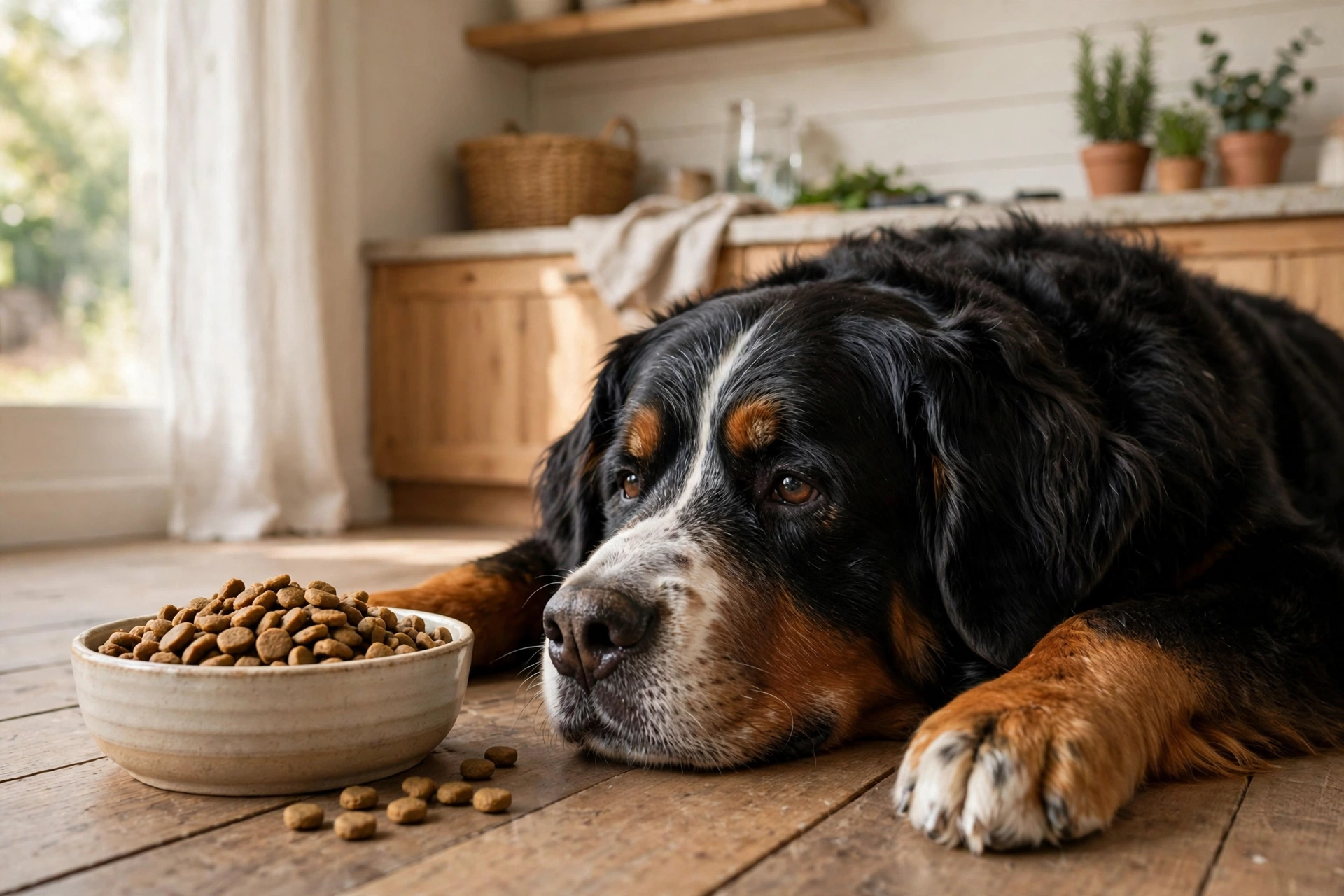
Best Senior Bernese Mountain Dog Food: 6 Top Picks (2026)
Finding the best senior Bernese Mountain Dog food matters more than it does for most breeds, because Berners age faster than almost any other popular dog. A Bernese Mountain Dog is considered a senior at around 7 years old, and with a typical lifespan of just 7 to 10 years, those golden years arrive early and pass quickly. The food in your older Berner’s bowl has to protect stiff hips and elbows, hold on to lean muscle, keep weight off a giant frame, and stay gentle on digestion that may not be as forgiving as it once was.
This guide covers the best senior Bernese Mountain Dog food for 2026. We compared the leading senior and large-breed senior formulas on ingredient quality, joint support, calorie control, and digestibility, and picked the six that make the most sense for a 75 to 120 pound senior Berner. You will also find a feeding portion table, guidance on when to switch from adult food, and the ingredients to avoid. This guide is for information only — check with your vet for your dog’s specific needs.
Key Takeaways
- Bernese Mountain Dogs become seniors at about 7 years old, earlier than most breeds, so switch to a senior formula around age 6 to 7 rather than waiting until 8 or 9.
- Look for a large-breed senior formula with glucosamine and chondroitin for joints, moderate protein (around 22 to 28 percent), controlled calories, and added omega-3 fatty acids for skin, coat, and brain health.
- Most senior Berners need roughly 1,400 to 1,800 calories a day, split into two meals, but the right amount depends on your dog’s weight, activity, and body condition.
- Switch foods gradually over 7 to 10 days, and watch stool quality, appetite, and mobility for two to three weeks before judging a new food.
Our Top Picks at a Glance
| Product | Best For | Key Feature |
|---|---|---|
| Hill’s Science Diet Large Breed Senior 6+ | Best overall | Balanced glucosamine and chondroitin with controlled minerals for joints, heart, and kidneys |
| Blue Buffalo Life Protection Formula Large Breed Senior | Best joint support value | 700 mg/kg glucosamine plus taurine and EPA for heart and joint health |
| IAMS Proactive Health Healthy Aging Large Breed | Best budget pick | Real chicken first with joint support and prebiotics at the lowest cost per pound |
| Purina ONE Plus Vibrant Maturity 7+ | Best for brain health | MCT oil for cognitive support plus glucosamine for joints |
| Nutro Natural Choice Senior Large Breed | Best clean label | Non-GMO ingredients with no corn, wheat, soy, or by-product meal |
| Royal Canin Size Health Nutrition Large Aging 8+ | Best for dogs 8 and older | Age-targeted formula with antioxidants and a kibble shape made for large jaws |
Hill’s Science Diet Large Breed Senior 6+
Hill’s Science Diet Large Breed Senior 6+ is the most complete senior formula we found for an aging Bernese Mountain Dog, and it earns the top spot for a simple reason: it covers every senior need at once instead of excelling at one and ignoring the rest. The recipe is built around real chicken, with natural sources of glucosamine and chondroitin to support stiff hips and elbows, balanced minerals to ease the workload on the heart and kidneys, and omega-6 fatty acids plus vitamin E for a coat that tends to dry out with age.
What sets Hill’s apart is the research behind it. Hill’s formulas are developed with feeding trials, and this one is specifically calibrated for large and giant breeds from age six onward — exactly the window when a Berner becomes a senior. The calorie level is controlled rather than very low, which matters for Berners: an older Berner still carries a huge frame, and a food that is too low in calories can strip muscle along with fat.
Based on ingredient analysis, brand reputation, and owner reviews, this is the safest first choice if you are unsure where to start. It is pricier than grocery-store senior foods, and it contains brewers rice and whole-grain corn, so it is not the pick for owners who want a grain-free recipe.
Blue Buffalo Life Protection Formula Large Breed Senior
Blue Buffalo’s large-breed senior formula is the strongest joint-support pick for the money. It raises glucosamine to 700 mg/kg — noticeably higher than the standard Blue Buffalo senior recipe — and pairs it with chondroitin, taurine for heart health, and EPA from menhaden fish meal. For a breed as prone to hip and elbow dysplasia as the Bernese, that extra joint support is worth paying attention to.
The ingredient list is clean: deboned chicken first, no poultry by-product meals, and no corn, wheat, or soy. Blue’s LifeSource Bits — cold-formed nuggets of vitamins, minerals, and antioxidants — are mixed into the kibble, and many owners of picky seniors report that their dogs eat around the plain kibble to get to the Bits first. The formula also includes L-carnitine to help maintain lean muscle.
One honest caution: this food is fairly calorie-dense, so portion control matters. A senior Berner that is already carrying extra weight can gain more on this recipe if you feed by the bag’s upper guideline instead of measuring for your dog’s actual body condition.
IAMS Proactive Health Healthy Aging Large Breed
IAMS Healthy Aging Large Breed is the best value senior food for Bernese Mountain Dogs, and it does not feel like a compromise. Real, farm-raised chicken is the first ingredient, and the recipe includes natural sources of glucosamine and chondroitin for joints, a fiber-plus-prebiotic blend for gentle digestion, and antioxidants for immune support.
At roughly $1.40 per pound, it is the most affordable senior large-breed recipe among the major brands, which matters when you are feeding a dog that eats three to four cups a day. The food is widely available at grocery stores, big-box retailers, and online, so you are unlikely to run out.
The trade-off is that the joint-support levels are lower than in premium formulas like Hill’s or Blue Buffalo, and the recipe contains corn and chicken by-product meal. If your senior Berner has early arthritis and your budget allows, one of the higher-tier picks may serve the joints better.
Purina ONE Plus Vibrant Maturity 7+
Purina ONE Plus Vibrant Maturity 7+ is the only pick on this list that targets the aging brain as directly as the aging body. It includes MCT vegetable oil, which provides ketone energy for the brain; Purina’s own studies found that MCTs improved alertness and activity in dogs over seven. If your senior Berner has started staring into corners, sleeping more, or seeming confused on walks, this is the formula most directly aimed at that problem.
The recipe also delivers the senior basics: real chicken first, added glucosamine for joint health, omega-6 fatty acids for skin and coat, and a dual-texture kibble — crunchy pieces mixed with tender shredded bits — that keeps picky seniors interested when appetite starts to fade. At about $1.61 per pound it sits in the middle of the price range, and it is easy to find in most stores.
Be aware that the protein level is around 28 percent, which is on the higher side for a senior Berner, and the recipe contains corn and soy. Dogs with early kidney issues should be fed a more moderate-protein diet, so check with your vet first if your Berner has kidney concerns.
Nutro Natural Choice Senior Large Breed
Nutro Natural Choice Senior Large Breed is the pick for owners who read ingredient labels closely. The recipe is non-GMO, with real deboned chicken first and no chicken by-product meal, corn, wheat, or soy.
Beyond the label, the formula covers the senior bases: a proven fiber blend for firm stools and comfortable digestion, glucosamine and chondroitin for joints, and a kibble size that encourages chewing, which helps reduce dental tartar in older dogs.
The downsides are practical: the bag is not resealable, which is annoying at this size, and the glucosamine level is modest compared with joint-focused brands. The chicken-heavy recipe also will not suit a Berner with a poultry sensitivity. But if clean ingredients and gentle digestion are your priorities, Nutro is a strong, honest choice.
Royal Canin Size Health Nutrition Large Aging 8+
Royal Canin Large Aging 8+ is the only formula on this list built specifically for dogs aged eight and up, and for Berners that distinction matters. A Bernese Mountain Dog that reaches eight is already a very old dog for the breed, and its needs shift again: even fewer calories, even more support for joints and cognition, and food that is easy to eat when teeth are worn and appetite is fading.
The recipe includes an antioxidant complex, EPA and DHA for joint and brain support, and a kibble shape designed for large jaws. Royal Canin also formulates for high palatability, which is genuinely important for the oldest Berners — a dog that will not eat gets no nutrition at all, no matter how good the label looks.
It is a premium-priced food, and like most Royal Canin recipes it is built around specific nutrient targets rather than a short, “natural” ingredient list. But for an eight-plus Berner, the age-specific formulation is a real advantage over a generic senior food.
When Is a Bernese Mountain Dog a Senior?
Most dog food brands label a dog “senior” at seven years old, and for Bernese Mountain Dogs that line is about right. Berners are a giant breed with a short lifespan of 7 to 10 years, and most breed sources consider them old at 7 to 8. That means a Berner can spend a third or more of its life on senior food, very different from a small breed that may not reach senior status until 10 or 11.
The practical advice: start thinking about a senior formula when your Berner turns six, and plan to switch around age seven. Do not wait for obvious problems. By the time a Berner is visibly stiff or losing muscle, a senior diet has months of catching up to do.
Watch for the signs that the switch is overdue: slower to rise after naps, reluctance on stairs, a greying muzzle, weight creeping up despite the same portions, or a dull coat. Any one of these is a good reason to move to a senior formula and to book a vet check at the same time.
How Much to Feed a Senior Bernese Mountain Dog
An older Bernese Mountain Dog typically needs fewer calories than it did as an adult, because metabolism slows and activity drops. A rough guide for a senior Berner at a healthy weight is 1,400 to 1,800 calories per day, but the exact amount depends on weight, activity, and whether
the dog is spayed or neutered. Use the table below as a starting point, then adjust by body condition: you should be able to feel the ribs easily under a thin layer of fat, and see a waist when you look down at your dog from above.
| Senior Berner Weight | Daily Calories (starting point) | Typical Daily Amount* |
|---|---|---|
| 75 to 85 pounds | 1,300 to 1,500 | 3 to 3.5 cups |
| 85 to 100 pounds | 1,450 to 1,650 | 3.5 to 4 cups |
| 100 to 120 pounds | 1,600 to 1,850 | 4 to 4.5 cups |
*Cup amounts assume a typical senior kibble at roughly 340 to 380 calories per cup. Always check the calorie content on your bag and measure with a standard measuring cup, not a scoop or a mug.
Split the daily amount into two meals, morning and evening. Two smaller meals are easier on an older dog’s digestion than one large meal, and they also reduce the risk of bloat — a serious concern in deep-chested breeds like the Bernese. Keep treats to no more than 10 percent of daily calories.
What to Look for in a Senior Bernese Mountain Dog Food
Joint support. Glucosamine and chondroitin are the headline nutrients for a reason: Berners are prone to hip and elbow dysplasia, and extra weight on a giant frame punishes the joints. Look for foods that list glucosamine levels on the label, and favor large-breed senior formulas, which are calibrated for dogs over 50 pounds.
Moderate protein. Here the Bernese community and the senior-food market do not fully agree, and it is worth knowing why. Many senior foods run 26 to 30 percent protein to fight muscle loss, while many Berner breeders recommend a moderate 18 to 26 percent protein for the breed at all life stages, because very high protein has been linked to hotspots and digestive upset in Berners. For a healthy senior Berner, a protein level in the low-to-mid 20s is a sensible middle ground. If your dog is losing muscle, your vet may suggest going higher; if your dog has early kidney disease, lower may be better.
Controlled calories and fat. Senior Berners gain weight easily as they slow down, and every extra pound adds stress to aging joints. Look for a food with moderate fat (around 10 to 14 percent) and a calorie density that lets you feed a satisfying volume without overfeeding.
Omega-3 fatty acids. EPA and DHA from fish oil support joints, skin, coat, and the aging brain. A food that lists fish oil or fish meal among its ingredients has a real advantage over one that relies on plant oils alone.
Digestibility and fiber. Older dogs often digest food less efficiently. Look for named animal proteins, a moderate fiber level (around 4 to 7 percent), and added prebiotics or probiotics. Firm, regular stools are the simplest sign that a food agrees with your dog. Also check the bag for an AAFCO nutritional adequacy statement for adult maintenance or all life stages — the baseline proof that a food is complete and balanced.
What to Avoid
- Very high protein formulas (above 32 percent): unless your vet recommends it, very high protein can stress aging kidneys and often triggers hotspots and loose stools in Berners.
- Foods with unnamed meat meals or “meat by-products” as the first ingredient: vague protein sources are a sign of a low-quality recipe.
- Excess calcium: large-breed senior formulas control calcium for a reason; too much can contribute to skeletal problems.
- Artificial colors, flavors, and preservatives: they add nothing for an older dog and can irritate sensitive digestion.
- Foods that are very high in fat: rich, fatty foods are a common trigger for pancreatitis in older dogs and for weight gain in a breed that gains it easily.
- One giant meal a day: feeding a deep-chested senior Berner once daily increases bloat risk. Always split into two meals.
If Your Senior Bernese Won’t Eat Kibble Anymore
Many senior Berners eventually go off dry food. Sore teeth, a weaker sense of smell, or a fading appetite can all make a bowl of plain kibble unappealing — and a Berner that skips meals loses weight fast at this size. Try these steps first: soften the kibble with warm water or low-sodium bone broth for ten minutes before serving, warm the food slightly to release aroma, and feed in a quiet spot without other dogs competing for the bowl.
If softened kibble still does not work, a fresh or wet food may be the answer. Fresh foods like Ollie or JustFoodForDogs are softer, smell stronger, and are often more appealing to older dogs, and they can be mixed with kibble as a topper rather than replacing it entirely. Wet food is another good option — high in moisture, easy to chew, and easy to digest.
See our guide to the best dog food for Bernese Mountain Dogs for the full breed picture, and our Bernese Mountain Dog feeding guide for portions at every life stage. If your senior Berner has a sensitive stomach as well, our picks for the best food for Bernese Mountain Dogs with sensitive stomachs cover gentle formulas that are easier on digestion.
How to Switch Your Senior Bernese to a New Food
Switch gradually over 7 to 10 days. Start with roughly 25 percent new food mixed into 75 percent old food for two to three days, then move to a 50/50 mix, then 75 percent new, then fully new. Older dogs are more sensitive to sudden changes, and a rushed switch is the most common cause of the loose stools owners blame on the food itself.
Judge a new food over two to three weeks, not two to three days. Look for firm stools, steady appetite, a coat that stays glossy, and — over a longer window — easier movement on stairs and after naps. If stools stay loose after two weeks, or your dog refuses the food outright, try a different recipe rather than forcing it.
Conclusion: Our Recommendation
The best senior Bernese Mountain Dog food is the one that protects your dog’s joints, holds its weight steady, and keeps it eating happily — and for most senior Berners, Hill’s Science Diet Large Breed Senior 6+ does all three better than any other formula we compared.
If your budget is tight, IAMS Healthy Aging Large Breed covers the essentials for far less. If your Berner is slowing down mentally, Purina ONE Vibrant Maturity 7+ directly targets brain health. And if your dog is eight or older, or has gone off other foods, Royal Canin Large Aging 8+ is built for exactly that stage of life.
Whatever you choose, remember that food is only part of the picture for a senior Berner. Keep the weight down, keep the walks gentle and regular, split meals into two servings, and see your vet twice a year. Berners give us fewer years than most breeds — good food, fed thoughtfully, is one of the best ways to make those years comfortable. For more on feeding older dogs generally, see our guide to the best senior dog food.
When is a Bernese Mountain Dog considered a senior?
Bernese Mountain Dogs are considered seniors at about 7 years old, earlier than most breeds, because their typical lifespan is only 7 to 10 years. Plan to switch to a senior formula around age 6 to 7.
How much should I feed my senior Bernese Mountain Dog?
Most senior Berners need roughly 1,400 to 1,800 calories a day, split into two meals. A 75 to 85 pound senior needs about 3 to 3.5 cups a day, and a 100 to 120 pound senior about 4 to 4.5 cups, but always adjust to your dog’s body condition.
What protein level is best for a senior Bernese Mountain Dog?
For a healthy senior Berner, a protein level in the low-to-mid 20s percent is a sensible middle ground. Many Berner breeders recommend moderate protein of 18 to 26 percent, while many senior foods run 26 to 30 percent to fight muscle loss. Ask your vet if your dog has kidney disease or muscle loss.
Should senior Bernese Mountain Dogs eat grain-free food?
Only if your dog has a grain sensitivity or allergy. Most Berners do fine with wholesome grains like rice, barley, and oats, which also provide fiber. Choose grain-free only for a specific reason, not by default.
How do I switch my senior Bernese to a new food?
Switch gradually over 7 to 10 days: start with about 25 percent new food mixed with 75 percent old food, then move to 50/50, then 75 percent new, then fully new. Older dogs are sensitive to sudden changes.
What if my senior Bernese won’t eat kibble anymore?
Soften the kibble with warm water or low-sodium bone broth, warm the food slightly to release aroma, and feed in a quiet spot. If that fails, try a fresh food like Ollie or JustFoodForDogs, or a wet food, as a topper or replacement.
Do senior Bernese Mountain Dogs need joint supplements?
A good large-breed senior food with glucosamine and chondroitin covers most dogs’ joint needs. A separate supplement may help dogs with diagnosed arthritis, but ask your vet first so you do not double up unnecessarily.
How often should a senior Bernese Mountain Dog see the vet?
Twice a year is a good rule for senior Berners. Older dogs can develop problems quickly, and twice-yearly checkups with bloodwork catch kidney, thyroid, and joint issues early.