
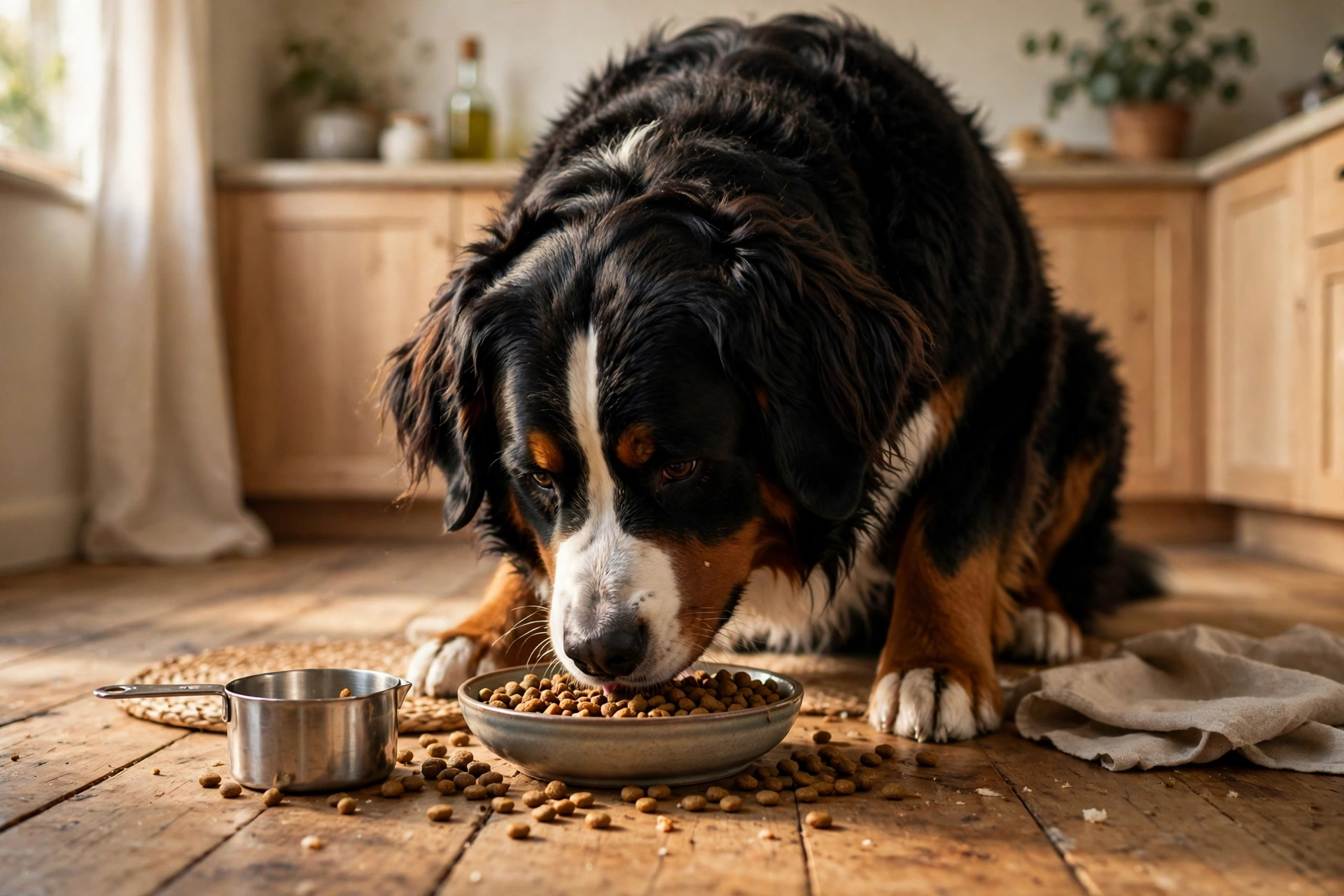
Bernese Mountain Dog Feeding Guide: How Much, How Often & What to Feed (2026)
A Bernese Mountain Dog can go from a 15-pound puppy to a 100-pound adult in less than two years, and that fast, heavy growth is exactly why feeding a Berner is different from feeding most other dogs. Feed too much, too fast, and you put extra strain on developing hips and elbows. Feed too little, and a growing puppy or a hard-working adult will not have the fuel they need. This Bernese Mountain Dog feeding guide takes the guesswork out of the bowl: how much to feed at every age, how many calories that really means, how often to feed, and how to feed in a way that protects your dog from bloat.
Use the charts below as your starting point, then adjust for your own dog. No chart can replace watching your Berner’s body condition, weight, and energy — but a chart plus a kitchen scale will get you far closer than a scoop and a guess.
Key Takeaways
- Most adult Berners eat 3 to 6 cups of dry food a day, split into 2 meals — but cups are unreliable on their own, because one cup of kibble can hold anywhere from 300 to 450 calories. Weigh food or count calories, not just cups.
- Feed puppies 3 to 4 small meals a day, adults 2 meals, and seniors 2 smaller meals. Never feed an adult Berner just once a day: split meals are one of the simplest bloat precautions you can take.
- Slow, lean growth is the goal for puppies. Choose a large-breed puppy formula, keep growth steady at no more than about 4 pounds per week, and never add calcium supplements to a complete food.
- Keep treats to 10% or less of daily calories, and subtract them from meals on training-heavy days. In a breed this food-motivated, uncounted treats are the fastest route to weight gain.
- Rest your Berner for at least an hour before and after meals, use a slow feeder if they bolt their food, and learn the warning signs of bloat — it is an emergency, not a wait-and-see problem.
Why Berners Need a Different Feeding Routine
Bernese Mountain Dogs are a giant breed with a slow maturation clock. While a small dog may be fully grown by eight months, a Berner keeps building frame and muscle until they are close to two years old, and their growth plates may not close until 18 to 24 months. That long growth window is the reason large-breed puppy food exists: it controls energy and mineral levels so puppies grow steadily instead of explosively. Rapid growth is linked to developmental joint problems such as hip and elbow dysplasia and osteochondritis dissecans (OCD), so “bigger puppy” is not “healthier puppy.”
As adults, Berners carry a lot of weight on joints that are already vulnerable, and they are deep-chested, which puts them at high risk for gastric dilatation-volvulus (GDV), commonly called bloat. How you feed — meal size, eating speed, and rest around meals — matters as much as what you feed. Add a thick double coat that hides weight gain, a famously food-motivated temperament, and a low tolerance for heat, and you have a breed where measured, consistent feeding pays off more than in almost any other.
The good news: Berners thrive on routine. The same food, the same measured amount, at the same times each day, makes digestion steadier, housetraining more predictable, and appetite changes — often the first sign of illness — much easier to spot.
How Much to Feed a Bernese Mountain Dog: The Charts
Start with the age chart, then cross-check it against the calorie chart below. If the two disagree, trust calories and body condition over cups: kibble density varies too much between brands for cups alone to be precise.
| Age stage | Daily total (dry food) | Meals per day |
|---|---|---|
| 8 to 12 weeks | 2 to 3 cups | 4 |
| 3 to 4 months | 3 to 4 cups | 4 |
| 4 to 6 months | 3 to 5 cups | 3 |
| 6 to 12 months | 5 to 6 cups | 2 to 3 |
| 12 to 18 months | 4 to 6 cups | 2 |
| Adult female (18 months to 7 years) | 3 to 5 cups | 2 |
| Adult male (18 months to 7 years) | 4 to 6 cups | 2 |
| Senior (7 years and older) | 3 to 5 cups, adjusted down if less active | 2 |
These are starting ranges for a typical large-breed kibble. A very active Berner who hikes on weekends may need the top of the range or about 10 to 15% more; a couch-potato Berner, or one recently spayed or neutered, may need about 10% less. Puppies usually move up through the ranges every few weeks, so weigh your puppy weekly and re-check the chart monthly — a portion that was right at four months will be wrong at seven.
The Calorie Method: A Worked Example
Cups are convenient, but calories are accurate. Most adult Berners need roughly 1,400 to 2,300 calories a day depending on weight and activity, and puppies need more calories per pound than adults because they are growing. The table below gives realistic starting targets; your food bag’s kcal per cup tells you how many cups that means for your brand.
| Dog | Typical daily calories | What that looks like |
|---|---|---|
| Adult female, about 80 lb, moderately active | 1,400 to 1,700 | About 4 cups of a 380 kcal/cup kibble |
| Adult male, about 100 lb, moderately active | 1,700 to 2,000 | About 5 cups of a 380 kcal/cup kibble |
| Adult male, about 120 lb, very active | 2,000 to 2,300 | About 5.5 to 6 cups of a 380 kcal/cup kibble |
| Senior, about 90 lb, less active | 1,300 to 1,600 | About 3.5 to 4 cups of a 380 kcal/cup kibble |
| Puppy, 4 to 6 months, about 40 to 60 lb | 1,200 to 1,800 | Split across 3 meals; follow your large-breed puppy food’s guide |
Here is the worked example. Say your adult male Berner weighs 100 pounds and your kibble lists 380 calories per cup. A target of 1,800 calories a day means about 4.7 cups — call it 2 cups in the morning and 2.5 cups in the evening, or as close to even as you can get. Switch to a denser food at 450 calories per cup and the same 1,800 calories is just 4 cups a day. Feed the old 5 cups of the new food and you have quietly added 450 calories a day — enough to put noticeable weight on a Berner within a month. Every time you change brands, recalculate from calories, not from habit.
A kitchen scale removes even that guesswork. Weigh a cup of your kibble once, note the grams, and weigh portions from then on. It takes ten seconds and it ends portion creep — the slow drift upward that happens when a “cup” gradually becomes a heaping cup.
How Often Should You Feed a Bernese Mountain Dog?
Meal frequency changes with age, and it matters for more than convenience. Small, frequent meals keep a puppy’s blood sugar steady and keep an adult’s stomach from being overloaded in a single sitting.
- Puppies under 4 months: 4 meals a day, spaced evenly.
- Puppies 4 to 6 months: 3 meals a day.
- Puppies 6 to 12 months: 2 to 3 meals a day; drop to 2 once they handle larger meals without digestive upset.
- Adults: 2 meals a day, morning and evening, roughly 12 hours apart.
- Seniors: 2 smaller meals a day; some seniors digest better with a small midday snack taken out of their daily total, not added to it.
Feed at consistent times. A regular schedule supports digestion, makes housetraining predictable, and means you will notice quickly if your Berner suddenly loses interest in food — which can be an early warning sign of illness in this breed.
Sample Day Menus
These menus use a 380 kcal per cup kibble as an example. Adjust the cups to your food’s calorie density and your dog’s condition.
Puppy, 5 months old, about 50 lb
Breakfast: 1.5 cups large-breed puppy kibble. Lunch: 1.5 cups. Dinner: 1.5 cups. Total: about 4.5 cups, roughly 1,700 calories. Fresh water available all day, and no vigorous play for an hour after each meal.
Adult male, 100 lb, moderately active
Breakfast: 2.5 cups adult large-breed kibble with a drizzle of fish oil if your vet approves. Dinner: 2.5 cups. Total: 5 cups, roughly 1,900 calories. Treats for the day kept under about 190 calories and counted within that total.
Senior female, 85 lb, slowing down
Breakfast: 2 cups senior or adult large-breed kibble. Dinner: 2 cups, with a spoonful of plain canned pumpkin for fiber if stools are soft. Total: 4 cups, roughly 1,500 calories. Weight checked monthly, portions trimmed by 10% if the waistline disappears under the coat.
What to Feed: Choosing the Right Food
For most Berners, a complete large-breed formula for their life stage is the simplest reliable choice. If you are still choosing a brand, our guide to the best dog food for Bernese Mountain Dogs compares adult formulas, and our best puppy food for Bernese Mountain Dogs guide covers the growth-stage options. Look for these markers on the label:
- A named animal protein first. Chicken, lamb, beef, or salmon — not generic “meat meal” or “animal by-products” — as the first ingredient.
- An AAFCO statement. It should say the food is complete and balanced for your dog’s life stage (growth, adult maintenance, or all life stages).
- Controlled minerals for puppies. Large-breed puppy formulas are balanced for a calcium-to-phosphorus ratio of about 1.2:1. Never add calcium supplements, cottage cheese, or bone meal to a complete puppy food — excess calcium can harm developing bones.
- Adult protein around 22 to 26% and fat around 12 to 16%. Enough protein to maintain heavy muscle, enough fat for energy and coat health, without the excess calories that pile weight onto joints.
- Joint support. Glucosamine and chondroitin in the food, plus omega-3 fatty acids from fish oil or flaxseed, support the hips, elbows, and that thick coat.
- Digestible carbohydrates. Brown rice, oatmeal, barley, or sweet potato provide steady energy and fiber. Grains are not the enemy for most Berners; unless your dog has a diagnosed grain sensitivity, a grain-inclusive formula is a sound choice.
Wet food can be a useful topper — a few tablespoons over kibble adds moisture and appeal — but count its calories, because wet food is easy to underestimate. Fresh and refrigerated foods are also fine if they are complete and balanced, but they cost far more at Berner quantities: a 100-pound dog can eat over a pound of food a day, so budget accordingly. If you are considering a raw or home-cooked diet, work with a board-certified veterinary nutritionist; getting calcium, phosphorus, and calories wrong during growth is a real risk for a giant breed, and raw meat carries bacterial risks for both dog and household.
Feeding for Bloat Safety
Bloat, or gastric dilatation-volvulus (GDV), is the feeding topic every Berner owner must take seriously. The stomach fills with gas and can twist, cutting off blood flow. It is a life-threatening emergency that needs immediate veterinary surgery. No feeding habit guarantees prevention, but several reduce risk:
- Split meals. Two or three smaller meals instead of one large one, every day, without exception.
- Slow the eating. If your Berner bolts food, use a slow-feeder bowl or spread kibble on a baking sheet. Gulped food means swallowed air.
- Rest around meals. No vigorous exercise, rough play, or long runs for at least an hour before and an hour after eating.
- Keep the bowl on the floor. Contrary to old advice, research suggests elevated bowls may actually increase bloat risk in large breeds. Discuss your dog’s setup with your vet rather than assuming higher is better.
- Limit water gulping at mealtimes. Fresh water should always be available, but discourage frantic drinking right after a meal.
Learn the warning signs now, before you ever need them: restlessness and pacing, a swollen or hard abdomen, unproductive retching or dry heaving, and excessive drooling. If you see them, go to an emergency vet immediately — do not wait to see if it passes. Some owners of high-risk breeds discuss prophylactic gastropexy (tacking the stomach to prevent twisting, often done during spay or neuter) with their vet; it is worth asking about at your next visit.
Switching Foods: Puppy to Adult, Adult to Senior
Berners mature slowly, so do not rush the life-stage switches. Most Berners move from large-breed puppy food to adult food between 18 and 24 months, once growth has slowed and your vet confirms growth plates are closing. The senior switch usually comes around 7 years, when metabolism slows and joint support matters even more — our senior dog feeding guide covers that stage in detail — but switch on your dog’s condition, not just their birthday: a lean, active 7-year-old may do better staying on adult food a little longer, while a stiff, gaining 6-year-old may benefit from a senior formula sooner.
Every switch, including a simple brand change, should take 7 to 10 days: 25% new food for days 1 to 3, 50% for days 4 to 6, 75% for days 7 to 9, then 100%. If stools loosen, slow down rather than pushing through. A Berner’s digestive system punishes abrupt changes.
Treats, Training, and the 10% Rule
Berners are gloriously food-motivated, which makes them a joy to train and very easy to overfeed. Treats should stay at 10% or less of daily calories — about 190 calories for a dog eating 1,900 a day. That budget disappears fast in a training class, so use small, low-calorie treats and subtract training treats from dinner on heavy training days.
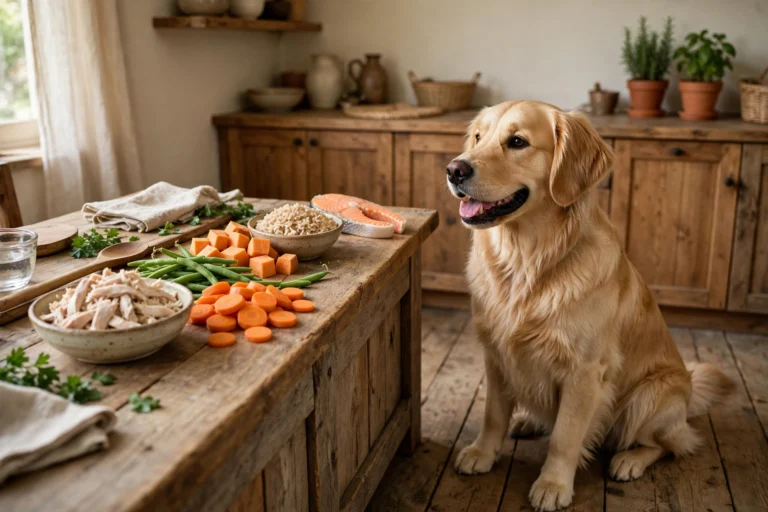
Two practical tricks help. Keep a single household treat jar: when it is empty, the day’s treat budget is spent, so well-meaning family members cannot each hand out “just one more.” When your Berner begs despite a healthy weight, add volume instead of calories. Steamed green beans or a spoonful of plain canned pumpkin (not pie filling) in the bowl helps them feel full without adding weight.
Weight, Body Condition, and When to Adjust
A Berner’s coat lies about their weight, so use your hands, not your eyes. You should be able to feel the ribs easily under a thin layer of fat — like the back of your hand with fingers flat. From above, there should be a visible waist behind the ribs, and from the side, a slight abdominal tuck. If you cannot feel the ribs without pressing, or the waist has vanished, trim the daily portion by 10% and re-check in two weeks.
Weigh your Berner monthly — most vet clinics will let you pop in for a free weigh-in — and keep a simple note of weight, portion, and food brand. Puppies should be weighed weekly, and steady growth of no more than about 4 pounds per week is a good guide; faster than that, talk to your vet about trimming portions rather than celebrating a “big” puppy. After spay or neuter, expect metabolism to slow and plan to cut about 10% from portions if weight starts climbing. In summer, Berners overheat easily and often move less, so watch portions on hot weeks; in winter, a dog doing real outdoor work may genuinely need more.
Foods Berners Should Never Eat
Some human foods are toxic to dogs and must stay out of reach — especially with a tall, counter-surfing breed. Never feed chocolate, grapes or raisins, onions or garlic, xylitol (found in many sugar-free products), or macadamia nuts. Cooked bones can splinter and cause choking or punctures, so never offer them. High-fat table scraps and greasy foods can trigger pancreatitis, a painful inflammation of the pancreas. And if your Berner shows chronic ear infections, itchy skin, paw licking, or recurring digestive trouble, ask your vet about a food sensitivity and a properly supervised elimination diet rather than guessing at ingredients yourself.
Common Feeding Mistakes to Avoid
- Free-feeding. Leaving food down all day makes portion control impossible and hides appetite changes.
- Adding calcium to puppy food. A complete large-breed puppy formula already has the right mineral balance; extra calcium can damage growing bones.
- Trusting the scoop. Kibble density varies by brand and the scoop creeps upward over time. Weigh food or count calories.
- One big meal a day. Convenient for you, riskier for a deep-chested breed. Split it.
- Exercising right after meals. Give at least an hour of rest before and after eating.
- Feeding the chart, not the dog. Charts are starting points. Body condition, weight trend, and energy are the real verdict.
For older Berners, see our guide to the best senior food for Bernese Mountain Dogs.
Conclusion: A Simple Routine That Works
The best Bernese Mountain Dog feeding routine is not complicated: a complete large-breed food for their life stage, measured by weight or calories, split into two meals (three or four for puppies), served at the same times each day, with rest around meals and treats counted honestly. That routine protects slow, steady growth in puppies, keeps adult weight off vulnerable joints, and gives you the simplest possible bloat precautions every single day.
Start with the charts in this guide, weigh your Berner monthly, and adjust by 10% at a time based on what your hands and the scale tell you. Small, consistent corrections beat dramatic diet overhauls — and a lean, well-fed Berner is a Berner with the best chance at a long, mobile, happy life.
This guide is for information only — check with your vet for your dog’s specific needs.
How much should a Bernese Mountain Dog eat per day?
Most adult Berners eat 3 to 6 cups of dry food a day, split into 2 meals, but cups alone are unreliable because one cup of kibble can hold 300 to 450 calories. Count calories or weigh portions instead, and adjust by body condition: adult females typically need 1,400 to 1,700 calories a day and adult males 1,700 to 2,300, depending on weight and activity.
How many times a day should I feed a Bernese Mountain Dog puppy?
Feed puppies under 4 months 4 meals a day, puppies 4 to 6 months 3 meals a day, and puppies 6 to 12 months 2 to 3 meals a day. Adults do best on 2 meals a day, morning and evening, and seniors on 2 smaller meals.
When should I switch my Bernese Mountain Dog from puppy to adult food?
Most Berners switch between 18 and 24 months, once growth has slowed and your vet confirms the growth plates are closing. Switch gradually over 7 to 10 days to avoid digestive upset.
What is the best food for a Bernese Mountain Dog?
A complete large-breed formula for your dog’s life stage, with a named animal protein first, an AAFCO complete-and-balanced statement, controlled calcium and phosphorus for puppies, and joint support from glucosamine, chondroitin, and omega-3 fatty acids.
How can I prevent bloat in my Bernese Mountain Dog?
Split food into 2 or 3 smaller meals, use a slow feeder if your dog bolts food, rest your dog for at least an hour before and after meals, and keep the bowl on the floor. Learn the warning signs — restlessness, a swollen hard abdomen, unproductive retching, and drooling — and go to an emergency vet immediately if you see them.
How much should a Bernese Mountain Dog weigh?
Adult females typically weigh 70 to 115 pounds and adult males 80 to 120 pounds, but body condition matters more than the scale: you should feel the ribs easily under a thin layer of fat and see a waist behind the ribs.
Can Bernese Mountain Dogs eat grain-free food?
Most Berners do fine on grain-inclusive foods with brown rice, oatmeal, or barley, and grains are not harmful for most dogs. Only choose grain-free if your vet identifies a diagnosed grain sensitivity, and discuss the choice with your vet first.
Why is my Bernese Mountain Dog always hungry?
Berners are famously food-motivated, so begging is normal even when they are well fed. Check that portions match their weight and activity, keep treats under 10% of daily calories, and try low-calorie fillers like steamed green beans or plain canned pumpkin. A sudden increase in hunger or weight loss deserves a vet visit.

4 Comments