
Homemade Dog Food for Sensitive Stomachs: Gentle Recipes & Vet Rules
If your dog’s stomach seems to rebel against every bag of kibble you bring home, you are not alone. Gas, loose stools, occasional vomiting, and skipped meals are some of the most common complaints dog owners raise, and for many dogs the answer is a simpler bowl. This guide to homemade dog food for sensitive stomach issues walks you through gentle, easy-to-digest recipes you can cook at home, explains which ingredients actually soothe digestion and which ones to keep far away from the bowl, and shows you how to use homemade meals safely, whether as a short-term reset or, with your vet’s input, as part of a longer-term feeding plan.
Below you will find five recipe frameworks (built on ingredient analysis, widely published canine nutrition guidance, and owner experience), a comparison table so you can pick the right starting point, cooking and balancing advice, serving-size guidance, and answers to the questions owners ask most. This guide is for information only. Check with your vet for your dog’s specific needs.
In This Guide
- Key Takeaways
- Homemade Sensitive-Stomach Recipes at a Glance
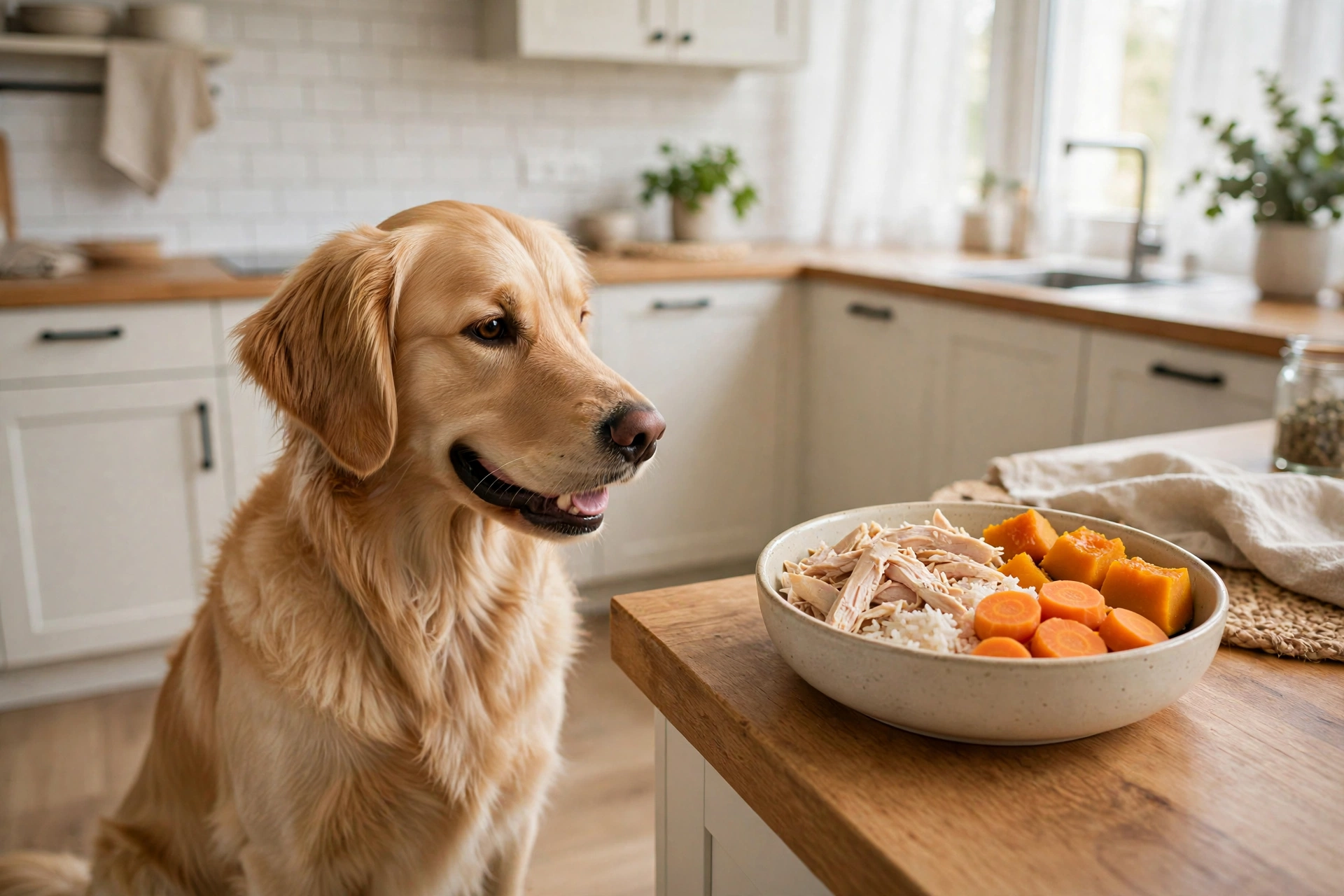
- Classic Chicken & Rice (The Bland-Diet Staple)
- Turkey & Pumpkin Stew
- White Fish & Sweet Potato (Chicken-Free Option)
- Oatmeal & Egg Porridge
- Bone Broth & Rice Porridge (Recovery Meal)
- How to Balance Homemade Meals (The Part Most Guides Skip)
- Balancing a Homemade Diet: The Vet Rules
- Ingredients to Avoid for Sensitive Stomachs
- Serving Sizes and Storage
- When Homemade Isn’t Enough: See Your Vet
- Elimination Diet: 8 to 12 Weeks, One Protein and One Carb
- How to Find the Ingredient That Upsets Your Dog
- Frequently Asked Questions
- Pros and Cons
- Conclusion
Key Takeaways
- A bland homemade base of one lean protein plus one gentle carbohydrate (like boiled chicken and white rice) is the classic short-term reset for upset stomachs: feed it for 2 to 3 days, then transition back.
- Pumpkin puree, sweet potato, and oatmeal add soluble fiber that firms stools and feeds good gut bacteria.
- Homemade meals fed long-term must be balanced for calcium, vitamins, and minerals. Talk to your vet or a canine nutritionist before going all-in.
- Avoid onion, garlic, grapes, raisins, xylitol (birch sugar), excess fat, and heavy spices, all can worsen digestive trouble or are toxic to dogs.
- Introduce any new homemade recipe gradually over 7 to 10 days and watch stools, appetite, and energy.
Homemade Sensitive-Stomach Recipes at a Glance
| Recipe | Best For | Key Feature |
|---|---|---|
| Classic Chicken & Rice | Acute upset stomach, diarrhea recovery | The simplest bland diet; vets recommend it most often |
| Turkey & Pumpkin Stew | Chronic loose stools, gassy dogs | Soluble fiber regulates digestion both ways |
| White Fish & Sweet Potato | Dogs sensitive to chicken or beef | Novel, low-fat protein with gentle carbs |
| Oatmeal & Egg Porridge | Morning meals, mild nausea | Warm, soft, easy to eat; soothing soluble fiber |
| Bone Broth & Rice Porridge | Low appetite, post-illness recovery | Hydrating, aromatic, encourages eating |
A note on costs and calories: the figures under each recipe are calculated estimates. Grocery prices are from Walmart, checked on November 13, 2026: chicken breast $4.84 a pound, ground turkey $4.22 a pound, cod fillets $12.24 a pound, canned pumpkin $1.97 per 15 oz can, bone broth $3.68 per 32 oz carton, low-sodium chicken broth $3.43 per 32 oz carton, eggs $1.67 a dozen, rolled oats $4.18 per 42 oz canister, white rice $3.52 per 5 lb bag, sweet potato $0.65 a pound, carrots $0.89 per 2 lb bag. Calories come from the stated ingredients using standard USDA values, and cost per day is for a 30 lb dog eating 2 to 3 cups a day (see the serving table below).
Classic Chicken & Rice (The Bland-Diet Staple)
This is the recipe veterinarians recommend most often for acute digestive upset, and for good reason: it is about as simple as a meal gets, which gives an irritated gut almost nothing to react to. It works best as a 2 to 3 day reset, not a permanent diet.
Ingredients: Classic Chicken & Rice
- 1 lb (454 g) boneless, skinless chicken breast
- 1 cup (185 g) uncooked white rice (yields about 3 cups cooked)
- Water, as needed
Instructions: Classic Chicken & Rice
- Boil the chicken breast in plain water until fully cooked through (about 20 to 25 minutes). Leave out oil, salt, and seasoning.
- Cook the white rice separately according to package directions. For extra-gentle digestion, slightly overcook it so the grains are soft.
- Shred or dice the chicken into bite-size pieces and mix with the rice at roughly a 1:2 ratio of chicken to rice by volume.
- Cool completely to room temperature before serving.
Why it fits: White rice is low in fiber and very easy to digest, and boiled chicken breast is lean protein with minimal fat, the two things an upset stomach tolerates best. Based on ingredient analysis and widespread veterinary guidance, this is the safest first step when stools turn soft. Serve small, frequent meals (a quarter-cup every few hours for a medium dog) rather than one big bowl.
Per batch, calculated estimates: about 1,280 kcal (about 5 cups), roughly 255 kcal per cup; about $5.15 a batch and $2.05 to $3.10 a day for a 30 lb dog eating 2 to 3 cups a day. Chicken to rice by volume: about 1 part chicken to 2 parts cooked rice.
Turkey & Pumpkin Stew
When loose stools linger beyond a day or two, pumpkin is the ingredient owners swear by, and the science backs it up. Plain canned pumpkin is rich in soluble fiber, which absorbs excess water in the gut and feeds beneficial gut bacteria. Paired with lean ground turkey, this stew is a step up from chicken and rice for dogs with recurring sensitivity.
Ingredients: Turkey & Pumpkin Stew
- 1 lb (454 g) lean ground turkey (93% lean or higher)
- 1 cup (158 g) cooked white rice
- 1/2 cup (122 g) plain canned pumpkin puree (100% pumpkin, never pumpkin pie filling)
- 1/2 cup (78 g) diced carrots, cooked soft
- 2 cups (480 ml) low-sodium chicken broth or water
Instructions: Turkey & Pumpkin Stew
- Brown the turkey in a pot over medium heat until no pink remains; drain off any fat.
- Add the broth, carrots, and pumpkin; simmer 10 minutes until the carrots are tender.
- Stir in the cooked rice and simmer 5 more minutes until slightly thickened.
- Cool fully before serving.
Why it fits: Turkey is a gentle, novel-ish protein for dogs that react to chicken, and the pumpkin-carrot fiber combo helps normalize both diarrhea and constipation. Owner reviews consistently rank pumpkin as the single most useful homemade addition for sensitive stomachs. This stew also freezes well in portions, so you can keep a “tummy emergency” batch on hand.
Per batch, calculated estimates: about 970 kcal (about 4.5 cups), roughly 215 kcal per cup; about $6.70 a batch and $2.95 to $4.45 a day for a 30 lb dog eating 2 to 3 cups a day. Ratio by volume once cooked: about 2 parts turkey to 1 part rice and 1/2 part pumpkin.
White Fish & Sweet Potato (Chicken-Free Option)
Some dogs with sensitive stomachs are actually reacting to common proteins: chicken and beef top the list of canine food sensitivities. If your dog’s trouble persists on poultry-based meals, a white fish recipe is worth trying. Cod, tilapia, or pollock are all lean, mild, and easy to digest.
Ingredients: White Fish & Sweet Potato
- 1 lb (454 g) white fish fillets (cod, tilapia, or pollock), bones removed
- 1 large sweet potato (about 200 g), peeled and cubed
- 1/2 cup (79 g) cooked white rice or quinoa
- 1 tablespoon (14 g) fish oil or olive oil (optional, once stools are stable)
Instructions: White Fish & Sweet Potato
- Steam or bake the sweet potato cubes until very soft, about 20 minutes; mash roughly.
- Poach the fish in barely simmering water for 8 to 10 minutes until it flakes easily. Check carefully for any small bones.
- Flake the fish and combine with the mashed sweet potato and rice.
- Cool to room temperature before serving.
Why it fits: White fish is one of the lowest-fat animal proteins available, and sweet potato provides gentle carbohydrates plus beta-carotene and fiber without the grain. For dogs that do poorly on chicken-based commercial diets (a pattern worth discussing with your vet), this recipe removes the most common trigger entirely. If you feed fish-based meals regularly, ask your vet about a vitamin E supplement, since fish-heavy diets can increase vitamin E needs.
Per batch, calculated estimates: about 650 kcal without the optional oil (about 780 kcal with it), about 3.5 cups, roughly 185 kcal per cup (about 220 kcal with the oil); about $12.60 a batch and $7.20 to $10.80 a day for a 30 lb dog eating 2 to 3 cups a day, which makes it the priciest of the five, because cod costs more per pound than chicken or turkey. Ratio by volume: about 3 parts fish to 2 parts sweet potato and 1 part rice.
Oatmeal & Egg Porridge
For dogs that wake up nauseous or turn their nose up at heavier meals, a warm porridge can be the most appealing option. Oatmeal is a soothing source of soluble fiber, and fully cooked eggs deliver complete, highly digestible protein.
Ingredients: Oatmeal & Egg Porridge
- 1 cup (81 g) plain rolled oats
- 2 cups (480 ml) water
- 2 large eggs (about 100 g), hard-boiled or scrambled without oil
- 2 tablespoons (30 g) plain canned pumpkin puree (optional)
Instructions: Oatmeal & Egg Porridge
- Cook the oats in water until soft and porridge-like, about 5 to 8 minutes.
- Cook the eggs fully (no runny yolks), then chop finely.
- Stir the egg (and pumpkin, if using) through the warm oatmeal.
- Serve warm, not hot.
Why it fits: The soft texture and mild smell of warm oatmeal encourages dogs with low appetite to eat, while the soluble fiber (beta-glucan) supports steady digestion. Eggs are roughly 97% digestible, making them one of the gentlest protein sources available. Keep portions modest at first. Eggs are nutrient-dense, and too much too fast can loosen stools in some dogs.
Per batch, calculated estimates: about 460 kcal (about 3 cups), roughly 150 kcal per cup; about $0.70 a batch and $0.45 to $0.70 a day for a 30 lb dog eating 2 to 3 cups a day, which makes it the cheapest of the five. Oats to water by volume: 1 part oats to 2 parts water.
Bone Broth & Rice Porridge (Recovery Meal)
When a dog is recovering from illness, medication, or a vet visit and barely wants to eat, hydration matters as much as calories. A savory bone-broth porridge delivers fluids, collagen, and gentle energy in a form most dogs find irresistible.
Ingredients: Bone Broth & Rice Porridge
- 2 cups (480 ml) low-sodium bone broth (store-bought with no onion/garlic, or homemade)
- 1/2 cup (93 g) uncooked white rice
- 1/2 cup (70 g) shredded boiled chicken or turkey (optional)
Instructions: Bone Broth & Rice Porridge
- Simmer the rice directly in the bone broth for 25 to 30 minutes, stirring occasionally, until it breaks down into a soft porridge.
- Stir in the shredded meat if using.
- Cool to lukewarm before serving.
Why it fits: Bone broth made from long-simmered bones contains gelatin and amino acids that support gut lining health, and its aroma tempts reluctant eaters. The overcooked rice porridge texture is extremely easy on the stomach. If buying broth, read the label every time: many commercial broths contain onion or garlic powder, both toxic to dogs.
Per batch, calculated estimates: about 500 kcal with the optional meat (about 400 kcal without it), about 3 cups, roughly 165 kcal per cup (about 135 kcal without the meat); about $3.00 a batch with the meat (about $2.00 without it) and $2.00 to $3.00 a day for a 30 lb dog eating 2 to 3 cups a day. Broth to rice by volume: 4 parts broth to 1 part uncooked rice.
How to Balance Homemade Meals (The Part Most Guides Skip)
Here is the honest truth the recipe-only blogs leave out: the meals above are excellent short-term, but a plain meat-and-rice diet fed for weeks will leave your dog short on calcium, zinc, vitamin D, and other essentials. Dogs evolved eating whole prey (including bones and organs), so muscle meat plus rice alone is incomplete.
If you want to feed homemade long-term, you have three responsible paths:
- Work with your vet or a board-certified veterinary nutritionist to formulate a complete recipe for your specific dog. This is the gold standard.
- Use a nutrient premix designed to balance homemade dog food (these add the vitamins and minerals plain ingredients lack). Follow the product’s dosing exactly.
- Feed homemade as a topper, not the whole diet, for example, 25% homemade mixed with 75% of a complete commercial sensitive-stomach food. This keeps things interesting for your dog without unbalancing the diet.
As a rule of thumb, a balanced homemade diet for an adult dog is roughly 40% protein, 50% carbohydrates and vegetables, and 10% healthy fats by calorie, plus calcium at about 1 to 1.5% of the diet on a dry-matter basis. Crushed, baked eggshell powder (1/2 teaspoon per pound of food) is a commonly used home calcium source, but confirm dosing with your vet.
Balancing a Homemade Diet: The Vet Rules
Before any homemade diet goes live, a vet or a board-certified veterinary nutritionist needs to check the recipe. That check is not a formality. A recipe can look complete and still be short on calcium, iodine, zinc, or vitamin D, and you cannot see those gaps from the bowl. A few days of plain chicken and rice is a reset, not a diet, so it does not need a balancer. Anything you feed for weeks or months does.
A balanced homemade diet has five parts doing their jobs. Protein builds and repairs tissue. A gentle carbohydrate gives steady energy. A small amount of fat carries calories and fat-soluble vitamins. Calcium builds bone and teeth. Vitamins and minerals cover everything else. The 40/50/10 rule of thumb in the section above is a starting point, not a finished recipe. Your vet or a board-certified veterinary nutritionist turns that starting point into exact amounts for your dog’s weight, age, and health, and that is the recipe you cook from.
Some things never belong in a homemade bowl. No onion or garlic in any form, no cooked bones (they splinter), no xylitol or other sugar alcohols, and no salt, seasoning, sauces, or rich drippings. If a recipe calls for broth, use a plain low-sodium one and check the label for onion and garlic powder, which hide in a lot of store-bought broths.
Say it plainly: a homemade diet without a balancer is incomplete. Plain meat, rice, and vegetables do not cover calcium, iodine, zinc, or vitamin D on their own. Either the recipe is checked and completed by a vet or a board-certified veterinary nutritionist, or it uses a nutrient premix (a balancer) dosed for homemade food. One of those two has to happen. A diet with neither is a short-term reset, not a long-term plan.
Supplements: What to Add, and How Much
These are the three supplements owners ask about most. All three are only under veterinary guidance, and the amounts below are starting points to discuss with your vet, not prescriptions.
Supplements: amounts to discuss with your vet (only under veterinary guidance)
- Calcium: ground eggshell, 1/2 teaspoon per pound of food, or a veterinary calcium supplement dosed by its label. This is the one supplement most homemade diets cannot skip.
- Fish oil: about 600 mg of combined EPA and DHA a day for a 30 lb dog, which is the low end of the commonly cited 20 to 55 mg per pound of body weight. Check the label, because EPA and DHA per capsule varies.
- Canine probiotic: a product made for dogs, dosed by its label for your dog’s weight, and only once your vet agrees it will not hide which ingredient caused a change during a food test.
The named next step is a consultation with a board-certified veterinary nutritionist. Ask your vet for a referral, or find one through the American College of Veterinary Nutrition. Bring the exact recipe, the amounts you feed, and your dog’s weight and lab work if you have it, so the nutritionist can check the whole diet, not just one meal.
What to Feed for Each Condition
| Condition | Dietary focus | Recipe to start from | Vet confirmation |
|---|---|---|---|
| Acute diarrhea | Bland, low-fat, low-fiber, small frequent meals, plenty of water | Classic Chicken & Rice | Required |
| Pancreatitis (low-fat) | Very low fat, no added oil, no skin or drippings | White Fish & Sweet Potato, skip the optional oil | Required |
| IBD | Highly digestible, one gentle protein, soluble fiber that regulates both ways | Turkey & Pumpkin Stew | Required |
| Chronic enteropathy | Novel protein, limited ingredients, a steady routine | White Fish & Sweet Potato | Required |
Vet confirmation is required for all four rows. These are starting points, not prescriptions: your vet or a board-certified veterinary nutritionist confirms the recipe, the amounts, and how long to feed it.
Ingredients to Avoid for Sensitive Stomachs
- Onion and garlic (all forms, including powders): toxic to dogs; damage red blood cells.
- Grapes and raisins: can cause kidney failure; the toxic dose is unpredictable.
- Xylitol (birch sugar): found in some peanut butters and sugar-free products; causes dangerous blood sugar crashes.
- Excess fat and greasy meats (bacon, sausage, skin, drippings): a top trigger for pancreatitis and diarrhea flare-ups.
- Heavy spices, hot sauce, and rich sauces: irritate the gut lining.
- Raw dough, alcohol, and caffeine: all dangerous for dogs.
- Dairy in large amounts: many dogs are lactose intolerant; small amounts of plain yogurt or cottage cheese are usually fine, but milk and cheese can worsen gas and loose stools.
- Raw vegetables in bulk: hard raw veg like broccoli stems can be tough to digest; always cook vegetables soft.
For the other side of the coin, see our guide to ingredients good for sensitive stomachs. Pumpkin, oats, and other gentle additions are worth keeping in the pantry, and the guide explains why each one helps.
Serving Sizes and Storage
Homemade food is less calorie-dense than kibble, so portions look bigger than you might expect. As a starting point:
| Dog Weight | Daily Amount (homemade) | Meals Per Day |
|---|---|---|
| 10 to 25 lbs | 1 to 1.5 cups | 2 |
| 25 to 50 lbs | 2 to 3 cups | 2 to 3 |
| 50 to 80 lbs | 3 to 4.5 cups | 2 to 3 |
| 80+ lbs | 4.5 to 6 cups | 2 to 3 |
These are starting estimates. Adjust to keep your dog at a healthy weight (you should feel ribs easily under a thin fat layer). When introducing any new recipe, transition over 7 to 10 days: start with 25% new food mixed into the old, increasing gradually while watching stools.
Storage: Refrigerate cooked homemade food in airtight containers for up to 4 days. Freeze portions for up to 3 months; thaw overnight in the fridge. Warm refrigerated food slightly before serving, and let it cool to lukewarm rather than serving it hot. Discard anything left in the bowl after 30 minutes.
When Homemade Isn’t Enough: See Your Vet
Homemade bland diets handle a lot, but they are not a substitute for diagnosis. Call your vet promptly if you see: vomiting or diarrhea lasting more than 2 to 3 days, blood in stool or vomit, lethargy, refusal to eat or drink for 24 hours, a bloated or painful abdomen, or repeated episodes that keep coming back. Chronic sensitivity can signal food allergies, inflammatory bowel disease, pancreatitis, or parasites, all of which need proper testing, not just a gentler recipe. If your dog’s issues persist on commercial food, our guide to the best dog food for sensitive stomach covers vet-popular commercial options, and the sensitive stomach and diarrhea guide goes deeper on digestive flare-ups. Puppy owners should also read our puppy food for sensitive stomach guide, since growing puppies have stricter nutritional requirements.
Elimination Diet: 8 to 12 Weeks, One Protein and One Carb
A one-week food test tells you whether a recipe agrees with your dog. A real elimination diet takes longer: 8 to 12 weeks on one protein and one carbohydrate, and nothing else. That is the timeline vets use to rule a food allergy in or out, because it takes that long for the gut to settle and for old reactions to fade.
Pick one protein your dog has eaten before without trouble, plus one gentle carbohydrate (white rice or sweet potato), and feed only that pair for the full 8 to 12 weeks. No treats, no table scraps, no flavored chews, and no toppers from other meals. Read the labels on anything that goes in the mouth, including dental chews and flavored medication, since they can carry the very protein you are testing.
Keep a food diary through the whole test: what you fed, how much, and how the stools, appetite, and energy looked each day. After the 8 to 12 weeks, if the gut has settled, reintroduce one ingredient at a time, waiting at least 3 days between additions, and write down what changes. When you are ready to work through the results, use the steps in How to Find the Ingredient That Upsets Your Dog.
Run the elimination diet with your vet. Your vet confirms the protein and carbohydrate, checks that the short-term diet is safe for your dog, and reads the diary with you at the end. If symptoms never fully settle, or if they flare again during reintroduction, that is useful information for your vet, not a failed test.
How to Find the Ingredient That Upsets Your Dog
Five recipes give you five places to start, but they do not tell you which ingredient your dog can handle and which one sets the stomach off. That is the part most owners skip, and it is why the same dog can do well on chicken and rice one week and have loose stools the next. The fix is simple: test one thing at a time and write it down. Pick one recipe from this guide and feed only that recipe for a full week, with no treats, table scraps, or toppers from other meals. Each day, write down what your dog ate, how much, and how the stools looked, using plain words like firm, soft, or loose, plus appetite and energy. A small notebook on the kitchen counter works fine, and so does a note on your phone. After a calm week, add one new ingredient, like pumpkin or a new protein, and wait three days before you add anything else. If stools stay firm, that ingredient is likely safe. If they turn soft within a day or two, drop it and go back to the last recipe that worked. This slow test is how you build a short list of safe foods for your dog, instead of guessing each time the stomach flares up. Take the diary to your vet too: a week of clear notes helps your vet spot a pattern far faster than memory alone.
Frequently Asked Questions
Is homemade dog food good for dogs with sensitive stomachs?
It can be. Homemade food lets you control every ingredient, remove common triggers, and cook everything soft and digestible. Short-term bland homemade diets are one of the most widely used tools for settling digestive upset. For long-term feeding, though, recipes must be nutritionally balanced (especially for calcium and micronutrients), so involve your vet or a canine nutritionist.
What is the best homemade food for a dog with diarrhea?
The classic combination is boiled boneless chicken breast and overcooked white rice in roughly a 1:2 ratio, fed in small frequent meals for 2 to 3 days. Adding a tablespoon or two of plain canned pumpkin puree per meal helps firm stools thanks to its soluble fiber. If diarrhea persists beyond 48 hours or includes blood, see your vet.
Can I feed my dog homemade food every day?
Yes, but only if the diet is complete and balanced. A simple meat-and-rice recipe fed indefinitely will cause deficiencies, most commonly calcium. Long-term homemade feeders should use a complete recipe worked out with your vet or a board-certified veterinary nutritionist, or a nutrient premix designed for homemade dog food, and schedule periodic vet checkups with bloodwork.
How long should I feed a bland homemade diet?
Most dogs need only 2 to 3 days on a bland diet, or until stools normalize and appetite returns. Then transition back to regular food gradually over 3 to 5 days. Feeding an unbalanced bland diet for weeks can cause nutritional deficiencies, so don’t extend it without veterinary guidance.
What should I never put in homemade dog food?
Never use onion, garlic, grapes, raisins, xylitol, chocolate, alcohol, caffeine, or macadamia nuts, all are toxic to dogs. Also avoid excess fat, heavy spices, and rich sauces, which are the most common triggers for sensitive-stomach flare-ups.
Can I give my dog probiotics or plain yogurt with homemade food?
Plain low-fat yogurt or a canine probiotic can help some dogs after diarrhea or antibiotics, but only if your dog handles dairy well and only with your vet’s say-so. Leave yogurt and probiotics out during a food test, because they add a new variable and hide which ingredient caused a change. Start with the plain recipe first, then ask your vet about gut support.
Pros and Cons
Homemade food for a sensitive stomach is a trade between full control of the bowl and extra work in the kitchen. Here is the honest balance.
Pros
- One lean protein and one gentle carbohydrate give an upset gut very little to react to.
- You control every ingredient, so common triggers like onion, garlic, and excess fat never reach the bowl.
- Small, frequent meals of soft food suit dogs that refuse kibble when their stomach hurts.
- Pumpkin, sweet potato, and oats add soluble fiber that helps firm loose stools.
Cons
- Plain meat and rice fed for weeks will leave your dog short on calcium and other nutrients.
- Cooking and portioning every meal takes more time than pouring kibble from a bag.
- Changing recipes too fast can hide which ingredient caused the upset.
- Homemade meals cannot replace a vet visit when vomiting or diarrhea lasts more than 2 to 3 days.
Conclusion
Cooking for a sensitive-stomach dog doesn’t have to be complicated, the five recipes above all start from the same principle: one gentle protein, one easy carbohydrate, cooked plain and served soft. For most dogs, the Turkey & Pumpkin Stew is the best everyday starting point because it pairs digestible protein with fiber that actively regulates the gut, while the Classic Chicken & Rice remains unbeatable for acute flare-ups. Whatever you choose, keep it bland, transition slowly, and remember the golden rule: short-term homemade is simple, long-term homemade needs a vet’s eye on the feeding and diet. If you prefer the convenience of a bag, our best dry dog food for sensitive stomach roundup covers gentle commercial options that pair well with homemade toppers. If diarrhea is the main problem, our sensitive stomach and diarrhea guide covers firm-stool formulas and when a vet visit is needed.




3 Comments