
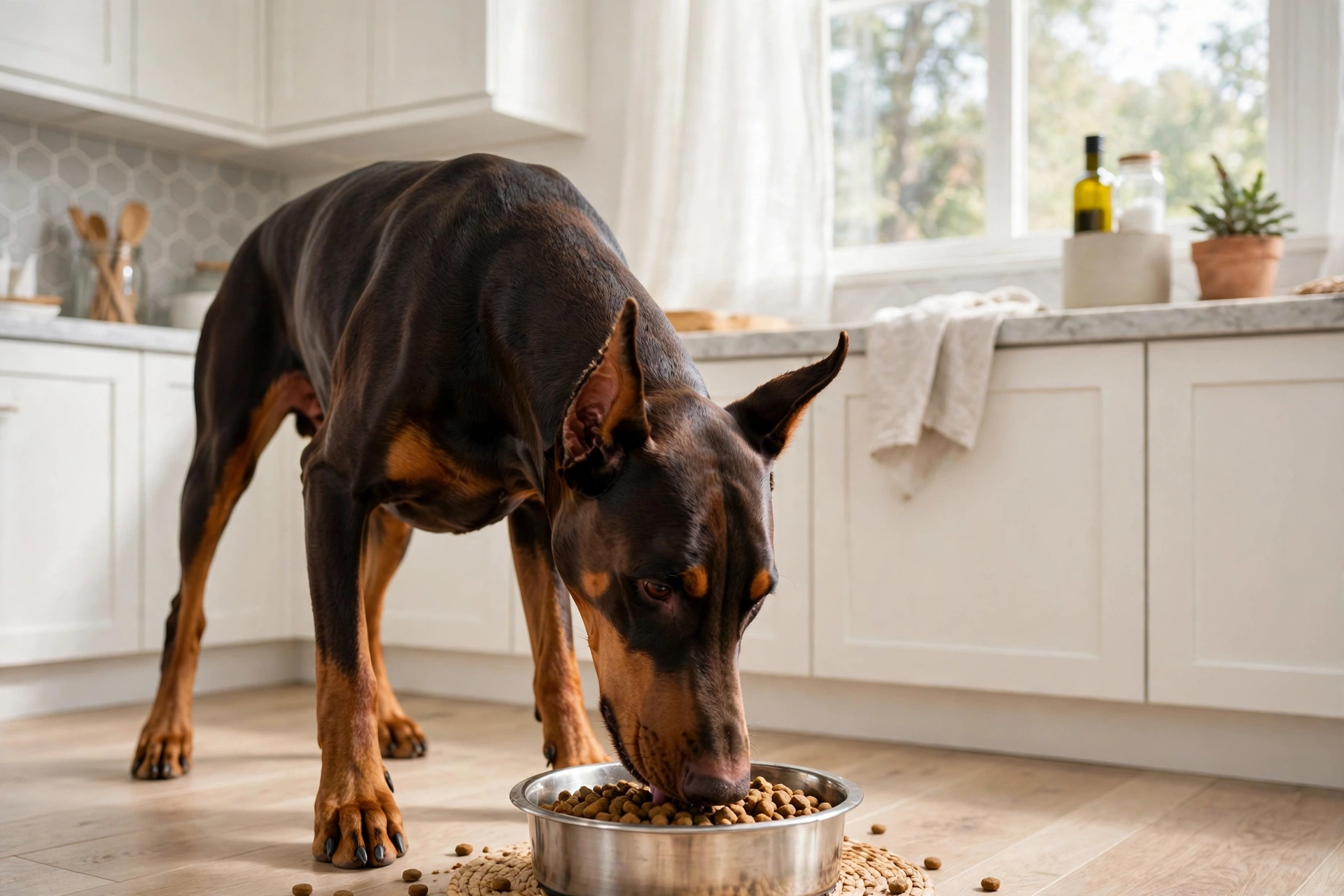
Doberman Pinscher Feeding Guide: How Much, How Often & What to Feed (2026)
Feeding a Doberman Pinscher well is less about finding one magic number and more about matching the food, the portion, and the schedule to the dog in front of you. This Doberman Pinscher feeding guide answers the questions every Dobie owner asks: how much should a Doberman eat each day, how often should you feed one, and what should actually be in the bowl from puppyhood through the senior years?
Inside, you will find a clear feeding chart by age, portion ranges in cups and calories, a sample daily schedule, what to look for in a good Doberman food, and the bloat-safe habits that matter most for this deep-chested breed. Dobermans are large, muscular, and very active dogs. Males typically stand 26 to 28 inches and weigh 75 to 100 pounds, females 24 to 26 inches and 60 to 90 pounds, so they need more food than a medium breed, but they also gain weight quickly when portions creep up and exercise drops off. Whether you have just brought home an 8-week-old puppy or you are adjusting portions for a slowing-down senior, this guide gives you a starting point you can adjust every couple of weeks based on body condition.
Feed adult Dobermans 3 to 5 cups of large-breed food a day, split into two meals about 12 hours apart, with a named meat first. Puppies need 4 meals at 8 to 12 weeks on a large-breed puppy formula, dropping to 2 meals by about 12 months. Keep your Dobie lean, and skip hard exercise for an hour around meals.
In This Guide
- Key Takeaways
- Doberman Pinscher Feeding Chart: Amounts by Age
- Feeding a Doberman Puppy: The First Year Matters Most
- Feeding an Adult Doberman: Portions, Calories, and Activity
- A Sample Doberman Feeding Schedule
- What to Look for in a Doberman’s Food
- Feeding a Senior Doberman: Less Food, Same Routine
- Bloat-Safe Feeding: The Habit That Matters Most for Dobermans
- Switching Foods Without an Upset Stomach
- Weight Control: How to Tell, and How to Fix It
- What to Avoid in a Doberman’s Diet
- Common Feeding Problems, Solved
- Pros and Cons
- Conclusion: A Simple Doberman Feeding Routine That Works
- Feeding a Doberman for Heart Health: What the DCM Risk Changes
Key Takeaways
- Feed adult Dobermans 2 meals a day (never one large meal), totalling roughly 3 to 5 cups of food depending on weight, calorie density, and activity.
- Doberman puppies need 4 meals at 8 to 12 weeks, dropping to 3, then 2 by about 12 months. Always use a large-breed puppy formula with controlled calcium and calories.
- Use calories, not just cups: a typical adult needs about 20 to 30 calories per pound of body weight, so check the kcal per cup on your food label.
- Keep your Dobie lean. You should be able to feel the ribs with light pressure and see a waist from above. Extra weight strains joints and the heart.
- Two smaller meals, a slow feeder for fast eaters, and no hard exercise for an hour before or after eating help lower the breed’s bloat risk.
- Treats should stay under 10% of daily calories, so cut meal portions on heavy training days.
Doberman Pinscher Feeding Chart: Amounts by Age
Every dog is different. A lean 70-pound female who naps most of the day needs less than a working 95-pound male who runs and trains daily. Use this chart as your starting point, then adjust every two weeks based on body condition, not the calendar alone.
| Life stage | Meals per day | Daily amount | Approx. daily calories |
|---|---|---|---|
| Puppy 8 to 12 weeks | 4 | 2 to 3 cups | 800 to 1,200 kcal |
| Puppy 3 to 6 months | 3 | 3 to 4 cups | 1,100 to 1,700 kcal |
| Puppy 6 to 12 months | 2 to 3 | 3 to 5 cups | 1,500 to 2,400 kcal |
| Adult 1 to 7 years | 2 | 3 to 5 cups | 1,800 to 2,800 kcal |
| Senior 7+ years | 2 | 2.5 to 4 cups | 1,400 to 2,200 kcal |
Why the wide ranges? A calorie-dense food at 400 kcal per cup needs far less volume than a lighter food at 320 kcal per cup. Start with the guide on your own bag, then adjust by about 10% and recheck in two weeks. Small, steady changes beat sudden swings.
Feeding a Doberman Puppy: The First Year Matters Most
Doberman puppies grow fast, and that rapid growth is exactly why feeding them correctly matters so much. Too many calories, or the wrong calcium-to-phosphorus balance, can push a large-breed puppy to grow too quickly and raise the risk of joint and skeletal problems later. That is why a large-breed puppy formula (not an all-life-stages food chosen at random, and not adult food) is the safest default for the first 12 to 18 months.
At 8 to 12 weeks, split the daily amount into four small meals. Puppies have small stomachs and high energy needs, and frequent small meals keep blood sugar steadier and make house training more predictable. Move to three meals at around 3 to 6 months, then to two meals somewhere between 6 and 12 months, depending on how your puppy is doing. Many owners find the morning and evening two-meal rhythm works well from about 9 months onward, but there is no prize for rushing it. If three meals keeps your puppy calmer and steadier, stay with three a little longer.
Do not free-feed a Doberman puppy. Leaving a full bowl down all day makes it hard to track how much he ate and masks a loss of appetite that could signal illness. Put the bowl down at mealtimes, give your puppy 15 to 20 minutes, then pick up whatever is left.
Growth is not a straight line. Dobermans often shoot up in height first and fill out with muscle later, and many stay lean and leggy through adolescence. Weigh your puppy every two to four weeks during the first year if you can, and keep a simple note of weight and portion.
Feeding an Adult Doberman: Portions, Calories, and Activity
Most adult Dobermans do best on two meals a day, roughly 12 hours apart, for example, 7 a.m. and 7 p.m. Two meals are not just convenient: for a deep-chested breed at risk of bloat, splitting the daily ration into two smaller meals is a sensible habit, and it keeps energy steadier through a long, active day than one large meal would.
As a starting point, a typical adult Doberman needs roughly 20 to 30 calories per pound of body weight per day. That gives you a useful check on any cup measurement:
| Adult weight | Typical daily calories | Typical kibble (at ~370 kcal/cup) |
|---|---|---|
| 60 pounds | 1,500 to 1,900 kcal | 4 to 5 cups |
| 75 pounds | 1,800 to 2,300 kcal | 4.5 to 6 cups |
| 90 pounds | 2,000 to 2,700 kcal | 5.5 to 7 cups |
Those numbers look high compared with the 2.5 to 3.5 cups quoted by some breed guides, and that gap is why calories matter more than cups. Those guides usually assume a very calorie-dense food, a smaller female, or a less active dog. A working Doberman can need well above the middle of the range; a neutered, low-activity Doberman may need well below it. Adjust to the dog, not to a chart.
Activity is the biggest lever after weight. On a heavy training, hiking, or sport day, your Doberman may need 10 to 20% more food; on a rest day, he needs less. Use a base portion for normal days and a modest top-up on genuinely hard days, and watch the waistline over weeks, not days.
For breed-specific options, see our best dog food for Doberman Pinschers guide and our best puppy food for Doberman Pinschers guide.
A Sample Doberman Feeding Schedule
A consistent schedule helps with house training, digestion, and behaviour. Dobermans thrive on routine, and a dog who knows when meals arrive is usually calmer around food than one who never knows. Here is a practical daily rhythm for a healthy adult:
| Time | What happens |
|---|---|
| 7:00 a.m. | First meal. Half the daily portion, served after a short morning toilet break. A short walk after eating is fine; save hard exercise for later. |
| Midday | Short walk and a toilet break. Treats for training count here, inside the 10% treat budget. |
| 6:00 to 7:00 p.m. | Second meal. The other half of the daily portion. |
| Evening | Last toilet break before bed. Fresh water stays down overnight. |
For puppies, the same shape applies with more meals, dropping as they grow. For seniors, keep the two-meal rhythm but watch for a dog who eats more slowly or leaves food. Mention that at the next vet visit rather than just adding tastier toppers. Dobermans should always have fresh, clean water available; never restrict water to control toilet breaks. A sudden big change in drinking is worth a vet check.
What to Look for in a Doberman’s Food
You do not need the most expensive bag on the shelf, but you do need a food that fits a large, muscular, active breed. Use this checklist when you compare labels:
A named animal protein first
Look for chicken, beef, lamb, salmon, or another named meat or fish meal as the first ingredient. “Meat meal” without a named animal is vaguer, and a food led by corn, wheat, or soy is unlikely to deliver the protein a Doberman’s muscle mass needs. Based on ingredient analysis, brand reputation, and owner reviews, most well-regarded large-breed foods sit in the 24 to 30% protein range for adults, with puppy formulas a little higher.
The right life-stage formula and AAFCO statement
Check the AAFCO nutritional adequacy statement on the bag. It should say the food is complete and balanced for the life stage you are feeding: growth for puppies, adult maintenance for adults, or all life stages with a large-breed note. For puppies, a formula specifically made for large breeds matters because it controls calcium and energy more carefully than a generic puppy food.
Moderate, good-quality fat
Fat is energy, and active Dobermans need it, but too much fat on a low-activity dog is the fastest route to weight gain. Adult foods in the 14 to 18% fat range suit most Dobermans, with working dogs at the higher end. Fish oil or flaxseed on the ingredient list is a plus for coat and skin, and for the omega-3 fatty acids that support joints and general health.
Digestible carbohydrates and fibre
Rice, oats, barley, and sweet potato are generally well tolerated. Fibre, from beet pulp, pumpkin, or similar ingredients, helps stool quality and satiety. That is useful for a breed that can be prone to loose stools when food changes too fast. If your Doberman has a sensitive stomach, a simpler recipe with fewer ingredients is often easier to troubleshoot than a long, busy one.
Joint and heart support where it counts
Glucosamine and chondroitin are common in large-breed foods and sensible for a breed prone to joint wear, though they are not a substitute for keeping the dog lean. Taurine is also worth noting, given the breed’s risk of dilated cardiomyopathy. But diet alone does not prevent heart disease, and regular cardiac screening matters far more than any single ingredient claim.
Feeding a Senior Doberman: Less Food, Same Routine
Dobermans are generally considered seniors from around 7 years old, and most slow down noticeably from that point. Muscle mass drops, metabolism slows, and joints get stiffer. That means the senior feeding goal is usually to feed a little less, keep protein up, and protect mobility, not to switch to a low-protein “old dog” food by default.
A typical senior Doberman needs roughly 10 to 20% fewer calories than he did as an adult, assuming activity has dropped too. If he is still running and training hard at 8, he may need close to his adult portion. Start by trimming the adult portion by about 10%, keep the two-meal schedule, and watch weight and muscle over a month. If he is losing muscle rather than fat, talk to your vet about protein level rather than just cutting more food. Older dogs still need good protein to hold muscle.
Senior foods often add joint support, extra fibre, and slightly lower fat. Those can help, but the portion and body condition matter more. Softer kibble, or kibble softened with warm water, can help a senior with dental wear. For a fuller look, see our best senior dog food guide.
As your Doberman moves into senior years, see our guide to best senior doberman pinscher food for later life stages.
Bloat-Safe Feeding: The Habit That Matters Most for Dobermans
Gastric dilatation-volvulus, usually called bloat, is the emergency every deep-chested breed owner should know about. The stomach fills with gas and can twist, cutting off blood flow. It comes on fast, it is painful, and it needs emergency veterinary care. A swollen, tight belly, retching without bringing anything up, restlessness, drooling, and pacing are the classic warning signs. No feeding habit guarantees prevention, but several habits lower risk, and they cost nothing:
- Feed two or more smaller meals a day, never one large meal.
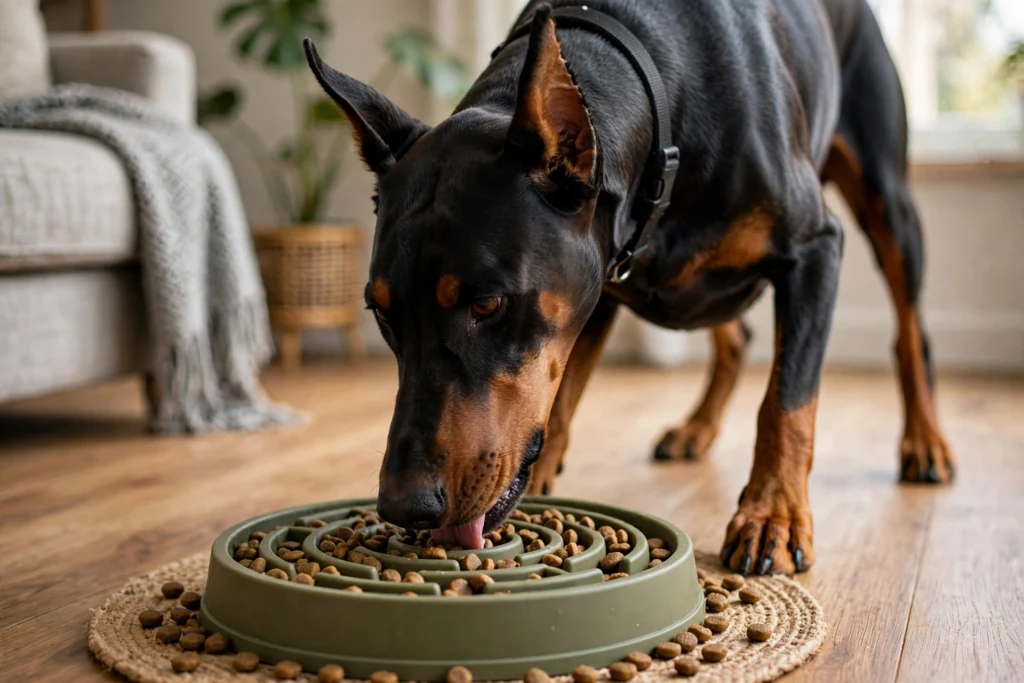
- Use a slow-feeder bowl or a puzzle feeder if your Doberman wolfs food in under two minutes. Eating fast swallows air, and air is part of the bloat picture.
- Keep your dog calm around meals. Avoid excitement, rough play, and hard exercise for at least an hour before or after eating.
- Do not let your dog gulp a huge amount of water immediately after eating. Fresh water should always be available, but a dog who drains the bowl in one go after a meal is worth slowing down with a smaller bowl refilled more often.
- Keep meals consistent. Sudden diet changes, large amounts of rich treats, and scavenged food can all upset the stomach and are worth avoiding.
Some owners ask about raised feeders. The evidence is mixed, and raised bowls are no longer routinely recommended as a bloat preventive. If bloat runs in your dog’s lines, ask your vet about the risks. That is a vet decision, not a feeding one.
Switching Foods Without an Upset Stomach
Dobermans can have sensitive stomachs, and a sudden food change is one of the most common causes of loose stools. Whenever you switch (puppy to adult, one brand to another, or to a weight-control food), do it gradually over 7 to 10 days:
| Days | Old food | New food |
|---|---|---|
| Days 1 to 2 | 75% | 25% |
| Days 3 to 4 | 50% | 50% |
| Days 5 to 6 | 25% | 75% |
| Day 7 onwards | 0% | 100% |
If stools loosen during the switch, slow down. Hold at the current ratio for an extra day or two before moving on. A brief period of softer stools during a transition is common; persistent diarrhoea, vomiting, blood in the stool, or a dog who stops eating is not, and needs a vet. Our full transition walkthrough is in how to change dog food safely. The same gradual principle applies when you move a puppy from three meals to two, or a senior to a new formula. Change one thing at a time, so you know what caused any problem.
Weight Control: How to Tell, and How to Fix It
The simplest weight tool you have is your hands and eyes. From above, a healthy Doberman should have a visible waist behind the ribs. From the side, the belly should tuck up. You should be able to feel the ribs with light pressure, without pressing hard, and without a thick fat layer over them. If you cannot feel the ribs at all, it is time to act, not with a crash diet, but with a steady plan.
To help a Doberman lose weight safely, cut the daily portion by about 10%, keep treats under 10% of daily calories, and add activity gradually. Do not cut food by a third overnight, and do not skip meals. Weigh your dog every two weeks and aim for slow loss, roughly 1 to 2% of body weight per month. If weight is not moving after a month, check hidden calories: table scraps, training treats, dental chews, and food stolen from another pet’s bowl all count. Our best dog food for weight loss guide covers lower-calorie options.
A Doberman losing weight without a portion change, or suddenly picky after always loving food, needs a vet check rather than a richer food. Weight change is a symptom as often as it is a feeding problem, and in a breed prone to heart and thyroid issues, it is worth investigating early.
What to Avoid in a Doberman’s Diet
- Chocolate, xylitol, grapes, raisins, onions, and garlic: all toxic to dogs, some in surprisingly small amounts. Xylitol in particular is found in sugar free gum and some peanut butters, so check the label before you share.
- Cooked bones: they splinter. Raw bones carry their own risks and are not needed in a complete diet.
- Table scraps as a habit: the occasional plain bite is fine for most dogs, but regular fatty scraps add calories, encourage begging, and can trigger pancreatitis in susceptible dogs.
- Mystery meat meals and vague ingredients: as covered above, a label is a promise. If you cannot tell what animal the protein came from, skip it.
- Overdoing treats and chews: dental sticks, pigs ears, rawhide, bully sticks, and training treats all have calories, some surprisingly many. Count them, do not just hand them over.
Common Feeding Problems, Solved
My Doberman eats too fast
Use a slow feeder, spread the kibble on a lick mat or a snuffle mat, or split the meal into two smaller portions served a few minutes apart. Eating more slowly lowers air intake and makes the meal last longer, which helps with satiety.
My Doberman refuses food
A dog who skips one meal but is otherwise well is usually fine. A dog who refuses for 24 hours, or who is lethargic, vomiting, or has diarrhoea, needs a vet. Do not immediately add toppers to bribe a dog into eating; it can train pickiness and mask a problem.
My Doberman has loose stools
Check the recent history first: a food change, a new treat, scavenged food, or stress all cause loose stools. If it persists beyond a few days, try a simple, limited ingredient food and talk to your vet about an elimination approach rather than cycling through random bags.
My Doberman begs at the table
Feed on a schedule, ignore begging, and never feed from the table. Everyone in the household has to follow the same rule, or the begging never stops.
My Doberman guards food
Resource guarding is a behaviour issue, not a hunger issue. Feed in a quiet spot, do not take the bowl away as a game, teach a reliable trade cue, and get help from a qualified trainer. In the meantime, keep children away at mealtimes.
Pros and Cons
This feeding routine is simple on purpose, but it is not a perfect fit for every Doberman. Here is the honest balance.
Pros
- Two meals a day with measured portions fits the breed’s bloat risk and keeps weight easy to track.
- The chart covers every life stage from 8-week puppies to seniors, with cups and calories side by side.
- The 10 percent treat budget leaves room for training without hiding extra calories.
- The bloat-safe habits cost nothing and lower the risk of the breed’s worst emergency.
Cons
- The cup ranges are wide, so owners must still weigh the dog and adjust every two weeks.
- No single food is named, so owners still have to pick a brand from the label checklist.
- The routine assumes a healthy dog, so a Doberman with heart, thyroid, or kidney trouble needs vet input.
- Fast eaters still need a slow feeder bought separately, since the routine alone does not slow them down.
Conclusion: A Simple Doberman Feeding Routine That Works
The best Doberman Pinscher feeding routine is a simple one, done consistently: two measured meals a day, a large-breed food with a named meat first, the right calories for your dog’s weight and activity, and a bloat-safe schedule around meals. Start with the ranges in this guide, then adjust every two weeks based on body condition. Treats stay under 10% of daily calories, and water is always available.
Your Doberman’s needs will change as he grows, ages, and trains. Warmer months and heavier exercise might call for a little more food; long rest periods mean a little less. The habit of checking body condition, weighing your dog regularly, and talking to your vet about any sudden changes is worth more than any single number on a chart. Share this guide with another Doberman owner who is still guessing at portions, and leave a comment if you found a routine that works especially well for your Dobie.
This guide is for information only. Check with your vet for your dog’s specific needs.
Feeding a Doberman for Heart Health: What the DCM Risk Changes
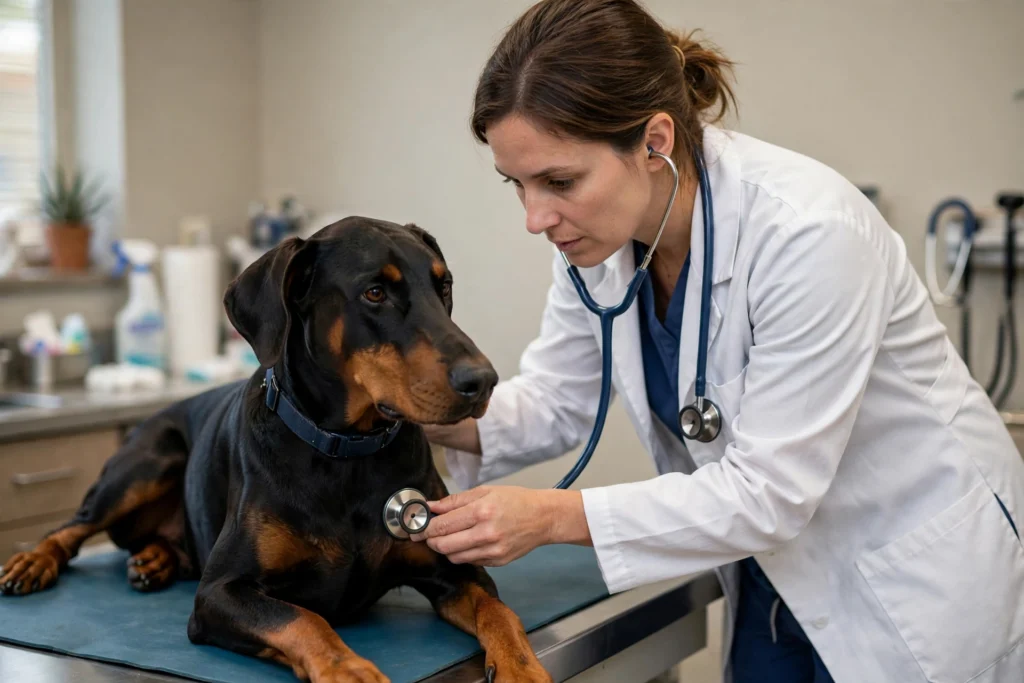
Heart disease is the one feeding topic that sets Dobermans apart from most breeds. Dilated cardiomyopathy, usually called DCM, weakens the heart muscle so it cannot pump well, and Dobermans carry one of the highest rates of it of any breed. Food cannot prevent DCM and cannot treat it, so no bag or supplement should ever be sold to you as a heart cure. What food can do is avoid adding extra strain. Keep your Doberman lean, since extra weight makes a weak heart work harder, and keep the two-meal routine from the rest of this guide, because a single huge meal also loads the chest. Be careful with grain-free food: the FDA has reported a link between some grain-free diets and DCM, so ask your vet before you switch to one, and pick a food from a maker that runs feeding trials and meets WSAVA standards rather than the newest boutique brand. Look for taurine and L-carnitine on the label, and omega-3 fats from fish oil, since these nutrients support heart muscle, but treat them as backup, not as a fix. Keep treats low in salt, and count them inside the 10 percent treat budget. If your vet finds a heart murmur or an enlarged heart, ask about a prescription cardiac diet and a cardiologist visit. Regular heart screening, not any single ingredient, is what catches DCM early enough to act on.
How much should a Doberman Pinscher eat per day?
Most adult Dobermans eat 3 to 5 cups of kibble per day, split into two meals. Puppies eat less in volume but more often, typically 2 to 3 cups split across 4 meals at 8 to 12 weeks. Always check your food’s kcal per cup and adjust to your dog’s weight and activity.
How many times a day should I feed my Doberman?
Feed adult Dobermans twice a day, roughly 12 hours apart. Puppies need 4 meals a day at 8 to 12 weeks, dropping to 3 meals at 3 to 6 months, and 2 meals by 6 to 12 months.
How much should a Doberman puppy eat?
Doberman puppies typically eat 2 to 5 cups per day depending on age, split into 3 to 4 meals. At 8 to 12 weeks, aim for 2 to 3 cups over 4 meals. By 6 to 12 months, most need 3 to 5 cups over 2 to 3 meals. Feed a large breed puppy formula and weigh your puppy every two to four weeks to adjust.
When should I switch my Doberman from puppy food to adult food?
Most Dobermans can move to adult food at 12 to 18 months, once growth has largely finished and your vet agrees. Make the change gradually over 7 to 10 days to avoid stomach upset.
What food is best for a Doberman Pinscher?
Look for complete and balanced large-breed food, whether grain inclusive or grain free, with a named meat first and a clear AAFCO statement. Talk to your vet about what suits your dog best, since each Doberman is different. Choose a reputable brand with a strong safety record and plenty of long-term feeding trials, rather than a boutique brand with only a short history.
What is the best feeding schedule for a Doberman?
A typical adult schedule is 7 a.m. and 6 to 7 p.m., with treats counted inside the 10% budget. Puppies add extra meals during the day. Keep the schedule consistent, and avoid hard exercise for an hour around meals.
How can I prevent bloat in my Doberman?
Feed two or more smaller meals a day, use a slow feeder if your dog eats too fast, keep meals calm, and avoid hard exercise for an hour before and after eating. Know the bloat warning signs and get emergency vet care straight away if you suspect it.
Can Dobermans eat raw food?
Some owners feed raw, but it carries risks from bacteria and unbalanced nutrition. If you are considering raw, talk to your vet or a veterinary nutritionist first, and never feed cooked bones.
Should I feed my Doberman a grain-free food?
Not by default. The FDA has reported a link between some grain-free diets and dilated cardiomyopathy, a heart disease Dobermans are already prone to, so talk to your vet before you switch. A grain-inclusive food with a named meat first is the safer default for most Dobermans. If your vet does recommend grain-free for a proven allergy, pick a food from a maker that runs feeding trials.
What should I feed a Doberman with heart disease?
Ask your vet first, since heart disease needs a diagnosis and a plan, not a bag swap. Many vets recommend a food from a maker that runs feeding trials, with taurine and omega-3 fats on the label, and keeping the dog lean so the heart works less hard. Some dogs need a prescription cardiac diet. Keep the two-meal routine and regular heart screening going alongside any food change.
3 Comments