

Bulldog Feeding Guide: How Much, How Often & What to Feed (2026)
A Bulldog will eat almost anything you put in front of him, and that is exactly why feeding one takes more care than feeding most dogs. Bulldogs gain weight easily, gulp their food, struggle with flat-face breathing, and often react to ingredients other dogs tolerate without a problem. A bulldog feeding guide is therefore less about finding a magic food and more about getting the everyday basics right: the right amount, at the right times, in a bowl your dog can actually eat from, with treats kept under control.
This guide covers Bulldogs in the broad sense, English Bulldogs first, with notes where French Bulldogs differ, because the two share the same brachycephalic feeding challenges even though their size and calorie needs are not identical. You will find how much to feed at every life stage, how often to feed, what to look for in a food, what to avoid, how to switch foods safely, and a sample day you can adapt to your own dog. It is built from ingredient analysis, brand reputation, and owner reviews, and it reflects the feeding schedules most Bulldog guides agree on in 2026. This guide is for information only. Check with your vet for your dog’s specific needs.
Most adult English Bulldogs eat 1 to 2 cups of food a day, about 400 to 700 calories, split into two meals. Puppies need 3 to 4 meals a day until close to a year old. Pick a balanced food with a named meat first, keep treats under 10% of calories, and use a shallow bowl or slow feeder.
In This Guide
- Key Takeaways
- Bulldog Feeding at a Glance
- How Much Should a Bulldog Eat?
- How Often Should You Feed a Bulldog?
- What Should Bulldogs Eat?
- Feeding a Flat-Faced Dog: Bowls, Pace, and Timing
- What to Avoid in a Bulldog’s Diet
- How to Switch Foods Safely
- A Sample Day of Bulldog Feeding
- When to Talk to Your Vet About Feeding
- Pros and Cons
- Conclusion
- Helping an Overweight Bulldog Lose Weight Safely
Key Takeaways
- Most adult Bulldogs do best on two measured meals a day; puppies need three to four smaller meals until they are close to a year old.
- Start with the feeding guide on your food’s label for your dog’s ideal weight, then adjust every two to three weeks based on body condition, not begging.
- Keep treats under 10% of daily calories. For a Bulldog, uncounted treats are the fastest route to weight gain.
- A shallow bowl or slow feeder, plus a calm 30 minutes after meals, helps flat-faced dogs eat more slowly and swallow less air.
- Switch foods gradually over seven to ten days, and talk to your vet if itching, loose stools, or vomiting persist beyond a normal transition.
Bulldog Feeding at a Glance

| Life stage | Meals per day | Typical daily amount* | What matters most |
|---|---|---|---|
| Puppy (8 weeks to 6 months) | 3 to 4 | 1 to 1.5 cups, split across meals | Puppy formula, DHA, steady growth without overfeeding |
| Junior (6 to 12 months) | 3, dropping to 2 | 1.5 to 2 cups | Transition to adult food around 10 to 12 months |
| Adult (1 to 7 years) | 2 | 1 to 2 cups (English Bulldog) | Weight control, measured portions, slow feeding |
| Senior (7 years and older) | 2 | 1 to 1.5 cups | Joint support, fewer calories, easy-to-chew food |
*Amounts are starting points for dry food and vary with calorie density, body weight, and activity. A typical adult English Bulldog eats roughly 400 to 700 calories a day, while a French Bulldog adult usually needs around 550 to 750 calories at 16 to 28 pounds. Always check the kcal per cup on your own bag, because two foods can differ by 100 calories per cup or more.
How Much Should a Bulldog Eat?
There is no single number of cups that suits every Bulldog, and the guides that pretend otherwise are the ones to be wary of. Calorie needs change with age, weight, neuter status, activity level, and the calorie density of the food itself. The reliable method, recommended by the American Kennel Club and veterinary nutrition sources alike, has four steps.
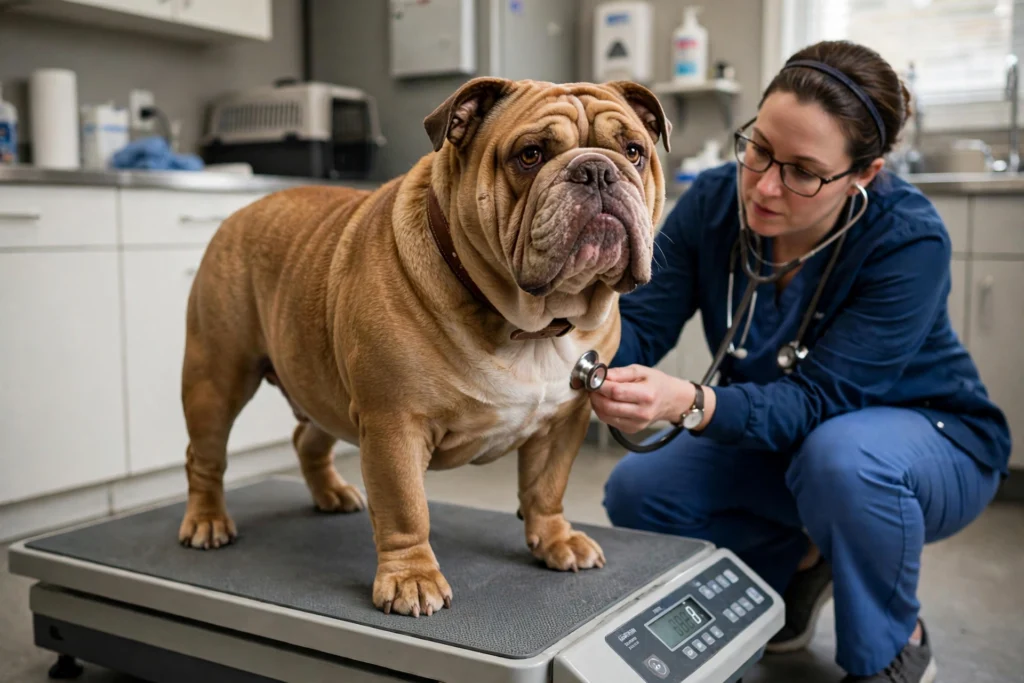
Establish your dog’s ideal weight with your vet, rather than feeding for the weight on the scale today. A typical adult English Bulldog eats roughly 400 to 700 calories a day, while a French Bulldog adult usually needs around 550 to 750 calories at 16 to 28 pounds. Always check the kcal per cup on your own bag, because two foods can differ by 100 calories per cup or more. Use the ranges below as a starting point and refine them every two weeks with the rib test.
The Rib Test: Your Best Portion Tool
Body condition beats the scale for Bulldogs because their stocky build hides fat well. Run your hands along your dog’s sides just behind the front legs. You should be able to feel the ribs easily under a thin layer of fat, about like the back of your hand. If the ribs feel like your knuckles, your dog is too thin. If you cannot feel them without pressing hard, your dog is carrying too much fat. From above, you should see a visible waist behind the ribs, and from the side, the belly should tuck up slightly rather than hanging level with the chest.
This matters more for Bulldogs than for most breeds. Extra weight worsens breathing, joint stress, and heat tolerance, all already weak points for a flat-faced, heavy dog. Research on brachycephalic breeds has linked obesity to a higher risk of airway problems, so weight control is not cosmetic for a Bulldog. It is one of the most important health decisions you will make for your dog.
Feeding Amounts by Weight (Adult English Bulldogs)
| Adult weight | Typical daily food | Typical daily calories |
|---|---|---|
| 35 to 40 pounds | 1 to 1.25 cups | 400 to 500 kcal |
| 40 to 50 pounds | 1.25 to 1.75 cups | 500 to 650 kcal |
| 50 to 55 pounds | 1.5 to 2 cups | 600 to 750 kcal |
These ranges assume a standard adult kibble at roughly 350 to 400 kcal per cup. A calorie-dense food, a very active dog, or an intact male may need more; a spayed or neutered couch-potato Bulldog will usually need less. French Bulldogs, at 16 to 28 pounds fully grown, generally land at the lower end of the adult range, around 1 to 1.5 cups a day split over two meals. If your dog is gaining weight on measured portions, talk to your vet before cutting further. Thyroid problems and other health issues can mimic simple overeating.
How Often Should You Feed a Bulldog?
Meal frequency changes as your Bulldog grows, and the pattern is consistent across the best feeding guides.
Puppies: 3 to 4 Meals a Day
Bulldog puppies from eight to twelve weeks need three to four small meals a day. Their stomachs are small, their growth is fast, and they burn energy quickly. From three to six months, three meals a day works well. Between six and twelve months, drop to two meals a day as growth slows, and switch from a puppy formula to an adult formula around ten to twelve months. Your vet can confirm the right timing for your dog.
Puppy meals should be served at regular times, not left out all day. Free feeding teaches a Bulldog to graze, makes house training harder, and makes it almost impossible to notice a change in appetite, which is often the first sign something is wrong. Soften kibble with a little warm water for very young puppies, and keep the bowl in the same quiet spot for every meal.
Adults: 2 Measured Meals a Day
Two measured meals a day, roughly twelve hours apart (for example, 7 a.m. and 6 p.m.) suits most adult Bulldogs. Two meals are easier on digestion than one large meal, reduce the risk of gulping and vomiting, and make it much easier to spot a change in appetite. One meal a day is not recommended for this breed: a Bulldog that eats a huge meal in one sitting is more likely to gulp air, bloat, and vomit, and a long gap between meals often leads to bile vomiting in the morning.
Seniors: 2 Smaller Meals a Day
Senior Bulldogs, aged seven and older, usually stay on two meals a day but in slightly smaller portions, since older dogs burn fewer calories. What changes is the formula, not the schedule: senior foods typically offer joint support such as glucosamine and chondroitin, omega-3 fatty acids, and easier-to-digest ingredients. Some seniors lose weight or muscle instead of gaining it, so weigh your older Bulldog monthly and adjust upward if the ribs become too prominent. If dental problems make kibble hard to chew, moistening it with warm water or mixing in a little wet food can help.
For an older Bulldog, choose the best senior bulldog food for age-appropriate nutrition and joint support.
What Should Bulldogs Eat?
| Food type | Best for | Key feature |
|---|---|---|
| Breed-specific kibble (Royal Canin Bulldog Adult) | Adult English Bulldogs | Wave-shaped kibble made for the Bulldog jaw |
| Salmon-based sensitive stomach food (Purina Pro Plan Sensitive Skin & Stomach) | Itchy skin or loose stools | Salmon first, live probiotics, no corn, wheat, or soy |
| Limited ingredient food (Natural Balance Salmon & Brown Rice) | Suspected food allergies | Single animal protein, short ingredient list |
| All life stages lamb and rice (Canidae All Life Stages) | Multi-dog households | Lamb-led, no corn, wheat, or soy |
| Grain-inclusive beef food (Merrick Classic Healthy Grains Beef) | Everyday adult feeding | Real beef first, glucosamine and chondroitin |
A Bulldog’s food should be complete and balanced for its life stage. Look for an AAFCO nutritional adequacy statement on the label that says so. Beyond that, the best Bulldog diets share a pattern: a named animal protein first, digestible carbohydrates, moderate fat, and targeted support for skin, joints, and digestion. Adult foods should contain at least 18% protein and 5% fat on a dry matter basis under AAFCO minimums, while puppy foods need higher levels, around 22% protein and 8% fat.
For a deeper look at these formulas, see our guides to the best dog food for Bulldogs and the best puppy food for Bulldogs. The right pick depends on your dog: a Bulldog with a sensitive stomach will often do better on a salmon or lamb formula, while a healthy adult with no sensitivities may thrive on a straightforward breed-specific or grain-inclusive kibble.
Wet Food, Dry Food, or a Mix?
Dry food is the practical default for most Bulldog owners: it is easy to measure, helps a little with dental health, and stores well. Wet food is softer and more aromatic, which helps fussy eaters, puppies, and seniors with dental problems, but it is harder to measure precisely and more expensive per calorie. A mix (dry food with a spoonful of wet food or a topper such as sardines in water, drained) gives you the best of both, as long as you count the topper’s calories in the daily total. Whatever you choose, the life-stage label and the measured portion matter more than the format.
Treats and Toppers
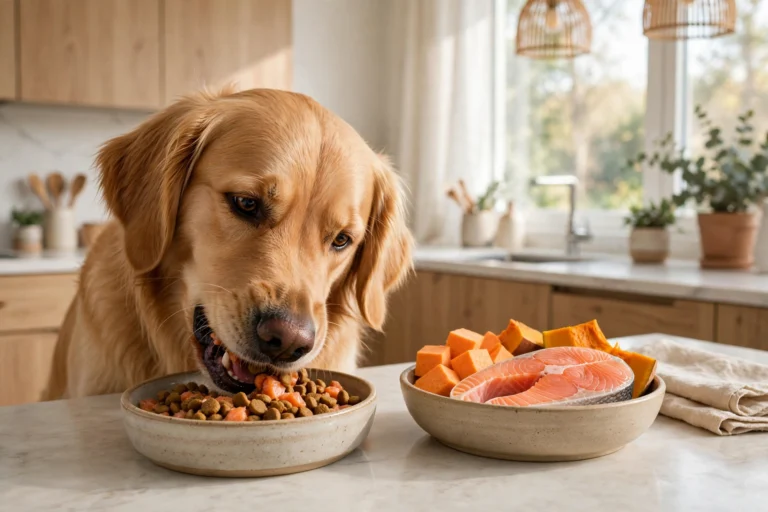
Treats should stay under 10% of your Bulldog’s daily calories. For a dog eating 600 calories a day, that is only 60 calories of treats: a couple of small biscuits, not a handful. Use small, soft, low-calorie training treats, count every training reward, and choose single-ingredient options such as freeze-dried fish or sweet potato chews where you can. Healthy toppers that add little in the way of calories include a spoonful of plain pumpkin puree for fiber, a few blueberries, or a little warm water stirred into kibble. Avoid table scraps entirely: fatty or seasoned human food is a common trigger for Bulldog stomach upsets and pancreatitis.
Feeding a Flat-Faced Dog: Bowls, Pace, and Timing
Bulldogs eat differently because of their anatomy. A short muzzle and crowded jaw mean your dog often pushes kibble around the bowl, gulps air, and swallows pieces barely chewed. That gulped air is one reason Bulldogs are famous for gas, and fast eating raises the risk of bloating and vomiting after meals. A few practical changes make a real difference.
Use a shallow, wide bowl that suits a short muzzle, or a slow-feeder bowl with ridges that force your dog to eat piece by piece. Puzzle feeders add the same benefit with extra mental enrichment. If your Bulldog inhales food even from a slow feeder, try scattering kibble on a snuffle mat or a baking tray so the meal takes longer. Moistening dry food with a little warm water can help puppies, seniors, and fussy eaters, though it removes the small dental benefit of crunching dry food.
Timing matters too. Feed after your dog has settled, not straight after a walk or play session, and keep things calm for at least 30 minutes after meals. No rough play, no excitement, no racing up stairs. Bulldogs overheat easily, so avoid feeding in the hottest part of the day in summer and never feed a panting, overheated dog a full meal; let them cool down first and offer water instead. Always keep fresh water available, and clean the bowl daily. Bulldog face folds and slobber make dirty bowls a fast route to bacteria.
What to Avoid in a Bulldog’s Diet
Bulldogs are prone to food sensitivities, and the most commonly reported triggers are chicken, beef, dairy, wheat, corn, soy, and egg. Though every dog is different, and a trigger for one Bulldog may be fine for another. If your dog has itchy skin, recurring ear irritation, or persistent loose stools, a limited-ingredient diet with a single novel protein such as salmon or lamb, fed exclusively for eight to twelve weeks, can help you and your vet narrow down the cause. Our guide to the best dog food for sensitive stomachs covers this in more detail.
Beyond specific triggers, avoid a few general traps. Skip foods whose first ingredient is a vague term such as “meat meal” or “animal by-product” rather than a named protein. Avoid high-fat performance formulas unless your dog is genuinely very active. Extra fat on a Bulldog mostly becomes extra weight. Never feed grapes, raisins, onions, garlic, chocolate, or anything containing xylitol, all of which are toxic to dogs. And be cautious with raw, grain-free, or homemade diets that are not properly formulated: if you want to go that route, work with a veterinary nutritionist, because an unbalanced homemade diet can harm a growing puppy in particular. Large calcium doses, for example, can damage growing joints. That is another reason to use a puppy-specific diet rather than adding supplements yourself.
How to Switch Foods Safely
| Days | Old food | New food |
|---|---|---|
| Days 1 to 2 | 75% | 25% |
| Days 3 to 4 | 50% | 50% |
| Days 5 to 6 | 25% | 75% |
| Days 7 to 10 | 0% | 100% |
Bulldogs have sensitive stomachs, so never switch foods overnight. A sudden change is one of the most common causes of diarrhea in this breed. Use a gradual transition over seven to ten days.
If loose stools appear, slow down and hold the current ratio for an extra day or two before moving on. A little soft stool during a transition is normal; persistent diarrhea, vomiting, or refusal to eat is not, and warrants a vet visit. Keep the same feeding times and the same bowl during a switch so the only thing changing is the food itself.
A Sample Day of Bulldog Feeding
Here is what a typical day looks like for a healthy 45-pound adult English Bulldog eating about 600 calories a day. Adjust the amounts to your dog’s weight and your food’s calorie density.
- At 7:00 a.m., breakfast is 3/4 cup of adult kibble in a slow-feeder bowl, plus a spoonful of plain pumpkin puree. Fresh water available.
- Midday, training treats: a few small, low-calorie treats during a short training session, counted within the 10% treat budget.
- At 6:00 p.m., dinner is 3/4 cup of kibble with a sardine in water, drained, as a topper. Calm rest for 30 minutes after eating.
- Evening: A single-ingredient chew such as a sweet potato chew, if the daily treat budget allows.
For a puppy, split the same daily amount across three or four meals instead, with the last meal no later than early evening so the puppy can toilet before bed. For a Bulldog that needs to lose weight, our guide to the best dog food for weight loss explains how to cut calories safely without leaving your dog hungry.
When to Talk to Your Vet About Feeding
Most feeding questions can be solved with measured portions and patience, but some signs need professional attention. See your vet if your Bulldog is losing weight despite eating well, if appetite changes suddenly or your dog stops eating for more than a day, if vomiting, diarrhea, gas, or itchy skin continue beyond a food transition, or if your dog keeps gaining weight on carefully measured portions. Puppies that fail to gain weight steadily, and seniors that suddenly lose weight, should also be checked promptly. Your vet can rule out parasites, digestive disease, thyroid problems, and other issues before you change the diet again.
Pros and Cons
Two measured meals and a clear portion plan make Bulldog feeding simple, but the guide still leaves a few choices to you. Here is the honest balance.
Pros
- Two measured meals a day and the rib test give a clear portion plan for every life stage.
- Five real formulas cover sensitive stomachs, allergies, multi-dog homes, and everyday feeding.
- Slow feeders, shallow bowls, and calm rest after meals fit a flat face and cut gulping.
- Weight tables by pounds and calories make it easy to spot overfeeding early.
Cons
- No puppy or senior formula is named, so young and old Bulldogs need a separate pick.
- Calorie needs vary a lot by food, so the cup amounts are only starting points.
- The guide leans on kibble and gives little help on fresh, raw, or home-cooked diets.
- The sample day fits one 45-pound adult, so owners of other sizes must scale it themselves.
Conclusion
Feeding a Bulldog well comes down to a handful of habits done consistently: two measured meals a day for adults, three to four for puppies, portions set by ideal weight and checked against body condition, treats kept under 10% of calories, and a bowl and pace that suit a flat face. The food itself should be complete and balanced for your dog’s life stage, led by a named protein, and free of ingredients your particular dog reacts to. Get those basics right, weigh your dog monthly, and adjust in small steps, and you will have a Bulldog at a healthy weight with a calm stomach and a much better chance of a long, comfortable life. If you are choosing a food to go with this schedule, start with our best dog food for Bulldogs picks and match the formula to your dog’s age, sensitivities, and waistline.
Helping an Overweight Bulldog Lose Weight Safely
If your Bulldog is already overweight, the fix is a slow cut, not a sudden one. Start by asking your vet for a target weight and a daily calorie number for that weight, then feed for the target weight, not the weight on the scale today. Cut the daily amount in small steps of about 10% at a time, and hold each new amount for two to four weeks while you check body condition with the rib test. Weigh your dog every month, since even a gain of 3 to 5 pounds matters on a 40 to 50 pound dog, and a steady loss of a little at a time is the goal. Count every treat and topper inside the daily total, and keep treats under 10% of daily calories, since uncounted extras are the fastest way to undo a cut. If your dog gains weight easily or stays heavy on measured portions, ask your vet about a weight management formula, which gives fewer calories per cup so the bowl still looks full. Keep exercise gentle and short, with calm rest for 30 minutes after meals and no feeding in the hottest part of the day, because extra weight already makes breathing, joints, and heat tolerance worse. If your dog keeps gaining weight on carefully measured portions, ask your vet to check for thyroid problems before you cut further.
How much should I feed my Bulldog per day?
Most adult English Bulldogs eat 1 to 2 cups of dry food a day, roughly 400 to 700 calories, split over two meals. Start with the feeding guide on your food’s label for your dog’s ideal weight, then adjust every two to three weeks based on body condition using the rib test.
How many times a day should a Bulldog eat?
Puppies need 3 to 4 small meals a day until about 6 months, then 3 meals until close to a year. Most adult and senior Bulldogs do best on 2 measured meals a day, roughly 12 hours apart.
When should I switch my Bulldog puppy to adult food?
Around 10 to 12 months of age, once growth has slowed. Switch gradually over 7 to 10 days and ask your vet to confirm the timing for your dog.
Why does my Bulldog eat so fast?
Bulldogs have short muzzles and crowded jaws, so they often push kibble around the bowl, gulp air, and swallow pieces barely chewed. A shallow bowl or slow feeder, plus calm rest for 30 minutes after meals, helps a lot.
What is the best food for a Bulldog with a sensitive stomach?
A limited-ingredient food with a single novel protein such as salmon or lamb, a digestible carbohydrate like brown rice, and no corn, wheat, or soy is a good starting point. Feed it exclusively for 8 to 12 weeks and discuss the plan with your vet.
Can Bulldogs eat wet food?
Yes. Wet food suits fussy eaters, puppies, and seniors with dental problems, and a mix of dry food with a spoonful of wet food works well. Just count the topper’s calories in the daily total.
How many treats can a Bulldog have each day?
Treats should stay under 10% of daily calories. For a dog eating 600 calories a day, that is only about 60 calories of treats. Use small, low-calorie treats and count every training reward.
Should I use a slow feeder bowl for my Bulldog?
Yes, for most Bulldogs. A slow feeder or puzzle feeder slows fast eaters, reduces gulped air and gas, and adds mental enrichment. If your dog still inhales food, try scattering kibble on a snuffle mat.
How can I help my overweight Bulldog lose weight?
Cut food slowly, in steps of about 10%, and hold each cut for two to four weeks while you check the rib test and weigh your dog monthly. Feed for the target weight your vet sets, count every treat inside the daily total, and ask your vet about a weight management formula if your dog stays heavy on measured portions. Keep exercise short and gentle, and never cut food sharply without vet advice.
How much water should my Bulldog drink each day?
As a rough guide, dogs drink about 1 ounce of water per pound of body weight each day, so a 45-pound Bulldog needs around 45 ounces. Keep fresh water close by at all times, and offer more in hot weather, since Bulldogs overheat easily. If your dog drinks far more or far less than usual, ask your vet.


3 Comments