
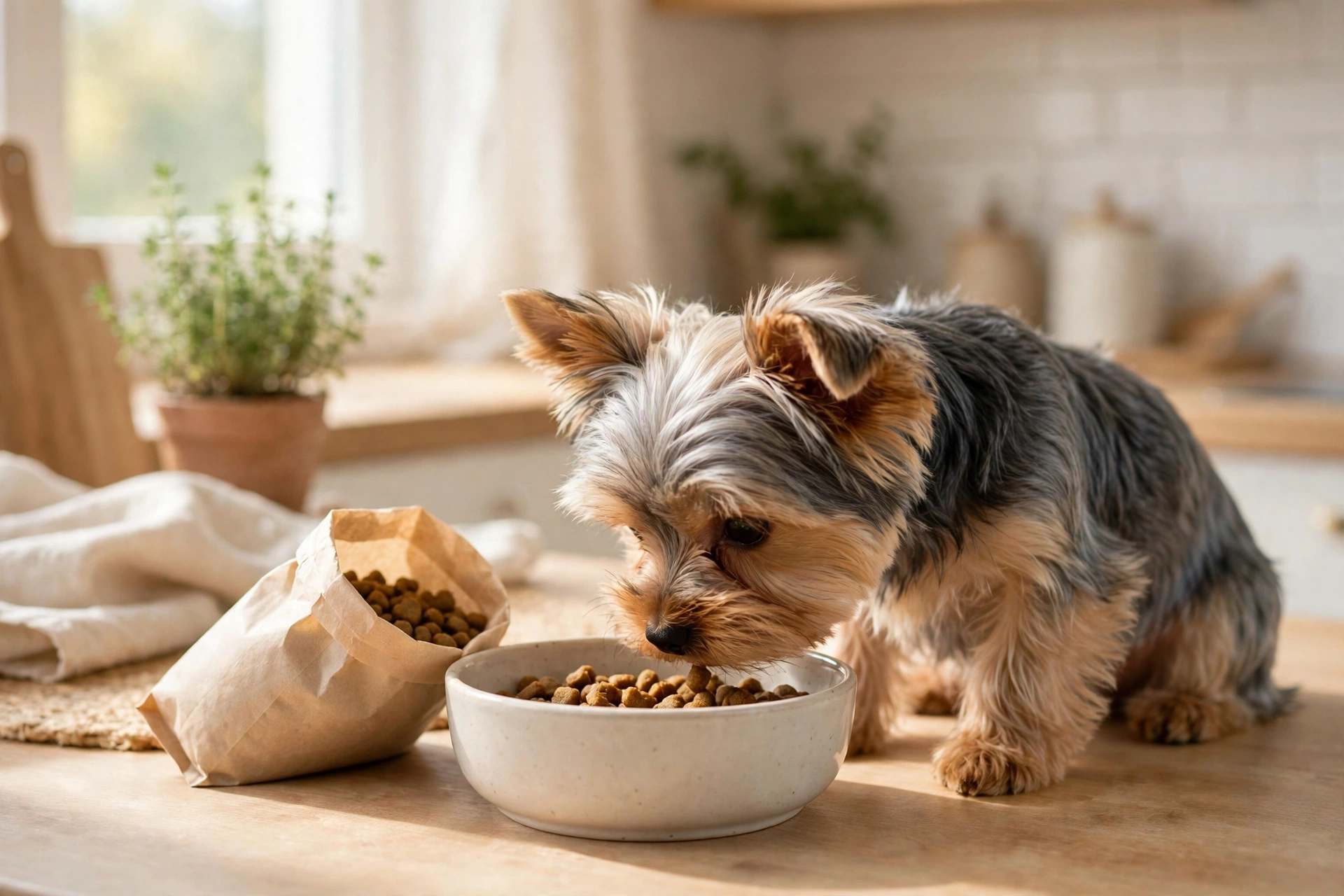
Best Puppy Food for Yorkshire Terriers: Tiny-breed meals for a 4 to 7 lb puppy, teething to adult food (6 Picks 2026)
A Yorkshire Terrier puppy is one of the tiniest dogs you will ever feed, most Yorkie puppies weigh under 2 pounds when they come home, and adults usually reach just 4 to 7 pounds. That tiny size changes everything about feeding. The best puppy food for Yorkshire Terriers has to pack a lot of calories into a very small stomach, come in kibble small enough for a tiny muzzle to pick up, and support fast brain development, a silky coat, and steady blood sugar. Get it wrong and you get a picky, wobbly, underfed puppy; get it right and your Yorkie grows into a confident, healthy little adult.
In this guide, we compare six small-breed puppy foods that actually suit a Yorkie puppy’s mouth and metabolism, including one breed-specific formula made just for Yorkshire Terriers, and we cover the questions other guides skip: exactly how many meals a Yorkie puppy needs at each age, how much to feed by weight, how to spot low blood sugar, and when to switch to adult food. Everything below is based on ingredient analysis, brand reputation, and owner reviews, not on feeding trials of our own. From teething to adult food, this guide follows your Yorkie puppy through every stage. For the general puppy-feeding method behind these picks, see our hub guide, Best Puppy Food for Large Breeds.
In This Guide
- Key takeaways
- Our top picks at a glance
- Royal Canin Yorkshire Terrier Puppy
- Wellness Small Breed Complete Health Puppy
- Hill’s Science Diet Puppy Small Paws
- Purina Pro Plan Puppy Small Breed Chicken & Rice
- Blue Buffalo Life Protection Small Breed Puppy
- IAMS ProActive Health Smart Puppy Small & Toy Breed
- How much should a Yorkie puppy eat?
- Feeding schedule and hypoglycemia: the Yorkie issue other guides gloss over
- Buying guide: what to look for in Yorkie puppy food
- What to avoid
- Wet food, dry food, or both?
- How to switch foods (and handle a picky Yorkie)
- When to switch to adult food
- Pros and Cons
- Teething, Crowded Teeth, and Food: What Changes at Mealtime
- Conclusion: our recommendation
Key takeaways
- Yorkie puppies need small-breed or toy-breed puppy food: tiny kibble they can actually pick up, and a calorie-dense recipe, because a Yorkie puppy’s stomach is too small for big, low-calorie meals.
- Feed 3 to 4 small meals a day until about 6 months, then 3 meals a day. Frequent meals protect a 4 to 7 lb Yorkie puppy from low blood sugar (hypoglycemia).
- Look for a named animal protein first, DHA from fish oil for brain and eye development, and an AAFCO statement for growth or all life stages.
- Our top pick for most Yorkie puppies is Royal Canin Yorkshire Terrier Puppy, the only formula shaped and sized specifically for a Yorkie’s muzzle; Wellness Small Breed Complete Health Puppy is the best all-round alternative.
- Yorkies usually move to adult food at 10 to 12 months, not at a year and a half like larger breeds, and dental care matters from day one, since Yorkies are prone to crowded teeth.
Our top picks at a glance
| Product | Best for | Key feature | kcal/cup | Price | Cost/month |
|---|---|---|---|---|---|
| Royal Canin Yorkshire Terrier Puppy | Most Yorkie puppies | Breed-specific kibble shaped for a Yorkie’s muzzle, plus coat-supporting omega fatty acids | 379 | $26.99 / 2.5 lb, Chewy, 2026-11-15 | ~$44/mo |
| Wellness Small Breed Complete Health Puppy | Best overall alternative | Deboned turkey first, very small kibble, DHA, no by-products or fillers | 489 | $19.99 / 4 lb, Chewy, 2026-11-15 | ~$21/mo |
| Hill’s Science Diet Puppy Small Paws | Steady small-breed staple | Nibble-size kibble, DHA from fish oil, balanced minerals for growing bones | 397 | $23.99 / 4.5 lb, Chewy, 2026-11-15 | ~$26/mo |
| Purina Pro Plan Puppy Small Breed Chicken & Rice | Best value | Chicken first, DHA-enriched, budget-friendly without artificial flavors | 482 | $19.98 / 6 lb, Chewy, 2026-11-15 | ~$15/mo |
| Blue Buffalo Life Protection Small Breed Puppy | Calorie-dense feeding | Deboned chicken first, DHA, antioxidant-rich LifeSource Bits | 417 | $39.58 / 15 lb, Chewy, 2026-11-15 | ~$10/mo |
| IAMS ProActive Health Smart Puppy Small & Toy Breed | Budget-friendly feeding | Small, easy-to-eat kibble at a lower price, with DHA for brain development | 445 | $18.25 / 7 lb, Chewy, 2026-11-15 | ~$14/mo |
Prices checked on Chewy on 2026-11-15. Cost per month is for a 6-month-old Yorkshire Terrier puppy expected to reach 5 lb as an adult.
Royal Canin Yorkshire Terrier Puppy
If you want a food designed for this exact breed, this is it. Royal Canin Yorkshire Terrier Puppy is formulated for Yorkie puppies up to 10 months, and its standout feature is the kibble itself: it is shaped and sized so a Yorkie’s small muzzle can pick it up and chew it, which matters more than it sounds. Many standard “small breed” kibbles are still too big for a 1-pound puppy. The formula includes omega-3 and omega-6 fatty acids plus biotin to support the skin and the long, silky coat Yorkies are known for, along with antioxidants and vitamin E for a developing immune system.
Be honest about the trade-offs: the first ingredient is a meat by-product rather than named whole meat, and this is one of the pricier puppy foods per pound. Owner reviews are generally positive on palatability and coat condition, though some puppies take a few days to accept a new kibble. Who it is for: first-time Yorkie owners who want a breed-specific, no-guesswork option and do not mind paying more for it. For a puppy that will top out at 4 to 7 lb, this is the most precisely sized food on the list. At $26.99 for the 2.5 lb bag on Chewy, it works out near $44 a month.
Wellness Small Breed Complete Health Puppy
Wellness Small Breed Complete Health Puppy is our best all-round pick if you prefer a whole-meat-first recipe. Deboned turkey leads the ingredient list, followed by chicken meal, giving puppies high-quality protein and fat plus the amino acids growth demands. The kibble is genuinely tiny (made for extremely small puppies), and the recipe is fortified with DHA for brain and eye development, with no by-products, fillers, or artificial preservatives.
It is also a useful middle ground on price: more affordable than the breed-specific Royal Canin, but a step up in ingredient quality from budget lines. Watch for one thing: because it contains both turkey and chicken, it is not a good choice if your puppy turns out to be sensitive to poultry. Who it is for: owners who want clean ingredients, tiny kibble, and strong all-round feeding and diet without a breed-specific price tag. At $19.99 for the 4 lb bag on Chewy, it works out near $21 a month.
Hill’s Science Diet Puppy Small Paws
Hill’s Science Diet Puppy Small Paws (Chicken Meal, Barley & Brown Rice) is the dependable, widely available choice, and it is a common recommendation in veterinary clinics. The “Small Paws” line is made for small and mini puppies, with nibble-size kibble, DHA from fish oil for brain and eye development, high-quality protein for lean muscle, and balanced minerals for strong bones and teeth. It carries an AAFCO statement for growing puppies and an antioxidant blend aimed at immune support.
The ingredient list is more grain-heavy than the foods above (chicken meal, whole grain wheat, and sorghum feature prominently), which is fine for most puppies but worth knowing if you prefer a meat-heavy recipe. Who it is for: owners who want a proven, easy-to-find food their vet is likely to know well, at a moderate price. At $23.99 for a 4.5 lb bag on Chewy, it works out near $26 a month.
Purina Pro Plan Puppy Small Breed Chicken & Rice
For families watching the budget, Purina Pro Plan Puppy Small Breed Chicken & Rice delivers the essentials at a notably lower price. Chicken is the first ingredient, the formula is enriched with DHA, and it contains no artificial flavors or preservatives. It is also very easy to find in US pet stores and supermarkets, which matters when you run out on a Sunday evening.
The compromises are real, though: corn gluten meal is the second ingredient, adding plant protein that is less valuable than meat protein, and poultry by-product meal appears on the label. If your puppy does well on it (good stools, steady growth, a healthy coat), those trade-offs are acceptable; if not, step up to one of the picks above. Who it is for: budget-conscious owners who still want a puppy-specific, DHA-enriched small-breed formula. At $19.98 for the 6 lb bag on Chewy, it works out near $15 a month.
Blue Buffalo Life Protection Small Breed Puppy
Blue Buffalo Life Protection Small Breed Puppy is a strong choice for Yorkie puppies because it is genuinely calorie-dense. Small dogs burn more calories per pound than big dogs, and a Yorkie puppy cannot eat a large volume at one sitting. Deboned chicken leads the recipe, followed by chicken meal and oatmeal, and it includes DHA, omega fatty acids, and Blue’s antioxidant-rich LifeSource Bits. The small-breed kibble size suits tiny mouths. At $39.58 for the 15 lb bag on Chewy, it works out near $10 a month.
This is a chicken-based food, so it is not the pick for a puppy with a suspected chicken sensitivity. Some owners also report that picky puppies need a few days to warm up to it. Who it is for: owners of active, fast-growing Yorkie puppies who need plenty of calories in small meals.
IAMS ProActive Health Smart Puppy Small & Toy Breed
IAMS ProActive Health Smart Puppy Small & Toy Breed is the value pick that does not force you into an all-life-stages compromise. It is made for small and toy breed puppies, with small kibble pieces a Yorkie puppy can actually pick up and chew, real chicken first, and DHA for brain development. Owner reviews consistently call it out as a genuinely affordable puppy food that puppies eat willingly, which is the whole point of a budget pick.
Be honest about the trade-off: the ingredient panel is less premium than the foods above, including chicken by-product meal and whole-grain corn further down the list. That does not make it unsafe. It is a complete and balanced growth formula, but if you prefer a chicken-first, by-product-free panel, spend the extra on Blue Buffalo or Wellness. At $18.25 for the 7 lb bag on Chewy, it works out near $14 a month.
How much should a Yorkie puppy eat?
There is no single number, because a Yorkie puppy’s needs change fast as it grows, and because every food has a different calorie density (roughly 379 to 489 kcal per cup for the foods above). Use the bag’s feeding guide as your starting point, then adjust by body condition.
| Puppy age | Typical weight range | Meals per day | Daily amount (guide only) |
|---|---|---|---|
| 8 to 12 weeks | 1 to 2.5 lb | 4 meals | 1/4 to 1/2 cup total, split across 4 meals |
| 3 to 6 months | 2 to 4 lb | 3 to 4 meals | 1/3 to 2/3 cup total, split across meals |
| 6 to 10 months | 3 to 6 lb | 3 meals | 1/2 to 3/4 cup total, split across 3 meals |
| 10 to 12 months | 4 to 7 lb | 2 to 3 meals | Transition toward adult portions |
Portions and cost per month at 5 lb adult weight
Basis: a 6-month-old Yorkshire Terrier puppy expected to reach 5 lb as an adult (the middle of the 4 to 7 lb adult range). At 6 months the puppy weighs about 3.9 lb. Daily feeding comes from each food’s label feeding guide, and cost per month uses the Chewy prices checked on 2026-11-15.
| Product | kcal/cup | Price | Daily feeding | Cost/month |
|---|---|---|---|---|
| Royal Canin Yorkshire Terrier Puppy | 379 | $26.99 / 2.5 lb, Chewy | 0.625 cup | ~$44/mo |
| Wellness Small Breed Complete Health Puppy (Turkey, Oatmeal & Salmon Meal) | 489 | $19.99 / 4 lb, Chewy | 0.5 cup | ~$21/mo |
| Hill’s Science Diet Puppy Small Paws | 397 | $23.99 / 4.5 lb, Chewy | 0.7 cup | ~$26/mo |
| Purina Pro Plan Puppy Small Breed Chicken & Rice | 482 | $19.98 / 6 lb, Chewy | 0.625 cup | ~$15/mo |
| Blue Buffalo Life Protection Small Breed Puppy | 417 | $39.58 / 15 lb, Chewy | 0.5 cup | ~$10/mo |
| IAMS ProActive Health Smart Puppy Small & Toy Breed | 445 | $18.25 / 7 lb, Chewy | 0.67 cup | ~$14/mo |
For the full feeding guide, see the Yorkshire Terrier Feeding Guide.
You should be able to feel your puppy’s ribs easily under a thin layer of fat, but not see them sharply, and your puppy should have a visible waist when viewed from above. Weigh your puppy weekly (a kitchen scale works well at this size) and adjust portions if weight gain stalls or speeds up.
These are starting points, not prescriptions. Always follow the specific food’s label first, since calorie density varies. And remember the Yorkie-specific rule: a very young Yorkie puppy should not go long stretches without a meal. Their tiny livers store little glycogen, so missed meals can lead to low blood sugar.
Feeding schedule and hypoglycemia: the Yorkie issue other guides gloss over
Yorkie puppies are more prone to hypoglycemia (low blood sugar) than larger puppies, especially under 3 to 4 months old or under 2 pounds. Signs include wobbliness, weakness, glassy or unfocused eyes, disorientation, trembling, and in severe cases collapse or seizures. This is a veterinary emergency. If you see these signs, offer a small amount of fast sugar if your vet has advised you to (such as a dab of honey on the gums) and contact your vet immediately. The Merck Veterinary Manual notes that puppy hypoglycemia is seen especially in toy breeds during the first 6 months of life, and that frequent meals of a commercial puppy diet usually manage it.
Prevention is mostly about routine: feed 4 small meals a day for the youngest puppies, keep meals on a regular schedule, avoid long gaps (especially overnight for very tiny puppies, a late-evening meal helps), and keep stress, cold, and missed meals to a minimum during the first months. If your puppy regularly refuses food, loses weight, or seems lethargic, switching foods on its own is not the answer. Ask your vet first. Keep a small amount of honey or corn syrup and your vet’s phone number close at hand, so you are not searching for them in an emergency.
Buying guide: what to look for in Yorkie puppy food
Small kibble, genuinely small. “Small breed” on the label is not enough. Check that the kibble is tiny enough for your puppy to pick up. If your puppy drops kibble, chews awkwardly, or swallows pieces whole, the kibble is too big, and a smaller-kibble formula (or softening kibble with warm water for very young puppies) will help.
Calorie density. Toy puppies need more calories per pound than large puppies, but their stomachs hold less. Look for a food with around 400 kcal per cup or more, and a fat content in the mid-to-high teens or above, so each small meal delivers enough energy. Some guides still cite 393 kcal/cup for Royal Canin Yorkshire Terrier Puppy; the current label is 379, and the tables on this page use the current value.
Named animal protein first. Deboned chicken, turkey, lamb, or salmon as the first ingredient is a good sign. Meat meals (like chicken meal) are also fine. They are concentrated protein. Vague terms like “meat by-products” as the main protein are a lower-quality signal.
DHA and brain development. DHA from fish oil supports brain and eye development in puppies. Most quality puppy foods include it. Our hub guide, Best Puppy Food for Large Breeds, explains why DHA matters and what to look for on the label.
AAFCO statement. Check the label for a statement that the food is formulated to meet AAFCO nutrient profiles for growth or for all life stages. This is the basic assurance that the recipe is complete and balanced for a growing puppy. An adult-maintenance food is not a substitute for puppy food.
Calcium and phosphorus balance. Growing puppies need the right balance of calcium and phosphorus for bones and teeth. Puppy-specific formulas are designed for this; adult foods and homemade diets without guidance are not reliable substitutes.
What to avoid
Avoid adult dog food for a puppy. It does not have the calorie density or nutrient profile a growing Yorkie needs. Avoid foods whose first ingredients are corn, wheat, or soy, and foods heavy in artificial colors, flavors, or preservatives. Be cautious with grain-free recipes chosen for no particular reason: grains are not fillers for most dogs, and grain-free kibble often replaces them with large amounts of peas, lentils, or potatoes. Skip raw or homemade diets for a Yorkie puppy unless a veterinary nutritionist has formulated them. Tiny puppies have no margin for feeding error. And avoid free-feeding (leaving food out all day) once your puppy is past the youngest stage: it makes house training harder, hides appetite changes that can signal illness, and encourages picky grazing.
Wet food, dry food, or both?
Most Yorkie puppies do well on dry kibble, which is convenient, calorie-dense, and gives teeth some mechanical cleaning action, relevant because Yorkies are prone to dental disease and crowded teeth. Wet food can help picky eaters, very young puppies, or puppies transitioning from breeder food, and it adds hydration. A mixed approach works well: dry kibble as the base, with a spoonful of wet food as a topper, or wet food for one meal a day. Whichever route you choose, brush your Yorkie’s teeth regularly with a dog toothbrush and toothpaste, and ask your vet about dental checks. Kibble alone does not prevent dental disease.
How to switch foods (and handle a picky Yorkie)
Yorkies have a reputation for pickiness, and sudden food changes often make it worse. Switch over 7 to 10 days: roughly 25% new food for 2 to 3 days, then 50%, then 75%, then fully new, watching stools at each step. If your puppy refuses the new food, try warming it slightly, adding a little warm water, or mixing in a topper. But rotating through five foods in a week teaches a puppy that refusing food brings something better. Keep treats to under 10% of daily calories, since tiny puppies fill up fast: a handful of training treats can easily replace a whole meal’s worth of calories. If refusal lasts more than a day, or comes with lethargy, vomiting, or diarrhea, call your vet rather than trying another brand.
If your Yorkie turns picky, warm the kibble with a little warm water and keep mealtimes boring and predictable: same bowl, same spot, same food, offered for 15 to 20 minutes and then picked up. Adding a new topper every time your puppy refuses food teaches them that holding out brings something better. If your puppy refuses food for more than a day, or seems lethargic or loses weight, ask your vet before switching foods.
When to switch to adult food
Yorkies mature faster than large breeds. Most Yorkie puppies are ready for adult food at around 10 to 12 months. Royal Canin’s breed-specific line, for example, is designed up to 10 months, after which the adult Yorkshire Terrier formula takes over. Switch gradually over a week, just like any food change, and expect portions to drop: adult maintenance needs fewer calories per pound than growth does. If your Yorkie is spayed or neutered, or is gaining weight easily, your vet may suggest moving to adult food at the earlier end of that range or choosing a weight-aware adult formula. For more on feeding your Yorkie as it grows, see our guide to the best dog food for Yorkshire Terriers, and for the feeding basics that apply at every age, our puppy feeding schedule and best puppy food for small breeds guides.
Pros and Cons
Feeding a Yorkie puppy is all about small size and steady energy. Here is the honest balance.
Pros
- Tiny kibble fits a small muzzle and is easy to pick up.
- Calorie-dense recipes pack enough energy into a small stomach.
- DHA supports fast brain development.
- Small, frequent meals help prevent low blood sugar.
Cons
- Yorkie puppies are prone to low blood sugar, so missed meals are risky.
- Tiny portions are easy to get wrong, so weighing or measuring food keeps portions accurate.
- Picky eating is common, so switching foods can take patience.
- Breed-specific formulas cost more than standard small-breed food.
Teething, Crowded Teeth, and Food: What Changes at Mealtime
A Yorkie puppy starts losing baby teeth at around 3 to 4 months, and the adult teeth are usually all in by 6 to 7 months. That is a lot of change in a tiny mouth, and Yorkies are one of the breeds most likely to keep a baby tooth after the adult tooth has come through, most often a canine tooth. A kept baby tooth crowds the adult teeth, traps food, and makes sore gums more likely, so lift your puppy’s lip once a week and look for two teeth in one spot. If you see a double tooth, or your puppy winces while eating, ask your vet to look at it. Leave a wobbly baby tooth alone. Pulling it yourself can hurt your puppy and damage the adult tooth underneath.
Sore gums change how a puppy eats. A puppy that loved dry kibble may start dropping pieces, chewing on one side, or walking away from the bowl. Soften the kibble with a little warm water for a few minutes until the gums settle. Offer a safe rubber chew or a frozen washcloth to gnaw on, and skip hard bones and antlers, which can crack tiny teeth. Start brushing with a small dog toothbrush and dog toothpaste while your puppy is young. Kibble alone does not clean teeth, and early brushing is the habit that protects a Yorkie mouth for life.
Conclusion: our recommendation
For most Yorkie puppies, start with Royal Canin Yorkshire Terrier Puppy: it is the only food here made for this breed’s muzzle, coat, and growth pattern, and it removes the guesswork for first-time owners. If you prefer a whole-meat-first recipe or a lower price, Wellness Small Breed Complete Health Puppy is the best all-round alternative, with Hill’s Science Diet Puppy Small Paws as the dependable everyday fallback. Whichever you choose, feed small, frequent meals, weigh your puppy weekly, and watch appetite closely. In a dog this small, the feeding routine matters as much as the food itself. If you also have a Pomeranian at home, see our Best Puppy Food for Pomeranians guide, and for the wider small-breed shortlist, see Best Puppy Food for Small Breeds. For adult Yorkies, see Best Dog Food for Yorkshire Terriers.
This guide covers feeding and diet for Yorkshire Terrier puppies in general terms; your own puppy’s needs may differ, so check portions and any health worries with your vet.
Frequently Asked Questions
When should I switch my Yorkie puppy to adult food?
Most Yorkshire Terriers are ready for adult food at around 10 to 12 months, much earlier than large breeds. Switch gradually over about a week, mixing increasing amounts of adult food with the puppy food, and expect daily portions to drop since adult maintenance needs fewer calories per pound than growth does.
How many times a day should a Yorkie puppy eat?
Feed 4 small meals a day up to about 3 months of age, then 3 to 4 meals a day until 6 months, and 3 meals a day from 6 to 12 months. Frequent small meals suit a Yorkie’s tiny stomach and help protect very young puppies from low blood sugar.
How much food does a Yorkie puppy need per day?
It depends on age, weight, and the food’s calorie density, so start with the feeding guide on the bag and adjust by body condition. As a rough guide, a Yorkie puppy eats roughly 1/4 to 3/4 cup per day in total, split across its meals, and weekly weigh-ins help you fine-tune the amount.
What are the signs of low blood sugar in a Yorkie puppy?
Signs of hypoglycemia include wobbliness, weakness, glassy or unfocused eyes, disorientation, trembling, and in severe cases collapse or seizures. This is a veterinary emergency: offer a small amount of fast sugar only if your vet has advised you to, and contact your vet immediately.
When do Yorkie puppies start teething, and should I change their food?
Teething usually starts at around 3 to 4 months, when baby teeth start to fall out and adult teeth come in, and it is mostly done by 6 to 7 months. Sore gums can make a puppy drop kibble, chew on one side, or eat less than usual. Soften the kibble with a little warm water until the gums settle, and offer a safe rubber chew for the sore mouth. If a baby tooth stays in place after the adult tooth appears, or eating seems painful, ask your vet to look at it. Leave a wobbly baby tooth alone. Pulling it yourself can hurt your puppy and damage the adult tooth underneath.
What should I keep at home in case my Yorkie puppy’s blood sugar drops?
Keep a small amount of honey or corn syrup, a warm blanket, and your vet’s phone number close at hand. If you see wobbliness, weakness, or glassy eyes, rub a small amount of honey on your puppy’s gums only if your vet has told you to do this, wrap your puppy in the blanket to keep it warm, and call your vet right away. Get a vet check even if your puppy seems better fast, since low blood sugar can come back. The best guard is routine: small meals on time, with no long gaps.

5 Comments