
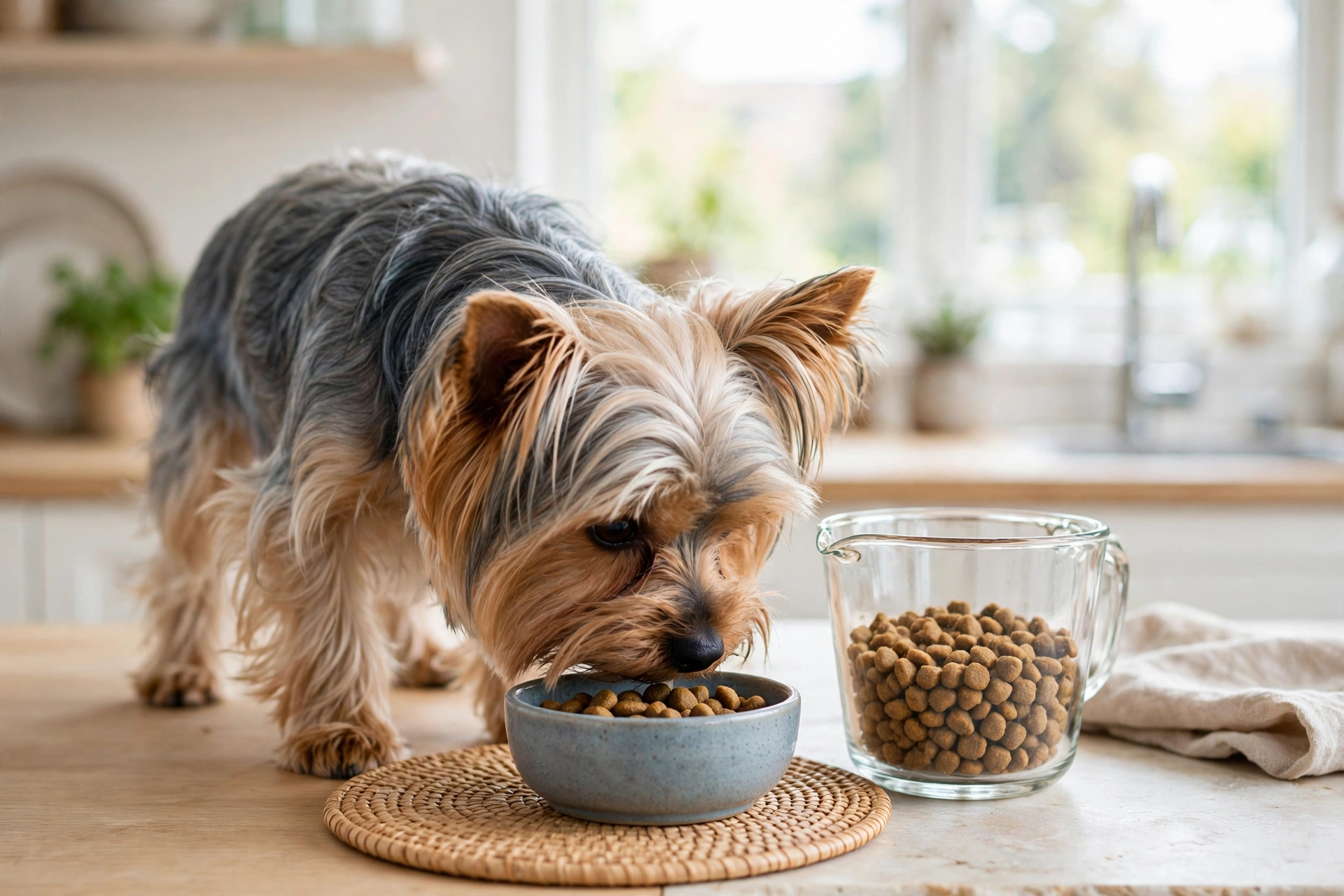
Yorkshire Terrier Feeding Guide: How Much, How Often & What to Feed (2026)
Yorkshire Terriers may weigh less than a bag of flour, but feeding one correctly takes more care than feeding a much larger dog. A few extra kibbles a day can mean real weight gain for a 5-pound Yorkie, while a missed meal can leave a tiny puppy shaky and low on energy. This Yorkshire Terrier feeding guide gives you the numbers that actually work: how much to feed by age and weight, how often to feed, how to convert calories into cups, and what a sensible day of meals looks like at each life stage.
It also explains why online guides disagree: one says a quarter-cup a day, another says three-quarters. Both can be right, because kibble varies enormously in calories per cup. Feed by calories first and cups second, and those contradictions disappear.
Quick Answer: Most adult Yorkies need 150 to 250 calories a day, split over 2 to 3 meals. Start from the calories in your food, not a cup amount. Puppies need 3 to 4 meals a day, and seniors do well on 2 meals with fewer calories. Measure with a cup or kitchen scale, and keep treats within 10 percent of calories.
In This Guide
- Key Takeaways
- Yorkshire Terrier Feeding at a Glance
- Why Feeding a Yorkie Is Different
- Feed by Calories First, Cups Second
- How Much to Feed a Yorkie Puppy
- How Much to Feed an Adult Yorkie
- How Much to Feed a Senior Yorkie
- Yorkies Under 3 Pounds and Teacup Yorkies
- Sample Day Menus
- Dry Food, Wet Food, or a Mix?
- What to Look for in a Yorkie’s Food
- Switching Foods Without an Upset Stomach
- What to Avoid
- Picky Eaters: Getting a Yorkie to Eat
- How to Tell If the Portion Is Right
- When to Call Your Vet About Feeding
- Pros and Cons
- Conclusion
- Yorkie Puppy Hypoglycemia: The Low Blood Sugar Risk Every New Owner Should Know
Key Takeaways
- Most adult Yorkies need roughly 150 to 250 calories a day, split over 2 to 3 small meals, but always start from your food’s calorie content, not a generic cup amount.
- Yorkie puppies need 3 to 4 meals a day; adults do best on 2 to 3; seniors usually do well on 2 meals, with slightly fewer calories and easier-to-chew food.
- Use a level measuring cup or, better, a kitchen scale. Eyeballing portions is the fastest way to overfeed a toy breed.
- Treats and toppers count: keep them within 10% of daily calories, or shrink meals to make room for them.
- Judge the portion by body condition: ribs you can feel but not see, and a visible waist from above. Adjust by about 10% at a time.
Yorkshire Terrier Feeding at a Glance
| Life stage | Meals per day | Typical daily amount* | Typical daily calories* |
|---|---|---|---|
| Puppy, 2 to 5 months | 4 (3 minimum) | 1/4 to 1/2 cup | 100 to 160 calories |
| Puppy, 6 to 12 months | 3 to 4 | 1/3 to 1/2 cup | 160 to 200 calories |
| Adult, 1 to 7 years | 2 to 3 | 1/3 to 2/3 cup | 150 to 250 calories |
| Senior, 8+ years | 2 | 1/3 to 1/2 cup | 130 to 200 calories |
*For a typical dry food at about 350 to 400 calories per cup. Wet food, calorie-dense kibble, and very active or very sedentary dogs will shift these numbers. See the calorie method below.
Why Feeding a Yorkie Is Different
A Yorkshire Terrier is a toy breed, usually 4 to 7 pounds fully grown, with a stomach to match. That small size creates four feeding problems that larger dogs simply do not have.
The margin for error is tiny. A tablespoon of extra kibble is a rounding error for a Labrador; for a 5-pound Yorkie it can be 10% of the day’s food. Yorkies also burn energy fast relative to their size, so long gaps between meals can leave them flat. In very young or very small puppies, that can mean low blood sugar (hypoglycemia), which shows up as weakness, wobbliness, or disorientation and needs prompt veterinary advice. Third, the breed is famously picky, and a dog that skips meals is hard to portion-manage. Fourth, Yorkies are prone to dental problems, so food texture and chewing matter more than they do for most breeds.
Feeding a Yorkie well rewards measurement, routine, and attention to the dog in front of you rather than to a single chart number.
Feed by Calories First, Cups Second
This is the single most useful idea in this guide, and it is the one most competing guides skip. Cup amounts only make sense once you know how many calories are in a cup of your food. Two kibbles can differ by 100 calories per cup or more, which is why one guide’s “half a cup” can be another guide’s “three-quarters of a cup” for the same dog.
Use this simple method:
- Estimate daily calories. As a starting point, use about 50 to 55 calories per pound of body weight for a growing puppy, about 40 calories per pound for a typical adult, and about 35 to 38 calories per pound for a less active senior. A 5-pound adult therefore starts at about 200 calories a day; a 5-pound puppy at about 250 to 275.
- Read your food’s calorie content. It is on the bag or can, usually as calories per cup (dry) or per can/tray (wet). If you feed wet food, a small 3.5-ounce tray is often roughly 90 to 120 calories. Check the label, because brands vary.
- Divide calories by calories per cup. Example: 200 calories ÷ 400 calories per cup = 1/2 cup per day. With a 350-calorie-per-cup food, the same dog needs about 1/2 cup plus a tablespoon (200 ÷ 350 = 0.57 cups).
- Split that daily total across meals, then subtract treats. If treats add up to 20 calories, the meals should total 180, not 200.
Worked examples make this concrete. A 4-pound adult at 40 calories per pound needs about 160 calories: roughly 1/2 cup of a 350-calorie kibble, or 2/5 cup of a 400-calorie kibble. A 7-pound active adult at 40 calories per pound needs about 280 calories: roughly 3/4 cup of a 380-calorie kibble. A 3-pound senior at 35 calories per pound needs about 105 calories: roughly 1/4 to 1/3 cup, depending on the food. These are starting points, not prescriptions. Body condition over the next two to four weeks tells you whether to hold, raise, or lower the amount.
How Much to Feed a Yorkie Puppy
Yorkie puppies grow fast and burn a lot of energy for their size, so they need more calories per pound than adults, divided into more meals. Up to about 3 months of age, or until a puppy weighs at least 2.5 pounds, many breeders and guides accept free-feeding (food left down and fully replaced regularly so it stays fresh) because a very tiny puppy should never go long without eating. Once a puppy passes that point, switch to scheduled meals: it makes house training far easier, since bowel movements become predictable, and it lets you see exactly how much your puppy is eating.
| Puppy age | Meals per day | Daily amount (typical kibble) |
|---|---|---|
| 8 to 12 weeks | 4 | 1/4 to 1/3 cup |
| 3 to 5 months | 4, moving to 3 | 1/4 to 1/2 cup |
| 6 to 9 months | 3 | 1/3 to 1/2 cup |
| 10 to 12 months | 3, moving to 2 to 3 | 1/2 cup |
Feed a puppy formula, not adult food: it is more calorie-dense and richer in the protein, fat, and minerals a growing toy breed needs. Weigh your puppy every week or two; steady gain matters more than any single day’s cup amount. If your puppy is constantly ravenous, gaining too fast, or leaving most meals untouched, talk to your vet before simply adding or removing food.
For more on choosing a puppy formula, see our guide to the best puppy food for Yorkshire Terriers.
How Much to Feed an Adult Yorkie
Most adult Yorkies, at 4 to 7 pounds, eat somewhere between 1/3 and 2/3 cup of dry food a day, or 150 to 250 calories. Where your dog falls in that range depends on weight, activity, neuter status, and the food itself. A 4-pound couch companion on a calorie-dense kibble may need barely 1/3 cup; a 7-pound Yorkie that walks for an hour and plays hard may need close to 3/4 cup of a lighter kibble.
Two or three meals a day both work for adults, but three smaller meals suit many Yorkies better than two larger ones: steadier energy, less begging between meals, and less risk of a long overnight fast for a dog that runs on a small tank. A practical adult schedule is breakfast at around 7:00 a.m., lunch or a midday meal at around 1:00 p.m. if you feed three times, and dinner at around 6:00 to 7:00 p.m., finishing at least two hours before bedtime so the last toilet trip happens before lights out.
Spayed and neutered dogs often need slightly fewer calories, as their metabolism slows a little. Weight gain in the months after neutering on the same portion usually calls for a 10% cut, not a new food.
How Much to Feed a Senior Yorkie
Yorkies are generally considered seniors at around 8 years, though some guides use 7. Senior dogs usually need fewer calories because they move less, but they still need plenty of protein to hold muscle, plus joint-supporting nutrients and food that is easy to chew if teeth are worn or missing. A typical senior portion is 1/3 to 1/2 cup of dry food a day, or roughly 130 to 200 calories for a 4 to 7 pound dog, a modest cut from adult amounts, not a drastic one.
Do not automatically switch to a senior formula at a birthday. If your older Yorkie holds weight and moves well, your vet may be happy for them to stay on adult food. A senior formula earns its place when weight creeps up, digestion gets fussier, or chewing gets hard. For seniors with few teeth, soak kibble briefly in warm water or low-sodium broth, or mix in wet food.
Yorkies Under 3 Pounds and Teacup Yorkies
Very small Yorkies (under about 3 pounds, including dogs sold as “teacup” Yorkies) need extra care, not just smaller portions. Their blood-sugar reserves are smaller, so missed meals matter more, and their daily food amount can be as little as 1/4 cup. Weigh food on a kitchen scale in grams where possible: when the whole day’s food weighs only 30 to 40 grams, a measuring cup’s margin of error is a large share of the meal. Keep meals frequent (3 to 4 a day even for adults), never leave a tiny puppy unfed for a full day to “teach” it to eat, and call your vet promptly if a tiny Yorkie goes off food, seems wobbly, or vomits yellowish foam on an empty stomach. “Teacup” is a marketing term, not an official size class. The feeding rules are the same, only the stakes are higher.
Sample Day Menus
These menus assume a 5-pound dog on a 380-calorie-per-cup kibble, with treats kept inside the daily total. Adjust the amounts for your dog’s weight and food using the calorie method above.
Puppy, 5 months old (about 250 calories)
- 7:00 a.m.: 1/6 cup puppy kibble (about 65 calories), fresh water
- 11:00 a.m.: 1/6 cup puppy kibble
- 3:00 p.m.: 1/6 cup puppy kibble
- 7:00 p.m.: 1/6 cup puppy kibble, plus a couple of tiny training treats counted in the total
Adult, 5 pounds (about 200 calories)
- 7:00 a.m.: 1/4 cup adult small-breed kibble
- 1:00 p.m.: 1/8 cup kibble, or a small training-treat session instead (reduce this meal accordingly)
- 6:30 p.m.: 1/4 cup kibble, with a spoonful of wet food as a topper if you use one (count its calories and cut kibble to match)
Senior, 6 pounds (about 180 calories)
- 7:00 a.m.: 1/4 cup senior or adult small-breed kibble, lightly soaked if teeth are worn
- 6:00 p.m.: 1/4 cup kibble, plus any joint supplement or medication given with food
Fresh water should be available all day. Many Yorkies drink more readily from a shallow bowl or pet fountain than from a deep bowl that wets their facial hair.
Dry Food, Wet Food, or a Mix?
Dry kibble is the default for most Yorkies for good reasons: it is convenient, economical, easy to measure precisely, and the crunch helps slow plaque build-up in a breed prone to dental disease. Choose a small-breed or toy-breed formula so the kibble pieces fit a tiny mouth, and look for a named animal protein first on the ingredient list and an AAFCO statement that the food is complete and balanced for your dog’s life stage.
Wet food is more palatable and hydrating, and it suits picky eaters, seniors with dental problems, and dogs that need encouragement to eat. Its drawback is measurement: a can’s calories are per can, not per cup, so you must read the label and do the division. A common mistake is feeding a full can plus a full kibble portion. If you mix, do the maths: for example, if a wet tray provides 100 calories and your dog needs 200, the kibble portion should provide only the remaining 100 calories, about 1/4 cup of a 400-calorie kibble.
Homemade and raw diets can work, but they are the hardest to balance for a toy breed, because a small error is a large share of a tiny daily ration. Use a recipe formulated with a veterinary nutritionist, not a generic internet recipe. Our guide to how to read dog food labels explains the AAFCO statement and calorie panel to check on any commercial food.
What to Look for in a Yorkie’s Food
- A named animal protein first: chicken, turkey, lamb, beef, or fish, not “meat meal” of unspecified origin or a grain as the first ingredient.
- An AAFCO statement for the right life stage: “complete and balanced” for growth, adult maintenance, or all life stages, as appropriate.
- Small kibble size: toy- or small-breed formulas are sized for Yorkie mouths and jaws.
- Moderate fat, adequate protein: adult foods around 25 to 30% protein suit most Yorkies; puppies need more, around 28 to 32%.
- Omega-3 and omega-6 fatty acids: fish oil or flaxseed supports the Yorkie’s famously long coat and skin health.
- Digestible fibre: beet pulp, pumpkin, or similar helps small, sensitive stomachs form firm stools.
- Calcium and phosphorus in balance for puppies: especially important in a fast-growing toy breed.
For breed-specific product picks, see our guide to the best dog food for Yorkshire Terriers.
Switching Foods Without an Upset Stomach
Yorkies have sensitive stomachs, and a sudden food change is one of the commonest causes of a few days of loose stools. Change over 7 to 10 days:
| Days | Old food | New food |
|---|---|---|
| 1 to 2 | 75% | 25% |
| 3 to 4 | 50% | 50% |
| 5 to 6 | 25% | 75% |
| 7 to 10 | 0% | 100% |
The same gradual approach applies when moving from puppy to adult food at around 12 months, and from adult to senior food. If loose stools last more than a couple of days after the switch, or if there is vomiting, blood, or a refusal to eat, pause and call your vet rather than pushing through. Full detail is in our guide on how to change dog food safely.
What to Avoid
- Toxic foods: chocolate, grapes and raisins, onions, garlic, chives, macadamia nuts, xylitol (birch sugar, common in sugar-free products), alcohol, and cooked bones that can splinter.
- Free-feeding adults: leaving food down all day makes portion control impossible and hides appetite changes, the earliest sign something is wrong.
- Guessing portions: a heaped scoop or a “handful” can easily be 20 to 30% over the intended amount for a toy breed.
- Table scraps as a second diet: fatty, salty, or seasoned human food adds calories fast and can trigger pancreatitis in small dogs.
- One meal a day: most Yorkies do poorly on a single daily meal, with long fasts, bile vomiting, and energy dips.
- Grain-free by default: unless your vet has identified a genuine grain sensitivity, there is no reason to avoid grains, and the FDA’s investigation into grain-free diets and heart disease means the choice deserves a vet conversation, not a marketing decision.
Picky Eaters: Getting a Yorkie to Eat
Yorkies are notorious for holding out for something better, and owners often make it worse by offering a new food every day. Pick one good food and stick with it. Put the measured meal down for 15 to 20 minutes, then pick it up until the next meal. A healthy Yorkie will rarely starve itself, and the routine teaches that mealtime is mealtime. Warming food for about 10 seconds and stirring well, or adding a spoonful of warm water or low-sodium broth, often helps more than switching brands. Avoid topping every meal with cheese, chicken, or treats: the dog learns to wait for the topper and the calorie maths falls apart.
A genuinely new refusal to eat (especially in a puppy or tiny dog, or one that seems lethargic or shaky) is not pickiness. Call your vet the same day.
How to Tell If the Portion Is Right
Weigh your Yorkie every two weeks and run this body-condition check monthly:
- Ribs: you should be able to feel them easily under a thin fat covering, but not see them.
- Waist: viewed from above, there should be a visible tuck in behind the ribs.
- Tummy tuck: viewed from the side, the belly should tuck up from the chest toward the hind legs, not hang level.
- Weight trend: a steady weight on the same portion is success; a gain of even half a pound is a 10% weight gain for a 5-pound dog and calls for a portion cut.
Adjust in steps of about 10% (for a 200-calorie dog, 20 calories, or about a tablespoon of kibble) and hold the new amount for two weeks before judging it. Changing portions every few days, or food and portion together, makes it impossible to tell what worked.
When to Call Your Vet About Feeding
Book a vet visit promptly if your Yorkie refuses food for more than a day (sooner for puppies and tiny dogs), vomits repeatedly or vomits blood, has diarrhoea lasting more than two days, shows weakness, trembling, or disorientation that could signal low blood sugar, gains or loses weight rapidly, or suddenly drinks and urinates far more than usual. Feeding guides cover healthy dogs; a medical cause (dental pain, pancreatitis, liver shunt, diabetes, or kidney disease, all seen in this breed) needs diagnosis, not a portion tweak.
This guide is for information only. Check with your vet for your dog’s specific needs.
Pros and Cons
Feeding a Yorkie well rewards measurement, routine, and attention to the dog in front of you. Here is the honest balance.
Pros
- The calorie-first method ends the confusion over cup sizes between brands.
- Two to three small meals a day suit a tiny stomach.
- Small-breed kibble fits a tiny mouth and helps slow plaque build-up.
- A kitchen scale makes portions exact when a few grams matter.
Cons
- Portions are tiny, so a few extra kibbles mean real weight gain.
- Puppies need three to four meals a day and cannot skip meals.
- Picky eating makes portion control harder.
- Wet food is harder to measure by the cup than dry food.
Conclusion
Feeding a Yorkshire Terrier well comes down to three habits: measure by calories, feed small meals on a steady schedule, and let body condition (not the bag, not the bowl, not the begging) decide the portion. Start with about 40 calories per pound for an adult (50 to 55 for a puppy, 35 to 38 for a quiet senior), convert that into cups using your food’s calorie density, split it over 2 to 4 meals, and adjust by 10% at a time based on weight and condition. Do that consistently, and the tiny dog with the enormous personality will get exactly enough food, no more, no less, at every stage of life.
Yorkie Puppy Hypoglycemia: The Low Blood Sugar Risk Every New Owner Should Know
Yorkie puppies carry a feeding risk that has nothing to do with portions. Their livers and muscles are so small that they store very little glucose, so a missed meal or a stressful day can send blood sugar crashing. Vets call it hypoglycemia, and it is most common in puppies between 5 and 16 weeks old. Most puppies grow out of it.
The warning signs come on fast: unusual sleepiness, weakness or wobbly walking, trembling or shivering, glazed eyes, refusal to eat, and cold gums, ears, or paws. Left alone, it can lead to seizures or collapse.
If your puppy shows those signs, stay calm and act at once. Rub a little honey, Karo syrup, or Nutri-Cal on the gums and under the tongue, then keep the puppy warm. Once the puppy perks up, offer a small meal of soft food. Never force food into the mouth of a puppy that is unconscious or seizing. Call your vet right away, and go straight in if there is no clear improvement within about 30 minutes.
Prevention is simpler than treatment. Feed small, frequent meals, 3 to 5 times a day for puppies under 12 weeks, and never let a young puppy go more than about 8 hours without food. A late evening meal and an early breakfast keep blood sugar steady overnight. Make sure the puppy actually eats, since food sitting in the bowl does not count, and keep the puppy warm and calm after stressful days.
How much should a Yorkie eat per day?
Most adult Yorkies need about 150 to 250 calories a day, or roughly 1/3 to 2/3 cup of typical dry food, split over 2 to 3 meals. Start from your food’s calories per cup, not a generic cup amount, and adjust by about 10% at a time based on weight and body condition.
How many times a day should I feed my Yorkie?
Puppies need 3 to 4 meals a day, adults do best on 2 to 3, and seniors usually do well on 2 meals. Very young puppies under 3 months, or under 2.5 pounds, may be free-fed until they can handle scheduled meals.
When should I switch my Yorkie from puppy to adult food?
Around 12 months, when growth is complete, switch gradually over 7 to 10 days. Move from 25% new food to 100% new food in steps, and pause and call your vet if loose stools, vomiting, or refusal to eat persist.
Can Yorkies eat wet food?
Yes, wet food suits picky eaters and seniors with dental problems, and adds hydration. Count its calories from the label and cut kibble to match, rather than feeding a full can plus a full kibble portion.
Why does my Yorkie vomit yellow foam?
Yellowish foam is often bile vomited on an empty stomach after a long gap between meals, which small dogs are prone to. Smaller, more frequent meals often help, but repeated vomiting, weakness, or refusal to eat needs a vet visit.
How do I know if my Yorkie is overweight?
You should be able to feel the ribs easily under a thin fat covering without seeing them, and see a waist tuck when viewed from above. A gain of half a pound is a 10% gain for a 5-pound dog, so weigh your Yorkie every two weeks.
What should I do if my Yorkie won’t eat?
Offer the measured meal for 15 to 20 minutes, then remove it until the next meal, and avoid switching foods daily or topping every meal with treats. A new refusal to eat, especially in a puppy or tiny dog, should be checked by a vet the same day.
Is grain-free food better for Yorkies?
Not by default. Unless your vet has identified a genuine grain sensitivity, grains are fine, and the FDA’s investigation into grain-free diets and heart disease means the choice deserves a vet conversation, not a marketing decision.
What should I do if my Yorkie puppy seems shaky or wobbly?
Act fast: shakiness, wobbliness, sleepiness, or glazed eyes can mean low blood sugar. Rub a little honey, Karo syrup, or Nutri-Cal on the puppy’s gums, keep the puppy warm, and offer a small meal once it perks up. Never force food if the puppy is unconscious or seizing. Call your vet at once, and go straight in if there is no clear improvement within about 30 minutes.
Can a Yorkie puppy go all night without food?
Very young puppies should not. Puppies under 12 weeks do best on 3 to 5 small meals a day, and no gap longer than about 8 hours without food. A late evening meal and an early breakfast keep blood sugar steady overnight. If your puppy skips meals or seems flat in the morning, talk to your vet rather than waiting it out.





3 Comments