
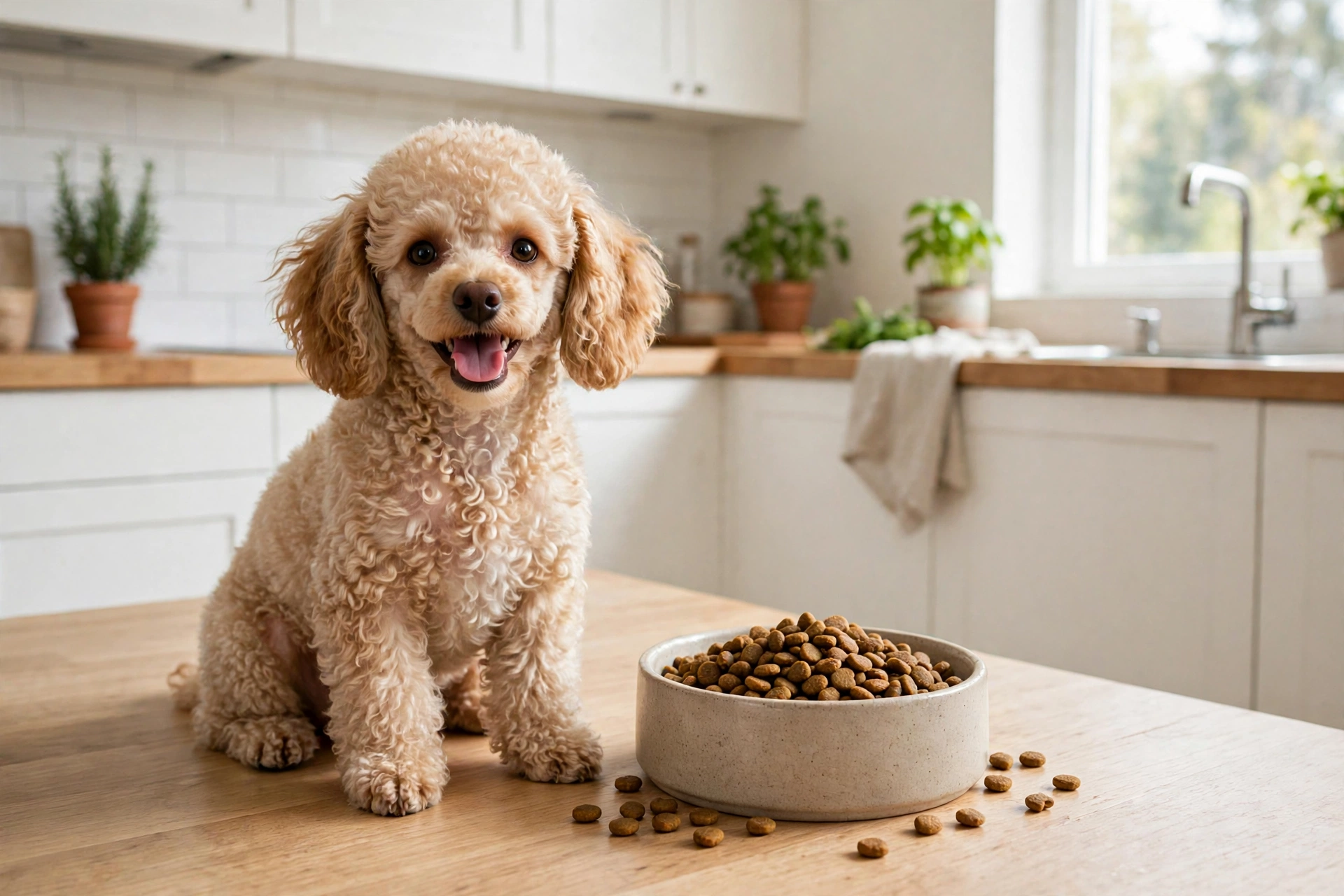
Best Puppy Food for Poodles: Size-split feeding for Toy, Miniature and Standard pups (6 Picks 2026)
Finding the best puppy food for poodles takes a little more thought than grabbing a generic puppy formula. Poodles come in three very different sizes: Toy, Miniature, and Standard, and a food that works for a 5-pound Toy puppy is not ideal for a Standard poodle puppy who may grow past 60 pounds. Pick the wrong formula and you risk everything from picky eating and soft stools to too-fast growth that stresses developing joints.
This guide covers exactly what makes poodle puppy feeding and diet different, six of the best puppy foods for poodles in 2026 for each size variety, a buying guide built on AAFCO puppy standards, and the feeding mistakes that trip up most new poodle owners. Everything below is based on ingredient analysis, brand reputation, and owner reviews, with practical, honest recommendations and no filler.
Key Takeaways
- Toy and Miniature poodle puppies need calorie-dense, small-kibble formulas with DHA for brain development; Standard poodle puppies need large-breed puppy formulas that control growth rate to protect joints.
- Royal Canin Poodle Puppy is the only breed-specific poodle puppy formula and the top pick for Toy and Miniature poodles up to 10 months.
- Look for an AAFCO statement for growth, a named animal protein first, and DHA from fish oil, so your poodle puppy gets the brain support and coat nourishment this breed needs.
- Poodle puppies eat 3 to 4 small meals a day. Toy puppies are prone to low blood sugar, so keep a young Toy eating on schedule, with no long gaps between meals.
- Skip adult formulas, generic ‘all breed’ growth advice, and abrupt food changes. A poodle puppy’s sensitive stomach reacts fast to all three, so a size-matched puppy formula and a slow switch are worth the extra care.
Quick Comparison: Our 6 Top Picks
| Product | Best For | kcal/cup | Protein / Fat | Price | Cost/month | Key Feature |
|---|---|---|---|---|---|---|
| Royal Canin Poodle Puppy Dry Dog Food | Best overall (Toy & Miniature) | 385 | 31% / 17% | $26.99 / 2.5 lb | Toy ~$51/mo; Mini ~$101/mo | Breed-specific kibble, prebiotics, EPA & DHA for coat |
| Hill’s Science Diet Puppy Small Paws | Best small-breed pick | 397 | 24% / 15% | $23.99 / 4.5 lb | Toy ~$32/mo; Mini ~$51/mo | DHA from fish oil, small kibble, high-quality chicken meal |
| Purina Pro Plan Small Breed Puppy | Best for sensitive digestion | 482 | 33% / 20% | $19.98 / 6 lb | Toy ~$8 to $31/mo; Mini ~$31 to $43/mo | Guaranteed live probiotics for gut health |
| Wellness Complete Health Small Breed Puppy | Best natural-ingredient option | 489 | 28% / 18% | $19.99 / 4 lb | Toy ~$21/mo; Mini ~$52/mo | Deboned turkey, no corn/wheat/soy, flaxseed omegas |
| Blue Buffalo Life Protection Small Breed Puppy | Best antioxidant support | 417 | 29% / 17% | $39.58 / 15 lb | Toy ~$10 to $15/mo; Mini ~$15 to $24/mo | LifeSource Bits with vitamins, minerals & antioxidants |
| Royal Canin Large Puppy Dry Dog Food | Best for Standard poodle puppies | 349 | 28% / 14% | $119.99 / 40 lb | ~$79/mo | Controlled calcium & phosphorus for steady joint growth |
Prices are Chewy prices checked November 14, 2026. Cost per month uses the feeding amounts in the portion tables below.
Royal Canin Poodle Puppy Dry Dog Food
Best overall, especially for Toy and Miniature poodle puppies.
Royal Canin is the only major brand that makes a puppy formula engineered specifically for poodles, and it shows up as the top recommendation in virtually every 2026 poodle food roundup for good reason. The formula targets purebred poodle puppies from 8 weeks to 10 months with an antioxidant complex (including vitamin E) to support immune development, EPA and DHA from fish oil for the curly coat poodles are famous for, and prebiotics plus highly digestible proteins to support healthy digestion and stool quality.
The standout is the kibble itself: small, rounded pieces designed for a poodle’s straight muzzle and jaw, making pickup and chewing easier, a real benefit for Toy poodles, who can struggle with oversized kibble. Adapted mineral levels support strong bones and joints during the rapid early-growth phase.
Who it’s for: Toy and Miniature poodle puppies up to 10 months. Not appropriate for Standard poodle puppies, who need a large-breed growth formula (see pick #6). Toy and Miniature poodles usually switch to adult food at 10 to 12 months.
Honest caveat: It’s premium-priced compared to general puppy formulas, and it comes in limited sizes. You’re paying for the breed-specific formulation, not a bigger bag. Pros: Only breed-specific formula, small kibble for a poodle’s muzzle, prebiotics and DHA for digestion and coat. Cons: Premium price and a small 2.5 lb bag, so it runs out fast.
Hill’s Science Diet Puppy Small Paws Chicken Meal & Rice
Best small-breed puppy pick.
Hill’s Science Diet Puppy Small Paws is its dedicated formula for small and miniature breed puppies. Chicken meal leads the ingredient list, giving a concentrated, highly digestible protein source for lean muscle development, while DHA from fish oil supports healthy brain and eye development, important for a breed as sharp as the poodle.
The kibble is sized for small jaws, and the formula includes a balanced blend of minerals for strong bones and teeth, which matters for Toy poodles: small breeds are prone to dental crowding, and a kibble that encourages real chewing helps. It carries the AAFCO statement for growth, so it meets the complete feeding and diet profile puppies need.
Who it’s for: Toy and Miniature poodle puppies whose owners want a science-backed formula from a brand with feeding-trial backing.
Honest caveat: It’s chicken-based, so it’s not the choice if your puppy already shows signs of a chicken sensitivity (itchy skin, chronic ear issues). Poodles are among the breeds most prone to chicken-related food reactions. Pros: Widely available, small kibble for small jaws, and feeding-trial backing, with DHA from fish oil. Cons: Chicken-based, so not for a puppy with a chicken sensitivity.
Purina Pro Plan Small Breed Puppy Chicken & Rice
Best for poodle puppies with sensitive digestion.
Poodles are genetically prone to sensitive stomachs, and Purina Pro Plan Small Breed Puppy addresses that head-on with guaranteed live probiotics in every bite, plus prebiotic fiber to support a healthy gut microbiome. Real chicken is the first ingredient, and the formula is fortified with DHA from fish oil for brain and vision development and calcium and phosphorus for growing bones and teeth.
What earns it a spot here: Purina Pro Plan is one of the few brands that conducts AAFCO feeding trials on its formulas rather than formulating by calculation alone, and owner reviews consistently report firmer stools and less gas in sensitive small-breed puppies. The nutrient density is tuned for small breeds’ fast metabolisms, important because Toy poodle puppies burn calories quickly and can’t afford to miss nutrients in small meals.
Who it’s for: Toy and Miniature poodle puppies with soft stools, gas, or generally touchy digestion. It is made for puppies expected to stay under 20 lb as adults, so it fits Toy and Miniature poodles but not a Standard.
Honest caveat: Like most mainstream formulas, it contains chicken and grains. That is fine for the vast majority of puppies, but it is not a limited-ingredient option if your puppy needs an elimination diet. Pros: Live probiotics for sensitive stomachs, AAFCO feeding trials, and firmer stools in owner reviews. Cons: Contains chicken and grains, so not a limited-ingredient option.
Wellness Complete Health Small Breed Puppy
Best natural-ingredient option.
Wellness Complete Health Small Breed Puppy leads with deboned turkey and chicken meal, skips corn, wheat, and soy entirely, and rounds out the formula with oatmeal, flaxseed, and salmon oil for omega-3 and omega-6 fatty acids that feed a poodle’s skin and curly coat from the inside out. DHA from salmon oil supports cognitive development, and the recipe includes probiotics and prebiotics for digestive health.
The ingredient panel reads cleaner than most mainstream puppy foods, with no artificial colors, flavors, or preservatives, and the protein comes from real animal sources rather than by-product meals.
Who it’s for: Owners who prioritize natural ingredients and want to avoid corn, wheat, and soy in their poodle puppy’s diet.
Honest caveat: Premium natural positioning means a higher price per pound than Purina or Hill’s, and the richer formula can be too much for some very sensitive stomachs, so transition slowly. Pros: Natural ingredients with no corn, wheat, or soy; deboned turkey first; salmon oil for the coat. Cons: Higher price per pound, and the richer formula can upset very sensitive stomachs.
Blue Buffalo Life Protection Formula Small Breed Puppy
Best antioxidant and immune support.
Blue Buffalo’s Life Protection Small Breed Puppy starts with deboned chicken, adds wholesome whole grains, garden veggies, and fruit, and includes the brand’s signature LifeSource Bits, a blend of antioxidants, vitamins, and minerals selected to support immune system health during the critical growth window. DHA and ARA (important fatty acids found in mother’s milk) support cognitive development and retinal health.
For poodle puppies, the small-breed kibble size and the high protein-to-calorie balance fit well: Toy and Miniature poodles need energy-dense food in small volumes because their stomachs are tiny but their metabolisms run hot. The formula is widely available across the US, in stores and online, which makes consistent feeding easy.
Who it’s for: Toy and Miniature poodle puppies, especially owners who want strong antioxidant and immune-system support in a widely available brand.
Honest caveat: Some puppies pick around the darker LifeSource Bits, and the brand has had more recipe-formula changes over the years than Hill’s or Purina. If your puppy thrives on it, buy consistently and watch for packaging changes. Pros: Widely available, small kibble, and antioxidant LifeSource Bits for immune support. Cons: Some puppies pick around the LifeSource Bits, and the brand has changed recipes over the years.
Royal Canin Large Puppy Dry Dog Food
Best for Standard poodle puppies.
This is the pick most general ‘poodle puppy’ roundups miss, and it matters: a Standard poodle puppy can grow from a few pounds to 40 to 70 pounds, and large-breed puppy formulas exist for a reason. Royal Canin Large Puppy is formulated with controlled levels of calcium and phosphorus to support steady, even skeletal growth. Too-rapid growth in large puppies is linked to developmental orthopedic problems, and Standards are already prone to hip issues.
The formula includes glucosamine and chondroitin precursors for joint support, an antioxidant complex for immune development, and highly digestible proteins with prebiotics for the poodle’s famously sensitive gut. Kibble is sized for larger jaws, encouraging the chewing that supports dental health.
Who it’s for: Standard poodle puppies expected to mature above ~50 pounds. Feed a large-breed puppy formula until around 18 months before transitioning to adult food.
Honest caveat: this one is not for Toy or Miniature poodle puppies. The calcium/phosphorus balance and calorie density are calibrated for large-breed growth, not small-breed metabolisms. Pros: Controlled calcium and phosphorus for steady growth, plus glucosamine and chondroitin for joints. Cons: Only for Standards, not for Toy or Miniature puppies, and premium-priced.
How Much to Feed Each Size
The five small-breed picks below are made for Toy and Miniature puppies, not for a Standard puppy. A Standard needs the large-breed pick in Table B. Amounts are for a 6-month-old puppy, taken from each bag’s own feeding table.
Table A: Toy and Miniature puppies (expected adult weight 10 to 15 lb)
| Product | kcal/cup | Daily feeding at 6 mo | Cost/month |
|---|---|---|---|
| Royal Canin Poodle Puppy | 385 | Toy (6.6 lb adult): ⅝ cup (69 g); Miniature (13 lb adult): 1¼ cups (126 g) | Toy ~$51/mo; Miniature ~$101/mo |
| Hill’s Science Diet Puppy Small Paws Chicken Meal & Rice | 397 | Toy (5 lb current): ⅞ cup/day; Miniature (10 lb current): 1⅜ cups/day (4 to 9 mo column) | Toy ~$32/mo; Miniature ~$51/mo |
| Purina Pro Plan Small Breed Puppy Chicken & Rice | 482 | Miniature (13 to 20 lb band, 4 to 6 mo): 1¼ to 1¾ cups; Toy (2 to 12 lb band): ⅓ to 1¼ cups | Toy ~$8 to $31/mo; Miniature ~$31 to $43/mo |
| Wellness Complete Health Small Breed Puppy | 489 | Toy (2 to 4 lb current): ½ cup/day; Miniature (9 to 12 lb current): 1¼ cups/day (5 to 7 mo column) | Toy ~$21/mo; Miniature ~$52/mo |
| Blue Buffalo Life Protection Formula Small Breed Puppy | 417 | Toy (4 to 8 lb current): ½ to ¾ cup/day; Miniature (9 to 14 lb current): ¾ to 1¼ cups/day (5 to 7 mo column) | Toy ~$10 to $15/mo; Miniature ~$15 to $24/mo |
Royal Canin Poodle Puppy cost uses about 10 cups per 2.5 lb bag, as Chewy’s Q&A states. Prices are Chewy prices checked November 14, 2026.
Table B: Standard puppies (expected adult weight 55 lb)
| Product | kcal/cup | Daily feeding at 6 mo (55 lb adult) | Cost/month |
|---|---|---|---|
| Royal Canin Large Puppy | 349 | 4⅛ cups/day (55 lb adult-weight row) | ~$79/mo |
At 6 months, the feeding tables on this page work out to roughly 160 to 600 kcal a day for a Toy poodle, 310 to 845 kcal a day for a Miniature, and about 1,440 kcal a day for a Standard at 55 lb adult weight. Those figures come from multiplying each pick’s cups per day by its kcal per cup, so the spread shows how the brands’ tables differ rather than a single target. The breed-specific Royal Canin Poodle Puppy sits in the middle at about 240 kcal a day for a Toy and about 480 for a Miniature. Use your own puppy’s weight and the bag’s guide, and adjust by the rib test.
Buying Guide: What to Look for in Poodle Puppy Food
Match the formula to the size variety. This is the single most important decision. Toy poodles (4 to 6 lbs adult) and Miniatures (10 to 15 lbs) need small-breed or toy-breed puppy formulas: calorie-dense, small kibble, DHA-rich. Standard poodles need large-breed puppy formulas with controlled mineral levels for joint-safe growth. One formula does not fit all three sizes.
Check the AAFCO statement. Every bag should carry a nutritional adequacy statement confirming the food is ‘formulated to meet the nutritional levels established by the AAFCO Dog Food Nutrient Profiles for growth’ (or ‘all life stages,’ which includes growth). This is your baseline quality filter, so skip any puppy food that lacks it. For the full calcium, DHA and AAFCO explainers, see our best puppy food for large breeds guide.
Named animal protein first. Look for a named meat or meat meal (chicken, turkey, lamb, salmon) as the first ingredient. “Meat meal” from a named source is a concentrated protein and perfectly fine; vague “meat by-products” or “animal digest” as the lead ingredient is a red flag.
DHA for brain development. DHA from fish oil supports brain and eye development in the puppy window. For the full explainer, see our best puppy food for large breeds guide.
Right protein and fat levels. AAFCO minimums for growth are 22.5% protein and 8.5% fat on a dry-matter basis, but quality puppy formulas for poodles typically run 28 to 32% protein and 15 to 20% fat. Higher protein supports lean muscle, and higher fat fuels the high energy of a growing puppy.
Digestive support. Given the breed’s sensitive stomachs, prebiotics, probiotics, and highly digestible proteins are genuine advantages, not marketing fluff. If your puppy has chronic soft stools on one quality food, a probiotic-fortified formula is worth trying before assuming an allergy.
For portion and schedule specifics by age, see our puppy feeding schedule guide and our best dog food for puppies roundup. Once your poodle matures, our best dog food for poodles guide covers adult formulas by size. For the later years, see our senior poodle food guide. Our Poodle feeding guide covers portions and schedules by size in more detail. If you also want a small-breed comparison, see our Best Puppy Food for Beagles and Best Puppy Food for French Bulldogs guides.
What to Avoid
Adult dog food for a growing puppy. Adult formulas lack the calorie density, DHA, and mineral balance puppies need. Feeding adult food through the growth phase can leave a poodle puppy undernourished at the exact moment its brain, bones, and immune system are developing.
A small-breed formula for a Standard puppy (and vice versa). The mineral and calorie profiles are genuinely different. A Standard puppy on toy-breed food risks developmental joint problems; a Toy puppy on large-breed food gets oversized kibble and the wrong nutrient balance.
Grain-free unless your vet advises it. The FDA continues to investigate a potential link between grain-free diets and dilated cardiomyopathy (DCM) in dogs. Poodles don’t need grain-free by default. Choose whole-grain-inclusive formulas unless a diagnosed grain allergy says otherwise.
Abrupt food switches. Poodles’ sensitive digestive tracts punish sudden changes with days of diarrhea. Transition over 7 to 10 days, starting with mostly the old food and gradually increasing the new.
Free-feeding a Toy poodle puppy. Scheduled, measured meals let you monitor appetite (a key health signal) and prevent both hypoglycemia from skipped meals and obesity from grazing. Toy puppies under 12 weeks should eat four small meals a day.
Your Poodle Puppy’s First Two Weeks: What to Feed
The first two weeks are not the time to find the perfect food. They are the time to keep feeding what your puppy already knows. Ask the breeder exactly what food your puppy was eating, buy a small bag of the same recipe, and feed it on the same schedule for the first week, even if you plan to switch later. A new home is stressful enough without a new food, and poodle puppies punish sudden changes with soft stools and skipped meals. If you do switch, start in week two and transition over 7 to 10 days, mixing a little more of the new food in each day.
For Toy puppies, the first weeks carry one extra rule: keep a young Toy eating on schedule, with no long gaps between meals. Toy poodle puppies under 12 weeks are prone to low blood sugar, so feed four small meals a day at regular times, keep a little food available if your puppy seems wobbly or unusually sleepy, and call your vet promptly rather than waiting it out. Measure every meal from day one. A kitchen scale or measuring cup beats guessing, and weigh your puppy weekly so you can see whether the portions are right. If stools stay loose for more than two weeks on a quality food, or your puppy stops eating, see your vet before trying another brand.
The Bottom Line
For most poodle puppies, Royal Canin Poodle Puppy is the best puppy food for poodles in 2026. It’s the only breed-specific formula, and its kibble design, digestive support, and coat-nourishing omegas are tailored to exactly what Toy and Miniature poodles need. If you prefer a mainstream brand, Hill’s Science Diet Puppy Small Paws is an excellent alternative, and Purina Pro Plan Small Breed Puppy is the one to try first for a sensitive stomach.
For a Standard, skip the small-breed bags entirely and go with Royal Canin Large Puppy for joint-safe growth. Match the formula to your poodle’s size, transition slowly, feed on a schedule, and check with your vet for your puppy’s specific needs, since this guide is for information only. When your puppy grows up, our best dog food for poodles guide covers adult formulas by size.
If you’re also shopping for a small-breed puppy outside the poodle family, our best puppy food for small breeds guide covers more options.
Frequently Asked Questions
What should I feed my poodle puppy in the first week?
Feed exactly what the breeder was feeding, on the same schedule, usually 3 to 4 small meals a day. Keep the same food for the first week while your puppy settles in, then switch gradually over 7 to 10 days if you want a different recipe. A sudden food change in week one is the most common cause of soft stools in new poodle puppies.
How do I know if my poodle puppy is eating enough?
Weigh your puppy weekly and use the rib test: you should feel the ribs easily under a thin layer of fat without seeing them. A puppy that finishes its measured meals, has firm stools, and gains weight steadily is eating enough. If a Toy puppy skips meals, seems wobbly, or is unusually sleepy, feed a small meal right away and call your vet. Young Toys are prone to low blood sugar.
What is the best puppy food for poodles?
Royal Canin Poodle Puppy is the top breed-specific pick for Toy and Miniature poodle puppies up to 10 months, with tailored kibble, prebiotics, and EPA and DHA for coat health. For Standard poodle puppies, a large-breed puppy formula like Royal Canin Large Puppy is the better choice because it controls growth rate to protect developing joints.
Should I feed my poodle puppy small-breed or large-breed food?
Match the formula to your poodle’s variety. Toy and Miniature poodle puppies need small-breed puppy formulas with small kibble and higher calorie density, while Standard poodle puppies need large-breed puppy formulas with controlled calcium and phosphorus for steady skeletal growth. Using the wrong size formula is one of the most common poodle feeding mistakes.
How much should I feed my poodle puppy?
Portions depend on size, age, and the food’s calorie content, so start with the feeding guide on the bag for your puppy’s current weight, then adjust so you can feel but not see the ribs. Toy poodle puppies may need only a quarter to three-quarters of a cup per day split into 3 to 4 meals, while Standard poodle puppies can need several cups daily. Weigh your puppy weekly and adjust as needed.
When should I switch my poodle puppy to adult food?
Toy and Miniature poodles can typically transition to adult food around 10 to 12 months, while Standard poodles should stay on puppy food until around 18 months. Transition gradually over 7 to 10 days to avoid digestive upset, which poodles are prone to.
3 Comments