
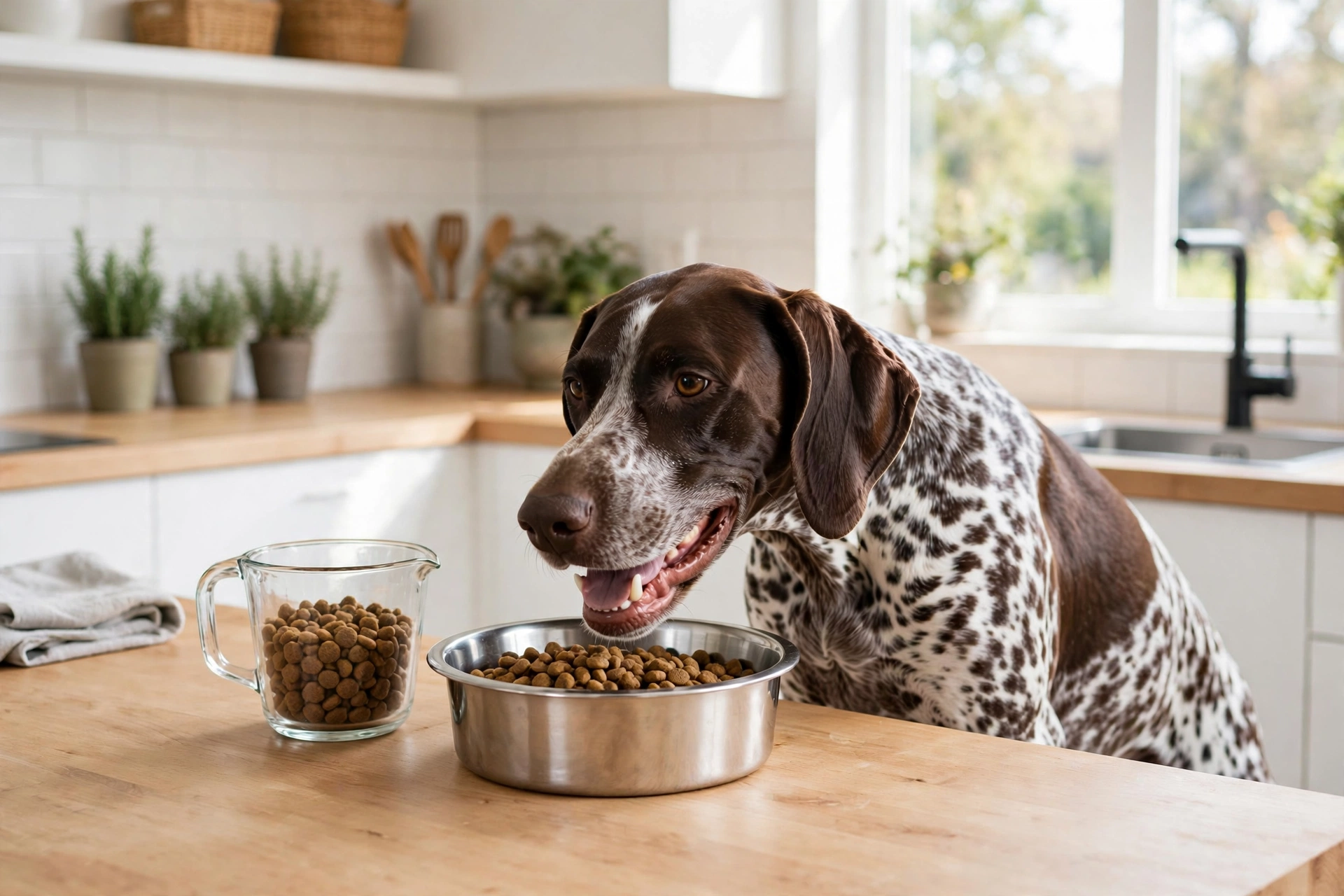
German Shorthaired Pointer Feeding Guide: How Much, How Often & What to Feed (2026)
If you live with a German Shorthaired Pointer, you already know the feeding question is never just “how much food?” These are lean, athletic, high-energy dogs, bred to run, point, swim, and hunt all day, and the amount they need on a quiet Tuesday at home can be very different from what they burn on a long Saturday hike or a day in the field. This German Shorthaired Pointer feeding guide pulls it all together: how much to feed at every life stage, how often to feed, what kind of food suits this breed best, and how to adjust when activity, weight, or age changes.
Use the charts below as a starting point, not a rigid prescription. Every GSP is different: a 45-pound female who mostly lounges between walks and a 70-pound male who trains for field trials do not eat the same amount, even if they eat the same food. The real skill is learning to read your dog’s body condition and adjust portions up or down from there. This guide is for information only. Check with your vet for your dog’s specific needs.
Quick Answer: An adult German Shorthaired Pointer eats 2 to 3.5 cups of dry food a day, split into two meals. Active dogs may need up to 4.5 cups, and puppies need 3 to 4 small meals a day. Pick a food with a named meat first, keep treats under 10% of daily calories, and wait an hour either side of exercise.
In This Guide
- Key Takeaways
- How Much Should a German Shorthaired Pointer Eat?
- How Often Should You Feed a German Shorthaired Pointer?
- What Should a German Shorthaired Pointer Eat?
- Feeding a Working or Highly Active GSP
- Switching Foods Without an Upset Stomach
- Bloat Safety: The Feeding Rule Every GSP Owner Should Know
- Treats, Training Rewards, and Weight Control
- How to Tell If the Amount Is Right
- Common German Shorthaired Pointer Feeding Mistakes
- Sample Daily Feeding Schedules
- Pros and Cons
- Conclusion
- Kibble, Raw, or Home-Cooked: Which Suits a GSP?
Key Takeaways
- Most adult German Shorthaired Pointers eat 2 to 3.5 cups of dry food per day, split into two meals, but active and working dogs may need up to 4.5 cups.
- Puppies need 3 to 4 small meals a day; adults do best on 2 meals; seniors usually stay on 2 smaller, joint-friendly meals.
- Feed for body condition, not just the bag: you should be able to feel your GSP’s ribs easily under a thin layer of fat and see a waist from above.
- Never feed right before or after vigorous exercise. Wait at least an hour either side to reduce bloat risk.
- Switch foods gradually over 7 to 10 days, and count training treats as part of the daily total (no more than 10% of calories).
How Much Should a German Shorthaired Pointer Eat?
Adult GSPs typically weigh 45 to 70 pounds (females 45 to 60 pounds, males 55 to 70 pounds) and most need roughly 1,500 to 2,200 calories a day at a normal, active-pet activity level. That usually translates to 2 to 3.5 cups of a standard dry food per day. Foods vary a lot in calorie density, though: a performance formula at 450 calories per cup feeds very differently from a light formula at 320 calories per cup, so always check the kcal per cup on your bag and do the math for your dog, not just your neighbour’s dog.
The charts below give typical daily amounts for a mid-calorie dry food (around 370 to 400 kcal per cup). If your food is much richer or lighter, adjust the cups so the calories stay in the same ballpark. And remember the golden rule of this whole guide: the chart gets you close, your dog’s body tells you the rest. Weigh your GSP monthly, or at least every few weeks, and adjust by about 10% at a time if weight is creeping up or down.
Puppy Feeding Chart (8 Weeks to 18 Months)
GSP puppies grow fast and burn a lot of energy doing it. They need a growth-formulated puppy food with controlled calcium and phosphorus for steady bone development, plus DHA for brain and eye development. Feed small, frequent meals: their stomachs are small and their energy needs are high.
| Age | Typical weight | Meals per day | Daily amount (dry food) |
|---|---|---|---|
| 8 to 12 weeks | 8 to 15 pounds | 4 | 1 to 1.5 cups |
| 3 to 4 months | 15 to 25 pounds | 4 | 1.5 to 2.5 cups |
| 5 to 6 months | 25 to 35 pounds | 3 | 2 to 3 cups |
| 7 to 9 months | 35 to 45 pounds | 3 | 2.5 to 3.5 cups |
| 10 to 12 months | 45 to 55 pounds | 2 to 3 | 3 to 4 cups |
| 13 to 18 months | 50 to 65 pounds | 2 | 3 to 4 cups |
Puppies under six months should eat three to four times a day. Around six months, most can drop to three meals, and by 12 months most are ready for two meals a day. Do not rush the switch: a puppy that wolfs one huge meal is more likely to get an upset stomach, and steady small meals support even growth. For food recommendations at this stage, see our guide to the best puppy food for German Shorthaired Pointers.
Adult Feeding Chart (18 Months to 7 Years)
Most adult GSPs settle into two meals a day (morning and evening), which keeps energy steady and makes portion control simple. Free-feeding (leaving food down all day) is a poor fit for this breed: GSPs are enthusiastic eaters, and it is far too easy for weight to creep up unnoticed when nobody is measuring.
| Adult weight | Moderately active (daily walks + play) | Highly active (running, hiking, training most days) |
|---|---|---|
| 45 pounds | 2 to 2.5 cups | 2.5 to 3.5 cups |
| 55 pounds | 2.5 to 3 cups | 3 to 4 cups |
| 65 pounds | 3 to 3.5 cups | 3.5 to 4.5 cups |
| 70+ pounds | 3.5 cups | 4 to 4.5 cups |
Notice how wide the range is. A GSP that gets an hour of walking plus garden play is a different animal, calorie-wise, from one that runs off-leash for two hours, swims, and trains. Start in the middle of the range for your dog’s weight and activity, then adjust after two to three weeks based on weight and body condition. If ribs disappear under a layer of fat, trim 10%. If ribs and hip bones are sharply visible, add 10%.
Senior Feeding Chart (8 Years and Older)
Many GSPs stay remarkably active into their senior years, so do not automatically cut food just because your dog turned eight. Metabolism does slow down, though, and joints appreciate a leaner frame, so seniors often need slightly fewer calories, with more emphasis on joint support and easy-to-digest protein.
| Senior weight | Daily amount (dry food) | Notes |
|---|---|---|
| 45 pounds | 2 to 2.5 cups | Split into 2 meals; watch weight monthly |
| 55 pounds | 2.5 to 3 cups | Look for glucosamine and omega-3s |
| 65 pounds | 3 to 3.5 cups | Reduce further only if weight rises |
| 70+ pounds | 3 to 3.5 cups | Keep protein up to protect muscle |
One common senior mistake is cutting protein along with calories. Older dogs actually need good-quality protein to hold on to muscle. What changes is the total calorie count, not the protein quality. If your senior GSP is still running and hiking, they may need just as much food as an adult. Let the scales and your hands, not the calendar, decide.
When your GSP reaches senior age, choose the best senior german shorthaired pointer food for age-appropriate nutrition and joint support.
How Often Should You Feed a German Shorthaired Pointer?
Frequency matters almost as much as amount, and it changes with age:
- Puppies under 6 months: 3 to 4 meals a day, spaced evenly through the day.
- Puppies 6 to 12 months: 3 meals a day, dropping to 2 as they approach adulthood.
- Adults: 2 meals a day, roughly 12 hours apart, for example, 7 a.m. and 6 p.m.
- Seniors: 2 meals a day; some older dogs with smaller appetites do better on 2 meals plus a small midday top-up, as long as the daily total stays the same.
Two meals beat one for this breed for a practical reason as well as a nutritional one: GSPs are a deep-chested breed with a known risk of bloat (gastric dilatation-volvulus), and one enormous meal (especially eaten fast) is a risk factor. Two moderate meals, eaten calmly, are the safer pattern. A slow-feeder bowl is worth trying if your GSP inhales food in under a minute; it slows eating, reduces gulping air, and makes mealtime last long enough to actually satisfy them.
What Should a German Shorthaired Pointer Eat?
A GSP’s food should be built around animal protein. Look for a named meat (chicken, turkey, lamb, beef, or fish) as the first ingredient, and a formula with at least 26 to 30% protein for adults, higher for puppies and performance dogs. Protein is what maintains that lean, muscular frame and repairs muscle after hard exercise. Our full rundown of formulas is in the guide to the best dog food for German Shorthaired Pointers.
Beyond protein, here is what to look for on the label:
- Healthy fats (14 to 20% for active adults): Fat is concentrated fuel for an athletic breed, and it carries the omega-3 and omega-6 fatty acids that support coat, skin, and joints. Fish oil and flaxseed are good sources.
- Digestible carbohydrates: Rice, oats, barley, and sweet potato give steady energy. Avoid formulas padded with unnamed fillers and long lists of by-products.
- Joint support: Glucosamine and chondroitin matter for a breed prone to hip dysplasia, especially once a dog is working hard or getting older.
- An AAFCO statement: The bag should state the food is complete and balanced for your dog’s life stage (growth, adult maintenance, or all life stages) under AAFCO profiles. This is the simplest quality check on any bag.
- Controlled calcium for puppies: Growth formulas should keep calcium and phosphorus in the right ratio for large-breed puppies. Too much calcium during rapid growth can stress developing joints.
Wet food, dry food, or a mix? All three can work. Kibble is convenient, easy to measure, and budget-friendly, which matters when a big active dog eats 3-plus cups a day. Wet food adds moisture and aroma, which helps picky eaters and older dogs, but it is more expensive per calorie and harder to measure precisely. Many GSP owners settle on a mix: kibble as the base with a spoonful or two of wet food as a topper. If you mix, do the calorie math: a topper is not free, and it still counts toward the daily total.
Feeding a Working or Highly Active GSP
This is where generic feeding guides fall short, because a pet GSP and a working GSP live in different calorie worlds. A dog that hunts, trials, runs canicross, or trains hard most days can need 30 to 50% more calories than the same dog on a rest week. Some working dogs need up to 3% of their ideal body weight in food per day during peak season.
The practical approach is to run two baselines: a normal-week portion and a hard-week portion. During hunting season or heavy training blocks, move toward the higher end of the adult chart, or switch to a performance formula with higher protein and fat (around 30% protein and 20% fat). On rest weeks, drop back to the maintenance amount. Do not keep feeding peak-season portions through a quiet month. That is exactly how a lean athlete quietly becomes an overweight dog.
Field days need their own timing plan. Feed a normal meal the evening before, then a smaller, easily digested meal at least two to three hours before work starts. Never a full meal right before hard exercise.
Switching Foods Without an Upset Stomach
GSPs can have sensitive stomachs, and a sudden food change is one of the most common causes of loose stools. Whether you are moving from puppy to adult food (usually around 12 to 14 months), switching brands, or moving between maintenance and performance formulas, take 7 to 10 days:
| Days | Old food | New food |
|---|---|---|
| 1 to 2 | 75% | 25% |
| 3 to 4 | 50% | 50% |
| 5 to 6 | 25% | 75% |
| 7 to 10 | 0% | 100% |
If stools loosen, hold at the current ratio for an extra day or two before moving on. If diarrhoea lasts more than a couple of days, or comes with vomiting, lethargy, or blood, stop and call your vet rather than pushing through. Our step-by-step plan is in how to change dog food safely.
Bloat Safety: The Feeding Rule Every GSP Owner Should Know
Bloat is the feeding topic that matters most for this breed, because deep-chested dogs like GSPs are at higher risk, and it can become an emergency fast. The signs (a swollen, tight belly, restlessness, pacing, drooling, and retching without bringing anything up) mean get to a vet immediately, day or night.
Feeding habits that reduce risk:
- Feed two smaller meals instead of one large one.
- Use a slow-feeder bowl if your dog eats very fast.
- Wait at least one hour after eating before vigorous exercise, and one hour after exercise before feeding.
- Avoid letting your dog gulp large amounts of water immediately after eating or hard exercise; offer smaller drinks instead.
- Keep meals calm: feed in a quiet spot, away from other dogs competing for food.
Older advice to raise food bowls off the floor is no longer generally recommended. Floor-level feeding is the usual default unless your vet advises otherwise for a specific reason.
Treats, Training Rewards, and Weight Control
GSPs are famously trainable, which means they earn a lot of treats, and that is a good thing, as long as treats stay within budget. The solution is to treat on purpose, not by accident. Set aside 10% of the daily food for training rewards, and use treats mainly for new or difficult skills. On heavy training days, switch to tiny, low-calorie rewards (small pieces of kibble from the daily ration, cucumber, carrot, or apple slices) so you can reward generously without overfeeding.
For a full training-treat strategy, see our guide to puppy feeding schedules, which covers how meal timing and treat budgeting work together in the early months. The same principle applies for life: if treats go up, meals come down by the same amount.
How to Tell If the Amount Is Right
Forget chasing a perfect number on the bag. These checks tell you more than any chart:
- The rib test: Run your hands along your dog’s sides. You should feel ribs easily under a thin fat covering, without pressing hard. If you cannot feel them, portions are too big. If they are sharply prominent with visible hip bones, portions are too small.
- The waist test: Look down at your dog from above. There should be a visible waist behind the ribs, and a tucked-up belly from the side.
- The stool test: Consistently firm, well-formed stools usually mean the amount and food suit your dog. Chronically soft stools can mean overfeeding, a too-rich food, or a food change done too fast.
- The energy test: A well-fed GSP is alert, keen, and holds weight steady on its current exercise. Lethargy plus weight loss deserves a vet visit, not just a bigger bowl.
Weigh your dog monthly and keep a simple note of the number. A gain or loss of more than 5% of body weight in a month is worth a vet conversation, especially if appetite or energy has changed too.
Common German Shorthaired Pointer Feeding Mistakes
- Feeding the bag, not the dog: Bag guides are averages for average dogs. GSPs are rarely average: adjust for activity, metabolism, and body condition.
- Free-feeding: Food left down all day makes portions invisible and weight gain silent. Measure every meal.
- Ignoring treats: Training rewards, chews, table scraps, and toppers all count. If weight creeps up, treats are the first place to look.
- Feeding around exercise the wrong way: A full meal right before a run, or a huge meal the moment a hot dog gets home, raises bloat risk and stomach upset.
- Switching foods overnight: Sudden changes cause most diet-related diarrhoea. Take the full 7 to 10 days.
- Cutting protein for seniors: Older dogs need quality protein to keep muscle. Cut calories if needed, not protein quality.
- Forgetting water: Fresh water should be available all day, especially after exercise and in warm weather. High-moisture foods help, but they do not replace the water bowl.
Sample Daily Feeding Schedules
Adult pet GSP (55 pounds, daily walks plus play): 7 a.m.: 1.5 cups kibble with a spoonful of wet topper; 6 p.m.: 1.5 cups kibble; training treats from the daily allowance during the day; fresh water always available.
Active adult GSP (65 pounds, running and training most days): 7 a.m.: 2 cups performance kibble; midday: small training rewards only; 6 p.m.: 2 cups performance kibble; no exercise for an hour either side of meals.
GSP puppy (4 months, 20 pounds): 7 a.m., 12 p.m., 5 p.m., and 8 p.m.: roughly 0.5 to 0.75 cups of puppy food at each meal, totalling 2 to 2.5 cups for the day, with the last meal a few hours before bedtime.
Pros and Cons
Feeding a GSP well comes down to matching food to activity. Here is the honest balance.
Pros
- Two measured meals a day keep a fast, deep-chested breed fed without the bloat risk of one huge meal.
- Charts by age, weight, and activity take the guesswork out of portions.
- A protein-first food supports muscle for a breed that runs, points, and swims all day.
- A set schedule makes training treats easy to count and keeps weight in check.
Cons
- Activity swings wildly from a quiet day at home to a day in the field, so portions need constant adjusting.
- A deep-chested build means bloat is a real risk, and meal timing has to be planned around exercise.
- Training treats add up fast on a breed that earns a lot of rewards.
- Puppies grow fast, so calcium and portion mistakes during growth can stress developing joints.
Conclusion
Feeding a German Shorthaired Pointer well comes down to a simple system: start with the chart for your dog’s age and weight, split food into two calm meals (three or four for puppies), choose a protein-first food with an AAFCO statement, and then adjust by body condition and activity, up in hard training blocks, down in quiet weeks. Respect the bloat rules around exercise, switch foods slowly, and keep treats inside their 10% budget. Do that consistently, and your GSP gets what this breed needs most from its food: steady energy, a lean muscular frame, and a stomach that stays settled. This guide is for information only. Check with your vet for your dog’s specific needs.
Kibble, Raw, or Home-Cooked: Which Suits a GSP?
Most GSP owners feed kibble, and for good reason. A good kibble is complete and balanced, it keeps well on the shelf, and it makes portion control simple, which matters for a breed that eats a lot and trains hard. Wet food works well as a topper, and this guide already covers that mix. Raw feeding has its fans, and some owners like the fresh meat and high moisture content. It also carries real risks: raw meat can carry bacteria that affect your dog and your household, and a raw diet that is not planned well can miss key nutrients. Home-cooked food has the same problem in a different shape. Cooking for a large, high-energy breed takes real planning, and a well-meaning homemade diet can leave gaps unless a vet or a veterinary nutritionist helps plan it. For most GSP owners, a high-quality kibble is the simplest safe choice. If you want to try raw or home-cooked food, talk to your vet first and plan the switch the same slow way this guide describes, over 7 to 10 days.
How much food should a German Shorthaired Pointer eat each day?
Most adults eat 2 to 3.5 cups of dry food per day, split into two meals, totalling roughly 1,500 to 2,200 calories. Highly active or working dogs may need up to 4.5 cups. Always adjust for your dog’s weight, activity, and body condition.
How often should I feed my German Shorthaired Pointer?
Puppies under six months need 3 to 4 small meals a day, puppies 6 to 12 months need 3 meals, and adults and seniors do best on 2 meals a day, roughly 12 hours apart.
When should a German Shorthaired Pointer puppy switch to adult food?
Usually around 12 to 14 months of age. Switch gradually over 7 to 10 days, mixing increasing amounts of the new food with decreasing amounts of the old food to avoid stomach upset.
How many calories does a German Shorthaired Pointer need?
Most adults need about 1,500 to 2,200 calories a day at a normal active-pet level. Working dogs in hunting season or heavy training may need 30 to 50 percent more, so adjust portions seasonally.
How can I reduce bloat risk when feeding my GSP?
Feed two smaller meals instead of one large meal, use a slow-feeder bowl if your dog eats very fast, and wait at least one hour after eating before vigorous exercise and one hour after exercise before feeding.
What should I look for in a German Shorthaired Pointer food?
A named animal protein as the first ingredient, at least 26 to 30 percent protein for adults, healthy fats, joint support such as glucosamine, and an AAFCO statement confirming the food is complete and balanced for your dog’s life stage.
Can I feed my German Shorthaired Pointer once a day?
It is not recommended. One large meal is harder on digestion and raises bloat risk in this deep-chested breed. Two moderate meals a day are safer and keep energy steadier.
How much water does a German Shorthaired Pointer need?
Fresh water should be available all day, especially after exercise and in warm weather. During hard work, offer small drinks often rather than letting a hot, tired dog gulp a huge bowl at once.
Can I feed my German Shorthaired Pointer a raw diet?
Yes, some owners do, but raw feeding carries a risk of bacterial contamination and nutritional gaps if the diet is not planned well. A high-quality kibble is the simpler safe choice for most owners. If you want to try raw food, talk to your vet or a veterinary nutritionist first and switch over 7 to 10 days.
Can German Shorthaired Pointers eat a grain-free diet?
Yes, if the food is complete and balanced, but most GSPs do not need a grain-free diet unless a vet has found a grain allergy or intolerance. The FDA has looked into a possible link between some grain-free diets high in legumes and a heart condition called DCM, so a food with healthy whole grains like oatmeal or brown rice is often the safer choice. Ask your vet before going grain-free.


3 Comments