
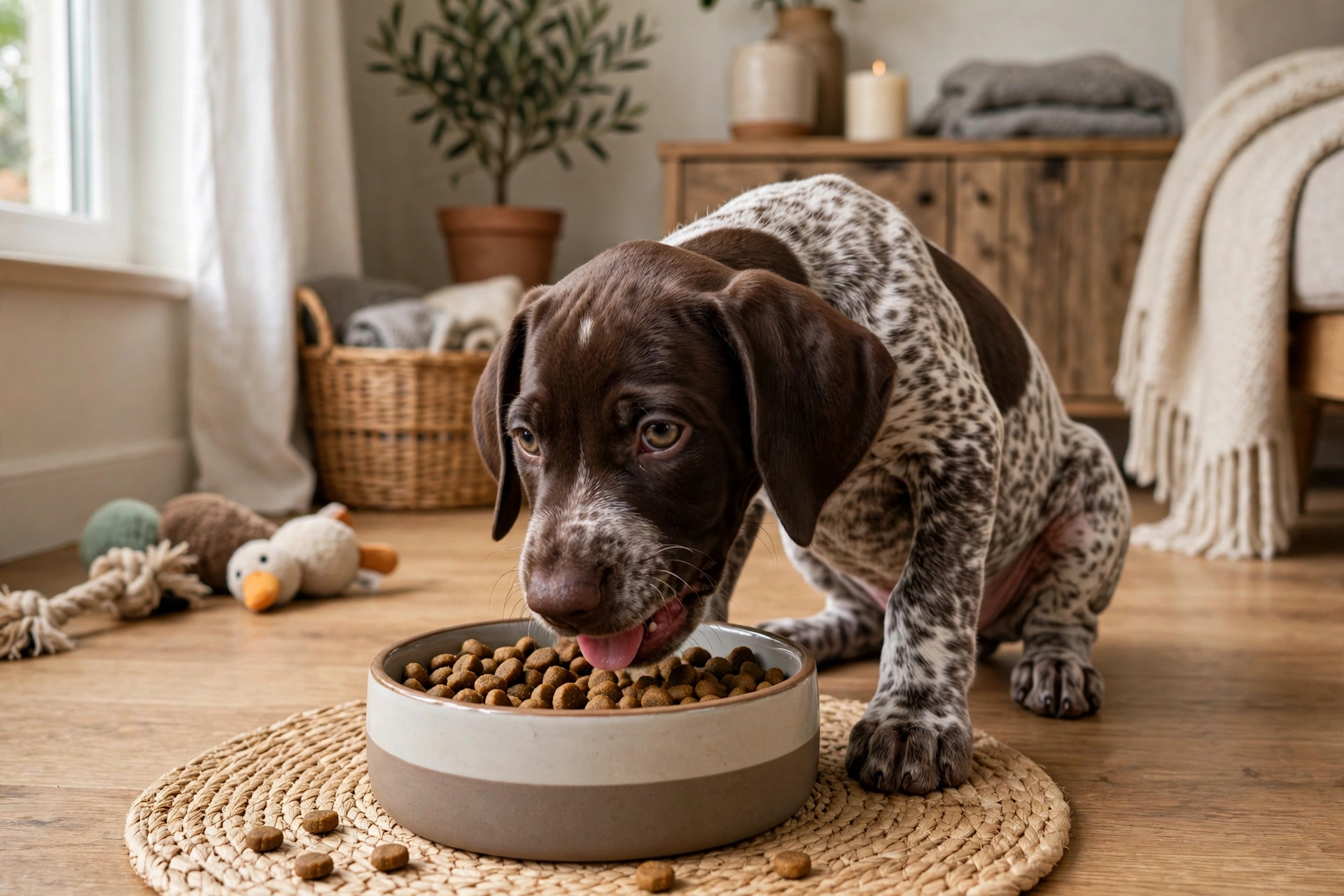
Best Puppy Food for German Shorthaired Pointers: Feeding a lean field athlete (6 Picks 2026)
A German Shorthaired Pointer puppy is a small athlete in training. From their first clumsy weeks to a sleek, field-ready first year, these pups grow fast, burn enormous energy, and build the lean muscle and strong bones that will carry them through a lifetime of running, hunting, and play. Feeding the best puppy food for German Shorthaired Pointers during that first year is not just about filling a bowl. It is about giving those growing bones, joints, brain, and muscles exactly the right fuel in the right proportions, dense enough to power a full day in the field without pushing growth too fast. If you want the big picture first, start with our guide to the Best Puppy Food for Large Breeds, then come back here for the GSP-specific picks.
This guide walks you through what makes a great puppy food for German Shorthaired Pointers: the protein, fat, calcium, and DHA levels that matter most, which specific US-available products stand out based on ingredient analysis, brand reputation, and owner reviews, and how to avoid the feeding mistakes that can slow or uneven growth. If you’re also planning for the long term, check out our companion guide to the best dog food for German Shorthaired Pointers for what comes after puppyhood.
Key Takeaways
- Feed a puppy-specific or all-life-stages formula with 25 to 32% protein, 15 to 20% fat, and DHA for brain and eye development.
- Keep the calcium-to-phosphorus ratio between roughly 1.1:1 and 1.4:1. Too much calcium can disrupt bone growth in fast-growing puppies.
- Look for a named meat protein (chicken, salmon, duck, lamb) at the top of the ingredient list, and skip foods built on corn, wheat, soy, or unnamed “meat by-products.”
- Most GSP puppies do best on three measured meals a day until about six months, then two meals daily.
- Our overall pick is the grain-free Open Farm Puppy (Chicken and Salmon) for its triple-protein blend and joint-supporting collagen, with Fromm Gold Holistic Puppy a close runner-up for steady, controlled growth.
Comparison Table: Top Picks at a Glance
| Product | Best For | kcal/cup | Price | Daily feeding | Cost/month |
|---|---|---|---|---|---|
| Open Farm Puppy (Grain-Free Chicken & Salmon) | Best overall | 462 | $93.99 / 22 lb (Open Farm, 2026-11-14) | ~3½ cups/day | ~$118/mo |
| Fromm Gold Holistic Puppy Dry Dog Food | Best for steady, controlled growth | 420 | $60.99 / 30 lb (Healthy Pet Austin, 2026-11-13) | ~3⅛ cups/day | ~$46/mo |
| Taste of the Wild Pacific Stream Puppy Formula | Best fish-based pick | 408 | $59.99 / 28 lb (Chewy, 2026-11-14) | ~3½ cups/day | ~$56/mo |
| Annamaet Ultra 32% | Best for high-energy puppies | 547 | $134.99 / 40 lb (Chewy, 2026-11-14) | Cannot compute | Cannot compute |
| Purina Pro Plan Large Breed Puppy Chicken & Rice | Best large-breed puppy formula | 419 | $74.98 / 34 lb (Chewy, 2026-11-14) | ~4.46 cups/day | ~$69/mo |
| Hill’s Science Diet Puppy Large Breed Chicken & Brown Rice Recipe | Best for easy digestion | 391 | $78.99 / 27.5 lb (Chewy, 2026-11-14) | ~3⅝ cups/day | ~$73/mo |
Prices checked 2026-11-14 on Chewy unless noted (Open Farm at the brand store, Fromm at Healthy Pet Austin, checked 2026-11-13). Daily feeding is for a 6-month-old puppy expected to reach 57 lb as an adult. One food you will not see here is a fresh option: Ollie and Farmer’s Dog price their plans per dog, so there is no fixed bag price or kcal/cup to compare like-for-like, and we did not want to guess.
Open Farm Puppy
Open Farm’s puppy formula earns the top spot because it was built with the exact things a growing sporting puppy needs: plenty of high-quality protein from multiple animal sources, joint-supporting nutrients, and clean, traceable ingredients. The variant we picked is the grain-free Chicken and Salmon recipe at 462 kcal/cup. It combines chicken, pork, and salmon, a purposeful three-protein blend that gives developing muscles a broad amino acid profile, and that density is what lets a lean field puppy fuel a full day of work without a mountain of kibble.
Key ingredients: Human-grade chicken, pork, and salmon lead the recipe, supported by non-GMO fruits and vegetables, pumpkin and chicory root as prebiotic fiber, and added collagen to support healthy joint development. That matters for a breed that will spend its life on the move.
Who it’s for: Owners who want a premium puppy food with transparent sourcing and are happy to pay more for human-grade ingredients. The triple-protein design may also help a puppy that seems sensitive to a single-protein diet.
Honest note: It’s pricier than conventional kibble, and fresh-leaning formats require consistent stock. But based on ingredient quality, brand reputation, and owner reviews, it’s the strongest all-round choice for a GSP pup.
Fromm Gold Holistic Puppy Dry Dog Food
Fromm Gold Holistic Puppy is a classic for a reason. GSPs are medium-large puppies that grow rapidly, and growing too fast is one of the real risks of the breed. Excess calcium and overly rich formulas can disrupt bone development. Fromm’s puppy formula keeps protein (27%) and fat (18%) at moderate levels with correct calcium-to-phosphorus ratios, encouraging puppies to grow slowly and evenly.
Key ingredients: Duck, chicken meal, chicken, oatmeal, and pearled barley, with no corn, wheat, or soy. DHA-rich salmon oil supports brain and eye development, and the family-owned brand is known for careful ingredient sourcing.
Who it’s for: GSP owners who want a balanced, not overly rich puppy food that supports healthy, not maximum-speed, growth. At 420 kcal/cup, it feeds generously without overloading calories.
Honest note: It contains grains (oatmeal, barley), so skip it if your vet has advised grain-free for allergy reasons. For most GSP puppies, though, these gentle grains digest well. It is also the cheapest pick in this list by cost per month, at about $46, though you will buy it from an independent pet store, since Chewy does not stock Fromm.
Taste of the Wild Pacific Stream Puppy Formula
If your puppy has itchy skin or a sensitive stomach, a fish-based formula can be a smart move. The Pacific Stream Puppy formula leads with real smoked salmon and ocean fish meal, delivering omega-3 and omega-6 fatty acids that support healthy skin and a glossy coat.
Key ingredients: Salmon, ocean fish meal, sweet potatoes, peas, and pea flour. It’s grain-free, free of corn, wheat, soy, and gluten, and includes Taste of the Wild’s proprietary K9-strain probiotics plus antioxidants from fruits and vegetables.
Who it’s for: Puppies with skin sensitivities or digestion issues, and owners who prefer a grain-free puppy food. At 27% protein and 15% fat, the nutrient levels are well matched to steady growth.
Honest note: Grain-free formulas aren’t automatically better for every puppy. Some dogs do great on grains. Choose grain-free if your puppy actually shows signs of grain sensitivity rather than on principle alone.
Annamaet Ultra
Some GSP puppies seem to run on jet fuel from eight weeks old. Annamaet Ultra is an all-life-stages formula designed for exactly that kind of dog: 32% protein and a calorie-dense 547 kcal/cup, built to keep up with performance puppies. The real advantage for GSP owners is longevity. Because it’s formulated for all life stages with a proper calcium-to-phosphorus ratio for growing puppies, you can keep feeding it straight into adulthood. One honest flag: Annamaet’s current AAFCO statement excludes growth of large-size dogs (70 lb or more as an adult). A GSP expected to mature under 70 lb is fine on it, but a 70 lb male sits right at the top of that exclusion, so read the bag and check with your vet before you commit.
Key ingredients: Chicken meal, brown rice, chicken fat, whole dried eggs, and herring meal. Annamaet uses algae as an omega-3 source for skin, coat, and heart health, plus DHA for brain development. The chicken is raised free of antibiotics.
Who it’s for: Very active GSP puppies that struggle to hold weight on standard formulas, and owners who like the simplicity of one food from puppyhood through adulthood.
Honest note: The calorie density is high, so measuring portions carefully matters. It’s easy to overfeed. Very high energy needs call for this; a calm couch-leaning pup may not.
Purina Pro Plan Large Breed Puppy Chicken & Rice
GSPs sit right on the medium-large borderline, and many owners (and vets) prefer a large-breed puppy formula for them because of the carefully controlled calcium and phosphorus levels. Purina Pro Plan’s Large Breed Puppy formula is one of the most widely fed large-breed puppy foods in the US for exactly this reason: it’s built to support controlled growth in big-framed puppies.
Key ingredients: Real chicken first, with rice as a gentle, digestible carbohydrate, plus DHA from fish oil for brain and vision development and antioxidants for immune support.
Who it’s for: GSP owners who want the peace of mind of a major-brand large-breed puppy formula with balanced minerals for a rapidly growing skeleton. It’s also one of the more budget-friendly picks here.
Honest note: It contains chicken and grains. Not ideal if your puppy has shown a chicken sensitivity, which some puppies do. Watch for itchy skin or loose stools during the first weeks.
Hill’s Science Diet Puppy Large Breed Chicken & Brown Rice Recipe
Some puppies just have fussy stomachs, and forcing a rich formula on a sensitive gut helps nobody. Hill’s Science Diet Puppy Large Breed is designed to be highly digestible while still delivering the balanced minerals and controlled calcium a growing large puppy needs. It’s a steady, no-drama choice backed by feeding-trial formulation.
Key ingredients: Chicken and brown rice lead the recipe, with natural DHA from fish oil, balanced minerals for strong bones and teeth, and a vitamin/antioxidant blend for immune support.
Who it’s for: Puppies with sensitive digestion, first-time owners who want a straightforward, widely available formula, and anyone whose vet leans toward feeding-trial-backed foods.
Honest note: Ingredient purists will find the label less exciting than premium boutique brands. But digestibility and consistent feeding results are where this food earns its keep.
Buying Guide: What to Look for in GSP Puppy Food
German Shorthaired Pointers grow into 45 to 70 lb athletic adults, and their puppy year is when the foundation gets laid. Here is what to prioritize on the label. For the general large-breed background on calcium, DHA, and AAFCO rules, see our Best Puppy Food for Large Breeds guide.
- Protein from named sources (25 to 32%): Chicken, salmon, duck, lamb. Real, identifiable animal proteins should lead the ingredient list. Avoid unnamed “meat by-products.”
- Moderate fat (15 to 20%): Enough to fuel a high-energy pup, but excessive fat can push growth too fast in large frames.
- Calcium-to-phosphorus ratio around 1.1:1 to 1.4:1: This is the sleeper spec for GSP puppies. Too much calcium disrupts bone and cartilage development just as reliably as too little. Large-breed puppy formulas are built around this.
- DHA for brain and eyes: Look for DHA from fish oil or algae. It supports brain and vision development during the critical first months.
- Joint support: Glucosamine, chondroitin, or collagen help a breed whose joints will take a lifetime of impact.
- Probiotics and fiber: Some puppies have sensitive stomachs; prebiotic fiber and live probiotics help keep digestion settled.
- AAFCO statement for growth: The label should say the food is “formulated to meet the nutritional levels established by the AAFCO Dog Food Nutrient Profiles for growth” (or “all life stages”). If you’re unsure how to read these statements, our guide on how to read dog food labels breaks it down line by line.
Feeding amounts matter as much as the formula. Start with our puppy feeding schedule to get portions and meal frequency right. Most GSP puppies do best on three measured meals a day until about six months, then two.
Amounts are for a 6-month-old puppy expected to reach 57 lb as an adult, with current weight assumed at about 35 lb where the label feeds by current weight. For the full schedule, see our German Shorthaired Pointer Feeding Guide. Multiply daily cups by kcal/cup and you get the day’s energy: on these foods a 6-month-old GSP lands between about 1,300 and 1,900 kcal a day, which is why comparing foods by cups alone misleads. The label amounts run a little higher than the roughly 1,250 kcal a day often quoted for GSP puppies, because each food’s cup carries a different amount of energy, so use body condition, not the cup count, as the final check.
| Food | kcal/cup | Daily amount | Daily calories | Cost/month |
|---|---|---|---|---|
| Open Farm Puppy (Grain-Free Chicken & Salmon) | 462 | ~3½ cups/day | ~1,617 kcal/day | ~$118/mo |
| Fromm Gold Holistic Puppy | 420 | ~3⅛ cups/day | ~1,313 kcal/day | ~$46/mo |
| Taste of the Wild Pacific Stream Puppy | 408 | ~3½ cups/day | ~1,428 kcal/day | ~$56/mo |
| Annamaet Ultra 32% | 547 | Cannot compute | Cannot compute | Cannot compute |
| Purina Pro Plan Large Breed Puppy Chicken & Rice | 419 | ~4.46 cups/day | ~1,869 kcal/day | ~$69/mo |
| Hill’s Science Diet Puppy Large Breed Chicken & Brown Rice | 391 | ~3⅝ cups/day | ~1,417 kcal/day | ~$73/mo |
What to Avoid
- Excess calcium or unbalanced minerals: Supplementing calcium or feeding adult food with unknown mineral ratios is one of the fastest ways to cause skeletal problems in growing puppies.
- Adult dog food for a growing GSP puppy: Adult formulas lack the protein density, DHA, and mineral balance puppies need. If you prefer one bag for life, choose a true all-life-stages formula, not a maintenance adult food.
- Vague ingredients: “Meat and bone meal,” “animal digest,” and unnamed fats tell you nothing about quality. Named sources only.
- Extreme protein or fat levels: More is not always better. Very high protein and fat formulas can accelerate growth in a breed that is already growing fast, and that extra speed is the last thing developing joints need.
- Corn, wheat, and soy as primary ingredients: Cheap fillers that add little nutritional value and are common triggers for itchy skin and digestive upset in some puppies.
- Sudden food switches: Transition any new food over 7 to 10 days. Some puppies get digestive upset when diet changes happen overnight.
When to Switch Your GSP Puppy to Adult Food
Most German Shorthaired Pointers should stay on puppy food until they are 12 to 14 months old, though very large or late-maturing individuals can benefit from staying on it up to 18 months. GSPs reach their adult height around 12 months and keep filling out through about 18 months, and their growth plates do not close until 18 to 24 months, so puppy formulas keep delivering the balanced minerals and higher protein their developing bodies need. When you do switch, transition gradually over 7 to 10 days by mixing increasing amounts of the adult food into the puppy food, and reassess portions with your vet. An adult GSP’s calorie needs shift as growth slows and activity settles into a routine.
Feeding a GSP Puppy That Trains and Runs All Day
A German Shorthaired Pointer puppy is not a couch puppy, and its feeding routine should not look like one. These pups burn enormous energy in training and play, so their calorie needs swing with activity: a puppy in regular field work or long daily runs needs noticeably more food than the same puppy on a quiet week, and the bag’s feeding chart, written for an average puppy, will underestimate the busy weeks and overfeed the quiet ones. Start from the chart, then adjust by body condition every week or two. You should be able to feel the ribs easily without seeing them. If the ribs start to show, add a little food; if they vanish under a layer of fat, cut back a little, whatever the chart says.
Timing matters as much as quantity for this deep-chested breed. Skip a full meal right before hard exercise or training, and wait at least an hour after a meal before running or working your puppy. A full stomach plus hard movement is the classic setup for bloat in a deep-chested breed like the GSP. Split the day’s food into three measured meals until about six months, then two, rather than one large bowl, and keep fresh water available at all times, especially after exercise. Training treats count as food, not free extras: measure out a small portion of the day’s kibble to use as training rewards, or keep pea-sized treats inside the 10% treat budget. On a 1,400 kcal day, 10% is about 140 kcal of treats, so a heavy training day does not quietly become an overfeeding day. Field-trial and hunting-line puppies run hotter than show-line pups and often need the top of the feeding range. If that sounds like your puppy, compare the Purina Pro Plan Large Breed Puppy and Annamaet Ultra rows in the table above first. If your puppy struggles to hold weight on a standard formula despite measured portions, talk to your vet before switching to a richer food. Very high-calorie formulas can push a fast-growing puppy to grow too quickly, which is the opposite of what those developing joints need.
Conclusion
Feeding a German Shorthaired Pointer puppy well comes down to three things: quality animal protein, carefully balanced calcium and phosphorus, and enough, but not excessive, calories to support steady growth. Open Farm Puppy is our overall pick for its triple-protein blend and joint-supporting collagen, while Fromm Gold Holistic Puppy is the best choice if you want deliberately moderate, slow-and-steady growth for a big-framed pup. Whatever you choose, measure portions, watch your puppy’s body condition, and adjust with your vet’s guidance as those lanky legs fill out. When your puppy grows up, our guide to the best dog food for German Shorthaired Pointers picks up where this one leaves off, and if you are comparing breeds, the German Shepherd and Australian Shepherd puppy guides use the same label-first approach.
This guide covers feeding, not medical advice. For anything about your GSP puppy’s health, your vet is the right call.
When your puppy reaches senior age, choose the best senior german shorthaired pointer food for age-appropriate feeding and diet and joint support.
Frequently Asked Questions
When should I feed my GSP puppy around exercise and training?
Skip a full meal right before hard exercise, and wait at least an hour after a meal before running or training. A full stomach plus hard movement raises bloat risk in this deep-chested breed.
How much should I feed my German Shorthaired Pointer puppy?
Most GSP puppies need roughly 1,250 calories a day, usually split into three measured meals until about six months old, then two meals daily. Always start with the feeding guide on the bag, then adjust based on your puppy’s body condition. You should be able to feel (but not see) their ribs. Ask your vet to confirm portions at each growth check.
When should I switch my GSP puppy to adult food?
Most German Shorthaired Pointers can transition between 12 and 14 months, though late-maturing pups may stay on puppy food until 18 months. Switch gradually over 7 to 10 days to avoid digestive upset. Your vet can confirm timing based on your dog’s size and growth rate.
Do German Shorthaired Pointer puppies need large-breed puppy food?
Many owners and vets choose large-breed puppy formulas for GSPs because they control calcium and phosphorus levels for growing big frames. Since GSPs grow fast and reach 45 to 70 pounds, a large-breed or carefully balanced puppy formula helps prevent too-rapid skeletal growth.
Why does the calcium-to-phosphorus ratio matter for GSP puppies?
The right ratio (roughly 1.1:1 to 1.4:1) supports healthy bone and cartilage development. Too much calcium can cause skeletal problems just as easily as too little, so skip calcium supplements on top of a balanced puppy food. This is one reason large-breed puppy formulas are popular for GSPs.
How often should I feed my GSP puppy each day?
Three meals a day until about six months old, then two meals daily. GSPs are a deep-chested breed, so bloat risk is worth taking seriously. Split food into smaller meals, wait at least an hour after meals before exercise, and avoid feeding right after hard play.


4 Comments