
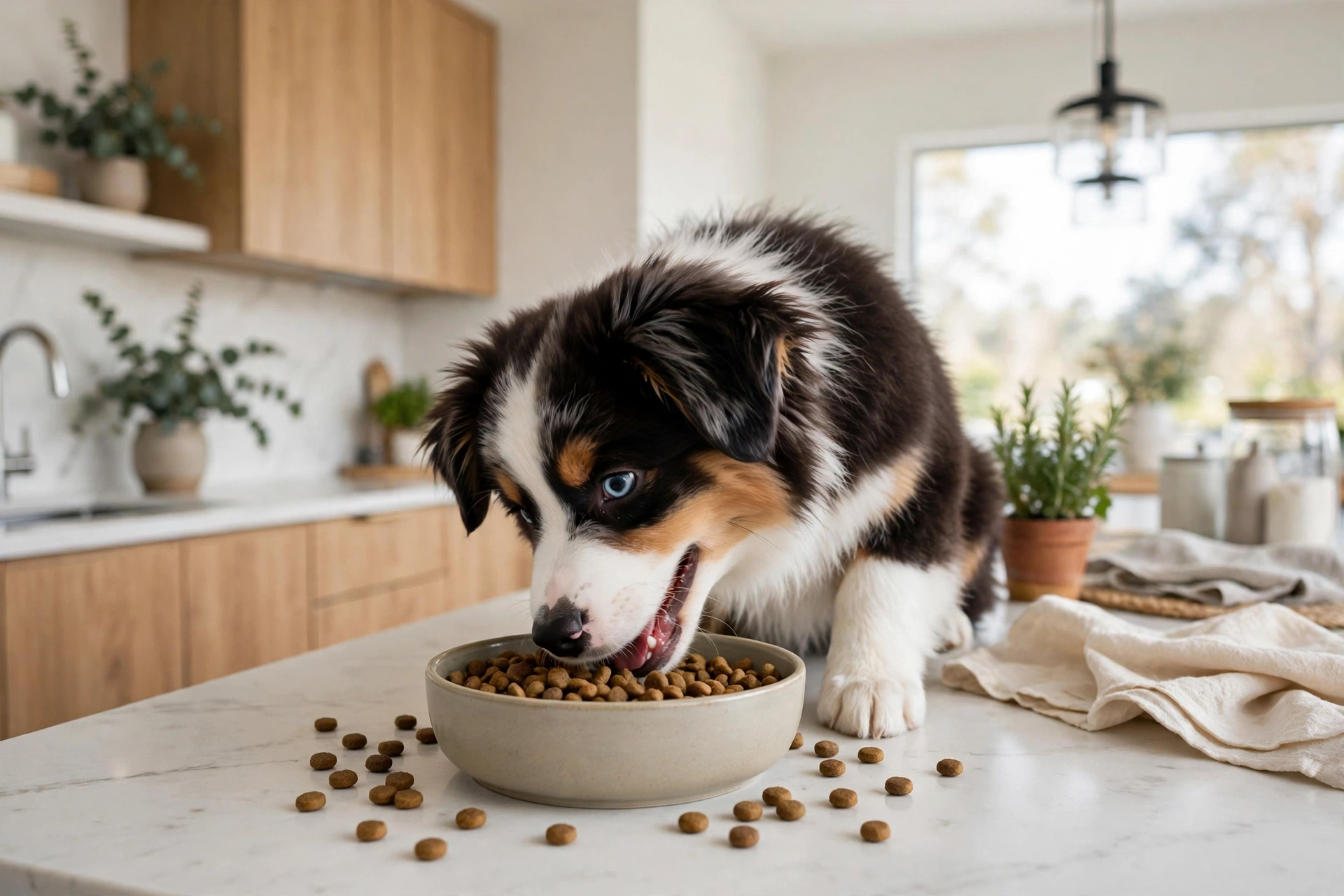
Best Puppy Food for Australian Shepherds: Fuel for a high-energy herding puppy (6 Picks 2026)
Choosing the best puppy food for Australian Shepherds matters more than it does for many breeds, because Aussie puppies grow fast, burn a remarkable amount of energy, and stay mentally busy from the moment they wake up. A food that works for a calm lap puppy will often leave an Australian Shepherd puppy hungry, restless, or with an upset stomach. This guide covers what growing Aussies actually need, compares six strong puppy foods available in the United States, and explains how much to feed and when to switch to adult food.
Australian Shepherds are medium-sized herding dogs, usually reaching 40 to 65 pounds as adults, with females on the smaller end of that range. Most Aussie puppies reach much of their adult height by 8 to 10 months, but they keep filling out, building muscle, and maturing well into their second year. That long, active growth period is why puppy food, not adult food, and not an all-life-stages shortcut unless it is genuinely formulated for growth, is the safer choice for the first year and beyond. Puppy formulas carry more protein, fat, and calories per cup, plus controlled calcium and DHA for brain and eye development. The trick is finding a food dense enough to fuel a herding puppy’s work rate, around 380 to 450 kcal per cup, without pushing bone growth too fast. Our guide to the best puppy food for large breeds explains the general method behind these picks.
This guide is based on ingredient analysis, brand reputation, and owner reviews. It is not a claim that we tested these foods or that a veterinarian reviewed this article. This guide covers feeding, not medical advice. For anything about your Aussie puppy’s health, your vet is the right call.
Key Takeaways
- Feed a puppy formula with an AAFCO statement for growth or all life stages, with a named animal protein first and roughly 26 to 30% protein.
- Aussie puppies need energy-dense food: look for around 380 to 450 kcal per cup unless your vet advises otherwise for a less active puppy.
- DHA, controlled calcium, and omega fatty acids matter for brain development, steady bone growth, and that thick Aussie coat.
- Split daily food into 3 to 4 meals for young puppies, dropping to 2 meals by about 6 months.
- Most Aussies switch to adult food between 12 and 15 months. Judge by growth and body condition, not the calendar alone.
Comparison Table: Our Top Picks at a Glance
| Product | Best for | kcal/cup | Protein/Fat | Price | Daily feeding | Cost/mo |
|---|---|---|---|---|---|---|
| Purina Pro Plan Puppy Shredded Blend Chicken & Rice Formula | Best overall for active Aussie puppies | 406 | 28% / 18% | $74.98 / 34 lb (Chewy, 2026-11-14) | ~2½ cups/day | ~$36/mo |
| Wellness Complete Health Puppy Deboned Chicken, Oatmeal & Salmon Meal Recipe | Balanced everyday feeding | 450 | 29% / 18% | $69.98 / 30 lb (Chewy, 2026-11-14) | ~3 cups/day | ~$55/mo |
| Blue Buffalo Life Protection Formula Puppy Chicken & Brown Rice Recipe | Picky puppies and steady digestion | 401 | 27% / 16% | $79.97 / 34 lb (Chewy, 2026-11-14) | ~2¼ cups/day | ~$38/mo |
| Hill’s Science Diet Puppy Large Breed Chicken & Brown Rice Recipe | Controlled growth for bigger Aussies | 391 | 24% / 11% | $78.99 / 27.5 lb (Chewy, 2026-11-14) | ~3¼ cups/day | ~$67/mo |
| Wellness CORE Digestive Health Puppy Chicken & Brown Rice Recipe | Puppies with sensitive stomachs | 398 | 31% / 15.5% | price not published | ~4 cups/day | Cannot compute |
| Purina Pro Plan Puppy Sensitive Skin & Stomach Salmon & Rice Formula | Chicken-sensitive puppies | 479 | 28% / 18% | $74.98 / 24 lb (Chewy, 2026-11-14) | ~3⅞ cups/day | ~$96/mo |
Prices checked on Chewy on November 14, 2026. Cost per month is for a 6-month-old puppy expected to reach 52 lb as an adult, at the daily feeding in the portion table below.
Purina Pro Plan Puppy Shredded Blend Chicken & Rice Formula
Purina Pro Plan Puppy Shredded Blend is the pick most often recommended for Australian Shepherd puppies, and for good reason. Chicken is the first ingredient, the formula includes DHA from fish oil for brain and vision development, and it contains live probiotics to support digestion during the stressful first months in a new home. The shredded blend texture, a mix of crunchy kibble and tender shreds, also helps with puppies that lose interest in plain kibble. At 406 kcal per cup and about $36 a month, it is also the cheapest pick in this guide, which makes it an easy place to start.
For an Aussie puppy, the energy density and protein level fit the breed well. Aussies are not couch puppies; even a pet Aussie that is not herding sheep will chase, fetch, and train for hours, and a food that is too light in calories can leave a growing puppy lean in the wrong way. This formula is widely available in US pet stores and supermarkets, which matters when you run out on a Sunday and cannot wait for a delivery. The main drawback is the grain content: puppies with a genuine grain intolerance will do better on a different pick below. Otherwise, this is the safest starting point for most Aussie puppies.
Wellness Complete Health Puppy Deboned Chicken, Oatmeal & Salmon Meal Recipe
Wellness Complete Health Puppy leads with deboned chicken, followed by oatmeal and salmon meal, giving puppies two quality animal protein sources plus a gentle, digestible grain. It includes DHA for brain development, calcium for bone growth, and omega fatty acids for skin and coat, all useful for a breed whose coat is one of its defining features. The recipe contains no corn, wheat, or soy, and no meat by-products.
Owner reviews consistently praise this food for stool quality, which is a practical point many guides skip. An Aussie puppy on a food that does not agree with them will show it quickly, and firm, regular stools are one of the clearest signs a food is working. The kibble size suits medium puppies, and the flavor is widely accepted, even by pickier Aussies. It is priced in the mid-to-premium range, so it costs more than supermarket puppy foods, but it is not the most expensive food on this list.
Blue Buffalo Life Protection Formula Puppy Chicken & Brown Rice Recipe
Blue Buffalo Life Protection Puppy uses real chicken first, brown rice and oatmeal for digestible energy, and DHA plus ARA fatty acids for development. Its signature LifeSource Bits, darker, vitamin-rich kibble pieces mixed into the bag, add antioxidants and vitamins, and many owners report that puppies pick those bits out first, which can help a fussy eater finish the bowl.
The smaller kibble size is a real advantage for young Aussie puppies, especially in the 8- to 16-week window when jaws are still small and chewing a large kibble can put a puppy off its food. Protein and fat levels are solid for growth without being extreme, and the whole-grain recipe avoids the heavy legume load found in some grain-free puppy foods. Watch the sodium level if your vet has flagged anything kidney-related, and transition slowly, as with any food change.
Hill’s Science Diet Puppy Large Breed Chicken & Brown Rice Recipe
Hill’s Science Diet Puppy Large Breed is formulated for puppies expected to reach 55 pounds or more. Its key strength is controlled mineral levels, particularly calcium, designed to support a steady rate of bone growth rather than the too-fast growth that can stress developing joints in medium and large breeds.
Protein sits around 24% and fat around 11% in this formula, lower than some picks here, so it suits Aussie puppies that are gaining steadily on a moderate activity level, or owners whose vet has advised against an overly energy-dense diet. It still includes DHA, fish oil, and whole grains, and Hill’s backs its formulas with feeding trials and extensive research. If your Aussie puppy is lean, extremely active, or working, you may need a higher-calorie pick instead; for a steadily growing larger Aussie, this controlled approach is a genuine advantage.
Wellness CORE Digestive Health Puppy Chicken & Brown Rice Recipe
Some Aussie puppies arrive home with loose stools, gas, or a stomach that reacts to every change. Wellness CORE Digestive Health Puppy is built for that situation, with prebiotics, probiotics, and digestive enzymes added to support gut health, plus pumpkin and other fruit and vegetable sources for vitamins and fiber. Chicken and brown rice keep the recipe digestible, and the formula supports immune health and cognitive development alongside digestion.
This is the pick to try when a standard puppy food causes repeated soft stools despite a slow transition and a vet check ruling out parasites or illness. Not every puppy needs the digestive extras. If your puppy is doing well on a simpler food, there is no need to pay for them. But for a sensitive Aussie puppy, a food designed around gut health can mean the difference between constant stomach upsets and a settled, happy puppy. If digestive problems persist for more than a few days, or if you see blood, vomiting, or lethargy, see your vet rather than trying another food.
Purina Pro Plan Puppy Sensitive Skin & Stomach Salmon & Rice Formula
Chicken is the most common protein in puppy food, and also one of the most common food sensitivities in dogs. If your Aussie puppy itches, has ear irritation, or has loose stools that improve when chicken is removed, Purina Pro Plan Puppy Sensitive Skin & Stomach Salmon & Rice is a strong chicken-free alternative. Salmon is the first ingredient, bringing omega-3 fatty acids that support skin and coat, and the grains, rice and barley, are easy to digest.
This formula also includes live probiotics and is widely recommended for puppies with sensitivities, which means it is easy to find and to stay on consistently. The fish smell is stronger than a chicken formula, which some owners notice, but most puppies love the taste. Stick with chicken if your puppy is doing well on it, and switch to a chicken-free food only when there is a real pattern of sensitivity, ideally confirmed with your vet. It is the priciest pick here per month, about $96, because the largest bag is 24 lb, so budget for that if you switch.
What Australian Shepherd Puppies Need Nutritionally
Aussie puppies need more than a generic puppy label. As a general guide for an active herding breed, most owners and nutritionists aim for roughly 26 to 30% protein and 14 to 20% fat, with enough calories to support growth without pushing a puppy into overweight. Check the AAFCO statement on the bag: it should say the food is formulated to meet nutritional levels for growth, or for all life stages including growth of large-size dogs if relevant.
DHA from fish oil or salmon meal supports brain and eye development, and omega fatty acids keep that thick Aussie coat in good shape. Calcium and phosphorus work best balanced and controlled, not maximized. Too much calcium in a growing medium or large puppy can contribute to skeletal problems, so a large-breed puppy formula or a formula with stated controlled mineral levels can be the right call for bigger Aussies. Controlled calcium protects developing joints, and hip dysplasia is the main joint watch for the breed. Our guide to the best puppy food for large breeds covers the general calcium, DHA, and AAFCO background in more detail.
Carbohydrates are not the enemy. Whole grains such as brown rice, oatmeal, and barley provide steady energy and fiber, and most Aussie puppies do well on them. Grain-free diets, which often replace grains with peas, lentils, and potatoes, were popular for years, but the FDA’s investigation into a possible link between certain grain-free diets and dilated cardiomyopathy (DCM) in dogs has made many owners and vets more cautious. Grain-free is not automatically harmful, and some puppies genuinely need it, but it should be a deliberate choice, ideally discussed with your vet, not a default.
One breed health watch worth knowing: Aussies are one of the breeds predisposed to exocrine pancreatic insufficiency (EPI). If your puppy has loose stools and weight loss despite a good appetite, that is a vet visit, not a food trial. Our guide to the best food for Australian Shepherds with a sensitive stomach covers the signs.
How Much to Feed an Australian Shepherd Puppy
Feeding amounts depend on age, weight, and activity, so always start with the bag’s feeding guide and then adjust by body condition. As a rough guide, an Aussie puppy of 3 to 6 months may eat roughly 1.5 to 2.5 cups per day, split across meals, while a 6- to 12-month puppy may eat 2 to 3 cups per day. Very active puppies, working-line puppies, and puppies in cold weather may need more; a quieter puppy in an apartment may need less. You should be able to feel ribs under a thin layer of fat, but not see them prominently, and your puppy should have a visible waist from above.
Feed young puppies 3 to 4 small meals a day up to about 6 months, then move to 2 meals a day. Regular meal times help with house training and prevent the grazing habit that makes it hard to judge appetite changes. Measure food with a standard cup rather than guessing, and count treats toward the daily total. Training treats add up fast with an Aussie, because you will use a lot of them. Treats should stay under 10% of daily calories. For a fuller schedule by age, see our puppy feeding schedule guide.
| Product | kcal/cup | Price | Daily feeding | Cost/mo |
|---|---|---|---|---|
| Purina Pro Plan Puppy Shredded Blend Chicken & Rice Formula | 406 | $74.98 / 34 lb (Chewy, 2026-11-14) | ~2½ cups/day | ~$36/mo |
| Wellness Complete Health Puppy Deboned Chicken, Oatmeal & Salmon Meal Recipe | 450 | $69.98 / 30 lb (Chewy, 2026-11-14) | ~3 cups/day | ~$55/mo |
| Blue Buffalo Life Protection Formula Puppy Chicken & Brown Rice Recipe | 401 | $79.97 / 34 lb (Chewy, 2026-11-14) | ~2¼ cups/day | ~$38/mo |
| Hill’s Science Diet Puppy Large Breed Chicken & Brown Rice Recipe | 391 | $78.99 / 27.5 lb (Chewy, 2026-11-14) | ~3¼ cups/day | ~$67/mo |
| Wellness CORE Digestive Health Puppy Chicken & Brown Rice Recipe | 398 | price not published | ~4 cups/day | Cannot compute |
| Purina Pro Plan Puppy Sensitive Skin & Stomach Salmon & Rice Formula | 479 | $74.98 / 24 lb (Chewy, 2026-11-14) | ~3⅞ cups/day | ~$96/mo |
Amounts are for a 6-month-old puppy expected to reach 52 lb as an adult. Where a label table is by current weight, the current weight at 6 months is assumed to be about 31 lb. Prices checked on Chewy on November 14, 2026. For a full schedule by age, see our Australian Shepherd feeding guide.
Feeding schedule by age
| Product | 3 months | 6 months | 9 to 12 months |
|---|---|---|---|
| Purina Pro Plan Puppy Shredded Blend Chicken & Rice Formula | ~1⅓ cups | ~2½ cups | ~3⅝ cups |
| Wellness Complete Health Puppy Deboned Chicken, Oatmeal & Salmon Meal Recipe | ~2½ cups | ~3 cups | ~3⅜ cups |
| Blue Buffalo Life Protection Formula Puppy Chicken & Brown Rice Recipe | ~2¼ cups | ~2¼ cups | ~2⅞ cups |
| Hill’s Science Diet Puppy Large Breed Chicken & Brown Rice Recipe | ~2¾ cups | ~3¼ cups | ~3⅓ cups |
| Wellness CORE Digestive Health Puppy Chicken & Brown Rice Recipe | feeding amount not published | ~4 cups | feeding amount not published |
| Purina Pro Plan Puppy Sensitive Skin & Stomach Salmon & Rice Formula | feeding amount not published | ~3⅞ cups | feeding amount not published |
Daily feeding in cups, from each food’s label feeding table. Assumed current weights for a puppy expected to reach 52 lb as an adult: about 20 lb at 3 months, about 31 lb at 6 months, and about 45 lb at 9 to 12 months. Where a label does not publish a feeding amount for an age, the table says so.
Agility and herding-trial Aussie puppies run hotter than a pet puppy and may need the top of the feeding range. The Purina Pro Plan Puppy Shredded Blend and Wellness CORE rows above are the energy-dense picks for a working line. On budget, the cheapest pick by cost per month is the Purina Pro Plan Puppy Shredded Blend at about $36 a month. The trade-off is the grain content, not the quality: it is a chicken-and-grain formula, so it is not the pick for a chicken-sensitive puppy. Judge a food by the cost per month and how your puppy does on it, not by the bag price alone.
Measured meals work better than free-feeding for an Aussie puppy. Herding breeds are smart and food-motivated, and free feeding makes it easy for a puppy to overeat, and hard for you to notice when appetite drops, often the first sign of illness. If your puppy consistently leaves food, eats far less than the guide, or suddenly loses interest, check with your vet before assuming pickiness. For comparison, see our guides to puppy food for Labradors and puppy food for Beagles.
Buying Guide: What to Look For
Start with the first ingredient. It should be a named animal protein, chicken, salmon, lamb, or a named meal such as chicken meal, not a vague term like “meat meal” or a plant protein. Named meals are concentrated protein sources and are not a red flag; by-product meal is lower quality and worth avoiding when a better option costs only slightly more. Next, check the guaranteed analysis for protein, fat, and fiber, and look for the calorie content (kcal per cup) so you can compare foods fairly.
Look for an AAFCO statement for growth, DHA from fish oil or salmon, and a balance of omega fatty acids. Probiotics and prebiotics are a bonus, especially for puppies with sensitive stomachs, but they do not replace a good base recipe. Avoid foods with artificial colors, artificial flavors, and vague preservatives, and be wary of long lists of peas, lentils, and other legumes in the first few ingredients, particularly in grain-free recipes. Finally, consider availability and price over the long term: the best food is one you can buy consistently for 12 to 15 months, not a boutique bag that is out of stock half the time. Our puppy food vs adult dog food guide explains why the life-stage label matters so much in this first year, and our guide to the best puppy food for large breeds covers the general buying method.
How to Switch Your Aussie Puppy to a New Food
Switch over 7 to 10 days. Start with roughly 25% new food and 75% old food for 2 to 3 days, move to a 50/50 mix, then 75% new, then fully new, watching stools and appetite at each step. If stools loosen, slow down and hold at the current ratio for a few extra days rather than pushing ahead. Aussie puppies are often enthusiastic eaters, so a slow switch can feel unnecessary, but their stomachs still benefit from the gradual change, especially when moving between protein sources or from a breeder’s food to your chosen brand.
Keep the old food bag until the switch is complete. Persistent refusal, vomiting, or diarrhea lasting more than a couple of days should prompt a vet visit, not another food trial.
When to Switch From Puppy Food to Adult Food
Most Australian Shepherds are ready for adult food between 12 and 15 months. Smaller females may be ready closer to 12 months, while larger males still filling out may benefit from puppy food until 15 months. Some owners use an all-life-stages food through this transition, but a clean switch from a puppy formula to an adult formula of a similar brand and protein source is usually smoother on the stomach.
Watch growth, not just age. If your Aussie has reached adult height, is gaining weight steadily rather than rapidly, and holds a healthy body condition on the current amount, that is a good time to plan the switch. Spaying or neutering often reduces calorie needs, so many owners switch and slightly reduce portions around the same period, on vet advice. Make the adult-food switch with the same 7- to 10-day gradual method used for any food change.
Conclusion: Our Recommendation
For most Australian Shepherd puppies, start with Purina Pro Plan Puppy Shredded Blend Chicken & Rice Formula. It combines a named protein first, DHA for development, probiotics for digestion, and wide US availability at a fair price, and it fits the energy needs of an active herding puppy. If your puppy has a sensitive stomach, try Wellness CORE Digestive Health Puppy instead; if chicken is a problem, Purina Pro Plan Puppy Sensitive Skin & Stomach Salmon & Rice is the chicken-free answer; and if your Aussie is on the larger side, Hill’s Science Diet Puppy Large Breed offers controlled growth support. If you are comparing herding and sporting breeds, our guides to the best puppy food for German Shorthaired Pointers and the best puppy food for Labradors use the same label-first approach.
Whichever pick you choose, feed measured meals, transition slowly, watch body condition week by week, and keep your vet in the loop during the first year. A good puppy food is not the most expensive bag on the shelf. It is the complete, growth-formulated food your individual Aussie puppy thrives on, bought consistently and fed in the right amount. This guide covers feeding, not medical advice. For anything about your Aussie puppy’s health, your vet is the right call.
Frequently Asked Questions
When should an Australian Shepherd puppy switch to adult food?
Most Aussies switch between 12 and 15 months. Smaller females are often ready near 12 months, while larger males still filling out may benefit from puppy food until 15 months. Judge by adult height, steady weight gain, and healthy body condition, and switch gradually over 7 to 10 days.
How much should an Australian Shepherd puppy eat per day?
As a rough guide, 1.5 to 2.5 cups per day at 3 to 6 months and 2 to 3 cups per day at 6 to 12 months, split into meals. Always start with the bag’s guide and adjust by body condition, activity, and your vet’s advice.
Is grain-free food good for Australian Shepherd puppies?
Not by default. Most Aussie puppies do well on whole grains such as brown rice and oatmeal. Grain-free diets often rely heavily on peas and lentils, and the FDA’s DCM investigation has made many vets cautious, so choose grain-free only for a specific reason, ideally discussed with your vet.
What protein percentage is best for an Aussie puppy?
Aim for roughly 26 to 30 percent protein and 14 to 20 percent fat, with a named animal protein first and an AAFCO statement for growth. Very active puppies may need the higher end of that range.
Can an Australian Shepherd puppy eat all life stages food?
Yes, if it is genuinely formulated for growth and carries an AAFCO statement for growth or all life stages. A dedicated puppy formula is usually simpler, because its protein, fat, and mineral levels are set for growth.
Do Australian Shepherd puppies need large-breed puppy food?
Not all of them. Larger Aussies expected to reach 55 pounds or more can benefit from a large-breed puppy formula with controlled calcium for steady bone growth, while smaller Aussies do well on a standard puppy formula.




3 Comments