
Puppy Feeding Schedule: How Much & How Often by Age & Weight (2026)
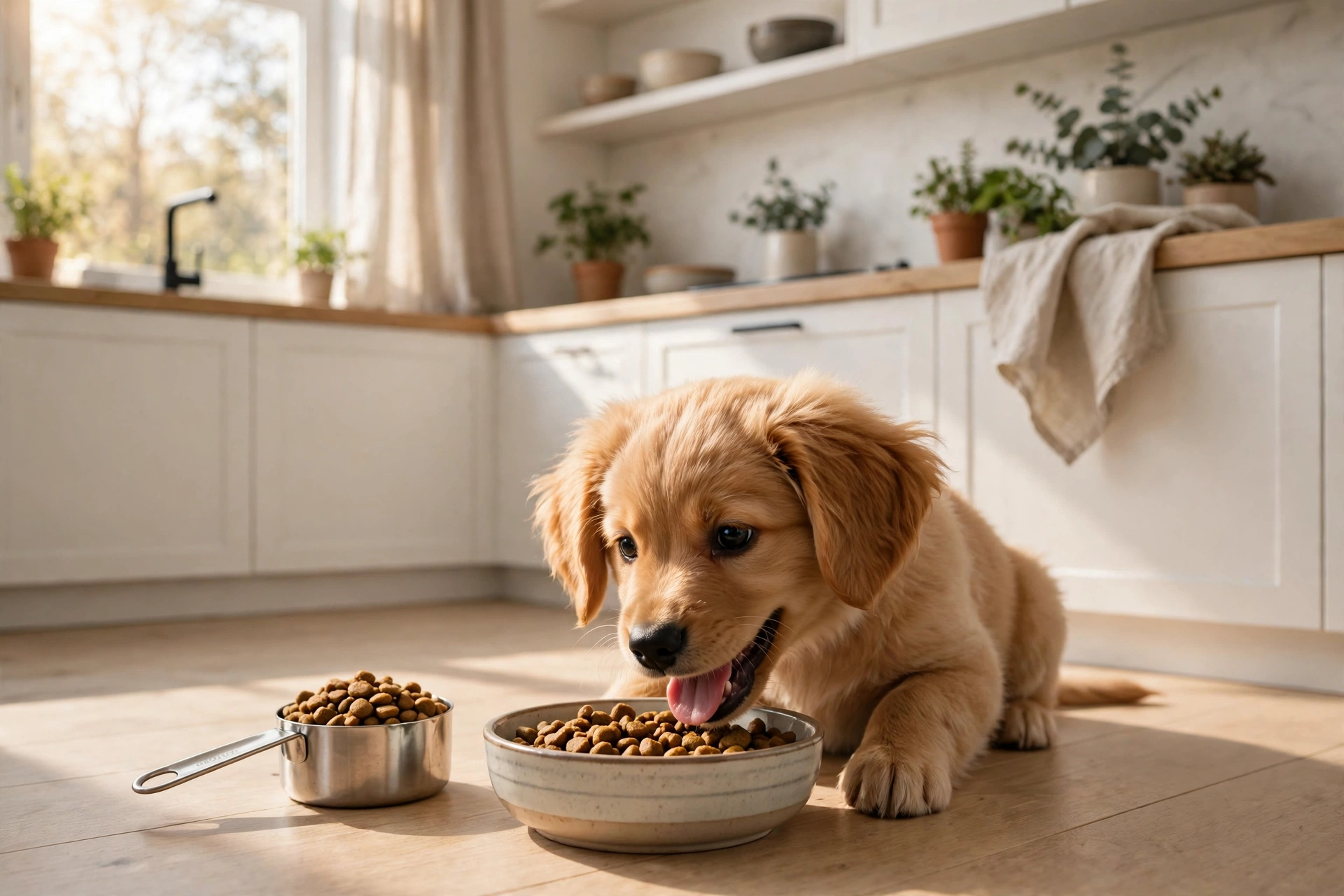
Bringing a puppy home raises a hundred small questions, and few feel as urgent as “Am I feeding this puppy right?” The good news is that a puppy feeding schedule is mostly about rhythm, not math. Feed a complete puppy food at consistent times each day, in the right number of meals for your puppy’s age, and adjust the portions as they grow, with your vet checking their progress along the way.
This guide walks you through exactly how often to feed by age, what a real day looks like at 8 weeks, 12 weeks, and 6 months, how to judge the right amount without obsessing over grams, and the calm mealtime habits that make house-training easier. Everything here reflects guidance from major veterinary and welfare organizations, including the AKC and leading animal charities. This is the master schedule: breed-specific amounts live on the breed feeding guides, linked from the matrix below, and the large-breed detail lives in Best Puppy Food for Large Breeds.
In This Guide
- Key Takeaways
- Why a Consistent Feeding Schedule Matters
- Puppy Feeding Schedule by Age: Meals Per Day
- A Sample Feeding Day at 8 Weeks
- A Sample Feeding Day at 12 Weeks
- A Sample Feeding Day at 6 Months
- How Much to Feed: Watch the Puppy, Not the Bowl
- What to Feed Your Growing Puppy
- Treats, Water, and the Rules That Keep Puppies Safe
- How to Know When to Adjust the Schedule
- Common Puppy Feeding Mistakes to Avoid
- When to Switch From Puppy Food to Adult Food
- Pros and Cons
- How Much to Feed in Cups and Calories: A Starting Figure
- Conclusion: Our Recommended Routine
Key Takeaways
- Feed 4 meals a day until roughly 12 weeks to 4 months, then 3 meals, then drop to 2 meals around 6 months. Most dogs stay on two meals for life.
- There is no universal “right amount” in cups or grams. Start with the feeding guide on your puppy food bag, then adjust based on your puppy’s body condition and your vet’s advice.
- Judge portions by watching the puppy, not the bowl: you should be able to feel ribs easily and see a visible waist.
- Toy and small-breed puppies need more frequent meals (4 to 5 a day when very young) because they are prone to low blood sugar.
- Keep mealtimes consistent, lift the bowl after 15 to 20 minutes, and always have fresh water available.
Why a Consistent Feeding Schedule Matters
A regular routine does far more than fill a small tummy. When your puppy eats at the same times every day, their body settles into a predictable rhythm, and that quietly does half your house-training for you. Most puppies need a bathroom break within 15 to 30 minutes of eating, so steady mealtimes mean predictable toilet trips you can plan around.
Scheduled meals also protect against overeating. The AKC and major welfare organizations advise against leaving food down all day. Free-feeding makes it nearly impossible to track what your puppy actually eats, encourages picky grazing habits, and can lead to unhealthy weight gain. Food left sitting out can also spoil.
There is a subtler benefit too. When you know exactly what your puppy normally eats, a skipped meal stands out immediately, and a sudden loss of appetite is often the very first sign that something is wrong. Consistency turns you into an early-warning system.
Finally, a predictable schedule is calming. Puppies are much less likely to beg, hover, or get food-anxious when they trust that dinner always comes at dinner time. This guide is for information only. Check with your vet for your dog’s specific needs.
Puppy Feeding Schedule by Age: Meals Per Day
Meals per day is the backbone of the whole plan, and the major welfare organizations agree on the broad shape. Young puppies need little and often: their stomachs are tiny, they burn through energy fast, and they cannot store energy well between meals. As the stomach grows and growth slows, meals consolidate.
Before 8 weeks, puppies are still with the breeder or dam, nursing and nibbling solids from about 3 to 4 weeks old, on 4 to 6 small meals a day or free-fed. This guide starts at 8 weeks, when most puppies come home.
| Puppy’s age | Meals per day | Daily amount: how to set it |
|---|---|---|
| 8 to 12 weeks | 4 meals (toy breeds 4 to 5) | From the food’s own label, by current weight, then set by body condition |
| 3 to 4 months | 3 to 4 meals (toy breeds 4 to 5) | From the food’s own label, by current weight, then set by body condition |
| 4 to 6 months | 3 meals (toy and small breeds may still need more frequent meals) | From the food’s own label, by current weight, then set by body condition |
| 6 to 12 months | 2 meals (giant breeds may stay on 3 longer) | From the food’s own label, by current weight, then set by body condition |
| Adults | 2 meals | Adult food’s own label |
Toy and small breeds need more meals. The AKC advises 4 to 5 small meals a day for toy puppies under 4 months, to help prevent low blood sugar, and VCA advises at least 3 small meals a day for puppies under 4 months. Merck notes that frequent meals of a commercial puppy diet usually manage toy-breed low blood sugar in the first 6 months. Watch for weakness, collapse, disorientation, tremors, or seizures, and call your vet promptly if you see them. For small-breed amounts, see Best Puppy Food for Small Breeds.
For breed-specific amounts, see the German Shepherd Feeding Guide.
The exact cutoffs differ slightly between sources, and that is fine. They describe a range, not a hard rule. One consistent sign that your puppy is ready for one fewer meal: they start leaving food in the bowl at a particular feeding. (The exception is greedy breeds like Labradors and Beagles, where you will have to make the call yourself.)
A Sample Feeding Day at 8 Weeks
At 8 weeks your puppy has just made the full transition to solid food and is settling into a brand-new home. Keep everything as familiar as possible: the same food the breeder or rescue was using, served at the same sort of times. Four meals, spaced evenly, with the last meal a couple of hours before bedtime so overnight toilet training is easier.
| Time | Meal | Tip |
|---|---|---|
| 7:00 AM | Breakfast | Take your puppy out immediately after, they will almost certainly need to go. |
| 11:00 AM | Midday meal | Quick potty break after, then some play and a nap. |
| 3:00 PM | Afternoon meal | Another meal-then-outside rhythm; keep energy calm around meals. |
| 7:00 PM | Dinner | Last big meal of the day. A final short walk and potty break before bed. |
Fresh water should be available all day, with the bowl washed daily and refilled often. Soak dry kibble in a little warm water for very young puppies if they seem to struggle with the crunch. Softening it slightly also helps smaller mouths eat without frustration.
A Sample Feeding Day at 12 Weeks
By 12 weeks most puppies are more confident eaters. Depending on which guidance your vet follows, you may still be on four meals or have just stepped down to three. Here is what a three-meal day looks like. Simply add the 11 AM meal back in if you are still on four.
| Time | Meal | Tip |
|---|---|---|
| 7:00 AM | Breakfast | Potty break right after, then the day’s first play or short training session. |
| 12:30 PM | Lunch | A slightly bigger portion than before, three meals means each one carries more of the day’s food. |
| 5:30 PM | Dinner | Served well before bedtime. Use part of this meal as training rewards if you are working on recall or sits. |
These times are an example, not a rule. Pick times that fit your household and keep them consistent. That is the part that actually matters.
A Sample Feeding Day at 6 Months
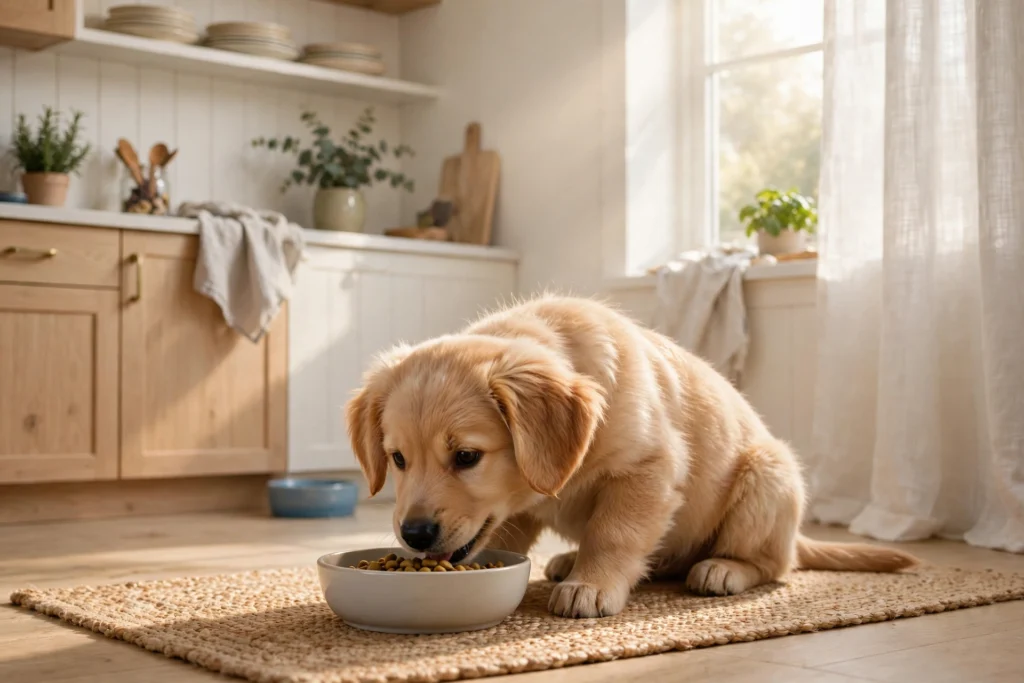
Around six months most puppies transition to two meals a day. The daily food amount stays roughly the same (or adjusts with growth), just divided in half instead of thirds.
| Time | Meal | Tip |
|---|---|---|
| 7:00 to 8:00 AM | Breakfast | Half the daily ration. Potty break right after. |
| 5:00 to 6:00 PM | Dinner | The other half. Keep the hour around meals calm rather than racing about, sensible lifelong practice, especially for large, deep-chested breeds. |
If your puppy is very active, struggling to hold weight, or is a toy breed, your vet may suggest sticking with three smaller meals a little longer. Every puppy is an individual. The schedule bends to the dog, not the other way around.
How Much to Feed: Watch the Puppy, Not the Bowl
Here is the honest answer no chart can give you: there is no universal amount. How much your puppy needs depends on the food’s calorie density, their breed and expected adult size, their age, and their own metabolism. A large-breed puppy and a toy puppy at the same age are living completely different nutritional lives.
That is why every reputable source points you to the feeding guide on your food’s bag as the starting point. Some guides are based on your puppy’s current weight; others estimate by expected adult weight, so check which yours uses. Start at the lower end of the recommended range for your puppy’s age and size, then adjust.
From there, adjust to the puppy in front of you. The AKC puts it perfectly: “watch the dog, not the dish.” Run your hands along your puppy’s sides: you should be able to feel ribs easily under a light cover of fat, and you should see a visible waist when looking down at them. Your vet will assess body condition at routine visits and tell you whether to add a little or trim a little. When you do adjust, change the daily amount by about 10 percent at a time and give it a week before changing again, and weigh your puppy every week, since growing puppies change fast.
Weighing the day’s food beats eyeballing it. A kitchen scale serves the same packet-guide amount at every meal, which keeps portions identical no matter who in the family is on feeding duty, and it makes vet-advised adjustments precise instead of approximate. If you don’t have a scale, a simple measuring jug works as well, roughly 1 cup per 100 g of dry food as a rough average. Check your own bag, because a cup weighs 95 g to 117 g depending on the food.
Two special cases matter:
- Large and giant breeds: Overfeeding large-breed puppies is linked to joint and bone problems as they grow. Feed a food specifically formulated for large-breed puppies, skip supplements unless your vet prescribes them, and let steady, lean growth win. Many large breeds need puppy food well past their first birthday, some up to 18 to 24 months. If you need product ideas for the biggest pups, see our guide to the best puppy food for large breeds.
- Toy and small breeds: Puppies expected to weigh under about 10 pounds as adults are prone to low blood sugar (hypoglycemia), especially when very young. They may need four to six small meals a day in their first months, and you should talk to your vet about meal frequency at the first check-up. For food options sized to tiny teeth, see our guide to the best puppy food for small breeds.
What to Feed Your Growing Puppy
Keep it simple: a complete commercial puppy food that matches your puppy’s life stage and breed size. Puppy formulas carry extra protein, fat, and minerals, including carefully balanced calcium and phosphorus, to support growth. Adult dog food does not have the right nutrient balance for a growing puppy, so swapping early to save money usually backfires. The large-breed calcium detail lives in Best Puppy Food for Large Breeds.
Look for an AAFCO nutritional adequacy statement on the label (something like “formulated to meet the nutritional levels established by the AAFCO Dog Food Nutrient Profiles for growth”). That one line tells you the food has been formulated to a recognized growth standard.
When your puppy first comes home, stick with whatever the breeder or rescue was feeding, on the same routine. Continuity matters while everything else in their world is changing. Sudden changes can cause vomiting, diarrhea, or a puppy who refuses to eat.
Wet food and dry food can both work. Wet food can encourage hesitant eaters, and dry food is convenient and economical. If you are leaning toward wet food for a little one, our guide to the best wet food for small dogs breaks down the options.
And one firm rule: skip cow’s milk. Most puppies can’t digest dairy properly, and it commonly causes diarrhea. Fresh water is the only drink they need.
Treats, Water, and the Rules That Keep Puppies Safe
Treats absolutely have a place. They are how you train recall, sits, and calm greetings. The widely shared rule is that treats should be no more than about 10% of the day’s food, and they should come out of the daily ration rather than being added on top. A neat trick: set aside a little of the day’s kibble as your training treats.
Some human foods are genuinely dangerous. Keep this short list out of reach: chocolate, grapes and raisins, onions, garlic and chives, xylitol (a sweetener found in some peanut butters and sugar-free sweets), alcohol, and cooked bones. If any are eaten, call your vet immediately, even before any symptoms show.
Water is the easy one: dogs need constant access to clean drinking water, always. Table scraps count as treats too, so agree a no-feeding-from-the-table rule early and you are far less likely to end up with a beggar at the table.
How to Know When to Adjust the Schedule
Growth is not a straight line, so your schedule should not be carved in stone. These are the signs owners most often miss:
- Leaving food consistently: If your puppy routinely walks away from one meal, they may be ready to drop it and spread that food across the remaining meals.
- Sudden ravenous behavior between meals: Could signal a growth spurt, so ask your vet before increasing amounts, since overfeeding at the wrong stage carries real risks.
- Loose stools with no other symptoms: Often caused by too much food rather than the wrong food. Trim portions slightly before you blame the formula.
- Losing body condition: A thinning puppy needs more food or a vet check, not just more meals.
- Appetite changes in a previously good eater: If a puppy who has not eaten for more than 24 hours, or has diarrhea that does not resolve quickly, see a vet promptly. Repeated vomiting, blood in vomit or stool, or unusual lethargy are also call-the-vet-now signs.
When in doubt, a quick weight-and-body-condition check turns a guess into a plan. Vets answer feeding questions every single day, so no one will think you are fussing.
Common Puppy Feeding Mistakes to Avoid
- Guessing portions with a scoop or “about a cupful”: Scoops drift over time. Weigh meals against the bag’s feeding guide so every portion is the same.
- Switching to adult food too early: Puppy food carries extra nutrients for growth. Toy breeds switch around 6 to 9 months, small breeds around 8 to 10 months, medium breeds around 12 months, large breeds around 18 months, and giant breeds around 24 months, so let your vet call it.
- Feeding one huge meal a day: Large single meals strain digestion and, in deep-chested large breeds, are linked to bloat risk. Two meals a day is the sensible minimum from about six months.
- Giving cow’s milk as a treat: Puppies cannot digest dairy properly and it commonly causes diarrhea. Fresh water is the only drink they need.
- Changing foods overnight: Mix the new food into the old gradually over about a week, increasing the new a little each day.
- Adding treats on top of full meals: Treats should come out of the daily ration. Treat-heavy days quietly turn into overfeeding.
- Free-feeding all day: Grazing makes it hard to track intake, can lead to weight gain, and removes your early-warning signal when appetite drops.
When to Switch From Puppy Food to Adult Food
This comes later than many owners expect, and timing depends on breed size. The VCA windows are: toy breeds 6 to 9 months, small breeds 8 to 10 months, medium breeds around 12 months, large breeds around 18 months, and giant breeds 24 months. The AKC’s advice is to err on the side of caution: better to feed puppy food a little too long than not long enough.
When the time comes, transition gradually over a week or more. Use the same mixing method as any food change. A quick vet check at switch time confirms your dog has finished growing and the new food suits their adult body condition. For the full comparison, see Puppy Food vs Adult Dog Food.
Pros and Cons
Feeding a puppy well is a trade between strict measuring and a happy, growing dog. Here is the honest balance.
Pros
- Four small meals a day suit tiny stomachs and keep blood sugar steady in young puppies.
- Set mealtimes make toilet training easier, since most puppies need to go soon after eating.
- Weighing food and checking ribs and waist beats guessing with a scoop.
- A complete puppy food covers growth needs without extra supplements.
Cons
- Starting amounts come from the food’s own label, so you still need to read your own bag.
- Meal times shift as the puppy grows, so the routine needs regular updates.
- Toy breeds need extra meals and close watch for low blood sugar.
- Treats and table scraps add up fast and can quietly push daily food over the limit.
How Much to Feed in Cups and Calories: A Starting Figure
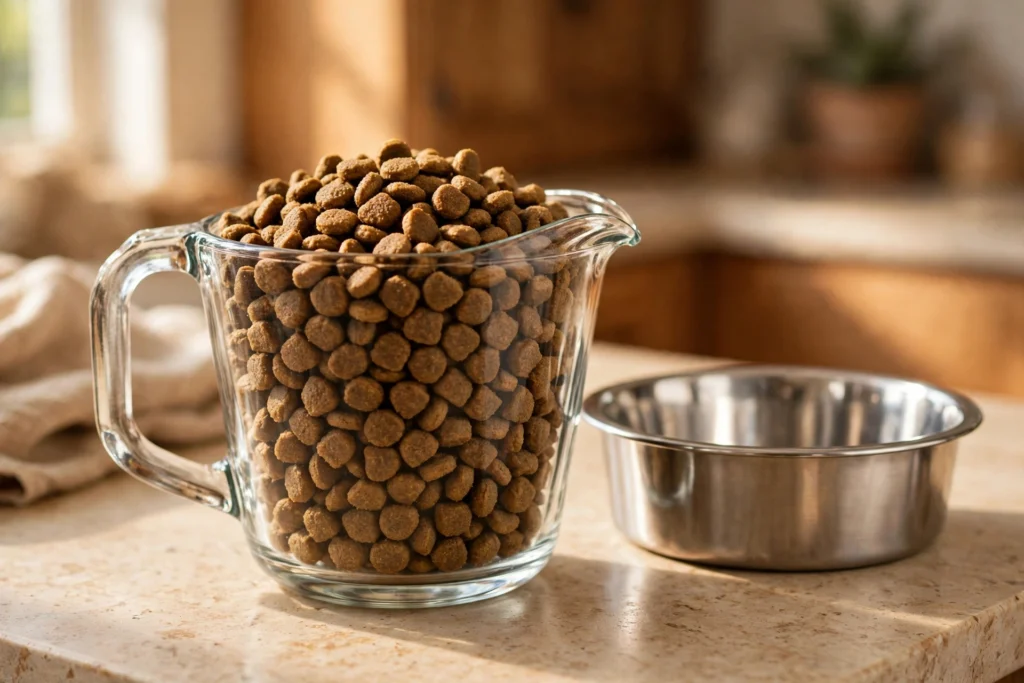
Start with the bag and watch your puppy, and use the figures below as your first numbers rather than guessing. Here is a safe starting point from published feeding charts. A puppy expected to reach 21 to 50 lb as an adult usually starts on about half a cup to 1 and a half cups of dry puppy food a day at 1 to 3 months, while a puppy expected to reach 51 to 75 lb starts on about 5/8 of a cup to 2 and 2/3 cups. Split that total across the day’s meals. A 4 month old puppy expected to reach 18 lb as an adult, on a food whose guide says 2 cups a day, eats 3/4 of a cup at each of three meals.
For a 6-month-old puppy weighing 20 lb, expected to reach 21 to 50 lb as an adult, the labels say: Blue Buffalo Life Protection Puppy, 1 to 1 and 3/4 cups a day; Purina Pro Plan Puppy Shredded Blend (Chicken and Rice), 1 and 1/3 to 2 and 1/4 cups a day; Hill’s Science Diet Puppy Sensitive Stomach and Skin, 2 and 1/4 cups a day. For kibble amounts by product, see Best Dry Puppy Food, and for cans per day, see Best Wet Puppy Food.
If you would rather work in calories, use the resting energy rule vets use. Take 70 times your puppy’s weight in kg to the power of 0.75, then multiply by 3 under 4 months and by 2 near a year. A 5 kg puppy at 4 months works out near 700 calories a day. Treat every figure as a starting point, not a rule. One cup of kibble can hold 300 calories or 500, so check the calories on your own bag, weigh the food, and let the ribs and waist decide the final amount with your vet.
Conclusion: Our Recommended Routine
If you remember nothing else, remember this: four meals a day until about 12 weeks to 4 months, three meals until around 6 months, and two meals a day from there. Most dogs happily stay on two for life. Start with the feeding guide on your puppy food bag, weigh the portions, and adjust by watching your puppy’s body condition rather than the bowl.
Keep the food complete and life-stage appropriate, transition changes gradually, keep treats within 10% of the daily ration, and hold mealtimes steady. Do that, and your puppy feeding schedule becomes something you barely have to think about: a quiet rhythm underneath a healthy, well-trained puppy.
Frequently Asked Questions
How many times a day should I feed my puppy?
Feed 4 meals a day until roughly 12 weeks to 4 months of age, then 3 meals a day until about 6 months, then drop to 2 meals a day. Most adult dogs stay on two meals a day for life. Toy and small-breed puppies may need 4 to 5 smaller meals a day when very young because they are prone to low blood sugar.
What time should I feed my puppy?
Pick times that fit your household and keep them consistent every day, for example 7 AM, 12:30 PM, and 5:30 PM for a three-meal schedule. Space meals fairly evenly through the day, and serve the last meal a couple of hours before bedtime to make overnight toilet training easier.
How much should my puppy eat per meal?
There is no universal amount. Start with the feeding guide on your puppy food bag, weigh the portions with a kitchen scale for consistency, then adjust based on your puppy’s body condition (you should be able to feel ribs easily under a light fat cover) and your vet’s advice.
How do I know if I am overfeeding my puppy?
Judge by body condition, not the bowl: feel the ribs and look for a visible waist from above. Persistent loose stools with no other symptoms often mean too much food rather than the wrong food. When in doubt, ask your vet at the next check-up.
Should I leave food out all day for my puppy?
No. Free-feeding makes it hard to track what your puppy actually eats, encourages picky grazing habits, and can lead to unhealthy weight gain. Set mealtimes, lift the bowl after 15 to 20 minutes, and watch for the early warning sign of a skipped meal.
How many calories does my puppy need a day?
Use the resting energy rule. Take 70 times your puppy’s weight in kg to the power of 0.75, then multiply by 3 for a puppy under 4 months and by 2 as they near a year. A 5 kg puppy at 4 months works out near 700 calories a day. Turn the calories into grams with the calories per 100 g on your food bag, weigh the food, and check ribs and waist every two weeks with your vet.

29 Comments