
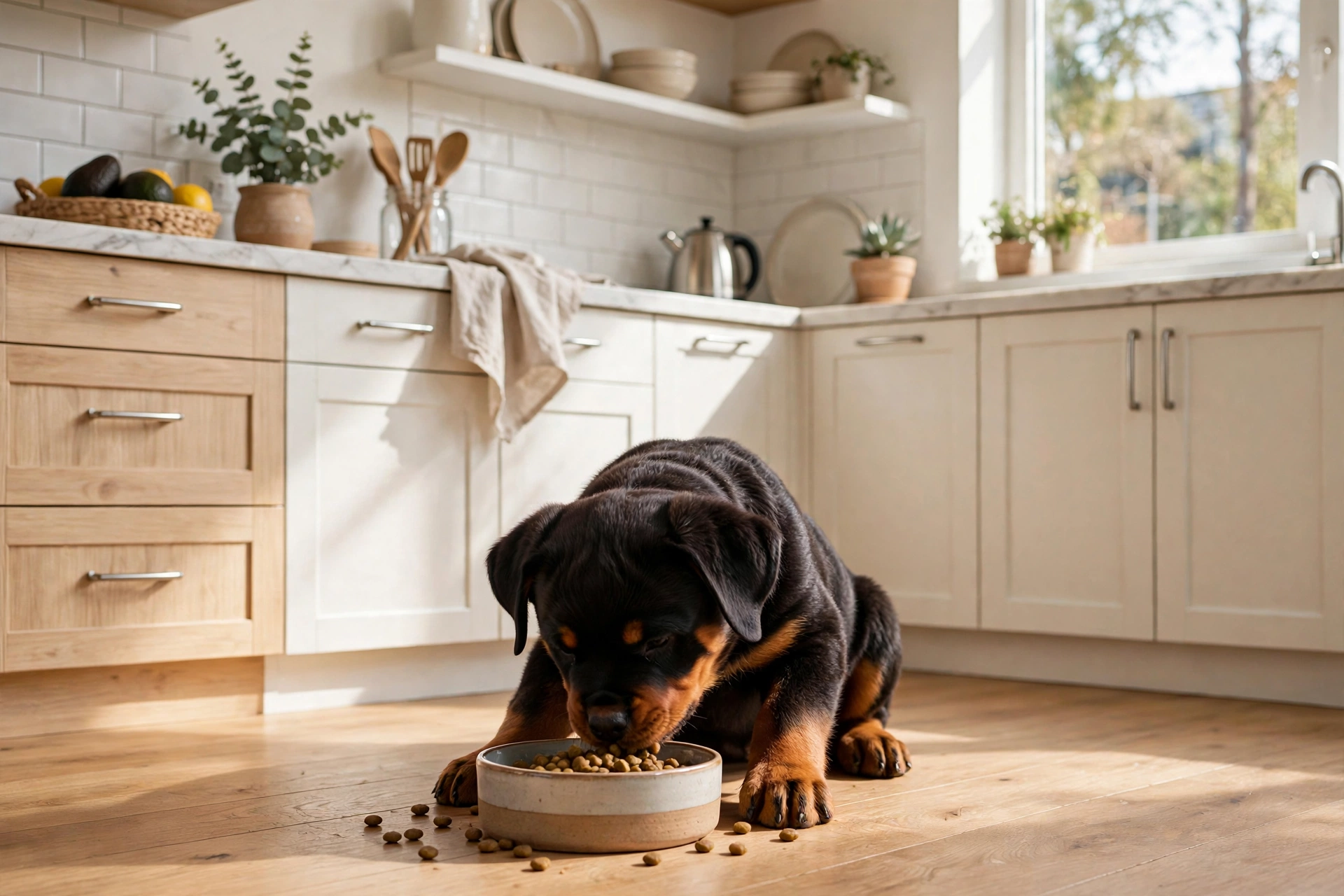
Best Puppy Food for Rottweilers: Joint-safe feeding for very fast growth (6 Picks 2026)
Bringing home a Rottweiler puppy is a big commitment, and nowhere does that show up faster than in the food bowl. Finding the best puppy food for Rottweilers is not as simple as grabbing any puppy kibble off the shelf. Rottweiler puppies grow fast. A Rottie can gain several pounds a week during the early months, and that rapid growth puts their developing bones and joints under real stress. The single most important choice you can make is feeding a formula clearly labeled “large breed puppy,” because these formulas control the calcium and phosphorus levels that keep fast-growing bones growing at the right pace. This guide breaks down exactly what to look for, ranks six of the best puppy foods for Rottweilers in 2026, and answers the questions Rottie owners ask most.
Pick a large-breed puppy formula with controlled calcium, 28 to 32 percent animal protein, and DHA. Feed 2 to 3 cups a day at 8 to 12 weeks in 4 meals, then 2 to 3 meals a day by 6 to 12 months. Keep growth slow and steady, skip calcium supplements, and stay on puppy food until about 18 months.
In This Guide
- Key Takeaways
- Best Puppy Food for Rottweilers: Our Top 6 Picks
- How to Choose the Right Puppy Food for Your Rottweiler
- What to Avoid
- Feeding Amounts: How Much Your Rottweiler Puppy Needs
- Pros and Cons
- How Fast Should Your Rottweiler Puppy Grow?
- The Bottom Line
- Frequently Asked Questions
Key Takeaways
- Pick a formula labeled “large breed puppy” with controlled calcium (max 1.5% dry matter) and a calcium-to-phosphorus ratio near 1.2:1. That balance is what protects a fast-growing Rottweiler from hip dysplasia, elbow dysplasia, and OCD.
- Look for 28 to 32% animal-based protein and 12 to 16% fat, with DHA from fish oil for your Rottweiler puppy’s brain and glucosamine for its fast-growing joints.
- Check the AAFCO statement: look for “growth of large-size dogs (70 lb or more as an adult).” That line is your proof the formula is tested for big breeds.
- Skip calcium powders, cottage cheese, or bone meal in a large-breed puppy’s diet. Extra calcium throws off the calcium-to-phosphorus ratio and raises the risk of skeletal problems in a fast-growing Rottweiler.
- Stick with grain-inclusive formulas. Grain-free diets have been linked to heart concerns (DCM) in large, deep-chested breeds like Rottweilers, so there is no reason to go grain-free unless your vet advises it.
Best Puppy Food for Rottweilers: Our Top 6 Picks
| Product | Best For | kcal/cup | Protein | Fat | Calcium (dry matter) | Price (Chewy, 2026-11-14) | Cost/month |
|---|---|---|---|---|---|---|---|
| Purina Pro Plan Large Breed Puppy (Chicken & Rice) | Best overall | 419 | 28% | 13% | 1.3% | $74.98 / 34 lb | ~$62 to $113/mo |
| Royal Canin Rottweiler Puppy | Best breed-specific | 358 | 24% | 18% | 1.2% | $104.99 / 30 lb | ~$147/mo |
| Hill’s Science Diet Large Breed Puppy (Chicken & Brown Rice) | Best for controlled bone growth | 391 | 24% | 11% | 0.9% | $78.99 / 27.5 lb | ~$109/mo |
| Eukanuba Large Breed Puppy (Chicken) | Best for brain development | 351 | 25.5% | 13% | 1.2% | $74.99 / 33 lb | ~$76/mo |
| Iams ProActive Health Large Breed Puppy | Best budget pick | 378 | 27% | 14% | 1.3% | $35.24 / 30.6 lb | ~$46/mo |
| Blue Buffalo Life Protection Formula Large Breed Puppy (Chicken & Brown Rice) | Best premium grain-inclusive | 385 | 26% | 15% | 1.3% | $79.97 / 34 lb | ~$62/mo |
These picks are based on ingredient analysis, brand reputation, and owner reviews, not on lab testing or veterinary endorsement, so take them as a well-researched starting point and confirm the right choice with your own vet. Prices are Chewy prices checked on 2026-11-14. Calcium is shown on a dry-matter basis, calculated from each label’s guaranteed-analysis calcium and moisture, and cost per month is for a 6-month-old Rottweiler puppy expected to reach 107 lb as an adult (about 60 lb now).
A quick credibility check: Purina, Hill’s, Royal Canin, and Eukanuba/Iams all employ veterinary nutritionists and run feeding trials, which is the heart of the WSAVA checklist for choosing a brand. Blue Buffalo does not publish feeding-trial details, so it does not clear that checklist on the public evidence available.
Purina Pro Plan Large Breed Puppy (Chicken & Rice)
Purina Pro Plan Large Breed Puppy earns the top spot because it checks every box that matters for a growing Rottweiler: real chicken is the first ingredient, it carries DHA from fish oil for brain and eye development, and it includes glucosamine to support developing joints. The formula is built specifically for puppies expected to mature over 50 pounds, which covers a Rottweiler easily, and it is designed to promote a healthy growth rate rather than maximum speed. Antioxidants help steady the developing immune system through the growth period, and the AAFCO growth statement covers large-size dogs. It is one of the most widely recommended large-breed puppy foods in the US, which also means it is easy to find at pet stores and online.
Who it’s for: Rottweiler owners who want a widely trusted formula that needs no guesswork.
Royal Canin Rottweiler Puppy
Royal Canin goes a step further than generic large-breed formulas by making a recipe specifically for Rottweiler puppies, covering them from 8 weeks to 18 months of age. The breed-specific approach shows up in the details: a specially shaped kibble designed for a Rottie’s jaw to pick up and chew properly, a nutrient blend aimed at healthy muscle development and digestive health, and antioxidants including vitamin E to support the immune system. It also includes L-carnitine and prebiotics for digestion. If you like the idea of feeding and diet tuned to your breed rather than just the size category, this is the obvious pick.
Who it’s for: Owners who want the only formula on this list made specifically for the Rottweiler breed.
Hill’s Science Diet Large Breed Puppy (Chicken & Brown Rice)
Hill’s Science Diet Large Breed Puppy is built around the single most important feeding-and-diet lever for Rottweilers: controlled calcium. The formula is carefully balanced to keep bone growth at a healthy rate during the critical months, which directly protects against developmental bone disorders. Alongside that, it provides DHA from fish oil for brain and eye development, high-quality protein for lean muscle, and added glucosamine and chondroitin for joint support. Natural ingredients include chicken meal, whole grains, flaxseed, and dried beet pulp. It sits at a higher price point, but the calcium discipline is exactly what a fast-growing Rottie needs most.
Who it’s for: Owners who want maximum confidence that calcium levels are being managed for safe skeletal growth.
Eukanuba Large Breed Puppy (Chicken)
Eukanuba Large Breed Puppy stands out for its clinically proven DHA levels, a real differentiator when you are raising a Rottweiler you hope will grow into a trainable, intelligent adult. The formula pairs high-quality chicken protein with optimized calcium and phosphorus levels for muscle and bone development together, and keeps calories moderate (around 351 kcal per cup), which supports the controlled growth a big breed needs. Natural fiber and probiotics keep digestion smooth, and integrated joint nutraceuticals give developing joints early support. The presence of chicken by-product meal and some wheat and corn may put off ingredient purists, but the nutrient balance is one of the most complete in the large-breed category.
Who it’s for: Owners who value proven DHA levels and a complete, balanced large-breed nutrient profile.
Iams ProActive Health Large Breed Puppy
You do not need to overspend to feed a Rottweiler puppy well. Iams ProActive Health Large Breed Puppy leads with real chicken as the first ingredient, includes DHA for brain development, and is formulated for large breeds, covering the essentials at one of the most accessible prices in this category. It is a practical choice for owners managing the already high cost of raising a big dog, and the brand has a long track record in large-breed feeding and diet. As with any puppy food, watch your pup’s condition and stool quality when transitioning and keep portions measured.
Who it’s for: Budget-conscious owners who want the large-breed essentials without the premium price tag.
Blue Buffalo Life Protection Formula Large Breed Puppy (Chicken & Brown Rice)
For owners who want premium ingredients in a grain-inclusive recipe, Blue Buffalo’s Life Protection Formula Large Breed Puppy starts with deboned chicken, adds wholesome whole grains like brown rice, oatmeal, and barley, and includes antioxidant-rich fruits and vegetables plus DHA for healthy growth and development. Analysis shows roughly 28.9% protein with a grain-inclusive profile, and it carries an AAFCO statement covering growth including large-size dogs. There are no by-product meals, corn, wheat, soy, or artificial preservatives. It costs more than mainstream options, but the ingredient list is one of the cleanest on this list.
Who it’s for: Owners who want a premium, grain-inclusive formula with named meat and whole grains.
How to Choose the Right Puppy Food for Your Rottweiler
Rottweiler puppies are not small dogs in training. They are a large breed with specific feeding-and-diet demands, and getting this stage right shapes their joints, bones, and overall health for life. Adults reach 80 to 135 lb (males 95 to 135 lb, females 80 to 100 lb), and puppies stay on puppy food until about 18 months, while their fast-growing joints face hip and elbow dysplasia and osteochondrosis. Here is what actually matters on the label. For the full explainer, see our guide to the best puppy food for large breeds.
Large-breed formula is non-negotiable
The single biggest mistake Rottie owners make is feeding a regular “all life stages” kibble. Rottweiler puppies do best on a formula clearly labeled “large breed puppy” with controlled calcium (max 1.5% on a dry-matter basis) and a calcium-to-phosphorus ratio near 1.2:1, which slows growth to protect developing joints and bones. Skip calcium powders, cottage cheese, or bone meal in a large-breed puppy’s diet.
Protein source and levels
Look for 28 to 32% protein from named animal sources like chicken, lamb, or fish. More is not automatically better: very high-protein foods often pack in extra calories, and extra calories are what push a Rottweiler puppy’s growth too fast.
DHA for brain development
DHA from fish oil supports brain and eye development during the first months of life, when the nervous system is growing fastest. Look for fish oil, salmon oil, or DHA on the label, and aim for about 0.1% of the diet. Puppies convert the ALA in flaxseed and canola oil to DHA poorly, so do not rely on those sources alone. For the full breakdown, see our guide to the best puppy food for large breeds.
Fiber and digestibility
Rottweilers can be prone to loose stools, so digestibility matters. Natural fiber sources (beet pulp, pumpkin, chicory root) support healthy digestion and firm stools. Aim for 3 to 5% crude fiber; more fiber dilutes energy, and if loose stools persist on a new food, talk to your vet.
The AAFCO statement
Flip the bag over and read the AAFCO nutritional adequacy statement. For a Rottweiler puppy, it should confirm the food is complete and balanced for growth and, critically, that it includes growth of large-size dogs (70 lb or more as an adult). That phrase is your proof the formula was designed and tested for big-breed growth.
What to Avoid
- Calcium supplements, cottage cheese, and bone meal added to the diet. Extra calcium throws off the calcium-to-phosphorus ratio and raises the risk of skeletal problems in a fast-growing Rottweiler. A complete large-breed puppy food already has calcium right where it needs to be.
- Grain-free diets without a medical reason. The FDA is still investigating a possible link between grain-free “BEG” (boutique, exotic-protein, grain-free) diets and DCM in large, deep-chested breeds, so unless your vet diagnoses a grain allergy, grain-inclusive is the safer choice.
- Foods with unnamed meat sources. If the label just says “animal by-product meal” or “meat meal” with no named animal, it tells you nothing about quality. Stick with foods that name the animal in the first ingredients.
- Artificial colors, flavors, and preservatives (BHA, BHT, ethoxyquin). They add nothing to your puppy’s diet and some owners prefer to avoid them entirely.
- Overfeeding and free feeding. A chubby Rottweiler puppy may look cute, but excess weight during growth strains developing joints. Measure every meal with a standard 8 oz cup, not a scoop. For a broader feeding schedule by age, see our puppy feeding schedule guide.
Feeding Amounts: How Much Your Rottweiler Puppy Needs
The table below is for a 6-month-old Rottweiler puppy expected to reach 107 lb as an adult and weighing about 60 lb now. Daily amounts come from each label’s feeding guide, and cost per month is a 30-day month at the Chewy price checked on 2026-11-14. For the full day-by-day plan, see our Rottweiler Feeding Guide.
| Product | kcal/cup | Price (Chewy, 2026-11-14) | Daily feeding | Cost/month |
|---|---|---|---|---|
| Purina Pro Plan Large Breed Puppy (Chicken & Rice) | 419 | $74.98 / 34 lb | 4 to 7.25 cups/day | ~$62 to $113/mo |
| Royal Canin Rottweiler Puppy | 358 | $104.99 / 30 lb | 6.49 cups/day | ~$147/mo |
| Hill’s Science Diet Large Breed Puppy (Chicken & Brown Rice) | 391 | $78.99 / 27.5 lb | 5.33 cups/day | ~$109/mo |
| Eukanuba Large Breed Puppy (Chicken) | 351 | $74.99 / 33 lb | 5.25 cups/day | ~$76/mo |
| Iams ProActive Health Large Breed Puppy | 378 | $35.24 / 30.6 lb | 5.75 cups/day | ~$46/mo |
| Blue Buffalo Life Protection Formula Large Breed Puppy (Chicken & Brown Rice) | 385 | $79.97 / 34 lb | 3.75 cups/day | ~$62/mo |
These are starting points for a moderate-calorie kibble at roughly 380 kcal per cup. Always adjust every two weeks based on body condition (ribs easily felt, waist visible from above). At 8 to 12 weeks (15 to 25 lb), feed 2 to 3 cups per day split into 4 meals. From 3 to 6 months (30 to 55 lb), move to 3 to 4.5 cups per day across 3 meals, and from 6 to 12 months (55 to 85 lb), most Rotties do well on 4.5 to 5.5 cups per day in 2 to 3 meals. Growth slows after 6 months, so resist the urge to keep increasing portions. Overfeeding a large-breed puppy is one of the fastest routes to joint problems. When switching brands, transition gradually over 7 to 10 days; our guide to changing dog food safely walks through the day-by-day schedule.
Pros and Cons
A large-breed puppy formula is the right call for a Rottweiler, but it still needs care. Here is the honest balance.
Pros
- Controlled calcium and phosphorus protect growing bones and joints.
- High animal protein builds the dense muscle Rottweilers are known for.
- DHA from fish oil supports brain and eye development.
- Six named picks cover budgets from value to premium.
Cons
- Portions need measuring, since overfeeding strains growing joints.
- Puppies need 3 to 4 meals a day, so someone has to be there to feed them.
- Breed-specific formulas cost more than generic puppy food.
- Growth should stay slow and steady, so patience matters more than big portions.
How Fast Should Your Rottweiler Puppy Grow?
A Rottweiler puppy should gain weight fast, but not too fast. As a rough guide, a male puppy gains about 5 to 10 pounds a week and reaches about half of his adult weight by 5 to 6 months. That pace is the goal. A puppy that shoots past it is usually eating too much, and extra weight during the fast-growth window puts more stress on hips and elbows that are still forming.
Weigh your puppy every week on the same scale and write the number down. The scale alone does not tell the whole story, so check body condition with your eyes and hands too. You should feel the ribs easily under a thin fat cover and see a waist from above. If the ribs vanish under fat or the waist fills out, cut the daily amount a little and check again in two weeks.
Use the feeding amounts in this guide as a starting point, not a fixed rule. Two puppies the same age can need different amounts because activity, metabolism, and the food itself all differ. Split the daily food into the meals shown above, since small, measured meals keep growth steady and lower the bloat risk that comes with a deep chest. Slow, steady growth now is what protects the joints later. Rottweilers live about 9 to 10 years, and the breed is also prone to osteosarcoma and cruciate ligament disease, so keeping growth slow and weight in check matters well beyond puppyhood.
The Bottom Line
The best puppy food for Rottweilers is one that treats controlled growth as the top priority: a large-breed puppy formula with balanced calcium and phosphorus, 28 to 32% animal protein, DHA for brain development, and joint support built in. Our top pick is Purina Pro Plan Large Breed Puppy (Chicken & Rice). It is the most complete, widely trusted package of everything a growing Rottie needs, from real chicken first to glucosamine for developing joints. If you prefer a breed-specific formula, Royal Canin Rottweiler Puppy is the tailored alternative, and Iams ProActive Health Large Breed Puppy keeps costs down without dropping the large-breed essentials. Whichever you choose, feed it consistently, measure every meal, and keep growth slow and steady. A Rottweiler should stay on large-breed puppy food until about 18 months, when skeletal growth finishes, before moving to an adult formula like the ones in our best dog food for Rottweilers guide. For a broader comparison across brands, our best puppy food for large breeds guide covers the wider category. The same slow-growth rules apply to other giant breeds, so if you also feed a Bernese or a Cane Corso, see our guides to the best puppy food for Bernese Mountain Dogs and the best puppy food for Cane Corsos.
This guide is for information only. Check with your vet for your dog’s specific needs.
Frequently Asked Questions
What is the best puppy food for a Rottweiler?
Purina Pro Plan Large Breed Puppy is the strongest overall choice: a large-breed formula with controlled calcium, high animal protein, DHA from fish oil, and glucosamine for developing joints. Royal Canin Rottweiler Puppy is the best breed-specific alternative, and Iams ProActive Health Large Breed Puppy is the best budget pick. These picks are based on ingredient analysis, brand reputation, and owner reviews. Confirm the right choice with your vet.
Why do Rottweiler puppies need a large-breed formula?
Rapid growth puts huge stress on developing bones. Large-breed formulas control calcium (max 1.5% dry matter) with a calcium-to-phosphorus ratio near 1.2:1. Excess calcium during the fast-growth window of roughly 2 to 7 months is linked to hip dysplasia, elbow dysplasia, and osteochondritis dissecans (OCD) later in life.
How much should I feed my Rottweiler puppy each day?
As a starting point for a moderate-calorie kibble at roughly 380 kcal per cup: 8 to 12 weeks, 2 to 3 cups per day in 4 meals; 3 to 6 months, 3 to 4.5 cups in 3 meals; 6 to 12 months, 4.5 to 5.5 cups in 2 to 3 meals. Adjust every two weeks based on body condition: ribs easily felt, waist visible from above.
When should I switch my Rottweiler puppy to adult food?
Around 18 months, not 12. Rottweilers finish skeletal growth at 18 to 24 months, and switching too early removes the controlled calcium and phosphorus balance that protects growing bones.
Should I add calcium or other supplements to my Rottweiler puppy’s diet?
No. Skip calcium powders, cottage cheese, or bone meal in a large-breed puppy’s diet. Extra calcium disrupts the calcium:phosphorus ratio and raises the risk of skeletal disease. A complete large-breed puppy food already has calcium right where it needs to be.
How do I know if my Rottweiler puppy is growing too fast?
Watch the scale and the body. A male puppy gains about 5 to 10 pounds a week and reaches about half of his adult weight by 5 to 6 months, so a puppy well past that pace is likely eating too much. You should feel the ribs easily and see a waist from above. If the ribs hide under fat, trim the daily amount a little and weigh again in two weeks.

4 Comments