
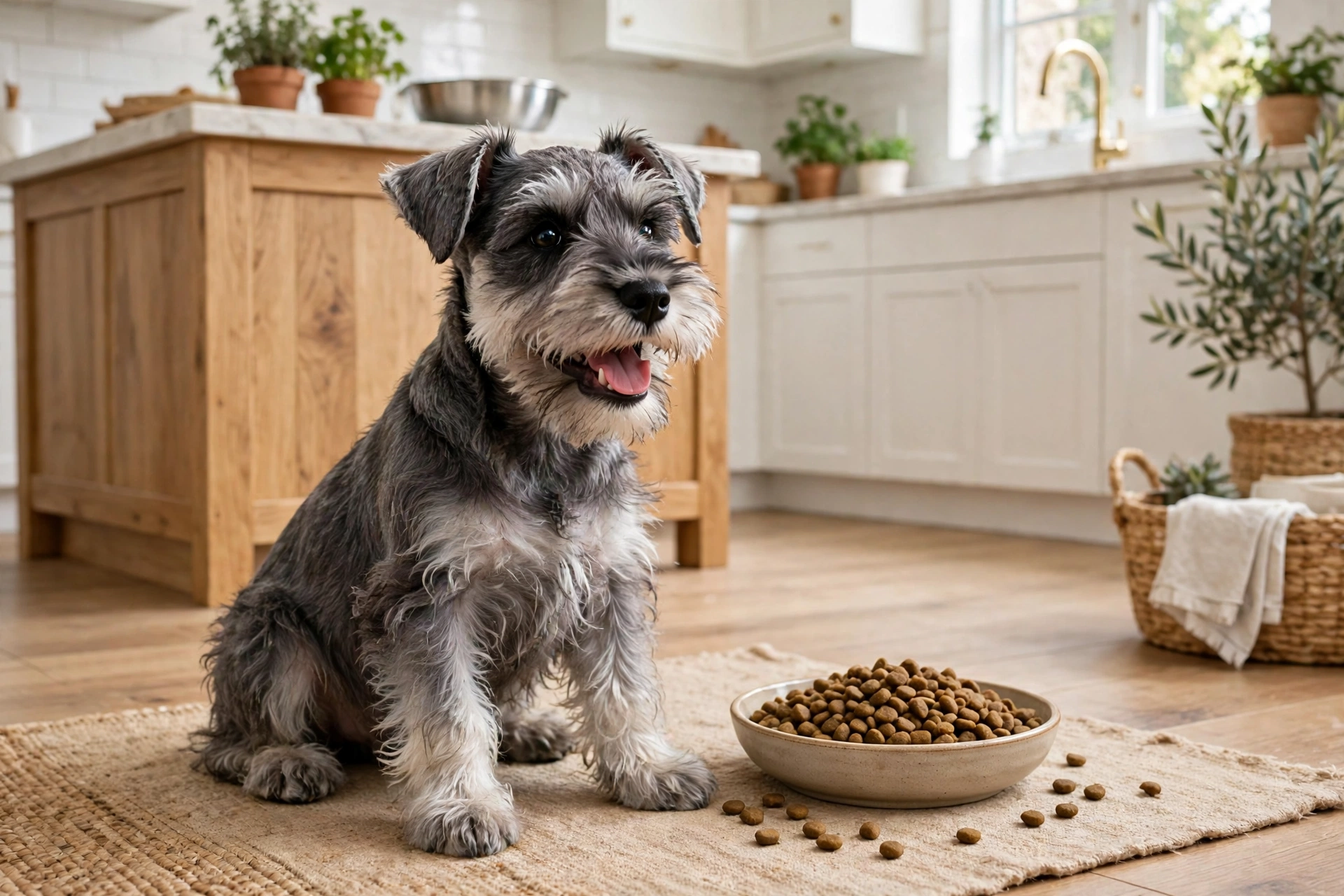
Best Puppy Food for Miniature Schnauzers: Moderate-fat picks for an 11 to 20 lb puppy (6 Picks 2026)
Choosing the best puppy food for miniature schnauzers is a little different from picking a generic puppy kibble. Miniature Schnauzer puppies are small, fast-growing, famously stubborn, and prone to a few breed-specific issues: weight gain, sensitive digestion, and, later in life, bladder stones and pancreatitis risk. The right puppy food supports steady growth without piling on excess fat, comes in a kibble size a tiny mouth can actually manage, and keeps calories measured rather than free-fed. Most adult Miniature Schnauzers weigh 11 to 20 lb, so the portions and picks below are built around a puppy that will stay small. This guide covers six of the best puppy foods for Miniature Schnauzers available in the US in 2026, how much to feed at each age, when to switch to adult food, and what to watch out for along the way. All picks below are based on ingredient analysis, brand reputation, and owner reviews, not on testing claims or vet endorsement. For the general rules behind puppy feeding, see our Best Puppy Food for Large Breeds guide.
Key takeaways
- Pick a puppy formula made for small breeds, or a breed-specific Miniature Schnauzer puppy formula, so kibble size and calorie density suit a puppy that will only reach 11 to 20 pounds as an adult.
- Look for a named meat as the first ingredient, DHA from fish oil, and an AAFCO statement for growth, not adult maintenance. For a Miniature Schnauzer, moderate fat and measured portions matter more than any single ingredient, since the breed is prone to fat-related digestive trouble later in life.
- Measure every meal. Miniature Schnauzers gain weight easily, and free-feeding is one of the fastest ways to create a chubby puppy.
- Plan the switch to adult food at around 10 to 12 months. Royal Canin’s breed-specific puppy formula is designed to 10 months, while most small-breed puppy foods run to 12 months.
- Keep fat moderate rather than extreme. Very high-fat puppy foods are a poor match for a breed already prone to fat-related digestive trouble later in life.
Our top picks at a glance
| Product | Best for | kcal/cup | Fat | Price | Cost/month |
|---|---|---|---|---|---|
| Royal Canin Miniature Schnauzer Puppy | Breed-specific formula | 341 | 12% | $26.99 / 2.5 lb, Chewy, 2026-11-15 | ~$99/mo |
| Hill’s Science Diet Puppy Small Bites Chicken Meal & Barley | Everyday small-breed feeding | 393 | 15% | $42.99 / 12.5 lb, Chewy, 2026-11-15 | ~$36/mo |
| Wellness Small Breed Complete Health Puppy (Turkey, Oatmeal & Salmon Meal) | Sensitive digestion | 489 | 19% | $19.99 / 4 lb, Chewy, 2026-11-15 | ~$52/mo |
| Blue Buffalo Life Protection Formula Puppy Lamb & Oatmeal | Lamb-based, moderate fat | 401 | 16% | $65.48 / 30 lb, Chewy, 2026-11-15 | ~$16 to $27/mo |
| Merrick Backcountry Raw Puppy (Grain-Free) | Picky eaters | 462 | 14% | $84.98 / 20 lb, Chewy, 2026-11-15 | ~$64/mo |
| Instinct Be Natural Puppy Real Chicken & Brown Rice | Natural ingredients | 468 | 18% | Not verified for the puppy SKU | Cannot compute |
Prices checked 2026-11-15 on Chewy. The Instinct Be Natural Puppy price could not be verified for the puppy SKU; the distributor list price is $49.99 for 24 lb.
Royal Canin Miniature Schnauzer Puppy Dry Dog Food
Best for: breed-specific formula. If you want a formula designed for this exact breed rather than small breeds in general, this is the obvious starting point. It is made for Miniature Schnauzer puppies from 8 weeks to 10 months, with a kibble shape sized for their jaws and nutrients aimed at immune development and digestion during the most rapid growth phase. Most adult Miniature Schnauzers weigh 11 to 20 lb, and this formula is built for a puppy that will stay in that range. Antioxidants including vitamin E support a developing immune system, and the formula includes L-carnitine, which helps with healthy weight management, useful for a breed that puts on weight easily. The trade-off is the narrow window: at 10 months you need to move on to an adult Miniature Schnauzer formula, sooner than the 12-month switch most generic puppy foods use. It is also a premium-priced food sold in a small 2.5-pound bag, so it suits owners who value breed-specific precision over bulk value. Based on ingredient analysis, brand reputation, and owner reviews, this is our top pick for new Miniature Schnauzer puppy owners who want the least guesswork.
Hill’s Science Diet Puppy Small Bites Chicken Meal & Barley Recipe
Best for: everyday small-breed feeding. Hill’s Puppy Small Bites is a workhorse choice: chicken meal as the protein base, barley and other whole grains for steady energy, DHA from fish oil, and a prebiotic fiber blend that supports the gut microbiome. The small bite size is genuinely small, a real advantage for a puppy whose adult mouth is still tiny, and the formula is made in the US and carries an AAFCO statement for growing puppies. It feeds up to 12 months, which gives you a longer, simpler runway than the breed-specific Royal Canin option. The main downside is that it is a general small-breed formula, not tuned to Schnauzer-specific concerns like coat texture or weight tendency, so portion control falls entirely on you. For owners who want a widely available, sensibly priced food they can buy in a 4.5- or 12.5-pound bag, this is hard to beat.
Wellness Small Breed Complete Health Puppy Turkey, Oatmeal & Salmon Meal Recipe
Best for: sensitive digestion. Some Miniature Schnauzer puppies have loose stools on rich, chicken-heavy foods, and this Wellness formula is a good alternative: deboned turkey first, followed by chicken meal, oatmeal, salmon meal, and barley. Oatmeal and barley are gentle, fiber-rich grains that tend to sit well with sensitive stomachs, and the recipe adds a probiotic to support digestion. At around 28% protein and 19% fat, it is energy-dense enough for a growing small breed without being overloaded with fat, and the kibble is sized for small mouths. It contains no by-products, fillers, or artificial preservatives. The calorie density (about 489 kcal per cup) means careful measuring pays off. A heaped cup too many is a meaningful overshoot for a 10-pound puppy. If your puppy’s stomach is unsettled on other foods, this is the first alternative to try, after ruling out anything medical with your vet.
Blue Buffalo Life Protection Formula Puppy Lamb & Oatmeal
Best for: a lamb-based, moderate-fat option. Blue Buffalo Life Protection Formula Puppy in Lamb & Oatmeal leads with deboned lamb, followed by oatmeal and barley, which suits puppies that do better on a lamb-based recipe. It includes DHA and ARA, calcium and phosphorus, and Blue Buffalo’s antioxidant-rich LifeSource Bits, a blend of vitamins, minerals, and antioxidants mixed into the kibble. At 401 kcal per cup and 16% fat, it is a moderate-fat, moderate-calorie option, which fits a weight-prone breed. The recipe is grain-inclusive, so if you want a grain-free pick, the Merrick Backcountry Raw Puppy below is the one to look at.
The oatmeal base is gentle on digestion, and the kibble is sized for small mouths. At 1 to 1.75 cups a day for a Miniature Schnauzer puppy at the 15 lb adult-weight basis, a 30 lb bag lasts a good while, which keeps the monthly cost down. Two honest caveats: some puppies pick out and leave the darker LifeSource Bits, and the 15 lb bag is not sold for this flavor, so you buy the 5 lb or 30 lb bag. Neither is a deal-breaker, but both are worth knowing before you buy.
Merrick Backcountry Raw Puppy Recipe
Best for: picky eaters. Miniature Schnauzers are famously opinionated about food, and some puppies will simply refuse a plain kibble. Merrick Backcountry Raw Puppy mixes freeze-dried raw chicken pieces into a grain-free kibble, which makes the bowl far more interesting without switching to a fully raw diet. Deboned chicken is the first ingredient, with sweet potatoes and potatoes providing carbohydrate, and the formula runs about 30% protein and 14% fat. The freeze-dried pieces add palatability and a protein boost, and the food is free from grains, corn, wheat, and soy. The downside is cost. Raw-inclusive foods are pricier per pound, and the richer taste can make a picky puppy even fussier about plain kibble later. Use it if your puppy is genuinely disinterested in food, not just holding out for something better, and keep treats to a minimum so the main meal stays appealing.
Instinct Be Natural Puppy Real Chicken & Brown Rice Recipe
Best for: natural ingredients. Instinct Be Natural coats its kibble in freeze-dried raw chicken, giving it much of the appeal of the Merrick option with a grain-inclusive recipe: chicken first, then chicken meal, barley, brown rice, and oatmeal. It is free from fillers, corn, wheat, soy, by-products, and artificial colors, flavors, and preservatives, which appeals to owners who read labels closely. At about 25% protein and 18% fat, it is a little lower in protein than the other picks here but still comfortably above the minimum for growing puppies (at least 22% protein and 8% fat on a dry-matter basis). The raw coating helps with palatability, and the whole grains provide steady energy for an active puppy. As with all raw-coated foods, store the bag properly and take uneaten food up rather than leaving it sitting out for hours.
How much should a Miniature Schnauzer puppy eat?
There is no single number that fits every puppy, because calorie needs depend on age, weight, activity, and the food’s calorie density, which ranges from about 341 to nearly 490 kcal per cup across the picks above. Use the feeding guide on your chosen bag as the starting point, then adjust by body condition: you should be able to feel (not prominently see) your puppy’s ribs, and they should have a visible waist when viewed from above. As a rough guide for a puppy on a typical small-breed puppy food:
| Age | Meals per day | Typical daily amount* |
|---|---|---|
| 8 to 12 weeks | 4 | 1/2 to 3/4 cup |
| 3 to 6 months | 3 | 3/4 to 1 cup |
| 6 to 10 months | 2 to 3 | 3/4 to 1 cup |
| 10 to 12 months | 2 | 2/3 to 1 cup (transitioning to adult food) |
*Approximate only. Always follow your specific food’s label and your vet’s advice, and adjust up or down based on body condition, not appetite. Schnauzers will happily eat more than they need.
Here is what that looks like per pick for a 6-month-old Miniature Schnauzer puppy with an expected adult weight of 15 lb (the midpoint of the AKC 11 to 20 lb range), assumed to weigh about 11.5 lb at 6 months. For the full feeding schedule, see our Miniature Schnauzer Feeding Guide.
| Product | kcal/cup | Price | Daily feeding | Cost/month |
|---|---|---|---|---|
| Royal Canin Miniature Schnauzer Puppy | 341 | $26.99 / 2.5 lb, Chewy | 1.45 cups | ~$99/mo |
| Hill’s Science Diet Puppy Small Bites | 393 | $42.99 / 12.5 lb, Chewy | 1.52 cups | ~$36/mo |
| Wellness Small Breed Complete Health Puppy | 489 | $19.99 / 4 lb, Chewy | 1.25 cups | ~$52/mo |
| Blue Buffalo Life Protection Formula Puppy Lamb & Oatmeal | 401 | $65.48 / 30 lb, Chewy | 1 to 1.75 cups | ~$16 to $27/mo |
| Merrick Backcountry Raw Puppy | 462 | $84.98 / 20 lb, Chewy | 2 cups | ~$64/mo |
| Instinct Be Natural Puppy | 468 | Not verified for the puppy SKU | 1 to 2 cups | Cannot compute |
Miniature Schnauzers are famously opinionated about food, so if your puppy turns picky, try a splash of warm water on the kibble to bring out the smell, and keep mealtimes short. Adding toppers at every meal teaches your puppy to hold out for something better, so keep them occasional. If your puppy skips more than a meal or two, or starts losing weight, ask your vet.
Free-feeding is the fastest way to end up with a chubby Miniature Schnauzer puppy, so measured meals work better. Leaving food down all day makes it impossible to track intake, encourages grazing and pickiness, and is a direct route to excess weight in a breed already prone to it. Split the daily amount into measured meals, pick up uneaten food after 20 to 30 minutes, and count training treats as part of the daily calories. For a small puppy, even a handful of treats can be 10% or more of the day’s intake. If you are using treats heavily during training, cut the meal portions slightly to compensate.
Buying guide: what to look for in a Miniature Schnauzer puppy food
A named meat first, and moderate fat
Look for a named animal protein (chicken, lamb, turkey, or salmon) as the first ingredient, not a vague “meat meal” or a plant protein. Puppies need at least 22% protein, and most quality puppy foods sit between 25% and 30%. Fat is equally important but in the other direction: enough for energy and brain development (DHA from fish oil is a plus), but not so much that a weight-prone breed is overloaded. Miniature Schnauzers are at higher risk of pancreatitis as adults, and while puppy food is not the cause of adult pancreatitis, building a habit of moderate fat and measured portions from puppyhood is the sensible foundation. Bladder stones are another adult-life risk for the breed, so those same habits are worth building now.
Small kibble, and an AAFCO growth statement
Kibble size matters more than most owners expect: a Miniature Schnauzer puppy’s mouth is small, and oversized kibble means gulping and dropped pieces. Check the bag’s AAFCO statement too: it should say the food is complete and balanced for growth. Our Best Puppy Food for Large Breeds guide covers the general AAFCO and feeding rules.
Calcium and phosphorus in balance
Growing puppies need the right calcium-to-phosphorus ratio, roughly 1.2 parts calcium to 1 part phosphorus, for healthy bone growth. Quality puppy foods formulate for this, so there is no need to add calcium supplements unless your vet specifically recommends them. The Best Puppy Food for Large Breeds hub covers the general calcium and DHA rules in full.
Digestibility and coat support
Miniature Schnauzers have a wiry double coat and skin that benefits from omega-3 and omega-6 fatty acids from fish oil or flaxseed. For digestion, look for a named fiber source (beet pulp, oatmeal, barley) and, if your puppy has a sensitive stomach, a probiotic or prebiotic fiber blend. If loose stools persist for more than a couple of days, or you see blood, vomiting, or lethargy, see your vet rather than cycling through foods.
Adult foods and fresh subscriptions are not like-for-like swaps for a Miniature Schnauzer puppy formula. A puppy formula is built for growth, with the calcium, DHA, and calorie density a small breed that will only reach 11 to 20 lb needs.
What to avoid
- Adult or “all life stages” foods fed without checking the label: all-life-stages foods are fine if they meet growth requirements, but a maintenance-only formula is not enough for a puppy.
- Free-feeding: the single biggest contributor to overweight Schnauzer puppies.
- Very high-fat puppy foods: extra fat means extra calories in a small body, and it does nothing for a breed that needs weight discipline.
- Foods with unnamed meat meals or heavy fillers: “meat meal,” corn gluten meal as a primary protein, and long lists of artificial colors and flavors are signs of a lower-quality recipe.
- Raw or homemade diets without guidance: puppies have precise calcium, phosphorus, and calorie needs, and an unbalanced homemade diet is a real risk during growth. If you want to go this route, do it with veterinary nutritionist input, not a recipe found online.
- Too many treats and table scraps: fatty scraps are a particular problem for this breed, and treats should stay under about 10% of daily calories.
When to switch from puppy food to adult food
Most Miniature Schnauzers reach adult size between 10 and 12 months, and that is when the switch happens. This is earlier than large breeds, which may stay on puppy food for 18 to 24 months. If you feed Royal Canin’s breed-specific puppy formula, the switch point is built in at 10 months, when you move to the adult Miniature Schnauzer formula. For general small-breed puppy foods, 12 months is the usual point. Either way, switching overnight is a bad idea. Blend the foods over 7 to 10 days, starting with roughly 25% adult food and increasing gradually, so the digestive system can adjust. A sudden switch is the most common cause of a week of loose stools. For a full walkthrough, see our guide on how to change dog food safely.
Wet food, dry food, or a mix?
Dry kibble is the practical default for most Miniature Schnauzer puppies: it is easy to measure, better for dental health than soft food alone, and less messy. Wet food can help a reluctant eater or a puppy transitioning from breeder food, and it adds hydration, but it is harder to portion precisely and can contribute to tartar if it becomes the whole diet. A common compromise is mostly kibble with a spoonful of wet food as a topper, counted within the daily calories. Whatever you choose, keep the total daily amount measured and consistent. The format matters less than the portion.
Our recommendation
For most Miniature Schnauzer puppies, start with Royal Canin Miniature Schnauzer Puppy Dry Dog Food if you want breed-specific precision and are happy to switch at 10 months, or Hill’s Science Diet Puppy Small Bites if you want a widely available, well-priced small-breed food that runs to 12 months. If your puppy’s stomach is sensitive, try Wellness Small Breed Complete Health Puppy next. Whichever you choose, measure every meal, keep treats small and counted, and watch body condition week by week. That discipline matters more for this breed than the difference between any two quality foods. This guide covers feeding and diet for Miniature Schnauzer puppies in general terms; the needs of your own puppy may differ, so check portions and any health worries with your vet. For more on the breed as a whole, see our best dog food for miniature schnauzers guide, and for portion basics across breeds, our puppy feeding schedule and best puppy food for small breeds guides.
If you are comparing small breeds, see our Best Puppy Food for Shih Tzus and Best Puppy Food for Cavalier King Charles Spaniels guides.
Frequently Asked Questions
What is the best puppy food for miniature schnauzers?
For most puppies, Royal Canin Miniature Schnauzer Puppy Dry Dog Food is the best breed-specific choice, while Hill’s Science Diet Puppy Small Bites is the best widely available small-breed alternative. Both are complete puppy formulas with small kibble and DHA for brain development.
How much should I feed my miniature schnauzer puppy?
Follow your food’s label as a starting point, then adjust by body condition. Roughly 1/2 to 3/4 cup daily at 8-12 weeks split over 4 meals, 3/4 to 1 cup at 3-6 months over 3 meals, and 3/4 to 1 cup at 6-12 months over 2-3 meals. Always measure meals and count treats.
When should I switch my miniature schnauzer puppy to adult food?
Around 10 to 12 months. Royal Canin’s breed-specific puppy formula is designed to 10 months, while most small-breed puppy foods run to 12 months. Switch gradually over 7-10 days.
Can miniature schnauzer puppies eat grain-free food?
Yes, if the formula is complete for puppies, but grain-free is a choice, not a necessity. Most puppies do well with grains such as barley and oatmeal, and grain-free should be a deliberate decision rather than a default.
Why is my miniature schnauzer puppy so picky about food?
The breed is famously opinionated about food. Keep meals consistent, avoid offering endless alternatives, pick up uneaten food after 20-30 minutes, and keep treats under about 10 percent of daily calories so the main meal stays appealing.
Are miniature schnauzer puppies prone to sensitive stomachs?
Some are, and loose stools can follow rich foods or sudden diet changes. A gentle formula with oatmeal or barley plus a probiotic can help, but persistent loose stools, vomiting, or blood should be checked by a vet.

One Comment