
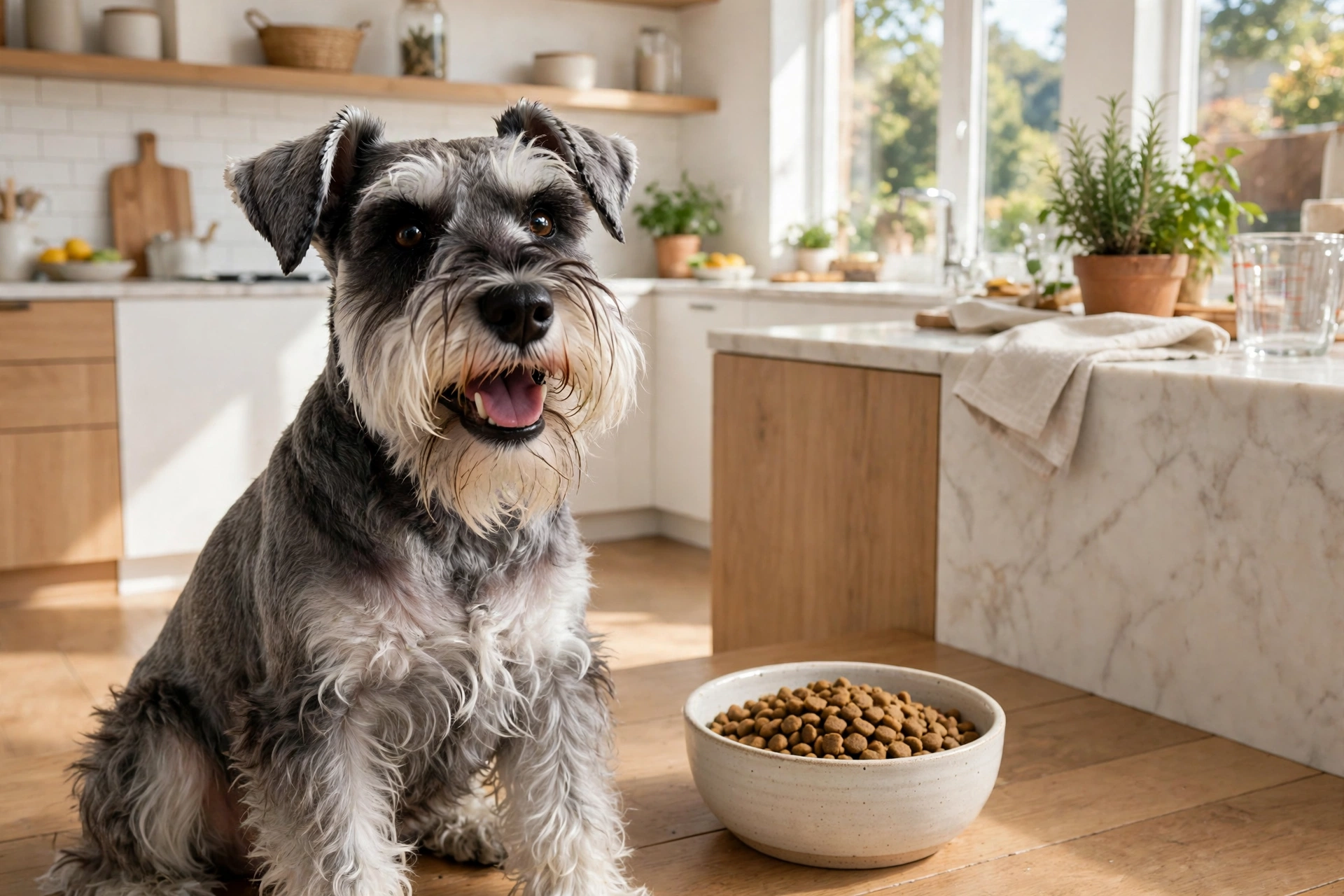
Best Dog Food for Miniature Schnauzers: 6 Top Picks (2026)
Miniature Schnauzers are small dogs with big appetites, strong opinions about dinner, and stomachs that do not forgive careless feeding. Pick the wrong food and you can end up with a pudgy, itchy, picky dog who turns his nose up at the bowl. Pick the right one and you get steady energy, a shiny wiry coat, firm stools, and a healthy weight that is easy to maintain.
This guide covers the best dog food for Miniature Schnauzers in 2026: six foods chosen for this breed’s real needs, not just for small dogs in general. Based on ingredient analysis, brand reputation, and owner reviews, we compare a breed-specific formula, a vet-trusted everyday kibble, a budget pick, a chicken-free fish recipe for sensitive skin, and two premium small-breed options. You will also find portion guidance by body weight, the fat question every Schnauzer owner should understand, and what to avoid.
Key Takeaways
- For most adult Miniature Schnauzers, a moderate-fat food (around 12–16% fat) with a named meat as the first ingredient is the safest starting point.
- Royal Canin Miniature Schnauzer Adult is the only pick made specifically for this breed, with kibble shaped for a Schnauzer’s muzzle and scissor bite.
- Measure every meal. Schnauzers gain weight easily, and free-feeding is the fastest route to an overweight dog.
- For itchy skin or a sensitive stomach, a fish-based or limited-ingredient recipe often works better than another chicken kibble.
- Switch foods slowly over 7–10 days, and keep treats under 10% of daily calories.
Our Top Picks at a Glance
| Product | Best For | Key Feature |
|---|---|---|
| Royal Canin Breed Health Nutrition Miniature Schnauzer Adult | Best overall / breed-specific | Kibble shaped for a Schnauzer’s bite, skin and weight support |
| Hill’s Science Diet Adult Small & Mini Chicken & Barley | Best everyday vet-trusted pick | Easy-to-digest ingredients, small kibble, omega-6 for skin and coat |
| IAMS Proactive Health Adult Minichunks | Best budget pick | Small kibble, real chicken first, solid nutrition at a low price |
| Blue Buffalo Life Protection Formula Small Breed Adult Chicken & Brown Rice | Best for everyday health | Real chicken, antioxidant-rich LifeSource Bits, small-breed kibble |
| Nulo FreeStyle Small Breed Salmon & Lentils | Best chicken-free / sensitive skin | Deboned salmon first, probiotics, no chicken protein |
| Nutro Ultra Small Breed Adult | Best premium trio-protein | Chicken, lamb, and salmon with 15 superfoods |
Why Miniature Schnauzers Need a Different Kind of Food
Most small-breed foods are built for a generic small dog. Miniature Schnauzers have a few breed quirks that change what “good” looks like, and most competitor roundups barely mention them.
Start with weight. Adult Miniature Schnauzers typically weigh 11–20 pounds, and they are famously food-motivated. They beg convincingly, they finish every bowl, and they gain weight on portions that look small to a human. Extra weight strains their joints and worsens their other health risks, so calorie control matters more than any superfood on the label.
Then fat. Miniature Schnauzers are known to be more prone to pancreatitis and to high blood fat (hyperlipidemia) than many breeds. That does not mean every Schnauzer needs a low-fat prescription diet, but it does mean very rich, high-fat foods are a poor default. A moderate fat level, roughly 12–16% on a dry-food label, suits most healthy adult Schnauzers. Several popular high-protein foods run 17–18% fat or more, which is fine for a very active dog but a needless gamble for a couch-loving Schnauzer. If your dog has ever had pancreatitis, ask your vet before choosing any food here.
Third, urinary health. The breed is also prone to calcium oxalate bladder stones. No kibble can promise to prevent stones, but two habits help: always keep fresh water available, and do not add calcium supplements to a complete diet unless your vet tells you to. A spoonful of wet food as a topper also adds moisture, which supports urinary health.
Fourth, skin and stomach. Schnauzers are prone to itchy skin and food sensitivities. When itching or loose stools appear, the culprit is often a protein the dog has eaten for years, most commonly chicken or beef. That is why a fish-based recipe earns a place in this list, and why our guide to the best dog food for sensitive stomachs pairs well with this one.
Finally, teeth and beards. Small breeds build tartar faster than large dogs, so crunchy small kibble that encourages chewing helps, though it never replaces brushing. And that famous beard traps wet food and odors, so a quick wipe after meals keeps it clean.
Royal Canin Breed Health Nutrition Miniature Schnauzer Adult
If you want one food designed for this breed and no other, this is it. Royal Canin Miniature Schnauzer Adult is made for purebred Miniature Schnauzers 10 months and older, and it shows in the details. The kibble is sized and shaped for a Schnauzer’s muzzle and scissor bite, which helps with pickup and chewing, and the formula targets the breed’s two biggest issues: skin health and weight control.
The guaranteed analysis reads 23% crude protein, 10% crude fat, and 3.5% crude fiber, at about 309 calories per cup. That 10% fat level is the lowest in this roundup and a genuine advantage for a breed prone to weight gain and fat sensitivity. Skin support comes from EPA and DHA fatty acids plus vitamin A, aimed at the breed’s sensitive skin and coat. The first ingredients are brewer’s rice followed by chicken by-product meal, which some owners dislike on principle, but the formula’s breed-specific design and moderate calories are hard to argue with in practice.
Who it is for: adult Schnauzers 10 months and up, especially dogs that gain weight easily or have mildly sensitive skin. Who should skip it: owners who insist on a named meat meal as the first ingredient, or dogs with a confirmed chicken sensitivity.
Hill’s Science Diet Adult Small & Mini Chicken & Barley
Hill’s Science Diet is the dependable, vet-trusted workhorse of this list. The Adult Small & Mini recipe leads with real chicken, uses barley and other easy-to-digest carbohydrates, and adds omega-6 fatty acids and vitamin E for skin and coat health. The kibble is small enough for a Schnauzer’s mouth, and the recipe is widely available in US pet stores, which matters when you need a bag this week rather than after a shipping delay.
What stands out here is digestibility. Hill’s builds this line around gentle digestion, and owner reviews consistently report firm stools and good acceptance by picky small dogs. It is a grain-inclusive food, which suits most Schnauzers: unless your dog has a diagnosed grain sensitivity, grains like barley are a useful, digestible energy source, not a filler to fear.
Who it is for: owners who want a safe, easy-to-find everyday food with a long track record. If your Schnauzer does well on chicken and has no special health issues, this is the least risky choice on the list. For dogs that need stricter weight control, compare it with our guide to the best dog food for weight loss before deciding.
IAMS Proactive Health Adult Minichunks
Good Schnauzer food does not have to cost a premium. IAMS Proactive Health Adult Minichunks gives you real chicken as the first ingredient, small bite-sized kibble, and a complete, balanced formula at one of the lowest prices in this roundup. The guaranteed analysis is 25% crude protein, 14% crude fat, and 4% crude fiber, at about 380 calories per cup, which sits comfortably inside the moderate-fat range for this breed.
The recipe adds omega-6 fatty acids for skin and coat, plus beet pulp and other fibers for digestion. It is a grain-inclusive food with whole-grain corn and sorghum, so it is not the pick for a dog with a confirmed grain sensitivity. But for a healthy adult Schnauzer on a budget, it covers the fundamentals: named protein first, small kibble, moderate fat, and an AAFCO complete-and-balanced statement.
Who it is for: multi-dog households, budget-conscious owners, and Schnauzers that eat enthusiastically and need portion discipline more than a premium ingredient list. Measure carefully, because at 380 calories per cup this food is more calorie-dense than the Royal Canin pick, so the same cup feeds a bigger share of the daily budget.
Blue Buffalo Life Protection Formula Small Breed Adult Chicken & Brown Rice
Blue Buffalo’s Life Protection Formula is a strong middle-ground choice: real deboned chicken first, brown rice and oatmeal for digestible energy, and the brand’s LifeSource Bits, a blend of antioxidants, vitamins, and minerals mixed into the kibble. The guaranteed analysis is 26% crude protein, 15% crude fat, and 4% crude fiber, at about 396 calories per cup.
At 15% fat it stays within the moderate range for most Schnauzers, while the higher protein suits active dogs that walk, hike, or play hard. The small-breed kibble size works well for Schnauzer jaws, and the recipe includes omega-3 and omega-6 fatty acids for skin and coat, plus glucosamine for joint support.
Who it is for: active adult Schnauzers that need a bit more protein and energy than a weight-control formula offers. If your dog is already overweight or mostly sedentary, the Royal Canin or Hill’s pick will serve you better, since this food’s 396 calories per cup add up fast in a small bowl.
Nulo FreeStyle Small Breed Salmon & Lentils
When a Schnauzer itches, scratches, or has recurring stomach upsets on chicken-based foods, changing the protein is often more useful than changing the brand. Nulo FreeStyle Small Breed Salmon & Lentils leads with deboned salmon, followed by turkey meal and menhaden fish meal, and it contains no chicken protein, egg, corn, wheat, or soy. That makes it the best pick in this roundup for dogs with suspected chicken sensitivity.
The small-breed kibble is extra small, which suits Schnauzer mouths, and the recipe includes the BC30 probiotic for digestive support, plus flaxseed and salmon-derived omega fatty acids for skin and coat. It is grain-free, using lentils, sweet potatoes, and chickpeas instead of grains. Grain-free is not better by default, but for a dog that genuinely reacts to grains, or to chicken, this combination solves both problems at once.
Who it is for: Schnauzers with itchy skin, dull coats, or sensitive stomachs that have not improved on chicken kibble, and owners who want a fish-first recipe. Give it a full 6–8 weeks before judging skin results, since coat changes take time. If loose stools are the main problem rather than itching, read our sensitive-stomach guide alongside this pick.
Nutro Ultra Small Breed Adult
Nutro Ultra Small Breed Adult is the premium pick for owners who want variety and nutrient density in one bag. It starts with real chicken as the number one ingredient, then adds lamb meal and salmon meal for a trio of proteins, plus a blend of 15 superfoods including coconut, chia seed, kale, blueberries, and pumpkin. It contains no chicken by-product meal, corn, wheat, or soy protein, and no artificial flavors, colors, or preservatives.
One honest flag: at around 27% protein and 17% fat, this is the richest food in this roundup, just above the moderate-fat range recommended above. That makes it a great fit for active, lean Schnauzers, and a less ideal fit for overweight or pancreatitis-prone dogs.
Who it is for: active adult Schnauzers, picky eaters who get bored with single-protein foods, and owners who want a superfood-rich recipe. For a broader look at small-breed feeding in general, see our guide to the best dog food for small breeds.
How Much Should a Miniature Schnauzer Eat?
Bag guidelines are a starting point, not a prescription. Most healthy adult Miniature Schnauzers need roughly 300–450 calories a day, depending on weight and activity, split into two meals. Use this table as a starting point, then adjust by body condition: you should be able to feel the ribs under a thin layer of fat, and see a visible waist from above.
| Adult Weight | Typical Daily Amount (dry food) | Meals Per Day |
|---|---|---|
| 11–13 pounds | 3/4 – 1 cup | 2 |
| 14–16 pounds | 1 – 1 1/4 cups | 2 |
| 17–20 pounds | 1 1/4 – 1 1/2 cups | 2 |
Three rules keep portions honest. Use a measuring cup, never a guess, and check the calories per cup on your specific food, since this list ranges from about 309 to 396 calories per cup. Count treats too: treats and table scraps should stay under 10% of daily calories, which for a Schnauzer means just a few small treats a day. Third, weigh your dog monthly. A half-pound gain on a 14-pound dog is nearly 4% of body weight, and it is much easier to catch early than to reverse later.
Puppies and seniors eat differently. Schnauzer puppies need a puppy formula with more calories and nutrients for growth until about 10–12 months, and seniors often need fewer calories with joint support. For puppy feeding basics, see our guide to the best puppy food for small breeds. This article focuses on healthy adults, which is where most Schnauzer owners start.
Buying Guide: What to Look For
A named meat first
Look for deboned chicken, salmon, lamb, or a named meat meal as the first ingredient. Vague terms like “meat meal” or “animal by-products” tell you nothing about the protein source. Meat meals are not bad ingredients, they are concentrated protein, but they should still name the animal.
Moderate fat, and watch the calories per cup
For most adult Schnauzers, aim for roughly 12–16% fat on the label and compare calories per cup before you compare prices. A cheaper bag at 400 calories per cup can cost more per day than a premium bag at 310, because you feed less of the second one.
An AAFCO statement
Every food here should carry an AAFCO nutritional adequacy statement for adult maintenance (or all life stages). This confirms the recipe meets recognized nutrient profiles. If a food lacks one, skip it, no matter how attractive the marketing.
Fiber and digestibility
Moderate fiber, around 3–5%, plus digestible carbohydrates like rice, barley, or oatmeal, supports firm stools. Probiotics and prebiotic fibers are a bonus for dogs with touchy digestion, not a substitute for a good base recipe.
Skin and coat support
Omega-3 and omega-6 fatty acids, vitamin E, and zinc all support the wiry Schnauzer coat and its itch-prone skin. Fish-based recipes bring omega-3s naturally; chicken-based recipes usually add them through flaxseed or fish oil.
Kibble size and dental health
Small, crunchy kibble fits a Schnauzer’s mouth and encourages chewing, which helps slow tartar buildup. Whatever you feed, brush your dog’s teeth or use vet-approved dental chews, because kibble alone will not prevent dental disease.
Grain-free only when there is a reason
Grain-free foods are not healthier by default. They help dogs with a diagnosed grain sensitivity, and they are the right choice if your vet has identified one. For other Schnauzers, grain-inclusive foods with rice, barley, or oatmeal are digestible, affordable, and perfectly appropriate.
What to Avoid
- Very high-fat foods and fatty table scraps. Rich foods, fried leftovers, and fatty meat trimmings are the classic triggers owners regret. For a breed prone to pancreatitis, the scrap bowl is riskier than the kibble bag.
- Free-feeding. Leaving the bowl full all day removes your only control over weight. Feed measured meals, pick the bowl up after 20–30 minutes, and you will know immediately if appetite changes.
- Foods without an AAFCO statement. Boutique, homemade-style, or imported foods sometimes skip this. Without it, you cannot be sure the recipe is complete.
- Switching foods overnight. A sudden change is the most common cause of a week of loose stools that gets blamed on the new food. Transition over 7–10 days instead.
- Calcium or vitamin supplements on top of a complete food. Extra calcium will not strengthen bones and can contribute to urinary stone risk in this breed. Supplement only on veterinary advice.
- Toxic foods, always. Chocolate, grapes and raisins, onions, garlic, xylitol (birch sugar) in sugar-free products, and cooked bones that can splinter should never reach a Schnauzer’s bowl.
Switching Foods and Handling a Picky Schnauzer
Switch over 7–10 days: roughly 25% new food for days 1–3, 50% for days 4–6, 75% for days 7–9, then 100% new. If stools loosen, hold at the current ratio for an extra day or two before moving on. A brief soft stool during a switch is normal; persistent diarrhea, vomiting, or refusal to eat for more than a day is a reason to call your vet.
For picky Schnauzers, resist rotating foods every week, which teaches the dog that refusing dinner produces something better. Instead, offer the new food for 20 minutes, then remove it until the next meal. Warming the food slightly, or adding a spoonful of low-sodium wet food as a topper, often helps without changing the base diet. If pickiness comes with weight loss, vomiting, or lethargy, that is not fussiness, it is a vet visit.
Our Recommendation
For most adult Miniature Schnauzers, start with Royal Canin Miniature Schnauzer Adult: it is the only breed-specific formula here, its moderate 10% fat suits the breed’s weight and pancreatitis risk, and its kibble fits a Schnauzer’s bite. If the price or the chicken by-product meal puts you off, Hill’s Science Diet Adult Small & Mini is the safest everyday alternative, and IAMS Minichunks is the best value.
If itchy skin or a sensitive stomach is the main problem, try Nulo FreeStyle Small Breed Salmon & Lentils and judge it over 6–8 weeks. Active, lean Schnauzers that need more energy will do well on Blue Buffalo Small Breed or Nutro Ultra, provided portions are measured strictly.
Whatever you choose, measure every meal, keep treats small, and watch the waistline, not just the bowl.
This guide is for information only — check with your vet for your dog’s specific needs.
What is the best dog food for a Miniature Schnauzer?
For most healthy adults, Royal Canin Miniature Schnauzer Adult is the best starting point because it is made specifically for the breed, with moderate 10% fat and kibble shaped for a Schnauzer’s bite. Hill’s Science Diet Adult Small & Mini is the safest everyday alternative, and IAMS Minichunks is the best budget pick.
How much should a Miniature Schnauzer eat per day?
Most healthy adults need roughly 300–450 calories a day, split into two meals — about 3/4 to 1 1/2 cups of dry food depending on weight and the food’s calories per cup. Measure every meal, keep treats under 10% of daily calories, and adjust by body condition.
Are Miniature Schnauzers prone to pancreatitis from fatty food?
The breed is known to be more prone to pancreatitis and high blood fat than many breeds. Very rich, high-fat foods and fatty table scraps raise the risk, so most healthy adults do best on a moderate-fat food around 12–16% fat. Dogs with a history of pancreatitis need a vet-approved diet.
Is grain-free food better for Miniature Schnauzers?
Not by default. Grain-free helps dogs with a diagnosed grain sensitivity, but for most Schnauzers grain-inclusive foods with rice, barley, or oatmeal are digestible and appropriate. Choose grain-free only when there is a specific reason, such as a confirmed sensitivity.
What food helps a Miniature Schnauzer with itchy skin?
A fish-based recipe such as Nulo FreeStyle Small Breed Salmon & Lentils often helps, since chicken is a common trigger and fish brings omega-3 fatty acids for skin and coat. Allow 6–8 weeks to judge skin results, and see your vet if itching is severe or comes with sores or hair loss.
Can Miniature Schnauzers eat wet food every day?
Yes, a complete and balanced wet food can be fed daily, but most owners use mainly dry kibble with a little wet food as a topper. Dry kibble helps with chewing and dental health, while wet food adds moisture and flavor — and it can stain the Schnauzer’s beard, so wipe it after meals.
How do I switch my Miniature Schnauzer to a new food?
Switch over 7–10 days: about 25% new food for days 1–3, 50% for days 4–6, 75% for days 7–9, then fully new. If stools loosen, hold at the current ratio for an extra day or two. Persistent diarrhea, vomiting, or refusal to eat for more than a day warrants a vet call.
Why is my Miniature Schnauzer so picky?
Schnauzers quickly learn that refusing dinner can produce something better. Offer the food for 20 minutes, then remove it until the next meal, and avoid rotating foods weekly. Warming the food slightly or adding a spoonful of wet topper often helps. Pickiness with weight loss, vomiting, or lethargy is a vet visit, not fussiness.

4 Comments