
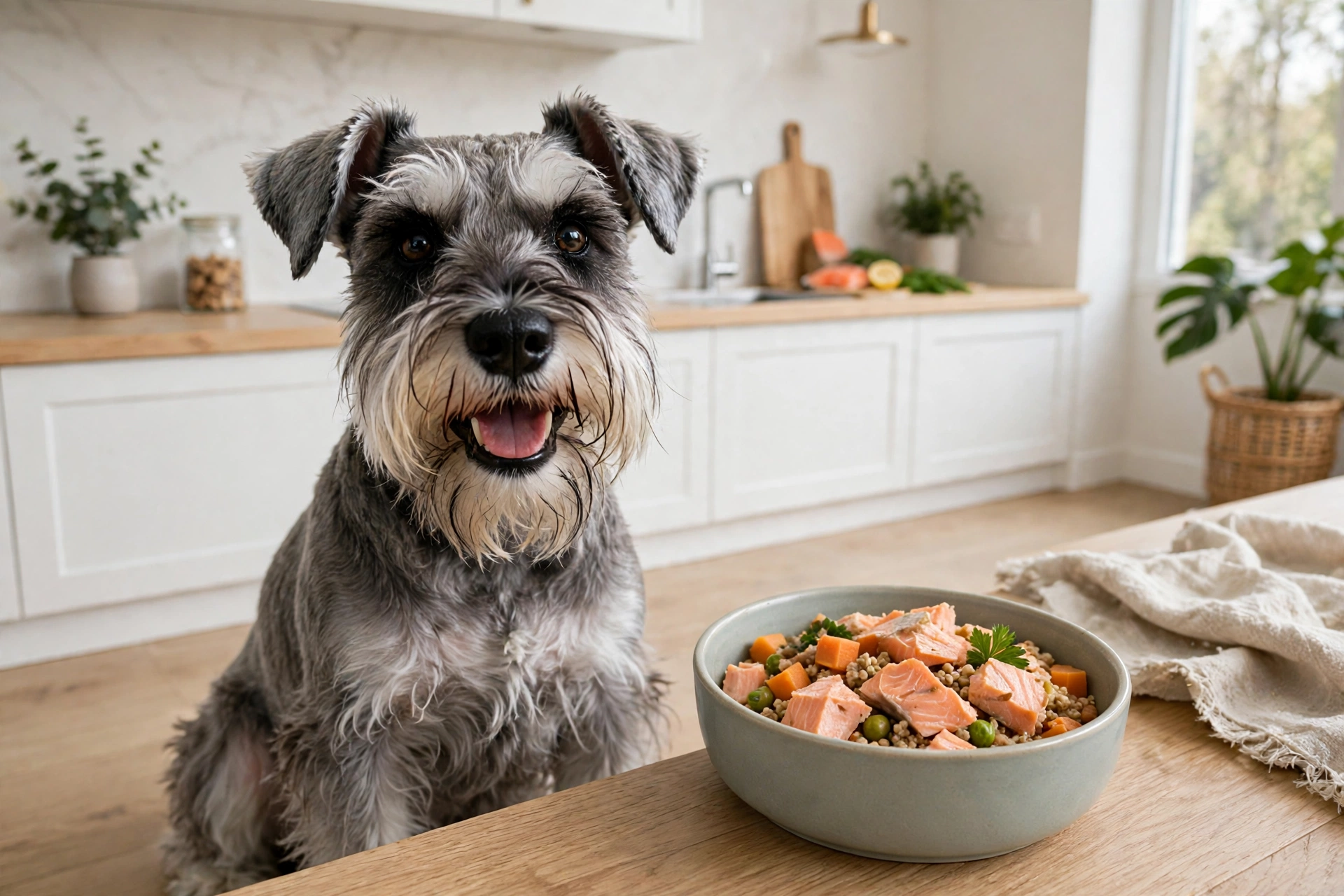
Best Food for Miniature Schnauzer Sensitive Stomach: Salmon-based Picks for pancreatitis-safe, low-fat feeding
If your Miniature Schnauzer has a sensitive stomach, mealtimes can feel like a gamble. One day the bowl is empty and the stools are firm; the next, you are cleaning up loose stools, listening to a gurgling belly, or watching a normally greedy little dog walk away from food. The best food for a Miniature Schnauzer with a sensitive stomach is not just a bag labelled gentle. It is a formula that respects this breed’s particular weakness: a pancreas that overreacts to fat. Merck lists Miniature Schnauzers as dramatically overrepresented among dogs with pancreatitis, and the breed is also prone to high blood fat, so low fat matters at least as much as the protein on the front of the bag. Our guide to the Best Dog Food for Sensitive Stomachs covers the general rules, and this page applies them to Schnauzers.
This guide covers six gentle, real US formulas that work well for sensitive Schnauzers, explains what to look for (and what to avoid) on the label, and gives you a practical transition and food-diary plan that most competitor guides skip entirely. Based on ingredient analysis, brand reputation, and owner reviews, these picks favor limited ingredients, moderate fat, digestible carbohydrates, and added gut support, without promising a cure for any medical condition.
Key Takeaways
- Miniature Schnauzers are prone to pancreatitis, so fat matters as much as the protein. For a dog with pancreatitis, Merck puts the fat target under 20 g of fat per 1,000 kcal, so skip rich, fatty treats and table scraps.
- Single-protein, limited-ingredient recipes make it far easier to spot a trigger. Beef, chicken, and dairy are the most commonly reported culprits.
- Look for digestible carbs (rice, oatmeal, potato, sweet potato), added prebiotics or probiotics, and an AAFCO complete-and-balanced statement for adult maintenance.
- Transition over 10 to 14 days, not 7, for a sensitive Schnauzer, and keep a simple food diary so you can see what actually changed.
- If vomiting, diarrhea, blood in the stool, or weight loss lasts more than a day or two, or keeps coming back, talk to your vet. A food change cannot fix everything.
Our Top Picks at a Glance
| Product | Best for | Protein | Fat | kcal/cup | Bag size | Chewy price | Cost/month |
|---|---|---|---|---|---|---|---|
| Royal Canin Miniature Schnauzer Adult | Breed-specific everyday feeding | 23% | 10% | 309 | 10 lb | $61.99 | ~$55/mo |
| Wellness Simple Limited Ingredient Diet, Grain-Free Small Breed Salmon & Potato | Spotting a food trigger | 29% | 13% | 450 | 10.5 lb | $53.97 | ~$45 to $56/mo |
| Merrick Limited Ingredient Diet, Real Salmon & Brown Rice | Grain-inclusive gentle option | 24% | 14% | 462 | 22 lb | $75.98 | ~$35/mo |
| Canidae PURE Limited Ingredient, Salmon & Sweet Potato | Probiotic support | 33% | 14% | 484 | 22 lb | $74.79 | ~$19 to $42/mo |
| Hill’s Science Diet Sensitive Stomach & Skin, Small & Mini Adult 1 to 6 | Small-breed sensitive stomachs | 21% | 12% | 380 | 15 lb | $62.99 | ~$36/mo |
| Purina Pro Plan Sensitive Skin & Stomach, Salmon & Rice (adult standard) | Budget-friendly gentle staple | 26% | 16% | 449 | 30 lb | $77.48 | ~$20 to $26/mo |
Prices checked on Chewy on Nov 13, 2026. Protein and fat are the minimums from each label’s guaranteed analysis, and kcal per cup comes from the official brand label.
Royal Canin Miniature Schnauzer Adult Dry Dog Food
Royal Canin’s breed-specific adult formula is the most Schnauzer-tailored pick on this list, and that shows in the details. The kibble is shaped for a Schnauzer’s jaw, the recipe carries skin and coat support, and at 10% fat it is the lowest-fat pick here, which is exactly what a pancreatitis-prone breed needs. Glucosamine is on the label for joints, and prebiotic fibers such as dried chicory root, fructooligosaccharides, and psyllium seed husk support the gut. Fish oil adds omega-3s. This is the pick to start with when no single ingredient is under suspicion, because it is built for the breed, not for a food trial.
It is not a limited-ingredient food, so if you are still hunting for a specific trigger, one of the single-protein picks below will serve you better. The recipe includes chicken by-product meal, so it is out if chicken is the suspect, and at $6.20 a pound it is the priciest food on this list. For a 15 lb adult, the label feeding guide gives 1.5 cups a day, which is 464 kcal.
Price and kibble: $61.99 for a 10 lb bag on Chewy (checked Nov 13, 2026), about $55 a month at 1.5 cups a day. Kibble size: made for a Schnauzer’s jaw, per Royal Canin, with no published dimension.
Pros: lowest fat on the list at 10%; breed-specific kibble and nutrients; glucosamine on the label; prebiotic fibers for gut health.
Cons: not limited-ingredient, so it cannot help you isolate a trigger; contains chicken by-product meal; the most expensive per pound here.
Wellness Simple Limited Ingredient Small Breed Salmon & Potato
Wellness Simple Limited Ingredient Small Breed Salmon & Potato When you do not know what is upsetting your Schnauzer, a short ingredient list is your best diagnostic tool. Salmon is the single protein and potato is the single main carb, with no chicken, corn, wheat, or soy to muddy the picture. Chicory root adds a prebiotic, and four probiotic strains support the gut. The recipe is AAFCO complete and balanced for adult maintenance.
The small-breed kibble size suits a Schnauzer’s mouth, and the salmon brings omega fatty acids that keep the coat glossy. The recipe also lists glucosamine and chondroitin for joints, which is a nice extra as your dog gets older. The catch is the price: the only bag is 10.5 lb, so even at $5.14 a pound it runs about $45 to $56 a month at 1 to 1.25 cups a day.
Price and kibble: $53.97 for a 10.5 lb bag on Chewy (checked Nov 13, 2026), about $45 to $56 a month at 1 to 1.25 cups a day. Kibble size: small-breed kibble, per Wellness, with no published dimension.
Pros: single salmon protein and a short list, ideal for a food trial; prebiotics plus probiotics; small-breed kibble; glucosamine and chondroitin on the label.
Cons: only a 10.5 lb bag, so the monthly cost runs high; 13% fat is moderate, not the lowest here; no grain-inclusive version if you want grains.
Merrick Limited Ingredient Real Salmon & Brown Rice
Merrick’s limited-ingredient recipe is the grain-inclusive cousin of the pick above, and that distinction matters. Some sensitive dogs do better with a little grain in the bowl, and brown rice, oatmeal, and barley are among the gentlest grains you can offer. Salmon is the single protein, and the recipe is free of chicken, dairy, corn, wheat, and soy, so there is little to hide behind if your dog reacts.
It also brings omega-3 and omega-6 fatty acids plus glucosamine, which is a nice bonus for an adult Schnauzer that is starting to slow down. The only downside: the kibble size is not published, so if you have a very small or elderly Schnauzer, you may want to check the kibble before committing to a full bag. Otherwise, this is an excellent limited-ingredient food for the money, and one of the cheapest ways to feed salmon to your Schnauzer every day.
Price and kibble: $75.98 for a 22 lb bag on Chewy (checked Nov 13, 2026), about $35 a month at 1.25 cups a day, or $3.45 a pound. Kibble size: not published.
Pros: grain-inclusive for dogs that do better with grains; single salmon protein; good value at $3.45 a pound; omega-3 and omega-6 fatty acids.
Cons: kibble size not published; not for dogs that need grain-free; 24% protein is lower than some salmon picks here.
CANIDAE PURE Real Salmon & Sweet Potato
CANIDAE PURE is built around salmon and salmon meal at the top of the list, with sweet potato as the gentle carb. That short ingredient list makes it a strong choice when you are trying to work out what your Schnauzer reacts to. The recipe is grain-free and free from corn, wheat, and soy, and the sweet potato brings soluble fibre that most sensitive stomachs handle well. A blend of probiotics is added after cooking to support gut health. Canidae has renamed this line Pure Farm to Bowl, so the bag you receive may say Farm to Bowl instead of PURE; it is the same salmon and sweet potato recipe.
The recipe is grain-free and suits dogs that do better without grains, though it is worth remembering that grain-free is not automatically gentler for every dog. At 33% protein it is the highest-protein pick on this list, and at 484 kcal per cup it is also the most calorie-dense, so the bowl looks smaller than you might expect. Watch the portion size as you would with any calorie-dense kibble, and give it a full two to three weeks before judging it, gut bacteria do not rebuild overnight, and most competitor guides that promise results in a few days are overselling.
Price and kibble: $74.79 for a 22 lb bag on Chewy (checked Nov 13, 2026), about $19 to $42 a month depending on how much your dog eats, or $3.40 a pound. Kibble size: not published.
Pros: highest protein here at 33%; probiotics added after cooking; grain-free; good value per pound.
Cons: 484 kcal per cup is the most calorie-dense pick, so portions need care; kibble size not published; the label feeding band covers 10 to 25 lb, so you will need to weigh portions rather than eyeball them.
Hill’s Science Diet Sensitive Stomach & Skin Small & Mini
Hill’s Sensitive Stomach & Skin in the Small & Mini size is designed exactly for this scenario: a small dog with a touchy stomach and itchy skin. The recipe uses prebiotic fibre to feed the good gut bacteria, and it is made with a small kibble that is easy for a Schnauzer to pick up and chew. Omega-6 fatty acids and vitamin E support the skin and coat, which matters when a stomach problem and itchy skin arrive together.
It is a practical, widely available choice that pet stores tend to stock, which makes it easy to find and easy to stick with. At $62.99 for a 15 lb bag on Chewy (checked Nov 13, 2026), it works out to about $36 a month at 1.25 cups a day. The trade-off is the recipe itself: chicken and barley is a familiar combination rather than a novel one, so if chicken is the ingredient you suspect, this is not the pick for you.
Price and kibble: $62.99 for a 15 lb bag on Chewy (checked Nov 13, 2026), about $36 a month at 1.25 cups a day, or $4.20 a pound. Kibble size: small kibble for small and mini breeds, per Hill’s, with no published dimension.
Pros: small kibble sized for a Schnauzer; prebiotic fibre for gut health; widely available; skin and coat support from omega-6 and vitamin E.
Cons: chicken-based, so it is no good if chicken is the suspect; 21% protein is the lowest here; 380 kcal per cup means a bigger bowl for the same calories.
Purina Pro Plan Sensitive Skin & Stomach Salmon & Rice
Purina Pro Plan’s Sensitive Skin & Stomach formula is the budget-friendly workhorse of this list, and the cheapest way to feed a sensitive Schnauzer over a full month. Salmon is the first ingredient, oatmeal and rice are gentle, digestible carbs, and live probiotics are added to support digestion. This is a good choice if you have already worked out that your Schnauzer tolerates fish and grains, and that you do not need a limited-ingredient recipe.
The brand’s size and long research history count for something when you are feeding a dog with a sensitive stomach. It also contains omega-3 and omega-6 fatty acids, which are good for your dog’s skin and coat, and it is the most affordable pick on this list. At $77.48 for a 30 lb bag on Chewy, it costs $2.58 per pound. At 449 kcal per cup, it costs about $20 to $26 a month. The catch is that the kibble is a standard size rather than a small-breed kibble, so very small or older Schnauzers may prefer a smaller kibble.
Price and kibble: $77.48 for a 30 lb bag on Chewy (checked Nov 13, 2026), about $20 to $26 a month at 1 to 1.33 cups a day, or $2.58 a pound. Kibble size: standard size, not a small-breed kibble.
Pros: cheapest per pound at $2.58; salmon first with live probiotics; big 30 lb bag lasts well; widely available.
Cons: standard-size kibble, not small-breed; not a limited-ingredient recipe, so it cannot help you isolate a trigger; 16% fat is the highest on this list.
Why Miniature Schnauzers Get Sensitive Stomachs
It is worth saying plainly: no major source, not the AKC, the VCA, Merck, or the breed club, lists Miniature Schnauzers as prone to sensitive stomachs as such. What they do list is more specific, and it matters more. Merck lists Miniature Schnauzers as dramatically overrepresented among dogs with pancreatitis, with a possible genetic predisposition, and the breed is also prone to hyperlipidemia, high levels of fat in the blood, which Merck and the American Miniature Schnauzer Club both note. That is why fat, not just the protein, is the thing to watch on the label. For a dog with pancreatitis, Merck puts the fat target under 20 g of fat per 1,000 kcal, which is the only fat figure an established veterinary source gives, and it is the number this guide works to. A sudden fatty meal is the classic trigger, so the rich scraps and fatty treats in the What to Avoid section below are not a small thing for this breed.
Miniature Schnauzers are also prone to calcium oxalate bladder stones, according to Merck, so fresh water should always be down, and a splash of water in the kibble never hurts. And if the real problem is itching, red ears, or sore paws rather than loose stools, the issue may be skin, not stomach; our guide to the Best Food for Miniature Schnauzer Skin Allergies covers that side of things.
How Much to Feed: Daily Amounts for a 15 lb Adult
These amounts come from the feeding guides on each label, and amounts are for a 15 lb adult dog. Your dog’s exact need depends on age and activity, so treat the label as the starting point and adjust by body condition. If you want the full picture by age and weight, our Miniature Schnauzer Feeding Guide walks through it.
| Product | kcal/cup | Cups/day | kcal/day | Chewy price | Cost/month |
|---|---|---|---|---|---|
| Royal Canin Miniature Schnauzer Adult | 309 | 1.5 | 464 | $61.99 / 10 lb | ~$55/mo |
| Wellness Simple Limited Ingredient Diet, Grain-Free Small Breed Salmon & Potato | 450 | 1 to 1.25 | 450 to 563 | $53.97 / 10.5 lb | ~$45 to $56/mo |
| Merrick Limited Ingredient Diet, Real Salmon & Brown Rice | 462 | 1.25 | 578 | $75.98 / 22 lb | ~$35/mo |
| Canidae PURE Limited Ingredient, Salmon & Sweet Potato | 484 | 0.62 to 1.38 | 300 to 668 | $74.79 / 22 lb | ~$19 to $42/mo |
| Hill’s Science Diet Sensitive Stomach & Skin, Small & Mini Adult 1 to 6 | 380 | 1.25 | 475 | $62.99 / 15 lb | ~$36/mo |
| Purina Pro Plan Sensitive Skin & Stomach, Salmon & Rice (adult standard) | 449 | 1 to 1.33 | 449 to 597 | $77.48 / 30 lb | ~$20 to $26/mo |
Amounts are for a 15 lb adult dog. Prices checked on Chewy on Nov 13, 2026. Canidae’s label band covers 10 to 25 lb, so its range is wide; weigh the food rather than eyeballing it.
Buying Guide: What to Look for in a Sensitive-Stomach Food
The general rules behind this list are covered in our hub guide to the Best Dog Food for Sensitive Stomachs. Here is the short version, with the Schnauzer details.
Protein source. Start with one named animal protein (salmon, lamb, or turkey) rather than a blend of three meats plus meat meal. A single protein makes it far easier to tell whether a food agrees with your dog.
Fat level. For a Schnauzer, fat is the number that matters most. For a dog with pancreatitis, Merck puts the target under 20 g of fat per 1,000 kcal. On this list, Royal Canin is the lowest at 10% fat and Purina the highest at 16%.
Fibre. Aim for roughly 2 to 5% crude fibre. Soluble fibres such as beet pulp, pumpkin, and oat fibre slow digestion down and firm stools up, while a long list of peas and lentils can do the opposite in some dogs.
Digestible carbohydrates. Rice, oatmeal, barley, potato, and sweet potato are usually well tolerated. A long list of peas, lentils, and chickpeas is a flag, not a feature, for a sensitive stomach.
AAFCO statement. Check the bag for a statement that the food is complete and balanced for adult maintenance (or all life stages). That statement is your baseline assurance that the recipe is not just gentle, but nutritionally complete.
Kibble size and format. Small-breed kibble encourages chewing and slows eating. If your Schnauzer inhales food, a slow-feeder bowl helps more than a bigger kibble. The three small-breed picks on this list, Royal Canin, Wellness Simple Small Breed, and Hill’s Small and Mini, all use a smaller kibble; the other three do not publish a kibble size.
Joint support. For an older Schnauzer, look at the label extras. Royal Canin and Wellness Simple both list glucosamine, and the salmon in every pick on this list brings omega-3 fatty acids, including EPA and DHA. That is a reasonable tie-breaker between two foods that otherwise suit the stomach, not a treatment, so a stiff or slow dog still needs a vet visit.
What to Avoid
- Fatty table scraps, bacon, sausage, fried food, and rich leftovers. For a pancreatitis-prone breed, these are the classic flare trigger, not a harmless treat.
- Sudden food changes, even to a better food. A sensitive Schnauzer’s gut needs a slow handover, not a cold swap.
- Foods with vague ingredients (meat meal, animal fat) when you are trying to identify a trigger. You cannot test what you cannot name.
- Overfeeding, free-feeding, and a treat drawer that adds up to a second meal. Treats should stay under 10% of daily calories.
- Rawhide, fatty bones, and rich dental chews during a sensitive period. They are a common hidden cause of a bad week.
- Switching foods every few days when stools are soft. Give each change a fair trial (see below) or you will never learn what actually works.
Feeding a second small breed? Our guides to the Best Food for Yorkshire Terrier Sensitive Stomach and the Best Food for Poodle Sensitive Stomach use the same low-fat, limited-ingredient approach.
The 10 to 14 Day Transition Plan (and the Food Diary Competitors Skip)
Most guides tell you to transition over seven days. For a sensitive Miniature Schnauzer, ten to fourteen days is a safer pace: a quarter new food for the first three days, half and half for the next four, three quarters new for the next four, then fully new food. If stools loosen at any step, stay at that step for two more days before moving on.
Keep a simple food diary for three weeks. Each day, note the food and amount, any treats or scraps, and the stool quality. It takes two minutes, and it is the only way to know whether the new food helped, or just the calendar.
Judge a new food after at least two to three weeks of consistent feeding, not after two good days. A gut takes time to settle, and a single firm stool is not a verdict.
Wet Food, Dry Food, or a Mix?
Dry food is convenient, helps with dental health, and makes portion control easy. Wet food adds moisture, which helps a breed prone to bladder stones, and it can tempt a dog that has gone off its food. Whatever format you choose, keep the protein and fat profile consistent. Swapping between a salmon kibble and a chicken wet food in the same week tells you nothing about either one.
When to See Your Vet
A sensitive stomach is common in this breed, but it is not always a food problem. See your vet promptly if vomiting repeats, diarrhea lasts more than 48 hours, there is blood in the stool, or your dog is losing weight. Those are signs to get checked, not signs to try another bag.
Our Recommendation
For most Miniature Schnauzers with a sensitive stomach, start with Wellness Simple Limited Ingredient Small Breed Salmon & Potato if you are still identifying a trigger, or Royal Canin Miniature Schnauzer Adult if you want a breed-specific everyday food and no single ingredient is under suspicion. Transition over 10 to 14 days, keep the diary, and give it three weeks. Purina Pro Plan Sensitive Skin & Stomach Salmon & Rice is an excellent, affordable long-term staple once you know salmon and grains agree with your dog. For more breed guidance, see our Best Dog Food for Miniature Schnauzer, our Miniature Schnauzer Feeding Guide, and our general Best Dog Food for Sensitive Stomachs.
Frequently Asked Questions
What is the best food for a Miniature Schnauzer with a sensitive stomach?
Start with a single-protein, limited-ingredient formula such as Wellness Simple Limited Ingredient Small Breed Salmon & Potato. Its short list makes it easy to spot a trigger, and the salmon and potato base is gentle. If no single ingredient is under suspicion, Royal Canin Miniature Schnauzer Adult is the breed-specific everyday option, and Purina Pro Plan Sensitive Skin & Stomach Salmon & Rice is the budget staple for the long term.
Why are Miniature Schnauzers prone to sensitive stomachs?
They are not listed as prone to sensitive stomachs as such. What is documented is narrower: Merck lists Miniature Schnauzers as dramatically overrepresented among dogs with pancreatitis, with a possible genetic predisposition, and the breed is also prone to hyperlipidemia, high fat in the blood. A pancreas that overreacts to fat is the real breed issue, which is why this guide leans low-fat and salmon-based.
Should I feed my sensitive Schnauzer a grain-free food?
Not necessarily. Grain-free does not automatically mean gentle, and digestible grains such as rice, oatmeal, and barley suit many sensitive dogs. What matters is the individual recipe: a single protein, a short ingredient list, moderate fat, and a feeding trial of two to three weeks.
How long should I take to switch my Schnauzer to a new food?
Take 10 to 14 days: 25% new food for days 1 to 3, 50/50 for days 4 to 7, 75% new for days 8 to 11, then fully new food from day 12. If stools loosen, hold at that step for two extra days before moving on, and judge the food after two to three weeks, not two days.
What treats are safe for a Miniature Schnauzer with a sensitive stomach?
Keep treats under about 10% of daily calories and choose simple, low-fat options that match the main food, so a salmon kibble pairs with a salmon treat, not a beef chew. Skip fatty table scraps, bacon, and rich dental chews during a sensitive period.
Is wet food or dry food better for a sensitive Schnauzer?
Both can work. Dry food makes portion control easy, while wet food or water added to kibble improves hydration, which matters for a breed prone to bladder stones. Keep the protein and fat the same in either format, and do not swap between proteins in the same week.
How many calories does a Miniature Schnauzer need per day?
It depends on weight, age, and activity, so the label’s feeding guide is your starting point, not a prescription. For a 15 lb adult, the label amounts on this page work out to about 450 to 600 kcal a day for most picks (Royal Canin 464, Wellness 450 to 563, Merrick 578, Hill’s 475, Purina 449 to 597), while Canidae’s wide 10 to 25 lb band runs 300 to 668, so weigh that one carefully. If your dog is gaining or losing weight on those amounts, adjust in small steps and check with your vet.
How often should I feed my Schnauzer?
Two to three meals a day suits most adult Miniature Schnauzers. Splitting the day’s food into two or three smaller meals is easier on a sensitive stomach than one large bowl, and it helps you keep portions honest. Puppies need more frequent, smaller meals, so check the feeding guide on the bag or ask your vet for a puppy schedule.




2 Comments