

Dachshund Feeding Guide: How Much, How Often & What to Feed (2026)
Quick Answer: Most adult Dachshunds do best on two measured meals a day, with portions matched to size, age, and the calories in your food. Puppies eat three meals a day until about 9 months old, then switch to two. Measure every meal, count treats inside the daily total, and keep your Dachshund lean to protect the back.
In This Guide
- Key Takeaways
- How Much Should a Dachshund Eat? The Quick Answer
- Dachshund Puppy Feeding Chart
- Adult Dachshund Feeding Chart: Portions by Weight and Calories
- Dachshund Feeding Schedule by Life Stage
- What to Feed a Dachshund
- Feeding a Senior Dachshund
- Treats and “Hidden” Calories
- Why Weight Control Matters So Much for Dachshunds
- How to Change Your Dachshund’s Food (7-Day Transition)
- A Sample Feeding Day
- Common Dachshund Feeding Mistakes
- Pros and Cons
- Conclusion
- Human Food for Dachshunds: What Is Safe and What Is Never Safe
Key Takeaways
- Most adult Dachshunds do best on two measured meals a day, roughly 1⅛ to 1½ cups of dry food for a miniature and 1⅝ to 2⅛ cups for a standard, adjusted for the food’s calorie density.
- Puppies eat three meals a day until about 9 months old, then switch to two. Seniors (around 7 to 8+) usually need fewer calories than they did as young adults.
- Measure every meal with a real measuring cup, count treats as part of the daily total (no more than about 10%), and never free-feed a Dachshund.
- Keeping your Dachshund lean is back protection, not vanity. Extra weight adds strain to a long spine already prone to intervertebral disc disease (IVDD).
- Use the charts below as a starting point, then adjust by body condition: you should feel the ribs easily and see a waist from above.
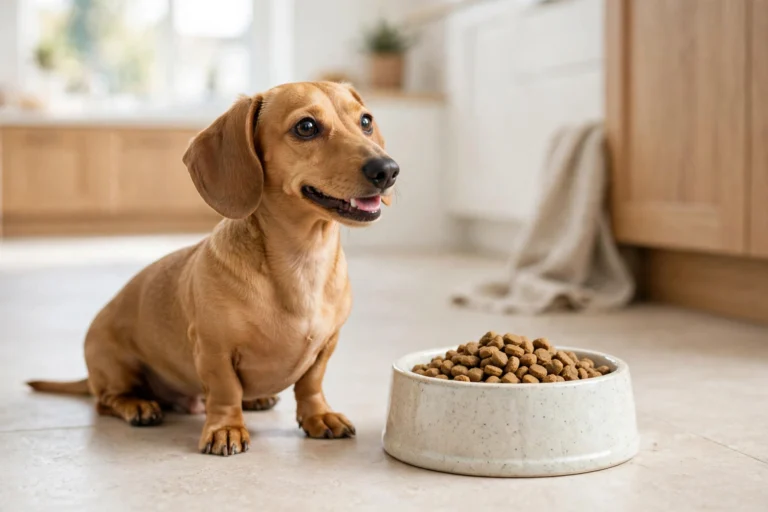
Dachshunds are small dogs with enormous appetites, and that combination is exactly what makes feeding them tricky. A Dachshund will happily convince you that the bowl was empty, the treat jar is running low, and dinner was somehow served to someone else. Give in too often, and the extra weight lands directly on the breed’s biggest vulnerability: that long, low back.
This Dachshund feeding guide takes the guesswork out of the bowl. You’ll find portion charts for miniature and standard Dachshund puppies, adults, and seniors, a feeding schedule for every life stage, calorie guidance by body weight, what to look for in a food, how to handle treats, and a simple plan for switching foods or fixing portions that have crept upward. Every number here is a starting point. Your Dachshund’s body condition and your vet fine-tune the rest.
How Much Should a Dachshund Eat? The Quick Answer
For a healthy adult Dachshund eating a typical dry food, use these daily totals as your baseline, split across two meals:
| Type | Meals per day | Dry food per day (total) |
|---|---|---|
| Miniature Dachshund (up to about 11 lb) | 2 | About 1⅛ to 1½ cups |
| Standard Dachshund (about 16 to 32 lb) | 2 | About 1⅝ to 2⅛ cups |
Those cup figures assume a standard-calorie kibble. Foods vary a lot in calorie density. A rich, high-fat formula can pack far more calories per cup than a weight-management one, so the food’s own feeding guide and its kcal/cup figure (printed on the bag as “calorie content”) always outrank a generic chart. When in doubt, feed by calories, not cups. The weight-based calorie table later in this guide shows how to do that.
Three things move your dog within (or beyond) these ranges: age, activity, and body condition. A young, active standard Dachshund who hikes every weekend needs the top of the range. A ten-year-old miniature who mostly supervises the couch from a blanket needs the bottom, or less. The scale and the rib check, covered below, tell you which.
Dachshund Puppy Feeding Chart
Dachshund puppies grow fast, but they should grow steadily, not as fast as possible. Overfeeding a puppy doesn’t build a bigger, stronger dog; it builds a heavier puppy whose developing skeleton and spine carry more load than they should. Small, frequent meals suit a puppy’s small stomach and keep blood sugar stable.
Feed a Dachshund puppy three meals a day until around 9 months old, then transition to two meals. The charts below give total cups per day (not per meal), assuming a quality puppy formula:
Miniature Dachshund Puppy Feeding Chart
| Age | Meals per day | Total cups per day |
|---|---|---|
| 2 months | 3 | About 1⅛ |
| 3 months | 3 | About 1¼ |
| 4 months | 3 | About 1¼ |
| 5 months | 3 | About 1⅜ |
| 6 months | 3 | About 1¼ |
| 7 months | 2 to 3 | About 1⅛ |
| 8 months | 2 | About 1 |
| 9 months | 2 | About 1 |
| 10 to 12 months | 2 | Feed as an adult |
Standard Dachshund Puppy Feeding Chart
| Age | Meals per day | Total cups per day |
|---|---|---|
| 2 months | 3 | About 1½ |
| 3 months | 3 | About 1¾ |
| 4 months | 3 | About 1⅞ |
| 5 months | 3 | About 2 |
| 6 months | 3 | About 1⅞ |
| 7 months | 2 to 3 | About 1¾ |
| 8 months | 2 | About 1½ |
| 9 months | 2 | About 1⅜ |
| 10 to 12 months | 2 | Feed as an adult |
Notice the pattern: portions rise to a peak around 5 months, then taper as growth slows. If your puppy is consistently finishing every meal in seconds and still looks lean with ribs you can feel, a small increase is reasonable. If the waist is disappearing, trim back. Puppies go through chunky and lanky phases, but they should never look round. For food recommendations by age, see our guides to the best puppy food for Dachshunds and the best dog food for Dachshunds.
When to Switch From Puppy Food to Adult Food
Most Dachshunds switch to adult food at around 10 to 12 months old. “Tweenie” Dachshunds that fall between miniature and standard sizes generally follow the same window. Go by your dog’s growth rather than the calendar alone. If your puppy is still growing fast, keep the puppy formula and re-check in four weeks. If your Dachshund is already at adult height and weight, move over. In both cases, the switch itself should be gradual (the 7-day transition plan below). Sudden changes are what upset stomachs.
Adult Dachshund Feeding Chart: Portions by Weight and Calories
Cup charts work well when you feed one food consistently, but calories are the more honest measure. They travel across brands, between kibble and wet food, and into treat math. To compare foods fairly, use your dog’s ideal weight, not their current weight if they need to slim down.
| Dog’s weight | Dry food per day (total) | Approximate calories per day |
|---|---|---|
| 5 lb | About ½ cup | 175 to 200 kcal |
| 10 lb | About 3/4 to 1 cup | 300 to 350 kcal |
| 15 lb | About 1 to 1 1/4 cups | 450 to 500 kcal |
| 20 lb | About 1 1/4 to 1 1/2 cups | 550 to 600 kcal |
| 25 lb | About 1 1/2 to 1 3/4 cups | 700 to 750 kcal |
| 30 lb | About 1 3/4 to 2 cups | 850 to 900 kcal |
To convert calories to cups, divide the day’s total by the calories in each cup of food. For example, if your 15-lb Dachshund needs about 475 kcal a day and your kibble provides 350 kcal per cup, that’s roughly 1⅓ cups per day, about ⅔ cup per meal, twice a day.
Two cautions. These are totals for the whole day, including anything used for training, not per meal. The bag’s feeding guide is also written for an average dog. If your Dachshund is spayed or neutered, tends toward the couch, or is already carrying extra weight, start at the low end of the range and adjust from there.
Dachshund Feeding Schedule by Life Stage
A predictable schedule does more than keep your Dachshund from staging a hunger protest at random hours. Regular mealtimes steady digestion, make house training easier for puppies, and make appetite changes, often the first sign something is wrong, easy to spot.
| Life stage | Meals per day | Typical schedule |
|---|---|---|
| Puppy (2 to 9 months) | 3 | Morning, midday, and early evening |
| Older puppy (9 to 12 months) | 2 | Morning and evening |
| Adult | 2 | Morning and evening, 8 to 12 hours apart |
| Senior (7 to 8+ years) | 2 (sometimes 3 smaller meals) | Morning and evening; a midday meal can help seniors who get nauseous on an empty stomach |
Pick times you can keep every day (for example, 7:00 a.m. and 6:00 p.m.) and keep them on weekends too. Put the bowl down, give your dog 15 to 20 minutes, then pick up anything uneaten.
Don’t free-feed. Leaving kibble out all day is the most common way Dachshunds gain weight, because most of them have no “off switch”. They’ll graze their way through far more than a measured portion, and you’ll have no idea how much they actually ate.
What to Feed a Dachshund
Portions only work if the food in the bowl is right. Look for a “complete and balanced” food with an AAFCO nutritional adequacy statement for your dog’s life stage (growth, adult maintenance, or all life stages). Beyond that, these are the qualities that matter most for this breed:
- A named animal protein first. Chicken, turkey, salmon, lamb, or beef should be the first ingredient, not a generic “meat meal” or a grain.
- Moderate, healthy fat. Fat carries flavor and essential fatty acids, but it’s also the most calorie-dense nutrient. For a breed that gains weight easily, a moderate-fat formula (rather than a rich, high-fat one) usually makes portion control easier. Omega-3 fatty acids from fish oil support skin, coat, and joints.
- Digestible fiber and carbohydrates. Sweet potato, brown rice, pumpkin, and beet pulp support steady digestion, helpful for Dachshunds with sensitive stomachs, and add bulk that helps a small dog feel full on fewer calories.
- Joint-supporting nutrients. Glucosamine and chondroitin won’t prevent back problems on their own, but foods that include them support joint and connective-tissue health, which matters for a breed built like this one.
- Small-breed or appropriately sized kibble. Small kibble suits small mouths and encourages chewing. If you feed wet food, remember it is far less calorie-dense per cup than kibble. Follow the wet food’s own feeding guide rather than converting cup-for-cup.
Skip foods that lean on vague ingredients (“animal by-products,” “meat meal” with no named source), added sugars, or artificial colors. None of them add nutrition, and the first two make it hard to know what your dog is actually eating. If your Dachshund has a sensitive stomach, a limited-ingredient or gentle formula is often easier to manage; our guide to the best dog food for Dachshunds covers options for sensitive stomachs, weight control, and seniors.
Feeding a Senior Dachshund
Most Dachshunds become seniors around 7 to 8 years old. Metabolism slows, activity usually drops, and the same portions that kept a three-year-old lean will quietly add weight to an eight-year-old. The fix is usually a modest calorie cut, often 10 to 20%, rather than a different feeding philosophy.
Senior-specific formulas can help: they tend to be lower in calories, slightly higher in fiber, and often include joint-supporting ingredients. Protein should stay adequate. Older dogs need protein to hold onto muscle, so don’t reach for the lowest-protein food on the shelf. Two practical adjustments help many seniors: splitting the day’s food into three smaller meals if a long overnight gap causes morning nausea or bile vomiting, and switching to a softer texture (wet food, or kibble softened with warm water) if teeth are worn or missing. Weigh a senior every month or two; slow, steady weight creep is the most common senior feeding problem, and it’s easiest to fix early. For breed-specific picks, see our feeding a senior dachshund guide.
Treats and “Hidden” Calories
Treats are where most Dachshund feeding plans quietly fall apart. A few training treats here, a bit of cheese there, a biscuit for being cute. On a dog whose entire daily budget might be 350 kcal, those extras can easily add 25% or more to the day’s intake.
The rule that keeps it simple: treats should make up no more than about 10% of daily calories, and they come out of the daily total rather than on top of it. If your Dachshund gets 35 kcal of treats, dinner shrinks by 35 kcal. For training, use pea-sized pieces of their regular kibble taken from the day’s measured portion, or low-calorie options like green beans, carrot coins, and apple slices (no seeds). See our guide to the best low calorie dog treats for training for picks that won’t blow the budget. And keep table scraps out of the routine entirely. They unbalance the diet, pile on calories, and some human foods are outright toxic to dogs (chocolate, grapes, raisins, onions, garlic, xylitol, and alcohol top the list).
Why Weight Control Matters So Much for Dachshunds
For most breeds, an extra pound or two is a cosmetic problem. For a Dachshund, it’s a structural one. The long spine is supported by discs that take more load with every extra pound of body weight, and Dachshunds are already genetically prone to intervertebral disc disease (IVDD), herniated or degenerating discs that cause pain, nerve damage, and in severe cases, paralysis. Even a couple of extra pounds makes that long back work harder every time your dog runs, jumps, or climbs stairs. Excess weight also strains the short legs, speeds up arthritis, and makes a dog move less, which leads to more weight gain. This cycle starts at the food bowl and ends at the vet’s office.
The 30-Second Body Condition Check
Do this check every week or two. It tells you more than the scale, especially for “tweenie” Dachshunds who fall between size categories:
- Ribs: Run your hands along the ribcage with light pressure. You should feel each rib easily under a thin layer of fat. If you have to press hard to find them, your dog is carrying extra weight. If the ribs are sharp and highly visible, your dog may be underweight.
- Waist: Look down at your dog from above. You should see a clear waist narrowing behind the ribs before widening again at the hips. A straight, sausage-like outline from above means it’s time to trim portions.
- Tuck: From the side, the belly should tuck upward from the ribs toward the hind legs, not hang in a straight line.
If the check says “overweight,” cut the daily portion by about 10% and re-check in two weeks. Don’t crash-diet a Dachshund. If the check says “underweight,” or your dog is losing weight without a portion change, see your vet: unexplained weight loss always deserves a checkup. For a structured plan, our guide to the best dog food for weight loss covers calorie targets and food choices for dogs who need to slim down.
How to Change Your Dachshund’s Food (7-Day Transition)
Whether you’re switching brands, moving from puppy to adult food, or changing portions, do it gradually. A sudden swap is one of the most common causes of soft stools and upset stomachs in Dachshunds. Use this schedule, mixing old and new food in the same bowl:
| Days | Old food | New food |
|---|---|---|
| Days 1 to 2 | 75% | 25% |
| Days 3 to 4 | 50% | 50% |
| Days 5 to 6 | 25% | 75% |
| Day 7 | 0% | 100% |
If stools stay soft, slow down. Hold at the current ratio for an extra day or two before advancing. If diarrhea, vomiting, or a refusal to eat lasts more than a day, stop the transition and call your vet. The same gradual approach applies when reducing portions: cut by about 10% every few days until you reach the target, rather than halving the bowl overnight. For more detail, see our guide on how to change dog food safely.
A Sample Feeding Day
Here’s what a well-run day looks like for a healthy adult miniature Dachshund eating about 1¼ cups of kibble (around 350 kcal) per day:
- 7:00 a.m.: ⅝ cup kibble + fresh water. Bowl picked up after 20 minutes.
- Mid-morning walk: training treats come from the day’s measured kibble allowance, or a few green beans (about 10 to 15 kcal total).
- 6:00 p.m.: ⅝ cup kibble + fresh water. Bowl picked up after 20 minutes.
- Evening: one small dental chew or a few apple slices, counted inside the daily total.
- All day: fresh, clean water available. A rough guide is about 1 ounce of water per pound of body weight per day, but dogs self-regulate well; a sudden spike in thirst is worth mentioning to your vet.
Scale the same template up for a standard Dachshund (larger portions, same rhythm) or down for a puppy (three meals, same measuring discipline). The template matters more than the exact clock times: measured portions, a fixed schedule, treats inside the budget, water always available.
Common Dachshund Feeding Mistakes
- Eyeballing portions. A “heaping cup” can be 20 to 30% more than a level cup. Use a proper measuring cup or a kitchen scale, and make sure everyone in the household uses the same measure.
- Feeding by the bag alone. Bag guides are averages for an average dog. They’re a starting point. Body condition decides the final number.
- Free-feeding. Leaving food out all day makes intake impossible to track and hides appetite changes.
- Forgetting treat calories. Treats count. If they don’t come out of the meal budget, they go straight onto the dog.
- Giving in to begging. Dachshunds are famously food-motivated, and a begging dog is not necessarily a hungry dog. If your dog is at a healthy weight and eating the recommended amount, resist the soulful stare. A sudden, dramatic increase in hunger or thirst, though, is worth a vet visit.
- Switching foods overnight. Gradual transitions prevent most digestive upset.
- Ignoring slow weight creep. Half a pound on a 10-lb dog is 5% of body weight. Weigh monthly and act on small changes.
- Storing kibble badly. Keep food in its sealed bag inside an airtight container, away from heat and sunlight. Stale or rancid kibble loses nutritional value and can put a picky dog off eating entirely.
Pros and Cons
A steady feeding routine is the best tool a Dachshund owner has, but it needs daily care. Here is the honest balance.
Pros
- Two measured meals a day keep weight steady, which protects the back.
- Portion charts by weight and age take the guesswork out of the bowl.
- Small-breed kibble suits a small mouth and is easy to measure.
- Counting treats inside the daily total stops hidden calories from adding up.
Cons
- Portions are small, so a few extra treats add up fast.
- Puppies need three to four meals a day, which takes planning.
- Switching foods needs a slow 7-day plan, not a sudden swap.
- A Dachshund that always acts hungry makes portion control a daily job.
Conclusion
The Dachshund feeding formula is simple, even if sticking to it takes discipline: two measured meals a day for adults (three for puppies), portions matched to your dog’s size and body condition, treats inside the daily budget, and a lean body as the goal. The charts in this guide give you the starting numbers; the rib check, the waist check, and the monthly weigh-in give you the feedback. Get those right and you’re doing one of the most important things possible for your Dachshund’s long-term health: protecting the back that makes this breed so unmistakable.
This guide is for information only. Check with your vet for your dog’s specific needs.
Human Food for Dachshunds: What Is Safe and What Is Never Safe
Table scraps are where most Dachshund owners go wrong without meaning to. A little human food can be a fine treat, but only if you know which foods are safe and which ones can do real harm. A Dachshund’s small size means a small amount goes further than it would in a big dog.
Safe choices are plain and simple. Cooked chicken, turkey, or lean beef with no seasoning, cooked eggs, and cooked boneless salmon all work well, and the omega-3 fats in fish help the joints and back this breed relies on. Carrots and green beans make great low-calorie snacks for a dog watching its weight, while sweet potato and plain pumpkin, not the pie filling, are gentle on digestion. Small amounts of blueberries, seedless watermelon, apple slices without seeds, and banana are fine too. Keep every extra inside the 10 percent treat budget.
Some foods are never safe. Chocolate holds theobromine, and dark and baking chocolate are the worst. Grapes and raisins can cause kidney failure, and the risky amount varies by dog, so avoid them entirely. Onions and garlic in any form, raw, cooked, or powdered, can damage red blood cells and cause anemia. Xylitol, the sweetener in sugar-free gum, candy, and some peanut butter, can crash blood sugar and harm the liver, so always check the label. Macadamia nuts, alcohol, and caffeine are dangerous too, and worse in a small breed. If your Dachshund eats any of these, call your vet right away.
How much should I feed my Dachshund per day?
A healthy adult miniature Dachshund needs roughly 1⅛ to 1½ cups of dry food per day, and a standard Dachshund about 1⅝ to 2⅛ cups, split across two meals. Always adjust for your food’s calorie density and your dog’s body condition, and use the calorie tables in this guide if you switch brands.
How many times a day should a Dachshund eat?
Dachshund puppies do best on three meals a day until about 9 months old, then transition to two. Adult Dachshunds should eat two measured meals a day on a consistent schedule, which supports digestion and helps prevent overeating.
How much should I feed a Dachshund puppy?
It depends on age and size. A miniature puppy goes from about 1⅛ cups a day at 2 months to around 1 cup by 8 to 9 months, while a standard puppy rises from about 1½ cups to a peak of around 2 cups at 5 months before tapering. Use the puppy charts in this guide as a starting point and adjust with your vet.
How many calories does a Dachshund need per day?
As a rough guide, a 5-lb Dachshund needs about 175 to 200 kcal per day, a 10-lb dog about 300 to 350 kcal, a 15-lb dog about 450 to 500 kcal, and a 30-lb dog about 850 to 900 kcal. Divide your dog’s daily calorie target by your food’s kcal/cup figure to get the right portion in cups.
When should I switch my Dachshund from puppy food to adult food?
Most Dachshunds transition to adult food at around 10 to 12 months old. Switch gradually over about a week, mixing increasing amounts of the new food in, and confirm the timing with your vet if your puppy is still filling out.
Can I feed my Dachshund once a day?
It is not recommended. Two measured meals a day are better for digestion, steady blood sugar, and portion control, and they make appetite changes easier to spot. Seniors who get nauseous on an empty stomach may even do better on three smaller meals.
Why is my Dachshund always hungry?
Dachshunds are famously food-motivated, so a begging dog is not necessarily an underfed one. If your dog is at a healthy weight and eating the recommended amount, resist the pleading stare. A sudden, dramatic increase in hunger or thirst, though, is worth a vet visit.
How do I know if my Dachshund is overweight?
Run your hands along the ribcage. You should feel each rib easily without pressing hard. Looking down from above, you should see a clear waist behind the ribs, and from the side the belly should tuck upward. If the ribs are hard to find or the waist has disappeared, trim portions by about 10% and re-check in two weeks.
What human foods can Dachshunds eat safely?
Plain cooked chicken, turkey, or lean beef, cooked eggs, cooked boneless salmon, and vegetables like carrots, green beans, sweet potatoes, and plain pumpkin. Small amounts of blueberries, seedless watermelon, apple slices without seeds, and banana are fine too. Keep everything plain and unseasoned, and count it inside the 10 percent treat budget.
How much exercise does a Dachshund need, and does it change how much I feed?
Most adult Dachshunds need 30 to 60 minutes of daily exercise, split into two walks plus some play. More active dogs burn more calories and may need a slightly larger portion, while quiet days call for a little less. Adjust by body condition: you should feel the ribs easily and see a waist from above. Never use exercise to make up for overfeeding.
3 Comments