
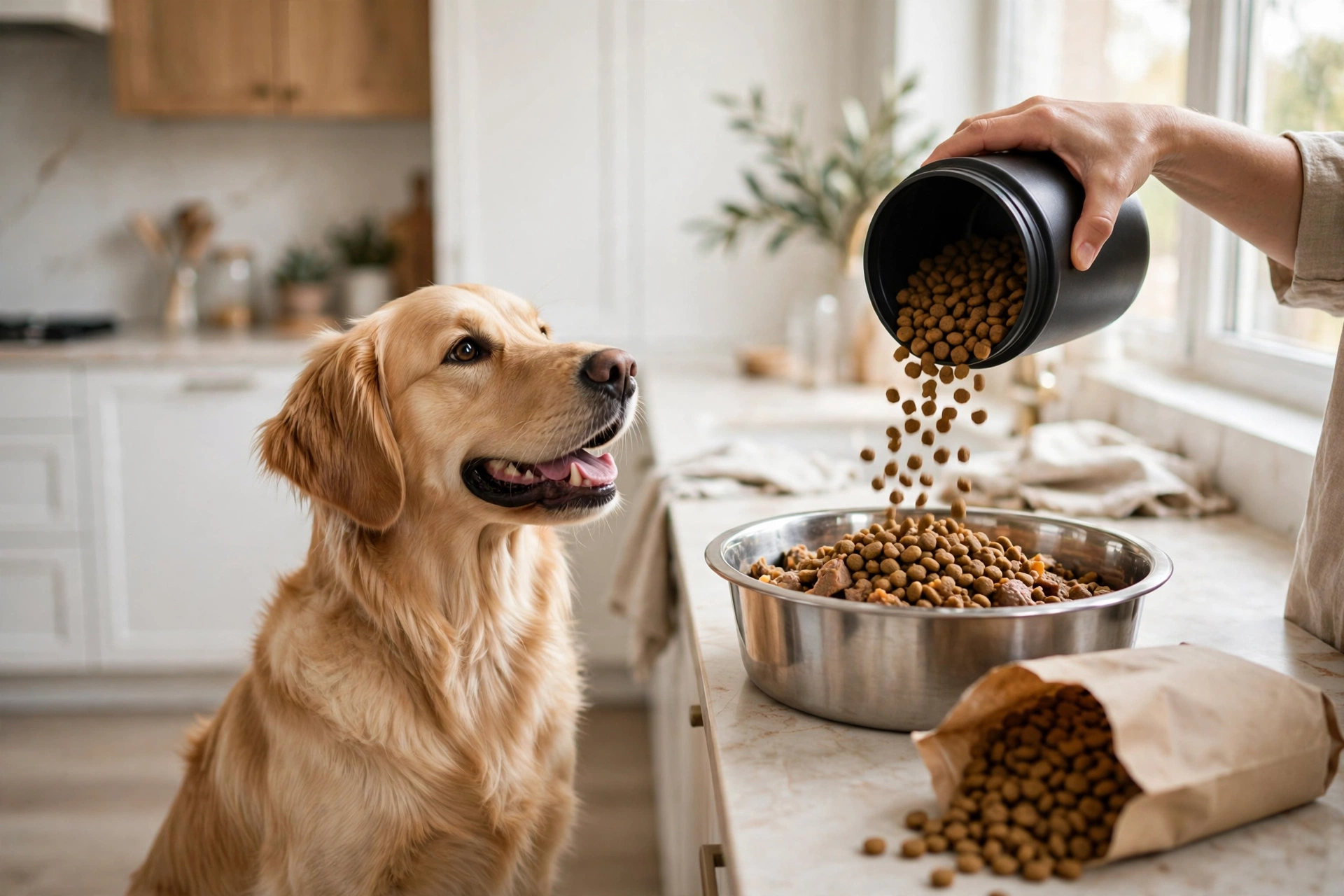
How to Change Dog Food Safely: Transition Schedule (2026)
Knowing how to change dog food safely is one of those skills that sounds simple until you’re staring at a half-eaten bowl and a dog with an upset stomach. Whether your vet recommended a new diet, your puppy is growing up, or you’ve simply found a better formula, the way you make the switch matters just as much as the food you choose. An abrupt change can trigger vomiting, diarrhea, and a flat-out refusal to eat, turning a positive upgrade into a miserable week.
The good news: a calm, gradual transition over 7 to 10 days lets your dog’s gut adjust smoothly. This guide walks you through a vet-aligned day-by-day transition schedule, how to adapt it for sensitive stomachs and picky eaters, the calorie-matching trick most owners miss when switching food types, and exactly what to do when things go sideways. By the end, you’ll have a plan that works for healthy adults, growing puppies, and seniors alike.
Quick Answer: Most dogs need 7 to 10 days to switch foods safely. Start with 25 percent new food, then 50/50, then 75 percent new, then all new. Match calories, not cup sizes, since foods differ in energy per cup. Hold at one step if stools turn soft, and stretch the plan to 14 days for puppies, seniors, and sensitive dogs.
In This Guide
- Why a Gradual Transition Matters
- The 7-Day Transition Schedule
- The 14-Day Plan for Sensitive Stomachs and Big Format Changes
- Match Calories, Not Just Cups
- What to Watch: The 2-Minute Stool Check
- Troubleshooting: When the Transition Hits a Bump
- Common Mistakes When Changing Dog Food
- Special Situations
- Choosing Your Dog’s Next Food
- When to Call Your Vet
- Pros and Cons
- Conclusion
- Before Day 1: Test the New Food First
- Switch gradually over 7 to 10 days, increasing the new food by roughly 25% every 2 days. Never go cold turkey unless your vet says so.
- Match calories, not cup measurements, when switching between different food types (kibble, wet, fresh) since calorie density varies widely.
- Watch your dog’s stool: mild softening is normal, but persistent diarrhea means you should step back to the previous ratio for 2 to 3 days.
- Sensitive dogs, puppies, and seniors often need a slower 10 to 14 day transition. There is no prize for finishing fast.
- Keep everything else constant during the switch: same treats, same feeding times, same routine.
Why a Gradual Transition Matters
Your dog’s digestive system is a finely tuned machine. The gut microbiome (the community of bacteria that helps break down food) has adapted to your dog’s current diet over weeks or months. A sudden swap shocks that system: the gut enzymes and bacteria that handled the old formula aren’t ready for the new protein sources, fat levels, and fiber content. The result is the classic trio of transition trouble: gas, loose stools, and vomiting.
A gradual switch gives the gut flora time to shift and re-balance. It’s the same reason veterinarians and nutritionists universally recommend the mixed-bowl method: small, controlled exposure that lets you spot problems early and back off before they become a real upset. Think of it as introducing two roommates slowly rather than throwing them into a shared apartment overnight.
This is especially true for puppies and seniors, whose digestive systems are less forgiving, and for dogs moving between very different food formats, say, from dry kibble to fresh food or from one protein family to another.
The 7-Day Transition Schedule
For most healthy adult dogs, this classic 7-day ladder is the standard recommended by vets:
| Days | Old Food | New Food | What to Expect |
|---|---|---|---|
| 1 to 2 | 75% | 25% | Usually uneventful; some dogs eat around the new kibble at first |
| 3 to 4 | 50% | 50% | Stool may soften slightly, normal if mild |
| 5 to 6 | 25% | 75% | Watch appetite and energy; any itchiness may appear now |
| Day 7+ | 0% | 100% | Full switch; stools should be firm within 2 to 3 more days |
Mix the two foods thoroughly in the same bowl so your dog can’t pick out only the old favorite. This is a real problem with picky eaters. Feed at your normal times and keep the total daily portion the same size as before (adjusting for calorie density, which we’ll cover below).
The 14-Day Plan for Sensitive Stomachs and Big Format Changes
If your dog has a sensitive stomach, has had transition problems before, or you’re moving between very different food types (kibble to fresh, dry to wet, or one protein to a very different one), stretch the ladder over 10 to 14 days. Smaller steps mean smaller reactions:
| Days | Old Food | New Food | Notes |
|---|---|---|---|
| 1 to 3 | 90% | 10% | Just a spoonful of new food; watch for any reaction |
| 4 to 6 | 75% | 25% | Stool check: two firm stools before moving on |
| 7 to 9 | 50% | 50% | The most common trouble spot, hold here if needed |
| 10 to 12 | 25% | 75% | Most dogs are settled by now |
| 13 to 14 | 0% | 100% | Full switch; monitor for a week |
The rule at every rung: only climb when things are stable. Two firm, normal stools in a row is your green light. If you see soft stools, hold at the current ratio for another 2 to 3 days before trying the next step.
Match Calories, Not Just Cups
Here’s the mistake almost every guide skips: a cup of one dog food is not equal to a cup of another. One cup of a calorie-dense kibble can pack twice the energy of a cup of wet or fresh food. If you mix 50/50 by volume, your dog may be accidentally overfed or underfed on transition days, and digestive upset often follows.
The fix is simple. Every US pet food label lists calorie content in kilocalories per kilogram (kcal/kg) under the “Calorie Content” heading, thanks to AAFCO labeling rules (our guide to how to read dog food labels explains where to find it). During the transition:
- Find your dog’s target daily calories (your vet’s figure, or the feeding guide on the current food your dog thrives on).
- Use the kcal/kg figures to work out how much of each food delivers the day’s percentage. A kitchen scale beats a coffee mug for this.
- Subtract treat calories first. Treats should stay the same during the transition, but they still count.
This matters most when switching between formats (dry to wet, kibble to fresh, or raw to kibble), where calorie density can differ by 2 to 3 times.
What to Watch: The 2-Minute Stool Check
Stool quality is your best real-time feedback during a food change. You don’t need anything fancy: a quick look after each walk tells you where you stand. Vets often reference the Purina fecal scoring chart, where a score of 3 to 4 (firm, segmented, “log-like”) is ideal.
- Slightly softer, but formed: normal during the transition. Carry on.
- Mushy or cow-pat consistency: hold at the current ratio for 2 to 3 extra days before increasing the new food.
- Watery diarrhea, mucus, or blood: pause the transition and call your vet, especially if it lasts more than 24 hours.
- Harder, smaller stools: often a sign of a more digestible food (common with fresh food); usually a good sign.
Also track appetite, energy, and any new itching or ear scratching. Skin reactions to a new protein can take several days to appear, which is why the later rungs of the ladder deserve the same attention as the first ones.
Troubleshooting: When the Transition Hits a Bump
| Problem | What It Means | What to Do |
|---|---|---|
| Soft stools at one step | Gut adjusting to the new formula | Hold the current ratio 2 to 3 extra days; try the next step again |
| Diarrhea that persists 48+ hours | Too fast, or the new food doesn’t agree | Step back one rung; if it recurs, call your vet, you may need a different food |
| Vomiting after meals | Eating too fast, portions too rich, or genuine intolerance | Slow feeder bowl; reduce the new-food share; vet call if repeated |
| Dog eats around the new kibble | Picky eater or texture dislike | Mix thoroughly; try warming the new food slightly to release aroma |
| Refuses the new food entirely | Taste, smell, or texture rejection | Drop back to a tiny ratio (10%) and climb very slowly; see our tips on why dogs refuse food |
| Gas but otherwise fine | Normal adjustment, especially with higher-fiber foods | Usually resolves; hold ratio a day or two if it’s severe |
| Itching or ear redness appears | Possible sensitivity to a new ingredient | Hold or step back; if it persists past a week on the new food, talk to your vet |
Common Mistakes When Changing Dog Food
1. Going cold turkey. Unless your vet specifically directs it (medical emergency, allergy elimination trial, or a recalled food that must stop immediately), an overnight switch is asking for digestive drama. Even dogs with “iron stomachs” can react to a big protein or fat change.
2. Changing everything at once. Don’t switch the main food, treats, and supplements in the same week. If something goes wrong, you won’t know which change caused it. Keep treats and routine identical during the transition.
3. Changing portion size at the same time. If you’re also adjusting how much your dog eats (for weight management, for example), stabilize the food first, then adjust portions. Two variables at once makes troubleshooting impossible.
4. Panicking at the first soft stool. Mild softening around days 3 to 5 is so common it’s practically expected. Pausing too early can stretch a 7-day transition into a 3-week one. Judge by the pattern over 2 to 3 days, not a single poop.
5. Switching flavors without a transition. Moving from chicken to beef within the same brand still changes the protein your dog’s gut has to process. You can often use a shorter 3 to 5 day ladder, but don’t skip the transition entirely, especially with sensitive dogs.
6. Free-feeding during the switch. Leaving food down all day makes it impossible to track intake or see what’s working. Stick to set mealtimes during the transition so you can monitor appetite accurately.
Special Situations
Picky eaters
Some dogs treat new food like a personal insult. Start at just 10% new food so the familiar smell dominates, mix it in warm (a spoonful of warm water releases aroma), and resist the urge to add toppers. Those are another change. Most holdouts come around by the 50/50 stage.
Puppy to adult food
The transition ladder is the same, but timing matters. Most dogs switch from puppy food to adult food around 12 months (9 to 12 for small breeds, 14 to 18 for large and giant breeds). Switch based on developmental stage (roughly 80 to 90% of expected adult weight), not just the birthday. Keep the transition at 10 to 14 days for puppies since their guts are still maturing.
Senior dogs
Older dogs often have slower digestion and may be on medications that interact with diet changes. Use the 14-day ladder, and check with your vet before switching. Some senior formulas differ significantly in phosphorus and protein levels, which matters for kidney health.
Same brand, different formula
Even within one brand, a new protein or a recipe update changes what the gut handles. Use a short 3 to 5 day transition rather than skipping it. Brands occasionally reformulate, so if your dog’s usual food suddenly causes issues, check the bag. The recipe may have changed under you.
Choosing Your Dog’s Next Food
A smooth transition starts before you open the bag. When picking the new food, look for:
- The AAFCO statement: the label should say “formulated to meet the nutritional levels established by the AAFCO Dog Food Nutrient Profiles” for your dog’s life stage (growth, adult maintenance, or all life stages).
- Named protein sources: “chicken,” “salmon,” or “beef” rather than vague “meat meal” or “animal by-products.”
- Appropriate fat levels: very rich foods (high fat) are harder to transition to, so that is a good reason to go slower.
- Life-stage fit: puppy, adult, and senior formulas differ in protein, calcium, and calorie density for real physiological reasons.
If you’re switching because of suspected sensitivities, our guide to dog food ingredients to avoid can help you read the new label with a critical eye.
When to Call Your Vet
Most transitions are uneventful, but stop the switch and call your vet if you see: vomiting more than once, watery diarrhea lasting over 24 hours, blood or mucus in the stool, complete food refusal for more than a day, or lethargy. Also loop your vet in before switching if your dog has kidney disease, diabetes, pancreatitis, or any chronic condition. Some medical diets need specific transition protocols.
This guide is for information only. Check with your vet for your dog’s specific needs.
Pros and Cons
Switching dog food the slow way takes patience, but it beats a week of upset stomachs. Here is the honest balance.
Pros
- A slow 7 to 10 day ladder gives the gut time to adjust, so most dogs switch with no upset at all.
- Matching calories instead of cups stops accidental overfeeding when the new food is denser than the old one.
- The stool check gives a clear, free signal at each step, so you know exactly when to hold and when to move on.
- The same ladder works for puppies, adults, and seniors with only the pace changed.
Cons
- A full switch takes a week or two, which feels slow when the old bag is empty or recalled.
- You need two foods open at once and a kitchen scale for exact ratios, which is more work than one bowl.
- Picky dogs may eat around the new kibble, so the plan needs extra patience and mixing.
- Mild soft stools are common mid-switch and can worry owners even when they are normal.
Conclusion
Changing dog food safely comes down to three things: go gradually (7 to 10 days for most dogs, 14 for sensitive ones), match calories rather than cup sizes when switching formats, and let your dog’s stool and appetite set the pace. The ladder is simple: 25%, 50%, 75%, then 100%. But the patience to hold at a rung when things wobble is what actually makes the difference.
Keep treats and routines steady, track what you see, and don’t be afraid to slow down. A week of careful mixing is a small price for a dog that sails through the change with firm stools, a happy appetite, and a new food they’ll thrive on.
Before Day 1: Test the New Food First
Do not open a big new bag on day one and hope for the best. Buy a small bag or a trial size first, and let your dog taste the new food before you build a whole plan around it. Give one or two pieces, or a small spoonful, next to the normal food for two or three days. This is not the switch itself. It is a quick taste test and a check for a fast bad reaction. Watch for face swelling, hives, or vomiting within an hour of eating. If any of those show up, stop and call your vet. If your dog will not touch the new food at all, fix that taste problem first, since no schedule can work with food your dog refuses to eat. Before day one, also write down a few simple notes about your dog right now: weight, what normal stools look like, coat shine, and how fast the bowl gets emptied. These notes are your baseline. When something changes during the switch, you can compare it with how things looked before and tell whether the new food caused it or it was already there. If you are switching because of a recall scare, check the FDA pet food recall list first so you know whether a switch is even needed.
How long does it take to change dog food safely?
Plan on 7 to 10 days for most dogs, increasing the new food by roughly 25% every two days. Dogs with sensitive stomachs, puppies, and seniors often need a slower 10 to 14 day transition. Only move to the next step once stools are firm and normal.
Can I switch my dog’s food cold turkey?
It’s not recommended. An abrupt switch can cause vomiting, diarrhea, and food refusal because the gut bacteria need time to adjust to new proteins and fat levels. Only skip the gradual transition if your vet directs it, such as a medical emergency or a recalled food.
What should I do if my dog gets diarrhea during the transition?
Hold at the current ratio for 2 to 3 extra days, then try the next step again. If severe diarrhea persists for more than 24 hours, or you see blood or mucus, pause the transition and call your vet.
Do I need to transition between flavors of the same brand?
Yes. Changing from chicken to beef still changes the protein your dog’s gut must process. You can usually use a shorter 3 to 5 day ladder, but don’t skip the transition entirely, especially for sensitive dogs.
Should I change treats during the transition?
No. Keep treats, supplements, and feeding times exactly the same while switching the main food. Changing multiple things at once makes it impossible to know what caused a problem.
When should puppies switch to adult food?
Most dogs switch around 12 months: 9 to 12 months for small breeds and 14 to 18 months for large and giant breeds. Base it on developmental stage (about 80 to 90% of expected adult weight), not just age, and use a 10 to 14 day transition.
Can I speed up the transition if my dog is doing fine?
Yes, slightly. If stools are firm and appetite is normal at each step, you can move through the ratios a bit faster. But never drop the transition entirely. Problems often show up at the 50% to 75% rungs.
How do I switch between very different foods like kibble and fresh food?
Use the slower 14-day plan and match calories rather than cup measurements, since one cup of kibble can hold twice the energy of a cup of fresh food. Check the kcal/kg figure on each label and use a kitchen scale to get the ratios right.
Should I buy a small bag of the new food first?
Yes. A small bag or trial size lets your dog taste the new food before you commit to a big bag. Give one or two pieces or a small spoonful next to the normal food for two or three days and watch for face swelling, hives, or vomiting within an hour. If your dog refuses it outright, sort out the taste problem before you start the 7 day ladder.
Can I give my dog pumpkin or probiotics during the food switch?
Plain canned pumpkin can help firm up soft stools during a switch, and a dog probiotic can support the gut while it adjusts. Use plain pumpkin with no added sugar or spice, about a spoonful for a small dog and a few spoonfuls for a large dog, mixed into the bowl. Ask your vet before adding a probiotic, and never use anti-diarrhea medicine without vet advice.
14 Comments