
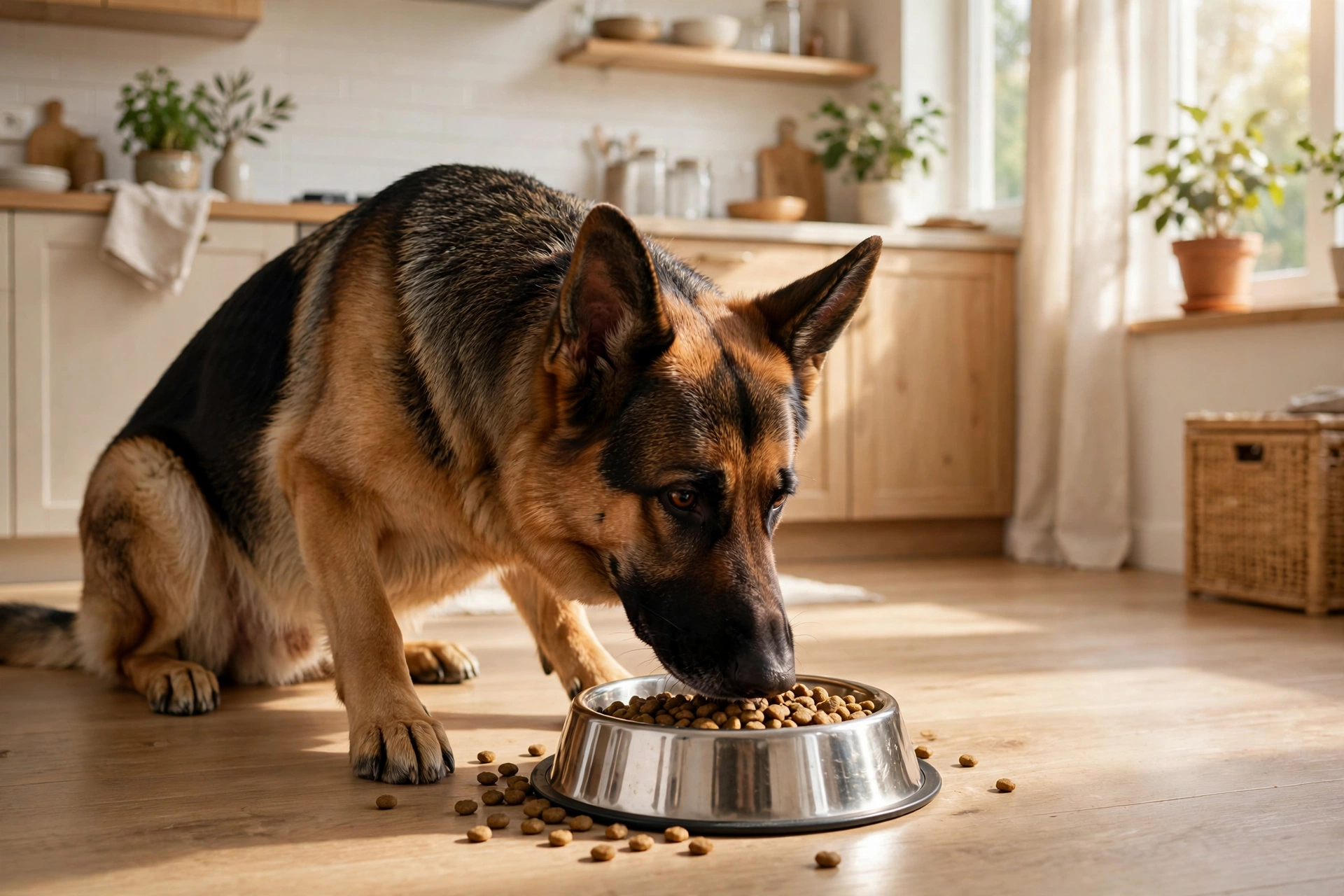
German Shepherd Feeding Guide: Portions & Schedule (2026)
German Shepherds are big, athletic dogs with appetites to match, and how you feed yours matters more than most owners realize. This German Shepherd feeding guide covers everything you need to know: how much to feed a German Shepherd puppy at each age, daily portion sizes for adults, feeding schedules that help prevent bloat, what to look for in your dog’s food, and the most common feeding mistakes owners make. Whether you just brought home an eight-week-old puppy or you are adjusting meals for a senior GSD, the charts and schedules below will give you a clear, practical starting point, with the all-important caveat that every dog is an individual, and the amounts on your dog food bag always come first.
German Shepherds grow fast, burn a lot of energy, and are a deep-chested breed with a real risk of bloat, so a thoughtful feeding routine is not optional, it is part of responsible ownership. Let’s get into it.
Quick Answer: A German Shepherd puppy needs three to four small meals a day, while most adults do best on two measured meals. Use a large-breed formula, keep portions matched to age and weight, and rest your dog before and after meals to lower bloat risk. Switch foods slowly, and move to adult food once growth steadies.
In This Guide
- Key Takeaways
- How Much to Feed a German Shepherd Puppy
- German Shepherd Adult Feeding Guide (1 to 7 Years)
- Senior German Shepherd Feeding (7+ Years)
- Sample German Shepherd Daily Feeding Schedules
- Best Dog Food Options for German Shepherds
- What to Look for in Your German Shepherd’s Food
- Feeding Mistakes German Shepherd Owners Should Avoid
- Pros and Cons
- Conclusion
- Raw Feeding for German Shepherds: Is It Worth It?
Key Takeaways
- Puppies eat 3 to 4 times a day (dropping to 2 meals by 6 to 12 months); adults thrive on two meals a day, never one large meal, to lower bloat risk.
- An average adult German Shepherd (around 66 lbs) needs roughly 1,100 to 1,300 calories per day. About 2.5 to 3.5 cups of a standard kibble, split into morning and evening meals.
- Use a large-breed puppy formula with controlled calcium and calorie density until 12 to 18 months; fast, uneven growth stresses developing joints.
- Never exercise your GSD right before or after meals. A one-hour rest around feeding time is one of the simplest bloat-prevention habits you can build.
- Watch body condition, not just the bag. You should be able to feel the ribs with light pressure and see a waist from above; adjust portions up or down from there.
How Much to Feed a German Shepherd Puppy
Puppies are where feeding precision matters most. A German Shepherd puppy gains weight incredibly fast in the first year, and pushing too many calories too early is linked to uneven skeletal growth and joint problems later. The rule of thumb used across veterinary guidance: puppies need roughly 35 to 40 calories per pound of body weight per day in the early months, tapering as growth slows.
The single best decision you can make at this stage is feeding a large-breed puppy formula rather than a standard puppy or adult food. Large-breed puppy foods are formulated with controlled calcium, phosphorus, and calorie density specifically to keep growth steady instead of explosive. That deliberate pacing is the whole point. For more on choosing the right formula, see our guide to the best German Shepherd puppy food.
German Shepherd Puppy Feeding Chart
| Age | Typical Weight | Daily Amount (kibble) | Meals Per Day |
|---|---|---|---|
| 8 to 12 weeks | 10 to 20 lbs | 1 to 1.5 cups | 4 |
| 3 to 4 months | 20 to 35 lbs | 1.5 to 2.5 cups | 3 |
| 4 to 6 months | 35 to 50 lbs | 2 to 3 cups | 3 |
| 6 to 12 months | 50 to 70 lbs | 2.5 to 3.5 cups | 2 to 3 |
| 12 to 18 months | 60 to 90 lbs | 3 to 4 cups | 2 |
These figures assume a kibble in the 350 to 400 kcal/cup range. Every brand’s caloric density is different, so cross-check against the feeding chart on your specific food. A very active puppy may need slightly more; a calmer one slightly less. The gold-standard check at any age is body condition: ribs felt with light pressure (not seen), a visible waist from above, and a slight abdominal tuck from the side. An overweight GSD puppy is carrying extra load on joints that are still developing, so err on the lean side.
When do you switch to adult food? Most large breeds, German Shepherds included, can move to adult food somewhere between 12 and 18 months, though some veterinary sources suggest keeping slow-growing lines on puppy formula until closer to 24 months. If your dog was on the smaller end as a puppy or grew steadily without spikes, earlier is fine; if growth was uneven, keep the puppy formula a little longer and ask your vet at the next checkup.
German Shepherd Adult Feeding Guide (1 to 7 Years)
An average adult German Shepherd weighing around 66 pounds needs roughly 1,100 to 1,300 calories per day. With a typical kibble at 400 kcal/cup, that works out to about 2.5 to 3.5 cups per day, split into two meals. But that “average” hides enormous variation: a working dog, a police K9, or a GSD doing serious daily training may need 30 to 50% more than a couch-companion of the same weight. A neutered, lower-energy house dog may need noticeably less. Activity level drives everything at this stage, so treat the chart below as a starting point and adjust by body condition over two to three weeks.
German Shepherd Adult Portion Chart
| Adult Weight | Daily Calories (approx.) | Daily Kibble (at 400 kcal/cup) | Meals Per Day |
|---|---|---|---|
| 50 lbs (lower end / female) | 900 to 1,100 | 2.25 to 2.75 cups | 2 |
| 66 lbs (average) | 1,100 to 1,300 | 2.75 to 3.25 cups | 2 |
| 75 to 90 lbs (upper end / large male) | 1,300 to 1,600 | 3.25 to 4 cups | 2 |
Two meals a day, morning and evening, is the sweet spot for adult German Shepherds. Here is why the schedule matters as much as the amount: German Shepherds are deep-chested, which makes them one of the breeds at real risk of bloat (gastric dilatation-volvulus). Eating one large meal quickly and then exercising is among the known triggers. Splitting the day’s food into two moderate meals, and keeping your dog calm for about an hour before and after eating, meaningfully reduces that risk. If your GSD inhales food, a slow-feeder bowl is a cheap, effective fix.
Senior German Shepherd Feeding (7+ Years)
Somewhere around age seven, metabolism slows, joints get creaky, and calorie needs drop. Senior German Shepherds typically need about 2 to 3 cups of kibble per day, roughly 20% less than their adult portions, assuming the same food. Many owners find they need to trim portions gradually over a year or two as the dog slows down; a sudden cut can leave a still-active senior under-fueled.
Senior formulas exist for a reason: they tend to be lower in fat, higher in fiber, and usually include glucosamine and chondroitin for joint support, both worthwhile for a breed where hip and elbow dysplasia run in the bloodlines. Watch for appetite changes, unexplained weight loss or gain, or difficulty chewing, and bring any of those up with your vet rather than just adjusting food on your own. Smaller, more frequent meals can help if digestion becomes an issue. Our senior German Shepherd dog food guide goes deeper on formulas built for this stage.
Sample German Shepherd Daily Feeding Schedules
Consistency is underrated. Dogs do best when meals land at the same times every day, because a predictable schedule regulates appetite and digestion, and makes house training far easier for puppies. Here are practical templates; shift the times to fit your routine, but keep them stable day to day.
Young puppy (8 to 16 weeks, 4 meals): 7:00 AM breakfast → 12:00 PM lunch → 4:30 PM afternoon meal → 8:00 PM dinner. Put the food down for 15 to 20 minutes, then pick the bowl up whether they finished or not. This builds routine fast and teaches you what “normal” appetite looks like. A puppy that suddenly skips a meal is telling you something.
Older puppy (4 to 12 months, 3 meals): 7:00 AM breakfast → 1:00 PM lunch → 6:30 PM dinner. Drop the afternoon meal when the puppy consistently leaves it unfinished or looks round. Most GSDs are ready for three meals by four months and two by around nine to twelve.
Adult (2 meals): 7:00 AM breakfast → 6:00 PM dinner, roughly 50/50 of the daily amount. No vigorous exercise for an hour before or after meals. Water stays available all day; food does not. Free-feeding, leaving food out all day, makes portion control guesswork and is one of the fastest paths to an overweight Shepherd.
Best Dog Food Options for German Shepherds
No single food is the “best” for every German Shepherd. The right pick depends on life stage, stomach sensitivity, and activity level. The six below are all established, widely available US formulas that fit the nutritional profile German Shepherds need: named protein first, AAFCO “complete and balanced” statements, and large-breed or breed-specific formulations where it matters. These picks are based on ingredient analysis, brand reputation, and owner feedback, not on feeding trials.
| Product | Best For | Key Feature |
|---|---|---|
| Royal Canin German Shepherd Adult Dry Dog Food | Breed-specific adult nutrition | Kibble shape + formula designed for the GSD jaw and digestive profile |
| Purina Pro Plan Large Breed Puppy Food | GSD puppies | Controlled calcium and calorie density for steady large-breed growth |
| Purina Pro Plan Sensitive Skin & Stomach Salmon & Rice Large Breed | GSDs with digestive sensitivity | Chicken-free salmon protein with prebiotic fiber for gut health |
| Hill’s Science Diet Large Breed Adult | Everyday adult feeding | Natural glucosamine and chondroitin sources for joint support |
| Eukanuba Large Breed Adult Dry Dog Food | Active and working GSDs | Higher protein/fat profile for dogs with serious energy output |
| Blue Buffalo Life Protection Formula Large Breed Adult | Owners wanting whole-food ingredients | Deboned chicken first plus antioxidant-rich LifeSource Bits |
Royal Canin German Shepherd Adult Dry Dog Food
The only pick on this list built specifically for the breed. Royal Canin’s GSD formula uses a kibble shape tailored to the breed’s long muzzle and scissor bite, which genuinely helps some dogs chew more deliberately rather than gulping. Nutritionally it targets the breed’s known weak spots: skin and coat support, digestive tolerance (GSDs are notorious for sensitive stomachs), and bone and joint support for a large, active frame. If you want a “just tell me what to buy” answer for a healthy adult Shepherd, this is the most defensible one. It is priced at a premium over generic large-breed formulas, but for a breed-specific formulation with decades of feeding data behind the brand, the cost is reasonable.
Purina Pro Plan Large Breed Puppy Food
For the puppy stage, where this guide’s precision matters most, Pro Plan’s large-breed puppy formula is one of the most vet-recommended options in the US. It delivers around 28% protein with DHA from fish oil for brain and vision development, and critically, it manages calcium and phosphorus levels for the controlled growth German Shepherd skeletons need. Purina backs its formulas with some of the largest feeding-research operations in the pet industry, which matters when the nutritional stakes are developmental. Feed it until 12 to 18 months (some slow-growing lines longer), then transition to the adult formula over 7 to 10 days.
Purina Pro Plan Sensitive Skin & Stomach Salmon & Rice Large Breed
German Shepherds react to food more than most breeds, and chicken shows up as a trigger often enough that a chicken-free option deserves a spot here. This salmon-based formula skips chicken entirely while keeping large-breed standards, and adds prebiotic fiber plus live probiotics for digestive health. If your GSD deals with chronic loose stools, gas, or itchiness that your vet suspects is food-related, this is the first thing worth trying before anything more drastic. See also our German Shepherd sensitive stomach food guide for a fuller rundown of gentle options.
Hill’s Science Diet Large Breed Adult
A solid everyday choice for adult Shepherds, and another brand with heavy veterinary endorsement. The large-breed adult formula includes natural sources of glucosamine and chondroitin for joint health, meaningful for a breed where hip and elbow dysplasia are endemic, along with omega-6 fatty acids and vitamin E for skin and coat. It is not the flashiest label on the shelf, but it is consistent, widely available, and formulated around published nutritional research rather than marketing trends.
Eukanuba Large Breed Adult Dry Dog Food
If your Shepherd works for a living, police K9, search and rescue, sport dog, or just a dog that runs hard every single day, Eukanuba’s large-breed adult formula runs a higher protein and fat profile that suits high-output dogs better than maintenance-level foods. It includes glucosamine and chondroitin for joint support under heavy use. For a moderately active house dog this formula may be richer than needed, so match the food to the dog’s actual workload, not the breed’s reputation.
Blue Buffalo Life Protection Formula Large Breed Adult
For owners who prefer whole-food-style ingredient lists: deboned chicken as the first ingredient, no corn, wheat, soy, or poultry by-product meals, plus Blue’s “LifeSource Bits”, a kibble blend of antioxidants, vitamins, and minerals. It includes glucosamine for joint health. Blue Buffalo has had recall history in the past (worth knowing; most major brands have), but the current large-breed adult formula is a legitimate mid-premium option that many GSD owners feed long-term with good results.
What to Look for in Your German Shepherd’s Food
You do not need a nutrition degree to read a dog food label: a handful of checks cover most of what matters for this breed:
- Named protein first. Chicken, beef, lamb, salmon, turkey. A real named source should be the first ingredient. “Meat meal” or “poultry by-product” at the top of the list is a pass.
- 22 to 26% protein (adults), 28 to 30% (puppies) on a dry matter basis, with 12 to 16% fat for adults. Puppies need the higher protein; adults do best in the moderate range.
- AAFCO “complete and balanced” statement matched to your dog’s life stage. This is the baseline assurance the food meets established nutrient profiles.
- Named fat sources like chicken fat or salmon oil rather than generic “animal fat”. Fat quality shows up in coat condition fast.
- Glucosamine and chondroitin on the label, especially for dogs over five. Joint support is nearly always worth having in a GSD’s food.
- Large-breed puppy formulation for puppies. This is the single most important label distinction in the first year, because it controls calcium and calories for proper skeletal growth.
- Digestible carbs and fiber. GSDs are known for sensitive stomachs, so whole grains, brown rice, sweet potato, and oatmeal tend to agree with them better than heavy corn, wheat, or soy loads. A note on grain-free: the FDA has been investigating a possible link between grain-free diets heavy in legumes (peas, lentils, chickpeas) and dilated cardiomyopathy in dogs. The research is still developing, but it is worth factoring in before going grain-free.
Feeding Mistakes German Shepherd Owners Should Avoid
One big meal a day. Beyond the bloat risk, a single huge meal spikes and crashes energy and encourages gulping. Two meals, always.
Exercising around mealtimes. Keep your dog calm for about an hour before and after eating. For a breed already prone to bloat, this is the easiest preventive habit there is.
Overfeeding the puppy. A chubby GSD puppy is not cute, it is a joint problem in the making. Extra weight on a rapidly growing skeleton stresses hips and elbows during the exact window they are forming. Lean and steady wins.
Free-feeding. Food available all day means you never really know how much your dog eats, and it trains grazing instead of mealtimes. Scheduled meals, bowl up after 15 to 20 minutes.
Switching foods abruptly. Any food change, puppy to adult, one brand to another, should happen over 7 to 10 days, mixing increasing amounts of the new food with the old. German Shepherd stomachs punish abrupt changes with days of loose stools.
Ignoring the toxic list. Grapes and raisins, onions and garlic, xylitol (in some peanut butters and sugar-free products), chocolate, macadamia nuts, alcohol, and cooked bones, all genuinely dangerous. Table scraps should stay minimal anyway; rich human food is a fast path to pancreatitis.
Supplementing blindly. Extra calcium sounds good for a growing large breed, but too much calcium during rapid growth actually causes skeletal problems, the opposite of the intent. If the food is complete and balanced, extra supplements need a vet’s sign-off, not guesswork.
Pros and Cons
A steady feeding routine is the best tool a German Shepherd owner has, but it needs daily care. Here is the honest balance.
Pros
- Measured meals at set times help prevent bloat in a deep-chested breed.
- Portion charts by age and weight take the guesswork out of feeding.
- Large-breed puppy formulas support steady growth and joint health.
- A slow switch plan avoids stomach upsets.
Cons
- German Shepherds grow fast, so portions need regular review.
- Feeding once a day raises bloat risk, so meals must be split.
- Exercise right before or after meals is risky, which limits walk times.
- Sensitive stomachs are common, so some foods need a careful trial.
Conclusion
Feeding a German Shepherd well comes down to a few disciplined habits: three to four small meals for young puppies, two balanced meals for adults, a large-breed puppy formula through the growth phase, portions set by body condition rather than guesswork, and calm around mealtimes to keep bloat risk down. Get those right and the rest, the specific brand, the exact cup count, is fine-tuning. If I had to name one starting point for a healthy adult Shepherd, it would be the breed-specific Royal Canin German Shepherd Adult; for puppies, Purina Pro Plan Large Breed Puppy; and for the many GSDs with touchy stomachs, the salmon-based Purina Pro Plan Sensitive Skin & Stomach. This guide is for information only. Check with your vet for your dog’s specific needs.
Raw Feeding for German Shepherds: Is It Worth It?
Raw feeding has a real following among German Shepherd owners. The idea is simple: a diet closer to what dogs were built to eat, with raw meat, bones, and organ meat instead of kibble. Some owners see a shinier coat, more energy, smaller stools, and cleaner teeth. Dogs with long-running gut trouble sometimes do better on raw, especially when something in their kibble was the trigger.
But raw feeding has real downsides. Raw meat can carry Salmonella and Listeria, which is a risk to your dog and to anyone who handles the food. Home-made raw diets are easy to get wrong on nutrition, especially the calcium and phosphorus balance, and that is risky for puppies. Raw also costs more, takes more time, and needs freezer space.
If you want to try it, a commercial raw formula that meets AAFCO standards is a safer start than building your own. Talk to your vet first, especially if your dog has health problems already or is still a puppy.
How many times a day should I feed my German Shepherd?
Adults do best on two meals a day, morning and evening, never one large meal, since German Shepherds are a deep-chested breed prone to bloat. Puppies under four months need three to four smaller meals, dropping to three around four months and two by nine to twelve months.
How much food should a German Shepherd puppy eat?
As a rule of thumb, German Shepherd puppies need about 35 to 40 calories per pound of body weight per day. That works out to roughly 1 to 1.5 cups of kibble at 8 to 12 weeks, 1.5 to 2.5 cups at 3 to 4 months, and 2.5 to 3.5 cups at 6 to 12 months. Always cross-checked against your specific food’s feeding chart.
When should I switch my German Shepherd from puppy to adult food?
Most German Shepherds can transition to adult food between 12 and 18 months. Slow-growing lines may benefit from staying on a large-breed puppy formula closer to 24 months. Switch gradually over 7 to 10 days to avoid digestive upset.
Should I feed my German Shepherd grain-free food?
Not necessarily. The FDA has been investigating a possible link between grain-free diets heavy in legumes (peas, lentils, chickpeas) and dilated cardiomyopathy in dogs. Most German Shepherds do well on foods with digestible whole grains like brown rice or oatmeal. Discuss it with your vet before going grain-free.
Can I feed my German Shepherd once a day?
It is not recommended. One large daily meal increases bloat risk in deep-chested breeds like German Shepherds and can cause energy spikes and crashes. Two balanced meals, morning and evening, is the safer routine for adults.
Why does my German Shepherd always seem hungry?
German Shepherds are enthusiastic eaters, so appetite alone is a poor guide. Feed by portion and body condition instead: you should be able to feel the ribs with light pressure and see a waist from above. If portions are correct and hunger seems extreme, rule out medical causes with your vet.
Should I exercise my German Shepherd before or after meals?
Neither. Keep your dog calm for about an hour before and after eating. Exercising on a full stomach is a known bloat trigger in German Shepherds, so schedule walks and play sessions away from mealtimes.
Can German Shepherds eat raw food?
Yes, but it needs care. Raw meat can carry Salmonella and Listeria, so it is a risk to your dog and to whoever handles the food. Home-made raw diets are easy to get wrong on nutrition, and the calcium and phosphorus balance matters most for puppies. A commercial raw formula that meets AAFCO standards is a safer place to start. Always talk to your vet before you switch, especially for a puppy or a dog with health problems.
What should I do if my German Shepherd has a sensitive stomach or a food allergy?
Start by talking to your vet. German Shepherds react to food more than most breeds, and the usual culprits are beef, dairy, wheat, chicken, egg, and soy. The one method that truly works is an elimination diet: 8 to 12 weeks on a new protein your dog has never eaten, such as venison, duck, or kangaroo, with a single carb source and nothing else. No treats and no table food. If things improve, you add foods back one at a time until you find the trigger.

5 Comments