
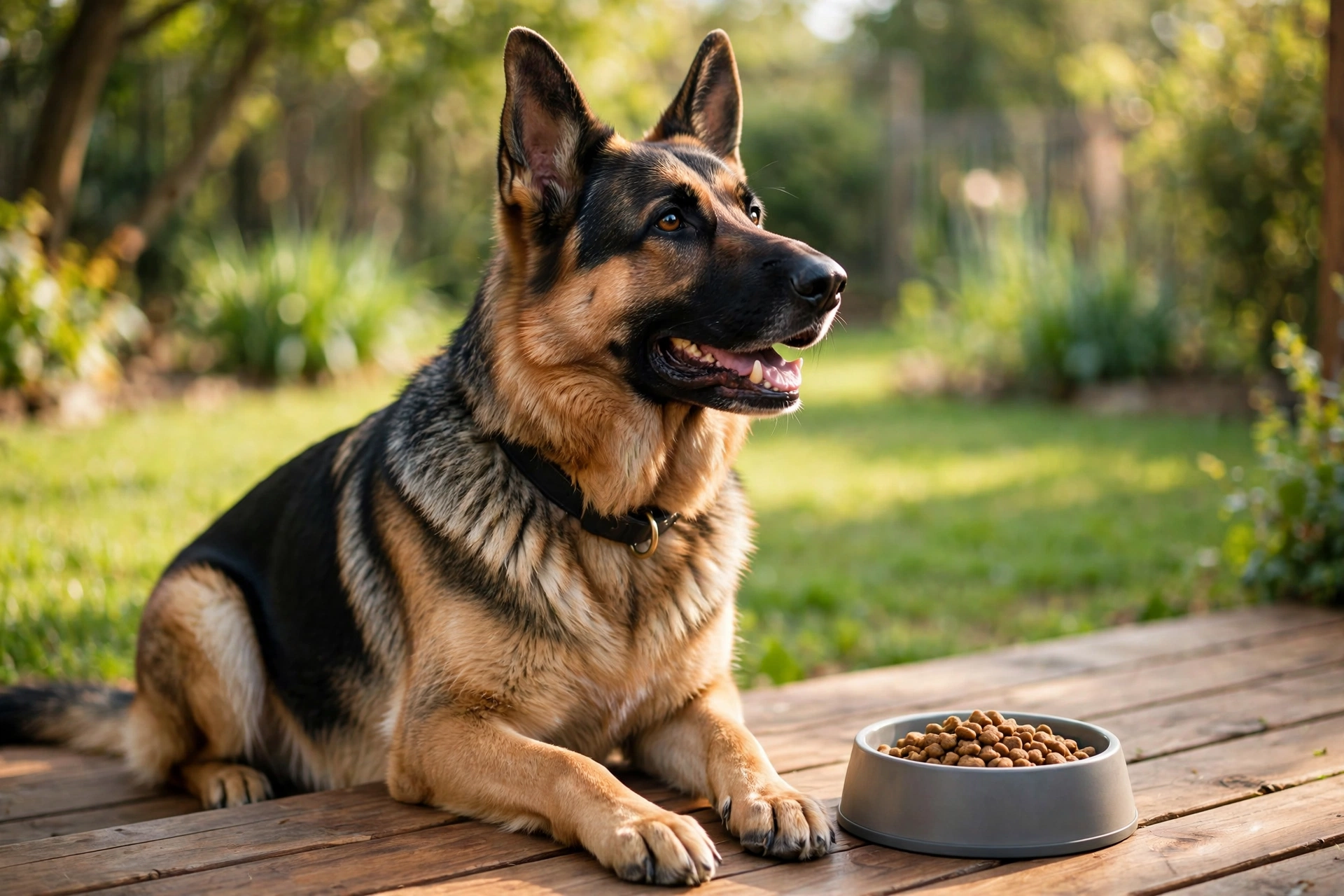
Best Food for German Shepherd Sensitive Stomach: Salmon-based Picks for sensitive digestion and bloat risk
If your German Shepherd has a sensitive stomach, you already know the signs: the loose stools that show up out of nowhere, the gassy evenings, and the weight that creeps off even when he eats well. German Shepherds are not officially listed as a sensitive-stomach breed, but they do carry the highest breed risk for exocrine pancreatic insufficiency (EPI), a condition where the pancreas does not make enough digestive enzymes, so a Shepherd with chronic loose stools deserves a closer look before you blame the food. For the full picture across breeds, see our guide to the best dog food for sensitive stomachs.
This guide breaks down what makes this breed’s digestion different, compares six of the best gentle food options available in 2026, and gives you a practical buying guide so you can pick with confidence. The picks below are based on ingredient analysis, brand reputation, and owner reviews, honest, practical recommendations from a fellow dog owner. Prices were checked on Chewy on November 13, 2026, and monthly costs are worked out for a 70 lb adult.
Key Takeaways
- Purina Pro Plan Sensitive Skin & Stomach Large Breed is the best overall pick for this breed’s sensitive digestion, salmon-based, prebiotic fiber, and priced at $59 to $79 a month.
- German Shepherds are not listed as a sensitive-stomach breed, but they carry the highest breed risk for EPI and IBD may be more common in the breed, so look for formulas with highly digestible proteins and prebiotic fiber.
- Breed-specific formulas like Royal Canin German Shepherd Adult and Dr. Gary’s Best Breed German Dog Diet are designed around this breed’s digestive profile.
- Transition any new food slowly over 7 to 10 days to avoid upsetting a sensitive stomach further.
- Ongoing vomiting, diarrhea, or weight loss always deserve a vet visit, no food replaces a diagnosis.
The 6 Picks at a Glance
| Product | Best For | Protein | Fat | Kcal per Cup | Bag Price | Price per lb | Cost per Month |
|---|---|---|---|---|---|---|---|
| Purina Pro Plan Sensitive Skin & Stomach Large Breed (Salmon & Rice) | Best overall for sensitive stomachs | 26% | 12% | 404 | $97.98 (34 lb) | $2.88 | $59 to $79 |
| Royal Canin German Shepherd Adult | Best breed-specific formula | 22% | 17% | 338 | $99.99 (30 lb) | $3.33 | $88 to $98 |
| Dr. Gary’s Best Breed German Dog Diet | Best breed-specific recipe from a small US maker | 25% | 12% | 456 | $56.69 (30 lb, FeedRite) | $1.89 | $43 to $50 |
| Hill’s Science Diet Sensitive Stomach & Skin Adult | Best easy-to-find mid-price pick | 20% | 13% | 391 | $89.99 (30 lb) | $3.00 | ~$79 |
| Nutro Natural Choice Large Breed Adult Lamb & Brown Rice | Best lamb-based option | 22% | 12% | 343 | $79.98 (30 lb) | $2.67 | $63 to $71 |
| Diamond Naturals Lamb Meal & Rice | Best budget pick | 23% | 14% | 403 | $43.99 (40 lb) | $1.10 | ~$30 |
Prices checked on Chewy, November 13, 2026, except Dr. Gary’s Best Breed, which is not sold on Chewy and is priced at FeedRite Pet Store. Protein and fat are the label’s guaranteed-analysis minimums. Cost per month is for a 70 lb adult at the feeding amount on each label.
The 6 Best Foods for German Shepherds With Sensitive Stomachs
Purina Pro Plan Sensitive Skin & Stomach Large Breed (Salmon & Rice)
If you only consider one option on this list, make it this one. Purina Pro Plan Sensitive Skin & Stomach Large Breed was built specifically for dogs like your German Shepherd: salmon is the first ingredient, oatmeal provides an easily digestible carbohydrate source, and natural prebiotic fiber supports the gut bacteria that keep digestion running smoothly.
The omega-3 fatty acids (EPA) in the salmon help on two fronts, calming skin sensitivity (which often travels with stomach sensitivity in this breed) and supporting joint health, which matters for a large breed. It’s fortified with glucosamine for hip and elbow support too. Because Pro Plan formulas are backed by feeding trials rather than formulation claims alone, there’s solid real-world evidence behind how dogs actually do on this food. At 404 kcal per cup, a 70 lb Shepherd needs 2.75 to 3.67 cups a day, which works out to $59 to $79 a month from a $97.98, 34 lb bag on Chewy, checked November 13, 2026.
One more thing worth saying up front: German Shepherds carry the highest breed risk for EPI, so if your dog is losing weight while eating well, read the EPI section below before you settle on a food, because no diet fixes a pancreas that is not making enzymes.
Who it’s for: German Shepherds with recurring loose stools, gas, or itchy skin on other foods. Owners who want one formula that addresses digestion and joint support together.
What to know: It’s priced in the premium range, and the salmon smell when you open the bag is strong. Dogs that do well on chicken-based foods won’t benefit from the switch.
Royal Canin German Shepherd Adult
Royal Canin German Shepherd Adult is the only widely available formula designed from the kibble shape up for this breed. The kibble pieces are shaped to encourage a German Shepherd to chew rather than gulp, and for a deep-chested, bloat-prone breed, slower eating is genuinely meaningful.
The formula uses highly digestible proteins and a targeted fiber blend aimed at healthy digestion, plus EPA and DHA from fish oil to support the skin barrier and coat. Glucosamine and chondroitin are included for hip and elbow support. Owners of GSDs with generally sensitive stomachs frequently report firmer stools within a couple of weeks of switching. At 338 kcal per cup, a 70 lb Shepherd needs about 5 cups a day at medium activity on the current Royal Canin feeding table, which works out to $88 to $98 a month from a $99.99, 30 lb bag on Chewy, checked November 13, 2026.
Who it’s for: Adult German Shepherds (15 months and up) with no major food allergies who want a purpose-built, no-guesswork formula.
What to know: Premium price point, and the recipe is poultry-based, dogs with confirmed chicken allergies should pick one of the lamb or salmon options below instead.
Dr. Gary’s Best Breed German Dog Diet
Dr. Gary’s Best Breed German Dog Diet was developed by a veterinarian specifically for German Shepherds and large breeds with digestive and skin issues. The standout feature for sensitive stomachs is the deliberate blend of soluble and insoluble fibers that support steady digestion. It’s slow-cooked for better digestibility and contains no corn, wheat, soy, or by-product meals.
Joint support comes from New Zealand green-lipped mussel, a natural source of glucosamine and chondroitin, while menhaden fish oil provides omega-3s for coat health. Many German Shepherd owners report that dogs who struggled on mainstream formulas finally settled on this one. At 456 kcal per cup, a 70 lb Shepherd needs 3 to 3.5 cups a day, which works out to $43 to $50 a month from a $56.69, 30 lb bag at FeedRite Pet Store, checked November 13, 2026. This one is not sold on Chewy.
Who it’s for: German Shepherds with documented sensitive stomachs or chronic skin issues that haven’t stabilized on bigger brands, and owners who prefer a recipe from a smaller US manufacturer.
What to know: It costs more than mass-market foods, has fewer flavor options, and is less widely available, you may need to order online.
Hill’s Science Diet Sensitive Stomach & Skin Adult
Hill’s Science Diet Sensitive Stomach & Skin is built around prebiotic fiber for gut health, plus highly digestible ingredients and omega-6 fatty acids and vitamin E for skin and coat support. At 391 kcal per cup, a 70 lb Shepherd needs about 3.79 cups a day, which works out to about $79 a month from an $89.99, 30 lb bag on Chewy, checked November 13, 2026.
For German Shepherds with mild-to-moderate sensitivity rather than a diagnosed condition, this is a reliable, widely available option that most dogs accept readily. It’s not a breed-specific formula, but the sensitive-stomach design overlaps with what most GSDs need: gentle protein, digestible carbs, and gut-supporting fiber.
Who it’s for: Owners who want an easy-to-find sensitive stomach formula at a mid-range price.
What to know: It’s not tailored to large-breed joint needs, so active or older German Shepherds may benefit more from a large-breed-specific pick on this list.
Nutro Natural Choice Large Breed Adult Lamb & Brown Rice
If chicken is the suspect in your German Shepherd’s digestive troubles, this is your pick, with one caveat. Nutro Natural Choice Large Breed Adult puts real lamb first and uses no chicken by-product meal, making it one of the most accessible lamb-first large-breed formulas. Brown rice and oatmeal provide gentle, digestible carbohydrates. But chicken meal is the second ingredient, so it is not a chicken-free recipe, and a truly chicken-sensitive dog should look at the salmon or lamb formulas that skip chicken altogether.
It includes glucosamine and chondroitin for joint health, omega-6 fatty acids for skin and coat, and is made with non-GMO ingredients. Nutro’s “Feed Clean” approach means no artificial flavors, colors, or preservatives, fewer unknown variables for a sensitive stomach to react to. At 343 kcal per cup, a 70 lb Shepherd needs 3.62 to 4.08 cups a day, which works out to $63 to $71 a month from a $79.98, 30 lb bag on Chewy, checked November 13, 2026.
Who it’s for: German Shepherds that seem to do worse on chicken by-product meal, and owners who want a clean, widely available lamb-first formula.
What to know: Lamb is a mild protein that most dogs digest well, but very picky eaters sometimes prefer fish-based flavors.
Diamond Naturals Lamb Meal & Rice
Diamond Naturals proves you don’t have to spend premium money to feed a sensitive stomach well. This budget pick uses pasture-raised lamb with added probiotics (their K9 Strain proprietary blend) for digestive and immune support, plus antioxidant-rich superfood fruits like blueberries and oranges.
It’s a genuinely solid formula at a fraction of the price of the premium options above, a practical choice if you have a multi-dog household or just want to keep feeding costs reasonable without dropping to grocery-store filler food. At 403 kcal per cup, a 70 lb Shepherd needs about 3.67 cups a day, which works out to about $30 a month from a $43.99, 40 lb bag on Chewy, checked November 13, 2026.
Who it’s for: Budget-conscious owners who still want probiotic support, named meat, and no artificial junk.
What to know: Diamond has had recalls in its past (2012), and while its recent manufacturing record is clean, some owners prefer brands with uninterrupted histories.
Why German Shepherds Get Sensitive Stomachs
No major veterinary source, not the AKC, VCA, Merck, or the German Shepherd breed club, lists German Shepherds as a breed prone to sensitive stomachs in general. What the evidence does show is narrower, and it is also more useful, because it points at specific conditions rather than a vague “sensitive stomach” label.
First, German Shepherds carry the highest breed risk for exocrine pancreatic insufficiency (EPI), a condition where the pancreas does not make enough digestive enzymes. It is suspected to be inherited in this breed (VCA). If your Shepherd is losing weight while eating well, or passing large, yellow-orange stools, that is the condition to rule out first.
Second, inflammatory bowel disease (IBD) may be more common in German Shepherds (Merck), and antibiotic-responsive enteropathy is overrepresented in the breed (Merck). Both can look exactly like a “sensitive stomach” until they are diagnosed.
Third, German Shepherds are a bloat-prone, deep-chested breed (Merck), which is why how you feed matters as much as what you feed. The feeding rules are in the box below.
If your German Shepherd has chronic loose stools, weight loss despite a good appetite, or frequent vomiting, see your vet before assuming it’s just a food issue. EPI is diagnosed with a blood test (TLI), and it’s far more common in this breed than most owners realize. This guide is for information only, check with your vet for your dog’s specific needs.
Is It EPI, Not Just a Sensitive Stomach?
German Shepherds carry the highest breed risk for EPI, so it is worth a proper check before you commit to a lifetime of diet management. EPI means the pancreas does not make enough of the enzymes that digest food, so food passes through mostly undigested.
- Weight loss even though your dog eats well and seems hungry
- Large, pale yellow-orange stools, often soft or loose
- Eating stool (coprophagia)
- A dull coat and low energy over weeks, not days
If that sounds familiar, ask your vet for a fasted serum TLI test. It is a blood test, taken after fasting, and it is the standard way EPI is diagnosed. Do not start a special diet and wait, because EPI needs a diagnosis, not a food trial. Some dogs with EPI also run low on vitamin B12, and the treatment is pancreatic enzyme replacement, which your vet manages, so this is not something to handle with diet alone.
Bloat (GDV) Feeding Rules
German Shepherds are a deep-chested, bloat-prone breed. These feeding rules lower the risk, but they do not remove it.
- Feed 2 to 3 smaller meals a day instead of one large meal.
- No vigorous exercise for 1 hour before and 1 hour after meals.
- Use a flat bowl on the floor, not a raised feeder, and a slow feeder if your dog gulps food.
- Keep fresh water available, but do not let your dog gulp a large bowl of water right after eating.
A swollen, tight belly, retching without bringing anything up, and restlessness or pacing are emergency signs of bloat. Get to a vet immediately, this is not a wait-and-see situation.
How Much to Feed: Portions and Cost per Month
These figures are for a 70 lb adult dog, using the feeding amount on each label and the Chewy prices checked on November 13, 2026. Split the daily amount into 2 to 3 meals. For portion sizes and a daily schedule, see our German Shepherd Feeding Guide.
| Product | Kcal per Cup | Bag Price | Daily Feeding (70 lb) | Cost per Month |
|---|---|---|---|---|
| Purina Pro Plan Sensitive Skin & Stomach Large Breed, Salmon & Rice | 404 | $97.98 (34 lb) | 2.75 to 3.67 cups (1,111 to 1,483 kcal) | $59 to $79 |
| Royal Canin German Shepherd Adult | 338 | $99.99 (30 lb) | About 5 cups (1,680 kcal; about 398 g, medium activity) | $88 to $98 |
| Dr. Gary’s Best Breed German Dog Diet | 456 | $56.69 (30 lb, FeedRite) | 3 to 3.5 cups (1,368 to 1,596 kcal) | $43 to $50 |
| Hill’s Science Diet Sensitive Stomach & Skin | 391 | $89.99 (30 lb) | 3.79 cups (1,482 kcal) | ~$79 |
| Nutro Natural Choice Large Breed Adult, Lamb & Brown Rice | 343 | $79.98 (30 lb) | 3.62 to 4.08 cups (1,242 to 1,400 kcal) | $63 to $71 |
| Diamond Naturals Lamb Meal & Rice | 403 | $43.99 (40 lb) | 3.67 cups (1,479 kcal) | ~$30 |
Amounts are for a 70 lb adult dog.
Worked example: a 75 lb adult on Purina Pro Plan Large Breed Salmon & Rice eats about 3.67 cups a day, the top of the 51 to 75 lb band. A 34 lb bag holds about 136 cups at 113 g per cup, so each cup costs about $0.72. That works out to about $2.64 a day and about $79 a month.
Feeding by Weight
These are cups per day. The 70 lb column uses each label’s feeding amount. The 50 lb and 90 lb amounts are estimated from it by metabolic body weight, so check your bag’s feeding guide for the exact band.
| Product | 50 lb (Cups/Day, Kcal) | 70 lb (Cups/Day, Kcal) | 90 lb (Cups/Day, Kcal) |
|---|---|---|---|
| Purina Pro Plan Sensitive Skin & Stomach Large Breed, Salmon & Rice | 2.14 to 2.86 cups (865 to 1,155 kcal) | 2.75 to 3.67 cups (1,111 to 1,483 kcal) | 3.31 to 4.42 cups (1,337 to 1,786 kcal) |
| Royal Canin German Shepherd Adult | 3.87 cups (1,308 kcal) | About 5 cups (1,680 kcal) | 5.99 cups (2,025 kcal) |
| Dr. Gary’s Best Breed German Dog Diet | 2.33 to 2.72 cups (1,064 to 1,242 kcal) | 3 to 3.5 cups (1,368 to 1,596 kcal) | 3.62 to 4.22 cups (1,649 to 1,924 kcal) |
| Hill’s Science Diet Sensitive Stomach & Skin | 2.95 cups (1,153 kcal) | 3.79 cups (1,482 kcal) | 4.57 cups (1,786 kcal) |
| Nutro Natural Choice Large Breed Adult, Lamb & Brown Rice | 2.82 to 3.18 cups (967 to 1,091 kcal) | 3.62 to 4.08 cups (1,242 to 1,400 kcal) | 4.37 to 4.92 cups (1,499 to 1,688 kcal) |
| Diamond Naturals Lamb Meal & Rice | 2.86 cups (1,150 kcal) | 3.67 cups (1,479 kcal) | 4.42 cups (1,782 kcal) |
What to Look For in German Shepherd Sensitive Stomach Food
Whether you choose one of the picks above or shop on your own, these are the ingredients and label claims that matter most:
Easily digestible protein
Look for a named animal protein first, salmon, lamb, or chicken, rather than generic “meat meal.” Highly digestible proteins mean less undigested material reaching the large intestine, which means less gas and softer stools.
Prebiotic fiber and probiotics
Prebiotic fibers (beet pulp, inulin, oatmeal) feed the good gut bacteria that keep digestion stable. Added probiotics go a step further by supporting the intestinal flora directly.
Moderate fat levels
Very high-fat formulas can overwhelm a sensitive digestive system. Look for moderate fat that provides energy without taxing the pancreas, most sensitive stomach formulas land in a comfortable middle range.
AAFCO nutritional adequacy statement
Every food you consider should carry an AAFCO statement confirming it’s complete and balanced for your dog’s life stage. This is the non-negotiable baseline, everything else is a bonus.
Large-breed joint support
Since you’re feeding a German Shepherd, don’t ignore the hips and elbows. Glucosamine, chondroitin, and omega-3 fatty acids (EPA/DHA) are worth having in the formula, especially if your dog is active or middle-aged.
For more on this breed’s overall nutritional needs, see our guides to the best dog food for German Shepherds and the best German Shepherd puppy food. If your dog also seems reactive to chicken specifically, our sensitive stomach dog food without chicken guide goes deeper.
A quick check on the brands: Purina, Hill’s and Royal Canin publicly document employing veterinary nutritionists and running AAFCO feeding trials, which is the WSAVA’s top-line test for a manufacturer. For Nutro, Diamond and Dr. Gary’s Best Breed, I could not verify published feeding-trial records from public sources, so I am not claiming that status for them.
What to Avoid
- Generic “meat meal” or by-product meals, you want a named protein you can actually identify.
- Artificial colors, flavors, and preservatives: They add nothing nutritionally and are common suspects in digestive flare-ups.
- Sudden formula switches, always transition over 7 to 10 days (see below).
- Extremely high-fat or very low-fiber formulas, both can make a sensitive stomach worse.
- Ignoring red flags. Persistent vomiting, blood in stool, or unexplained weight loss are vet-visit territory, not a reason to try yet another bag of food. And remember, weight loss despite a good appetite, large yellow-orange stools, or eating stool can point to EPI, which needs a TLI test, not a new bag of food.
If you also have another large, deep-chested dog at home, our guides to the best food for a Doberman Pinscher with a sensitive stomach and the best food for a Rottweiler with a sensitive stomach use the same approach.
How to Transition Your German Shepherd to a New Food
Switch over 7 to 10 days, mixing the new food into the old in gradually increasing ratios, about 25/75 for the first few days, then 50/50, then 75/25, then a full switch to the new food. If loose stools appear, hold at the current ratio for a couple of extra days before continuing. For general tips on switching foods, see our Best Dog Food for Sensitive Stomachs hub, and for more on portions, see our German Shepherd Feeding Guide.
The Bottom Line
The best food for a German Shepherd with a sensitive stomach combines digestible protein, prebiotic fiber, moderate fat, and joint support. Purina Pro Plan Sensitive Skin & Stomach Large Breed is the safest first switch for most dogs, while Royal Canin German Shepherd Adult or Dr. Gary’s Best Breed are strong choices if you want a breed-built formula, and Diamond Naturals is the best budget option. See our main best dog food for German Shepherds guide for the full range.
One last thing: if 2 to 3 weeks on a gentle over-the-counter food brings no improvement, or if the weight loss continues, ask your vet about a prescription diet, Hill’s Prescription Diet i/d is the usual option for diagnosed digestive disease, and it is vet-only. Do not try it without a diagnosis, and if the signs point to EPI, say so, because no over-the-counter food fixes that. This guide is for information only, check with your vet for your dog’s specific needs.
Frequently Asked Questions
Why are German Shepherds prone to sensitive stomachs?
No major veterinary source lists German Shepherds as prone to sensitive stomachs in general. What the evidence does show is that they carry the highest breed risk for exocrine pancreatic insufficiency (EPI), that inflammatory bowel disease may be more common in the breed, and that antibiotic-responsive enteropathy is overrepresented. So chronic digestive trouble in a GSD should always be checked by a vet rather than assumed to be a simple food intolerance. Early diagnosis makes a big difference.
What should I look for in food for a German Shepherd with a sensitive stomach?
Prioritize a named, easily digestible protein (salmon, lamb, or chicken), prebiotic fiber or probiotics for gut health, moderate fat levels, and an AAFCO statement confirming the food is complete and balanced. Large-breed formulas with glucosamine are a bonus for hip and elbow support.
Is grain-free food better for a German Shepherd with a sensitive stomach?
Not necessarily. Many sensitive stomach formulas use gentle grains like oatmeal and rice, which most dogs digest easily. Grain-free isn’t automatically gentler, focus on digestibility, protein quality, and fiber rather than the grain-free label alone.
Should I avoid chicken for my German Shepherd’s sensitive stomach?
Chicken is a relatively common trigger for dogs with food sensitivities, so if your GSD does poorly on chicken-based foods, try a salmon- or lamb-based formula instead. That said, many German Shepherds digest chicken just fine, switch only if symptoms point that way.
How do I safely switch my German Shepherd to a new food?
Transition over 7 to 10 days, mixing the new food into the old in gradually increasing ratios (25/75, then 50/50, then 75/25). If loose stools appear, hold at the current ratio for a couple of extra days before continuing.
When should I see a vet about my German Shepherd’s stomach problems?
See your vet if vomiting or diarrhea persists more than a day or two, you notice blood in the stool, your dog is losing weight despite eating well, or symptoms keep returning. These can signal conditions like EPI that food alone can’t fix. This guide is for information only. Check with your vet for your dog’s specific needs.





4 Comments