
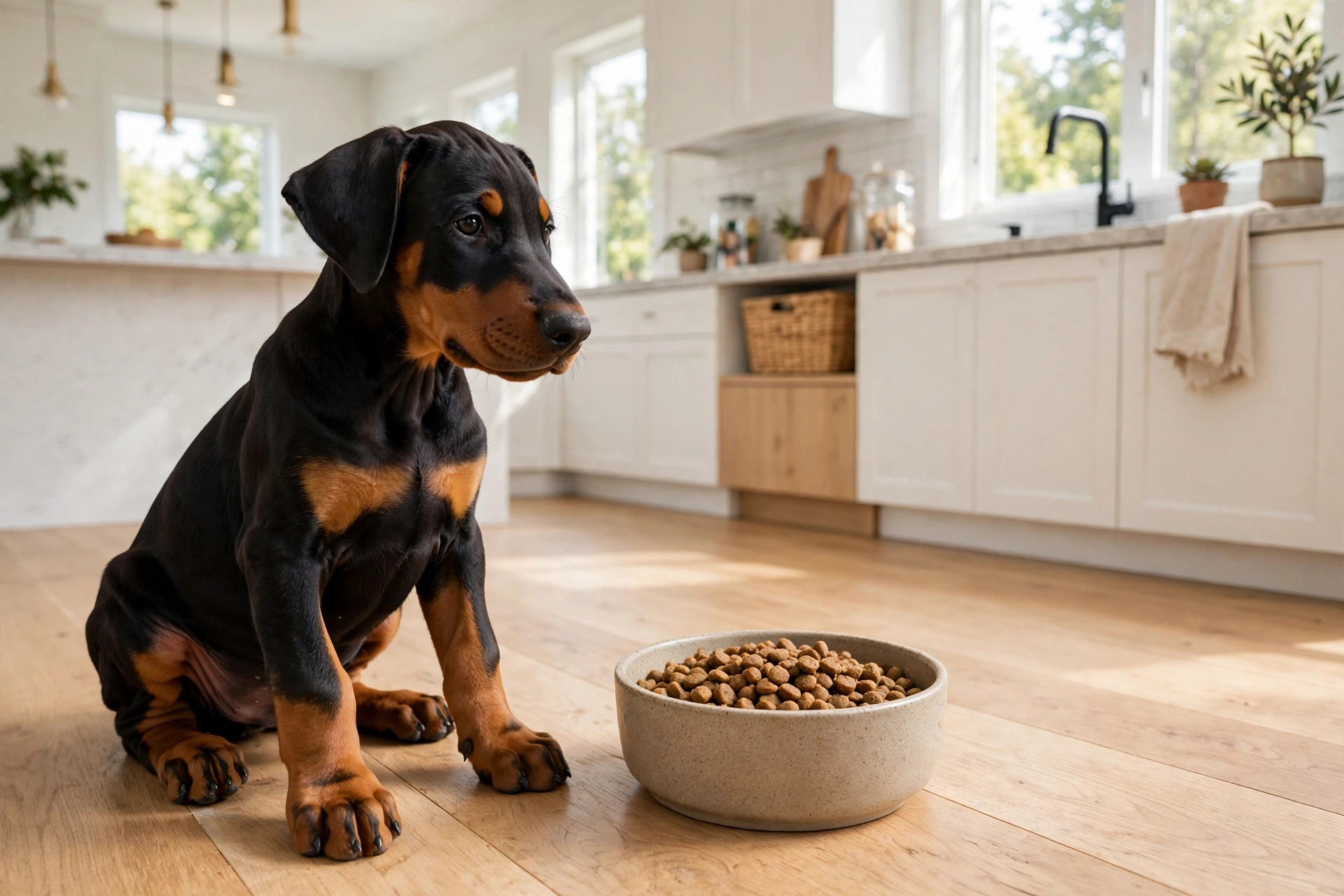
Best Puppy Food for Doberman Pinschers: Lean growth for a deep-chested breed (6 Picks 2026)
Why Doberman Puppies Need Food Made for Steady Growth
Bringing home a Doberman Pinscher puppy means signing up for one of the fastest growth curves in the dog world. A puppy that weighs a few pounds at eight weeks can pass 60 pounds before its first birthday, and most Dobermans keep filling out until they are 18 to 24 months old. That explosive growth is exactly why the best puppy food for Doberman Pinschers is not just any puppy kibble. It needs to support big bones, lean muscle, and a developing brain without pushing growth so fast that joints and bones pay the price later. And the routine around the bowl matters just as much: measured meals and a calm hour around feeding keep the bloat risk down from day one.
Dobermans are a large, deep-chested breed, and that brings two breed-specific concerns into every feeding decision. Their skeletons grow quickly, so calcium and phosphorus levels matter more than they do for a small-breed puppy. Deep-chested dogs are also more prone to bloat, so how you feed matters almost as much as what you feed. The good news is that several well-established large-breed puppy formulas already account for both issues, and this guide compares them side by side.
In this guide, you will find six real, widely sold US puppy foods that fit Doberman puppies, what each one does best, and how to choose between them. The picks below are based on ingredient analysis, brand reputation, and owner reviews. You will also find a buying guide, a portion table with the label amount for each pick, and the mistakes to avoid. This guide covers feeding, not medical advice. For anything about your Doberman puppy’s health, your vet is the right call.
Key Takeaways
- Choose a large-breed puppy formula, not a regular puppy food. It is built for controlled, steady growth in a puppy that can pass 60 lb before its first birthday.
- Look for an AAFCO statement for growth or all life stages, a named animal protein first, and DHA from fish oil for brain development. Those three checks weed out most of the wrong bags fast.
- Keep calcium in a sensible range and skip calcium supplements unless your vet recommends them. Extra calcium can harm a fast-growing Doberman skeleton.
- Feed measured meals two to four times a day, and keep one huge meal followed by hard exercise off the menu for a Doberman puppy.
- Plan to switch to adult food gradually at around 18 to 24 months, not at the first birthday. Dobermans keep filling out well past a year old.
Best Puppy Food for Doberman Pinschers at a Glance
| Product | Best For | kcal/cup | Protein | Fat | Price | Daily feeding | Cost/month |
|---|---|---|---|---|---|---|---|
| Purina Pro Plan Puppy Large Breed Chicken & Rice | Best overall | 419 | 28% | 13% | $74.98 / 34 lb | ~4.83 cups | ~$75/mo |
| Hill’s Science Diet Puppy Large Breed Chicken & Brown Rice | Steady growth | 391 | 24% | 11% | $78.99 / 27.5 lb | 5 cups | ~$103/mo |
| ORIJEN Amazing Grains Puppy Large | High-protein feeding | 483 | 38% | 16% | $106.99 / 22.5 lb | ~3½ cups | ~$138/mo |
| Blue Buffalo Life Protection Formula Puppy Large Breed | Antioxidant support | 385 | 26% | 15% | $79.97 / 34 lb | ~3½ cups | ~$58/mo |
| Royal Canin Large Puppy | Sensitive digestion | 349 | 28% | 14% | $119.99 / 40 lb | ~5.3 cups | ~$101/mo |
| Purina ONE +Plus Healthy Puppy Formula | Best budget pick | 374 | 28% | 17% | $49.98 / 31.1 lb | ~4.88 cups | ~$49/mo |
Prices checked 2026-11-14 on Chewy. Daily feeding is for a 6-month-old puppy expected to reach 80 lb as an adult. One food you will not see here is a fresh option: Ollie and Farmer’s Dog price their plans per dog, so there is no fixed bag price or kcal/cup to compare like-for-like, and we did not want to guess.
Purina Pro Plan Puppy Large Breed Chicken & Rice
If you ask a room full of Doberman owners what their puppies eat, Purina Pro Plan Large Breed Puppy comes up more than any other kibble, and there are good reasons for that. The first ingredient is real chicken, and the formula is built specifically for puppies expected to reach more than 50 pounds as adults. It includes DHA from fish oil for brain and vision development, plus live probiotics for digestive health, which matters for a breed whose stomachs can be sensitive during the transition to a new home.
What makes it the best overall pick for Doberman puppies is the balance. Protein sits at a level that builds lean muscle without the excess energy that can push a puppy to grow too fast, and the calcium and phosphorus levels are formulated for large-breed growth rather than borrowed from an all-breed recipe. It is also widely available in the US in several bag sizes, so you can buy a small bag first to check your puppy tolerates it before committing to a large one. For most Doberman puppy owners, this is the safest starting point, and it is the formula many breeders already send puppies home eating. Pair it with measured meals and a calm hour around feeding, and you have both halves of lean, bloat-safe growth covered.
Hill’s Science Diet Puppy Large Breed Chicken & Brown Rice
Hill’s Science Diet Puppy Large Breed is the pick for owners who worry most about growth rate, and with a Doberman, that worry is justified. Puppies that gain weight too quickly can put extra strain on developing joints, and this formula is designed around balanced minerals and controlled energy to encourage steady rather than explosive growth. Chicken meal provides concentrated protein, brown rice and oats supply digestible carbohydrates, and fish oil adds DHA for brain development.
Owners also report that this food tends to produce firm stools, which is a useful early signal that a food agrees with a puppy. The kibble size suits a large-breed puppy’s jaw, and the formula avoids artificial colors and flavors. It costs more than budget kibble, but for a breed where skeletal development is a long game, the controlled mineral profile is worth paying for. If your vet has flagged that your puppy is growing unusually fast, this is the first alternative to discuss with them.
ORIJEN Amazing Grains Puppy Large
ORIJEN Amazing Grains Puppy Large is for owners who want a protein-forward food without going grain-free. The first several ingredients are fresh or raw animal proteins, including chicken and fish, and the grains in the recipe, oats, millet, and quinoa, provide fiber and steady energy rather than acting as cheap filler. That combination matters for Dobermans because the breed is predisposed to dilated cardiomyopathy (DCM), and no food prevents it. Grain-inclusive formulas are the conservative default unless a grain allergy is diagnosed, which is why many vets currently prefer them for Dobermans.
This is a richer, more calorie-dense food than the other picks here, so portion control matters even more. Fed in the right amount, it supports lean muscle and a glossy coat, and owners often report smaller, firmer stools. It is one of the priciest options in this guide, and it is not the right choice if your puppy has a sensitive stomach that prefers a simpler recipe. But if your Doberman puppy is active, lean, and thriving on a high-protein diet, this is the strongest premium option.
Blue Buffalo Life Protection Formula Puppy Large Breed
Blue Buffalo’s Life Protection Formula Puppy Large Breed starts with deboned chicken and adds the brand’s signature LifeSource Bits, a blend of antioxidants, vitamins, and minerals designed to support the developing immune system. It also includes DHA and ARA, fatty acids important for brain and eye development, and calcium and phosphorus in ratios aimed at large-breed puppies.
Where this food stands out is ingredient transparency: no poultry by-product meals, no corn, wheat, or soy, and no artificial flavors or preservatives. That makes it a good fit for owners who read labels closely. The trade-off is that some puppies find the LifeSource Bits less palatable than the rest of the kibble and pick around them, and the formula is richer than a basic chicken-and-rice recipe, so a gradual transition is important. For a Doberman puppy with no digestive issues, it is a solid, widely available middle-ground choice.
Royal Canin Large Puppy
Royal Canin Large Puppy is the pick for Doberman puppies whose stomachs protest at every food change. Its proteins are selected for high digestibility, and the formula includes prebiotics to support a balanced gut microbiome. That matters because loose stools in a large-breed puppy are not just messy. They can mean the puppy is not absorbing the nutrients it needs for growth.
The formula is also designed around the growth curve of dogs expected to reach 55 to 100 pounds as adults, which covers most Dobermans, with an adapted energy content for the second growth phase after 15 months. The kibble is sized and shaped for a large puppy’s jaw, which encourages chewing rather than gulping, a small but real help for a breed prone to eating too fast. It is a more processed, less “natural” looking ingredient list than some owners prefer, but for a puppy with a genuinely sensitive stomach, digestibility beats ideology.
Purina ONE +Plus Healthy Puppy Formula
Purina ONE +Plus Healthy Puppy Formula proves that a Doberman puppy does not need a premium-priced bag to eat well. Real chicken is the first ingredient, DHA is included for brain and vision development, and the formula carries an AAFCO statement for growth. It is widely stocked in US grocery and pet stores, which makes it the easiest pick to find in a hurry. At about $49 a month, it is also the cheapest pick in this guide by a clear margin.
The compromise is that it is an all-breed puppy formula rather than a large-breed-specific one, so its mineral levels are not tuned to a Doberman’s growth curve the way the large-breed picks are. For many puppies that is perfectly fine, especially when the owner feeds measured portions and monitors body condition. But if your puppy is growing very fast or your vet has raised a concern about bone development, one of the large-breed formulas above is a better fit. As a budget option that still covers the fundamentals, though, this one is hard to beat.
What Doberman Puppies Actually Need From Their Food
The single most important concept in feeding a Doberman puppy is controlled growth. Research on large-breed puppies has consistently shown that rapid weight gain, not just total weight, is linked to developmental joint problems. That means the goal is not to grow the biggest puppy the fastest, but to keep your puppy lean, with ribs easily felt under a thin layer of fat, and gaining weight steadily along its growth curve.
Protein should come from a named animal source, chicken, lamb, fish, or beef, listed first on the label, at roughly 26 to 32 percent of the food on a dry-matter basis. Fat supplies energy and essential fatty acids, so look for fish oil or flaxseed as a source of omega-3s. Calcium is the mineral to watch: too little weakens bones, but too much, especially from supplements added on top of a complete food, can disrupt skeletal development. Skip calcium supplements with a complete large-breed puppy food unless your vet tells you to add them.
Finally, check the AAFCO statement on the bag. It should say the food is formulated to meet the nutritional levels for growth or for all life stages, ideally including feeding trials. That statement is your basic guarantee that the recipe is complete and balanced for a puppy, rather than a treat or a supplement dressed up as food. For the general calcium, DHA, and label-reading background behind these checks, see our guide to the best puppy food for large breeds.
Buying Guide: How to Choose Between These Foods
Start with your puppy’s current situation, not with a brand ranking. If your breeder sent your puppy home on a particular food and the puppy is doing well, there is no rush to switch. Continuity matters more than optimization in the first weeks. If you are choosing fresh, start with a large-breed puppy formula and one of the profiles above that matches your priorities: overall reliability, steady growth, high protein, immune support, sensitive digestion, or budget.
Read the label beyond the front of the bag. The first three ingredients should include a named animal protein, and you should be able to recognize most of what follows. Grain-inclusive formulas are the safer default for Dobermans unless your vet has diagnosed a grain allergy, given the ongoing questions around grain-free diets and heart health in this breed.
Think about your household, too. A food that only comes in a 30-pound bag is a poor trial choice for a puppy that may reject it, so look for a small bag or a retailer with a satisfaction guarantee. And budget honestly: a Doberman puppy eats a lot, so compare cost per day, not cost per bag. Purina ONE is the cheapest pick here at about $49 a month, and the trade-off is that it is an all-breed formula, not a large-breed one, so its minerals are not tuned to a Doberman’s growth curve. For the general label-reading and buying background, see our guide to the best puppy food for large breeds.
How Much to Feed a Doberman Puppy
Every bag carries a feeding guide, and it is a starting point, not a prescription. Doberman puppies vary enormously in appetite and metabolism, so use the guide, then adjust by body condition: you should be able to feel ribs with light pressure but not see them prominently, and your puppy should have a visible waist when viewed from above. The table below works out what each pick actually costs and how much of it a 6-month-old Doberman needs. Amounts are for a 6-month-old puppy expected to reach 80 lb as an adult, with a current weight assumed to be about 55 lb.
| Food | kcal/cup | Price | Daily amount | Daily calories | Cost/month |
|---|---|---|---|---|---|
| Purina Pro Plan Puppy Large Breed Chicken & Rice | 419 | $74.98 / 34 lb | ~4.83 cups | ~2,024 kcal | ~$75/mo |
| Hill’s Science Diet Puppy Large Breed Chicken & Brown Rice | 391 | $78.99 / 27.5 lb | 5 cups | 1,955 kcal | ~$103/mo |
| ORIJEN Amazing Grains Puppy Large | 483 | $106.99 / 22.5 lb | ~3½ cups | ~1,691 kcal | ~$138/mo |
| Blue Buffalo Life Protection Formula Puppy Large Breed | 385 | $79.97 / 34 lb | ~3½ cups | ~1,348 kcal | ~$58/mo |
| Royal Canin Large Puppy | 349 | $119.99 / 40 lb | ~5.3 cups | ~1,850 kcal | ~$101/mo |
| Purina ONE +Plus Healthy Puppy Formula | 374 | $49.98 / 31.1 lb | ~4.88 cups | ~1,825 kcal | ~$49/mo |
These amounts are approximate and depend on the food’s calorie density, so always check your bag’s guide and adjust from there. If your puppy is gaining too fast or looking round, cut back by about 10 percent and reassess in two weeks. If ribs are prominent or energy is low, increase slightly. Weigh your puppy every two weeks during the fastest growth phase so you are adjusting on data, not guesswork. On these foods, a 6-month-old Doberman eats roughly 1,350 to 2,000 calories a day, which lines up with the roughly 1,800 calories a day often quoted for Doberman puppies. For the full schedule by age, see our Doberman Pinscher Feeding Guide.
Feeding Habits That Protect a Deep-Chested Puppy
Because Dobermans are deep-chested, bloat is a risk worth taking seriously from puppyhood. Feed measured meals rather than leaving food out all day. If your puppy inhales meals in under two minutes, a slow-feeder bowl is the practical fix: it forces a slower pace, and paired with measured meals it is one of the best bloat habits you can build. Keep vigorous exercise out of the hour before and after meals, and split the daily ration into at least two meals once your puppy is past the youngest stage. One large meal a day is the habit to break.
Water should always be available, but a puppy gulping huge amounts right after eating or exercising is worth slowing down. Keep mealtimes calm and predictable, and teach children in the household not to excite the puppy around feeding time. None of these habits guarantees bloat will never happen, but together they reduce one of the few risk factors you can control. If you ever notice a swollen abdomen, restlessness, retching without producing vomit, or sudden distress after a meal, treat it as an emergency and contact your vet immediately.
What to Avoid
- Adult dog food for a growing Doberman puppy. It lacks the calorie density, DHA, and mineral balance a puppy needs to grow lean and steady.
- Calcium or bone-meal supplements added to a complete food. Extra calcium can harm a Doberman puppy’s developing bones.
- Raw or home-cooked diets without veterinary nutritionist guidance. It is easy to unbalance calcium, phosphorus, and vitamins during growth.
- Grain-free formulas chosen by default. Dobermans are a breed where many vets prefer grain-inclusive diets unless an allergy is diagnosed.
- Free-feeding all day. It hides appetite changes, encourages fast weight gain, and works against bloat prevention in a deep-chested breed like the Doberman.
- Switching foods abruptly. Sudden changes commonly cause diarrhea in Doberman puppies, so transition over 7 to 10 days.
- Cheap foods built on unnamed meat meals, artificial colors, and heavy filler content. They rarely deliver the nutrient density a large, fast-growing Doberman puppy needs.
When to Switch to Adult Food
Most Dobermans should stay on puppy food longer than smaller breeds, typically until 18 to 24 months, when growth has mostly finished. Switching at 12 months, as many generic guides suggest, is too early for a breed that is still filling out. When the time comes, transition over 7 to 10 days: start with about 25 percent new food mixed into the old, move to half and half by day five, and reach 100 percent new food by day ten. If stools loosen during the switch, slow down rather than pushing through.
For more detail on portions as your puppy grows, see our puppy feeding schedule, and if you are comparing formulas across breeds, our best puppy food for large breeds guide covers the same principles in broader terms. Puppies with touchy stomachs may also benefit from the gentler options in our best dog food for sensitive stomach guide, and when you do switch foods, follow the gradual method in our guide to changing dog food safely.
Conclusion: Our Recommendation
For most Doberman puppies, Purina Pro Plan Puppy Large Breed Chicken & Rice is the best place to start: it is large-breed specific, widely trusted by Doberman breeders and owners, includes DHA and probiotics, and is easy to find. If your puppy’s growth is running fast or your vet wants tighter mineral control, Hill’s Science Diet Puppy Large Breed is the strongest alternative. And if your puppy’s stomach is the main challenge, Royal Canin Large Puppy’s digestibility-first design is worth the premium.
Whichever you choose, remember that the food is only half the equation. Measured meals, a calm feeding routine, regular weigh-ins, and a switch to adult food at 18 to 24 months will do as much for your Doberman’s long-term health as the brand in the bowl. Feed for steady growth, watch the puppy rather than the bowl, and enjoy the brief, wonderful stage when your Doberman is still small enough to fit on your lap. It will not last long. If you are comparing across breeds, the same lean-growth thinking applies in our guides to the best puppy food for German Shepherds and the best puppy food for Boxers.
Later, when your Doberman reaches senior age, see our guide to best senior doberman pinscher food for age-appropriate picks. Once your Doberman is grown, our best dog food for Doberman Pinschers guide picks up where this one leaves off.
Frequently Asked Questions
What is the best puppy food for Doberman Pinschers?
For most Doberman puppies, Purina Pro Plan Puppy Large Breed Chicken & Rice is the best starting point because it is large-breed specific, includes DHA and probiotics, and is widely trusted by Doberman breeders and owners.
When should I switch my Doberman puppy to adult food?
Most Dobermans should stay on puppy food until 18 to 24 months, when growth has mostly finished, then transition gradually over 7 to 10 days.
How much should I feed my Doberman puppy?
Follow the bag’s guide as a starting point, split into 3 to 4 meals for young puppies and 2 meals from about 6 to 12 months, and adjust by body condition so ribs are easily felt but not prominent.
Is grain-free food bad for Doberman puppies?
Not automatically, but many vets currently prefer grain-inclusive diets for Dobermans unless a grain allergy is diagnosed, so discuss grain-free choices with your vet first.
Can Doberman puppies eat regular puppy food instead of large-breed food?
They can survive on it, but large-breed puppy formulas are better because their calcium, phosphorus, and energy levels are tuned for controlled skeletal growth.
Should I add calcium supplements to my Doberman puppy’s food?
No. Skip calcium supplements with a complete large-breed puppy food unless your vet recommends them, because extra calcium can harm developing bones.
3 Comments