
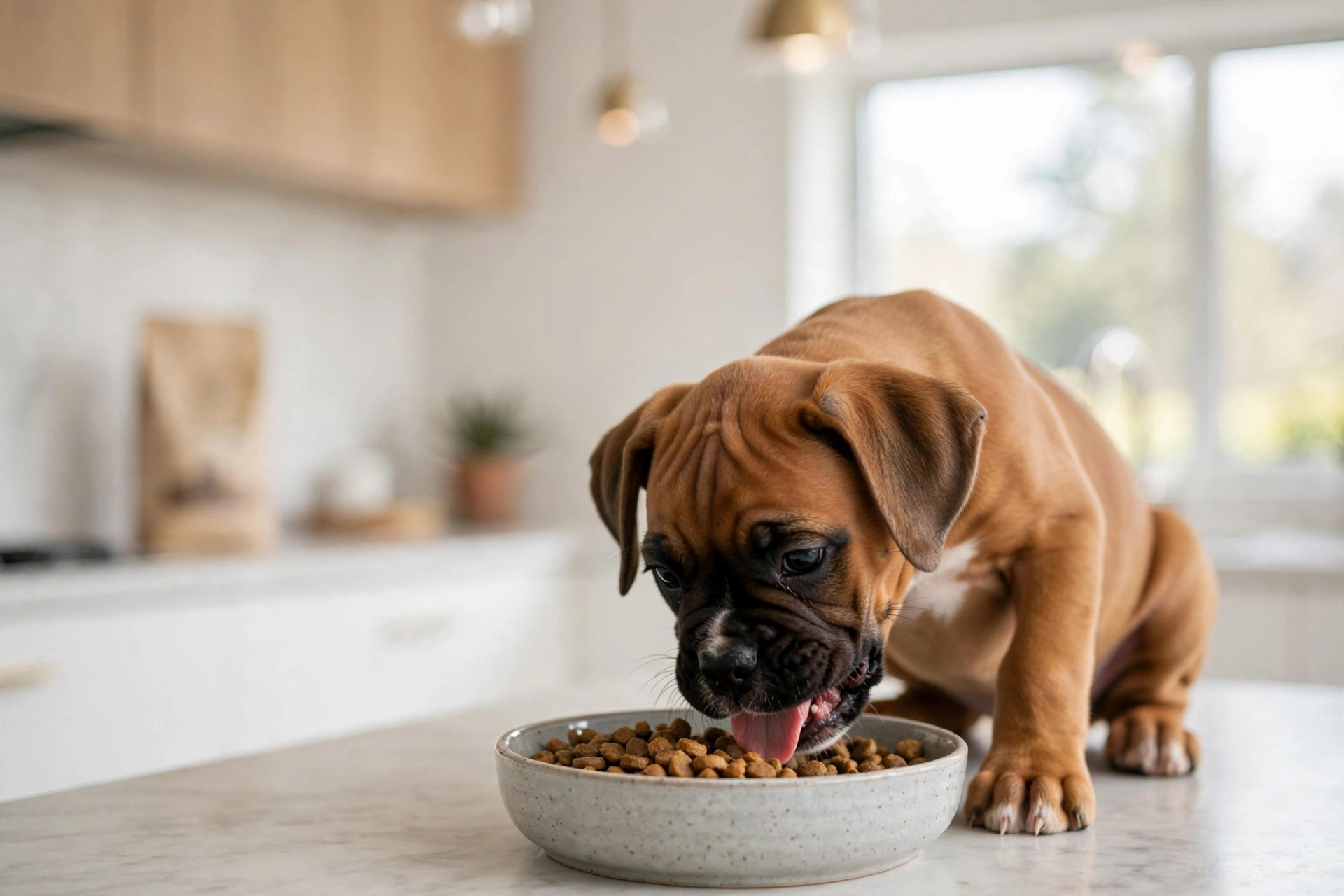
Best Puppy Food for Boxers: Lean-muscle growth (6 Picks 2026)
Finding the best puppy food for Boxers is not quite the same as picking any large-breed puppy food off the shelf. Boxer puppies grow fast and build muscle early, and some have sensitive stomachs, a flat face that makes eating awkward, and a habit of inhaling dinner in about ninety seconds. The right food supports steady, controlled growth instead of pushing it, gives them the protein and DHA their developing brains and bodies need, and is easy enough to chew and digest that mealtimes stop ending in gas, loose stools, or a bowl skidding across the kitchen floor.
In this guide, we compare six puppy foods that work well for Boxers in the US, based on ingredient analysis, brand reputation, and owner reviews. You will also find a feeding-amount table by age, a clear answer on when to switch to adult food, and the buying-guide details that matter most for this breed: controlled calcium, protein quality, fat levels, and the AAFCO statement to look for on the bag. For the general large-breed principles behind these picks, see our Best Puppy Food for Large Breeds guide.
Key Takeaways
- Choose a large-breed puppy formula with controlled calcium and phosphorus. It keeps a fast-growing Boxer’s bones growing at a steady pace instead of racing ahead of his joints.
- Look for a named animal protein first on the ingredient list, plus DHA from fish oil. That combination builds the lean muscle Boxers are known for while their brains and eyes are still developing.
- Royal Canin Boxer Puppy is the only pick shaped for a Boxer’s flat face and underbite, and it is made for Boxers up to 15 months old.
- Feed three to four small meals a day, and use a slow-feeder bowl if your puppy gulps food. Boxers are deep-chested, so the same bloat precautions that apply to any deep-chested breed matter here, and calm eating habits start now.
- Keep your puppy on a puppy formula until about 12 to 15 months old, then switch to adult food gradually over 7 to 10 days.
Best Puppy Food for Boxers at a Glance
| Product | Best for | Key feature | kcal/cup | Protein/Fat | Price | Cost/mo |
|---|---|---|---|---|---|---|
| Royal Canin Boxer Puppy Dry Dog Food | Overall best for Boxers | Breed-specific kibble shape, made for Boxers up to 15 months | 361 | 28% / 16% | $104.99 / 30 lb | ~$98/mo |
| Purina Pro Plan Large Breed Puppy | Best value large-breed pick | Chicken first, with DHA and live probiotics for digestion | 419 | 28% / 13% | $74.98 / 34 lb | ~$69/mo |
| Hill’s Science Diet Puppy Large Breed | Best for steady growth | Balanced minerals for controlled bone growth | 391 | 24% / 11% | $78.99 / 27.5 lb | ~$82/mo |
| Blue Buffalo Life Protection Formula Large Breed Puppy | Best natural-ingredient pick | Deboned chicken, oatmeal, and antioxidant-rich LifeSource Bits | 385 | 26% / 15% | $79.97 / 34 lb | ~$45/mo |
| Taste of the Wild High Prairie Puppy Formula | Best grain-free option | Roasted bison and venison with probiotics | 415 | 28% / 17% | $59.99 / 28 lb | ~$60/mo |
| Wellness Complete Health Large Breed Puppy | Best for sensitive stomachs | Deboned chicken and oatmeal, with no corn, wheat, or soy | 367 | 29% / 13% | $69.98 / 30 lb | ~$80/mo |
Prices checked on Chewy on November 14, 2026. Cost per month is for a 6-month-old puppy expected to reach 65 lb as an adult, at the daily feeding in the portion table below.
Royal Canin Boxer Puppy Dry Dog Food
Best for: Boxer owners who want a formula made for this breed and nothing else.
Royal Canin Boxer Puppy is the only food on this list designed specifically for Boxer puppies, and it shows in the details. The kibble is shaped for a Boxer’s short muzzle and underbite, so puppies can pick it up and chew it instead of chasing round pieces around the bowl. The formula is made for Boxers up to 15 months old, which matches the breed’s longer puppy stage better than a generic 12-month cut-off.
The recipe focuses on the things Boxer puppies actually need: protein for lean muscle development, prebiotics and psyllium for digestive health, and nutrients that support their natural defences during the fast-growth months. Calcium and phosphorus are kept at levels suited to a large breed’s controlled growth, which matters because growing too fast can stress developing joints.
The trade-off is price. Breed-specific food costs more per bag than a mainstream large-breed puppy food, and it is a single-protein, single-flavour approach, so picky puppies have no alternative recipe within the same line. If your budget stretches to it, though, this is the most Boxer-tailored starting point available in the US.
Purina Pro Plan Large Breed Puppy
Best for: Owners who want a proven large-breed puppy food at a sensible price.
Purina Pro Plan Large Breed Puppy (Chicken & Rice) leads with real chicken and is built around the two things large-breed puppies need most: controlled growth and a healthy gut. It includes DHA from fish oil for brain and vision development, plus live probiotics that are added after cooking so they actually survive into the bowl. That is a genuine help for Boxer puppies whose stomachs tend to be unsettled.
Protein sits at a solid level for a growing large breed without going overboard, and the calcium-to-phosphorus balance is formulated for large-breed puppies rather than all life stages. That distinction matters: an all-life-stages food is not the same as a large-breed puppy food, and for a breed that can reach 50 to 80 pounds as an adult, controlled growth is the safer path.
This is also one of the easiest foods on this list to find in US pet stores and supermarkets, which counts when you are going through a bag every couple of weeks with a hungry Boxer puppy in the house.
Hill’s Science Diet Puppy Large Breed
Best for: Steady growth for large-breed puppies.
Hill’s Science Diet Puppy Large Breed is a long-standing, widely recommended choice, and its strength is balance rather than any single headline ingredient. Chicken leads the recipe, fish oil supplies DHA, and the mineral levels are set for controlled skeletal growth in large breeds. That is the factor that helps a fast-growing Boxer puppy develop strong bones without outgrowing its joints.
The formula also includes a blend of prebiotic fibre for digestive health, which suits Boxers well, and it comes in a kibble size that most puppies manage easily. Owners often report firmer stools after switching to it, which is a practical win when you are house-training.
It is not the cheapest option, and it is not grain-free, so if your puppy has a confirmed grain sensitivity it is not the right pick. For most Boxer puppies, though, the grains here, barley, rice, and oats, are digestible energy sources rather than fillers, and the overall nutritional profile is hard to fault.
Blue Buffalo Life Protection Formula Large Breed Puppy
Best for: Owners who prefer a natural-ingredient recipe with no by-product meals.
Blue Buffalo Life Protection Formula Large Breed Puppy starts with deboned chicken, followed by chicken meal, oatmeal, and barley. It contains no corn, wheat, soy, or poultry by-product meals, and it adds the brand’s LifeSource Bits, small, darker kibbles mixed in that carry antioxidants, vitamins, and minerals.
For Boxer puppies, the appeal is the combination of real meat protein for muscle growth, DHA and ARA for cognitive development, and calcium and phosphorus levels formulated for large-breed puppies. The oatmeal and barley base is also gentle on digestion compared with recipes built on cheaper fillers.
One thing to watch: some puppies pick out the LifeSource Bits and leave them, and the food is calorie-dense, so measure portions rather than free-feeding. A Boxer puppy that grazes all day is more likely to grow too fast and to develop sloppy eating habits that are hard to break later.
Taste of the Wild High Prairie Puppy Formula
Best for: Boxer puppies who do better on a grain-free, novel-protein recipe.
Taste of the Wild High Prairie Puppy Formula is built on roasted bison and roasted venison, with sweet potatoes and peas supplying digestible energy instead of grains. It includes DHA for brain development, antioxidants from fruits and vegetables, and a proprietary probiotic blend added after cooking.
This is a good option to consider if your Boxer puppy has already shown sensitivity to chicken or grains, two of the more common triggers in the breed, because the protein sources are different from the usual chicken-first recipes. Many owners of gassy, itchy Boxers find that a change of protein, rather than a change of brand, is what settles things down.
A word of caution that applies to every grain-free food: the FDA has flagged a possible link between grain-free diets and heart trouble in some dogs. Grain-free is a choice, not a default, so it is worth discussing with your vet before choosing it.
Wellness Complete Health Large Breed Puppy
Best for: Boxer puppies with sensitive stomachs.
Wellness Complete Health Large Breed Puppy leads with deboned chicken and chicken meal, with oatmeal and barley as gentle carbohydrate sources. It contains no corn, wheat, or soy, and it includes probiotics, omega fatty acids for skin and coat, and DHA for development.
What makes it a strong pick for sensitive Boxer puppies is the restraint of the recipe: a short, recognisable ingredient list with one main protein and easily digested carbs, rather than a long list of exotic additions. When a puppy’s stomach is unsettled, fewer variables make it much easier to work out what agrees with them and what does not.
It is also formulated with controlled calcium for large-breed growth, so you are not trading digestive comfort for skeletal safety. If your Boxer puppy has loose stools on a richer food, this is a sensible next step before moving to a limited-ingredient or prescription diet.
What to Look for in Puppy Food for Boxers
Large-breed puppy formulation. This is the single most important filter. A food labelled for large-breed puppies is formulated with controlled calcium and a calcium-to-phosphorus ratio suited to slower, steadier skeletal growth. An all-life-stages or adult food is not a substitute during the first year. The general principles are covered in our Best Puppy Food for Large Breeds guide.
Named animal protein first, at a level that builds lean muscle. The first ingredient should be a named meat, lamb, bison, salmon, or a named meat meal, and protein around 26 to 32% with fat around 14 to 20% suits a Boxer puppy’s muscle growth without pushing weight gain. Avoid foods that lead with corn, wheat, soy, or vague terms like meat meal or animal by-products.
Jaw-shaped kibble and a slow feeder for a flat-faced gulper. A Boxer’s short muzzle and underbite make round kibble hard to pick up, so a shape made for the jaw, like Royal Canin Boxer Puppy’s wave-shaped kibble, genuinely helps. Pair it with a slow-feeder bowl and measured meals, and skip free-feeding: a puppy that grazes all day grows too fast and learns sloppy eating habits.
DHA, digestive support, and the AAFCO statement. DHA from fish oil supports brain and eye development, and prebiotics, probiotics, and digestible fibre help Boxer puppies, who are famously gassy and prone to loose stools. Whatever you pick, the bag should state that the food is complete and balanced for growth or for all life stages including growth.
How Much to Feed a Boxer Puppy
Portions depend on your puppy’s age, weight, and activity, and the feeding guide on your chosen bag is the best starting point. The table below works it out for a 6-month-old Boxer puppy expected to reach 65 lb as an adult, using each food’s own label values.
| Product | kcal/cup | Price | Daily feeding | Cost/mo |
|---|---|---|---|---|
| Royal Canin Boxer Puppy Dry Dog Food | 361 | $104.99 / 30 lb | ~4.43 cups/day | ~$98/mo |
| Purina Pro Plan Large Breed Puppy | 419 | $74.98 / 34 lb | ~4.46 cups/day | ~$69/mo |
| Hill’s Science Diet Puppy Large Breed | 391 | $78.99 / 27.5 lb | 4 cups/day | ~$82/mo |
| Blue Buffalo Life Protection Formula Large Breed Puppy | 385 | $79.97 / 34 lb | ~2¾ cups/day | ~$45/mo |
| Taste of the Wild High Prairie Puppy Formula | 415 | $59.99 / 28 lb | ~3¾ cups/day | ~$60/mo |
| Wellness Complete Health Large Breed Puppy | 367 | $69.98 / 30 lb | 5 cups/day | ~$80/mo |
Amounts are for a 6-month-old puppy expected to reach 65 lb as an adult. For the rows worked out by current weight, we assume a 6-month-old Boxer weighs about 40 lb. Prices checked on Chewy on November 14, 2026. For a full portion-by-age breakdown, see our Boxer Feeding Guide.
Split the daily amount across three or four meals, and adjust by body condition rather than by the bag alone. You should be able to feel your puppy’s ribs under a thin layer of fat but not see them prominently, and they should have a visible waist when viewed from above. If the ribs disappear under padding, trim the portion by about 10%. If they stick out, add the same. Weigh your puppy monthly, because Boxers grow so fast that a portion that was right three weeks ago can already be too small.
Measured meals work better than free-feeding for a Boxer puppy. Leaving food down all day makes it impossible to track appetite changes, encourages fast eating, and usually leads to overeating in a breed that loves food a little too much. Pick meals up after 20 minutes, uneaten or not. A slow-feeder bowl helps here too: it stretches a meal out and pairs with the small, frequent meals a deep-chested breed does best on.
When to Switch From Puppy to Adult Food
Most Boxer puppies are ready for adult food between 12 and 15 months old. If you feed Royal Canin Boxer Puppy, the line itself is designed to run to 15 months, and the next step is Royal Canin Boxer Adult. For other large-breed puppy foods, 12 months is a reasonable switching point for a puppy that has reached close to adult height, but there is no penalty for waiting until 15 months if your puppy is still filling out.
Switch gradually over 7 to 10 days: start with roughly 25% new food and 75% old for two to three days, move to a 50/50 mix, then 75% new, then fully switched. A sudden change is the most common cause of a week of loose stools, and it is easily avoided. If your puppy’s stools stay loose beyond the transition, slow the switch down rather than abandoning the new food immediately.
For a full portion-by-age breakdown and adult feeding amounts, see our best dog food for Boxers guide, and for general puppy portion guidance, our puppy feeding schedule. If your Boxer puppy turns out to be one of the sensitive-stomach majority, the best puppy food for large breeds guide covers gentler alternatives, and our best dry puppy food roundup is useful if you want to compare dry-only options.
What to Avoid
- Adult or all-life-stages food in the first year. It is not formulated for controlled large-breed growth, and the calcium levels may be wrong for a growing Boxer.
- Foods with unnamed proteins or fillers first. Corn, wheat, and soy leading the ingredient list, or meat meal with no animal named, are signs of a cheap recipe.
- Overfeeding and rapid growth. A roly-poly Boxer puppy looks cute, but excess weight on growing joints is a real risk. Lean and steady beats big and fast.
- One giant meal a day. Boxers are deep-chested, so the same bloat precautions that apply to any deep-chested breed matter here. Small, split meals and a slow-feeder bowl build the calm eating habits that lower risk later.
- Toxic foods and rich table scraps. Chocolate, grapes, raisins, onions, garlic, xylitol, and macadamia nuts are all off the menu for dogs, and fatty scraps are worth keeping small: rich scraps can upset a sensitive stomach.
- Exercise right after meals. Keep hard play out of the hour before and after eating, because a deep-chested dog does best with a calm window around meals.
Conclusion: Our Recommendation
If you want one straightforward answer, start with Royal Canin Boxer Puppy. It is the only food here made for Boxers specifically, with the right kibble shape, the right growth window, and digestive support built in. If the price puts you off, Purina Pro Plan Large Breed Puppy is the best-value alternative and a proven large-breed formula, while Wellness Complete Health Large Breed Puppy is the pick to try first if your puppy’s stomach is already giving you trouble.
Whichever food you choose, the habits matter as much as the bag: measure portions, feed several small meals, slow down a gulper with a slow-feeder bowl, and switch to adult food gradually at 12 to 15 months. Get those right, and your Boxer puppy has the best possible start. If you are comparing breeds, our guides to the best puppy food for Doberman Pinschers and the best puppy food for German Shepherds use the same label-value approach for two other large breeds. One more note: no fresh-food subscription made this list, because fresh services price by the individual dog, so there is no fixed per-bag price to put in the table above.
This guide covers feeding, not medical advice. For anything about your Boxer puppy’s health, your vet is the right call. When your Boxer moves to adult food, see our guide to best dog food for Boxers.
Frequently Asked Questions
When should I switch my Boxer puppy to adult food?
Most Boxer puppies are ready for adult food between 12 and 15 months old. Royal Canin Boxer Puppy is designed to run to 15 months, while other large-breed puppy foods can be switched at around 12 months if your puppy is close to adult height. Switch gradually over 7 to 10 days to avoid stomach upset.
How much should I feed a Boxer puppy each day?
It depends on age: roughly 1.5 to 2 cups a day at 8 to 12 weeks across four meals, 2 to 3 cups at 3 to 6 months across three meals, and 3 to 4 cups from 6 months onward across two to three meals. Always adjust by body condition and follow the guide on your chosen food’s bag.
Is grain-free puppy food safe for Boxers?
Grain-free food is not automatically unsafe, but the FDA has investigated a possible link between grain-free diets and heart disease in some dogs, and Boxers already carry higher heart risk. Discuss grain-free with your vet before choosing it, especially if heart problems run in your puppy’s lines.
What if my Boxer puppy has a sensitive stomach?
Start with a gentle recipe built on one main protein and digestible carbs such as oatmeal and barley, like Wellness Complete Health Large Breed Puppy. Feed several small meals, switch foods gradually over 7 to 10 days, and ask your vet about a limited-ingredient or prescription diet if problems persist.
Do Boxer puppies need large-breed puppy food specifically?
Yes. Large-breed puppy foods control calcium and phosphorus for steady skeletal growth, which helps protect developing joints in a breed that grows fast and reaches 50 to 80 pounds as an adult. An adult or all-life-stages food is not a substitute in the first year.
How do I slow down a Boxer puppy that eats too fast?
Use a slow-feeder bowl, split food into three to four small meals a day, and avoid exercise in the hour before and after meals. Calm eating habits started in puppyhood also help lower bloat risk when your Boxer is an adult.


2 Comments