
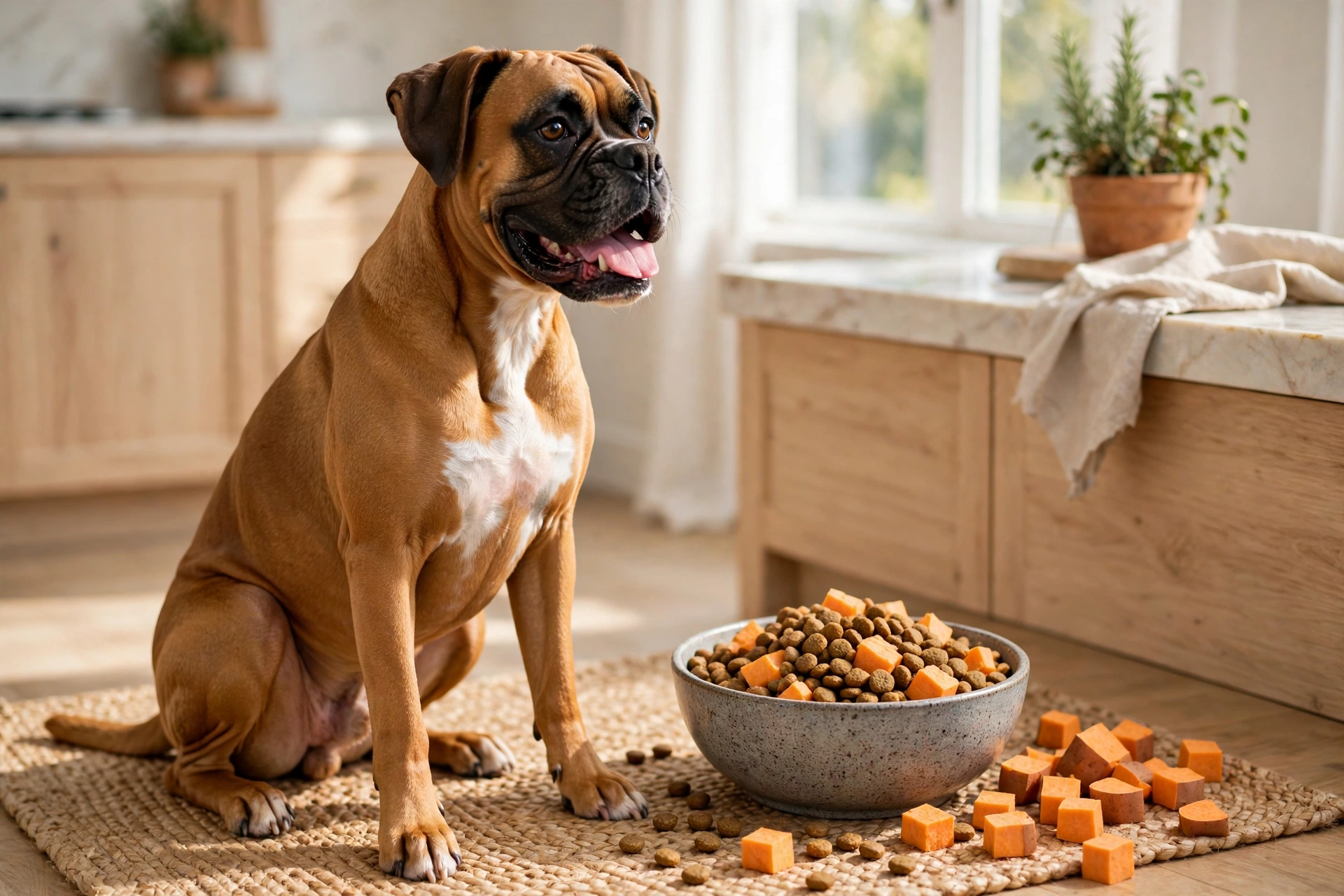
Best Food for Boxer Sensitive Stomach: Salmon-based Picks for gassy, sensitive stomach
If your Boxer has a sensitive stomach, you already know the signs: room-clearing gas, soft or runny stools, a gurgling belly, the occasional vomit, and sometimes itchy skin or ear trouble riding along. No major veterinary source, such as the AKC, VCA, Merck, or the breed club, lists Boxers as a breed prone to sensitive stomachs. But two things about Boxers are real and verified. They gulp their food, and gulped food means swallowed air, and swallowed air means gas. And a small number of young Boxers develop histiocytic ulcerative colitis, often called Boxer colitis, which brings bloody diarrhea, urgency, and weight loss, usually before the age of two. The good news is that the right food, fed the right way, settles most Boxers down without a prescription diet. For the wider picture on gentle diets, see our guide to the best dog food for sensitive stomachs.
In this guide to the best food for a Boxer with a sensitive stomach, we compare six real, US-available formulas and explain what actually helps a sensitive Boxer belly, plus the feeding habits that make the biggest difference. Every pick below is judged on the same honest basis: ingredient analysis, brand reputation, and owner reviews. We have not claimed to test these foods ourselves. This guide is for information only. Check with your vet for your dog’s specific needs.
Key Takeaways
- For most Boxers with a sensitive stomach, a salmon-based, chicken-free formula is the safest first try. Salmon is easy to digest and rarely a trigger.
- Purina Pro Plan Sensitive Skin & Stomach Salmon & Rice is our top overall pick. It pairs a gentle protein with prebiotic fiber and live probiotics.
- How you feed matters as much as what you feed: split meals, use a slow-feeder bowl, and wait before exercise. A gulped meal means swallowed air, and swallowed air means gas.
- Switch foods over 10 to 14 days, not overnight. A rushed switch can cause the very diarrhea you are trying to fix.
- If vomiting, diarrhea, or blood in the stool lasts more than 48 hours, or weight loss keeps happening despite a good appetite, that is a vet visit, not a new bag. Boxer colitis can look like a food problem at first.
Top Picks at a Glance
Here is the short version. The reviews below go into detail, and the portion table further down shows what each food costs per month for a 65 lb adult.
| Product | Best for | Protein | Fat | kcal/cup | Bag size | Price (Chewy, Nov 12, 2026) | Est. cost/month |
|---|---|---|---|---|---|---|---|
| Purina Pro Plan Sensitive Skin & Stomach, Salmon & Rice | Most Boxers; best overall | 26% | 16% | 449 | 30 lb | $77.48 | ~$49 to $64/mo |
| Hill’s Science Diet Adult Sensitive Stomach & Skin, Chicken & Barley | Gas and loose stools | 20% | 13% | 391 | 30 lb | $89.99 | ~$74/mo |
| CANIDAE Grain-Free PURE Limited Ingredient, Salmon & Sweet Potato | Chicken-free limited ingredient | 30% | 14% | 484 | 22 lb | $74.79 | ~$69 to $92/mo |
| Blue Buffalo Basics Limited Ingredient Diet, Skin & Stomach Care Salmon & Potato (with grains) | Single-protein diets | 20% | 12% | 362 | 24 lb | $74.98 | ~$81 to $97/mo |
| Diamond CARE Sensitive Skin Formula (Pea & Hydrolyzed Salmon) | Hydrolyzed protein option | 22% | 12% | 358 | 25 lb | $52.99 | ~$57/mo |
| Purina Pro Plan Sensitive Skin & Stomach, Salmon & Rice Entrée Classic (wet) | Picky eaters and low-water drinkers | 6.5% | 4.5% | 370 kcal/13-oz can | 13-oz can, case of 12 | $41.52 / 12-pack | ~$374/mo |
Prices checked on Chewy on November 12, 2026. Wet food protein and fat are as fed (78% moisture), so they read low next to dry foods. Cost per month is estimated for a 65 lb adult Boxer at the feeding amounts in the portion table below.
Purina Pro Plan Sensitive Skin & Stomach Salmon & Rice
This is the formula Boxer owners mention most often when a sensitive stomach finally settles, and for a good reason: it is one of the few sensitive-stomach recipes that keeps a named fish protein first, a gentle grain second, and a digestive support system built in. Salmon is the first ingredient, followed by rice and oatmeal, both gentle, soluble-fiber grains that tend to firm stools rather than loosen them. Oatmeal in particular is a slow-digesting grain that supports steady energy without triggering the food sensitivities some Boxers develop to wheat, corn, or soy.
What sets it apart for Boxers specifically is the gut support built into the recipe: prebiotic fiber to feed the friendly bacteria in the gut, and live probiotics that promote proper digestion. That is a strong combination when your Boxer’s main issue is a combination of gurgles, gas, and unpredictable stools, rather than a true food allergy, which is a different problem.
That swallowed-air problem is a big part of the Boxer belly story. Boxers gulp, and gulped food means air in the gut, so a food that digests cleanly and a slower meal both matter. This one digests cleanly, and the slow-feeder bowl handles the rest. It is also worth noting that this formula is widely available in the US and competitively priced for a premium food. For a Boxer who is already a picky eater (and many are), the same formula is also available in a wet version, which you can use as a topper. Just make sure any topper matches the protein in the kibble, so you do not undermine a chicken-free trial.
Pros: salmon first; prebiotic fiber and live probiotics; moderate 26% protein and 16% fat; widely available; wet version exists for toppers.
Cons: not a limited-ingredient diet; contains grains, so it is not the pick if grains are the suspect.
Hill’s Science Diet Sensitive Stomach & Skin
Hill’s Sensitive Stomach & Skin is built around one idea: ingredients your dog can actually digest. The recipe uses a blend of prebiotic fibers, and the chicken and barley formula is known for being easy on the stomach. It avoids common irritants like corn, soy, and wheat, and it does not rely on artificial additions or by-products. Many owners report less gas within the first couple of weeks.
This is a strong pick if your Boxer’s main problem is flatulence and soft stools rather than itchy skin, and if you prefer a grain-inclusive recipe for your dog’s sensitive stomach. It is also a sensible next step if a salmon formula alone has not fully worked, since the protein source and fiber balance are quite different. And because the kibble is relatively small, it is easier for a Boxer to chew and digest, especially if your dog tends to gulp food, though small kibble is not a reason to skip the slow-feeder bowl. And finally, keep portions measured. VCA notes that Boxers tend to stay in good weight, so steady, measured meals are the goal, not free feeding.
Pros: prebiotic fiber and highly digestible recipe; gentle grains; small kibble easy to chew; around $74 a month for a 65 lb Boxer.
Cons: chicken is the first ingredient; 20% protein is the lowest of the six dry picks; not a limited-ingredient diet.
CANIDAE Grain-Free PURE Limited Ingredient Salmon & Sweet Potato
When you suspect a specific ingredient is the problem but you do not know which one, a limited-ingredient diet is the smartest diagnostic tool you can buy.
CANIDAE PURE Limited Ingredient Salmon & Sweet Potato is built around eight key ingredients: salmon, sweet potato, peas, and a handful of essential vitamins and minerals. Nothing else. That simplicity makes it easy to work out what your Boxer is reacting to, and to keep the diet clean during a food trial. If chicken is your Boxer’s trigger, this is one of the safest starting points, because it contains no chicken, beef, dairy, corn, wheat, or soy. The PURE line also comes in a lamb and sweet potato version if salmon does not suit your Boxer’s taste.
Sweet potato is an underrated choice for sensitive stomachs: it is rich in soluble fiber, which firms stools, and it is less likely to trigger a food sensitivity than common starches like corn or wheat. The formula is also enriched with probiotics after cooking, which adds another layer of digestive support.
One caution: this recipe is grain-free and built on peas, lentils, and garbanzo beans. Boxers are one of the breeds predisposed to dilated cardiomyopathy (VCA), so a grain-free, legume-heavy diet is worth a conversation with your vet before you settle on it. The main drawback is price: this is among the more expensive formulas on this list, especially for a 65-pound dog that eats two to three cups a day. But if your Boxer has a known protein sensitivity or you need a short, clean ingredient list, it is worth the premium.
Pros: eight key ingredients; salmon first; no chicken, beef, dairy, corn, wheat, or soy; probiotics added after cooking; 30% protein.
Cons: grain-free and legume-heavy, so a vet conversation about heart health is smart; smallest bag (22 lb), so a 65 lb dog goes through it faster; around $69 to $92 a month.
Blue Buffalo Basics Skin & Stomach Care Salmon & Potato
Blue Buffalo Basics follows the same limited-ingredient logic with a slightly different recipe: deboned salmon is the first ingredient, followed by oatmeal, brown rice, and pumpkin. Pumpkin is a natural source of fiber and gentle on digestion, and the inclusion of oatmeal and brown rice provides a steady, digestible source of carbohydrates, all without the common trigger ingredients that bother many sensitive Boxers.
Basics also skips chicken and poultry by-product meals entirely, plus corn, wheat, soy, dairy, and eggs. That makes it an excellent choice for a Boxer whose digestive issues may be linked to chicken. It is available in both a grain-free version and a with-grains version, so check the bag: the version in this guide is the with-grains Salmon & Potato recipe, with oatmeal and brown rice, at 362 kcal per cup. Do not mix it up with the grain-free Turkey & Potato product, which is a different food at 352 kcal per cup.
The biggest downside is the price. At around $81 to $97 a month for a 65 lb Boxer, it is the most expensive dry pick on this list, largely because the bag is 24 lb and a Boxer eats 3.75 to 4.5 cups a day. But if your Boxer does well on it, the cost is justified. A sensitive stomach is expensive to manage, but it is cheaper than vet visits.
Pros: single animal protein (salmon); pumpkin in the recipe; with-grains version avoids the legume-heavy grain-free concern; chicken-free.
Cons: priciest dry pick per month, around $81 to $97; standard kibble size; check the bag, because the grain-free version is a different product.
Diamond CARE Sensitive Skin Formula
Diamond CARE takes a different approach to the protein problem: its salmon is hydrolyzed, meaning the protein is broken into tiny fragments that the immune system is less likely to recognize as a trigger. For a Boxer whose stomach reacts to whole proteins, even in limited-ingredient foods, hydrolyzed protein is often the next step, and this is the closest you can get to a veterinary elimination diet without a prescription.
The formula uses a short list of ingredients, including peas (rather than grains) as the main carbohydrate, and guarantees probiotics for digestive health. It is a solid compromise: more targeted than a standard sensitive-stomach food, but far cheaper than a prescription hydrolyzed diet. At around $57 a month for a 65 lb Boxer, it is the cheapest pick on this list.
This is the pick to discuss with your vet when standard sensitive-stomach foods have not worked, and it is the one to try if your Boxer reacts to whole proteins but has shown improvement on one of the limited-ingredient foods. If you are considering this food, talk to your vet first: a hydrolyzed formula is best used as part of a proper elimination trial, with no treats or scraps during the trial period. It is grain-free and pea-based, so the same vet conversation about grain-free diets and heart health applies.
Pros: hydrolyzed salmon; cheapest pick, around $57 a month; guaranteed probiotics; closest over-the-counter option to a vet elimination diet.
Cons: strict trial needed, with no treats or scraps; grain-free and pea-based; the 25 lb bag is the value size.
Purina Pro Plan Sensitive Skin & Stomach Salmon & Rice Entrée Classic (Wet)
Some Boxers with sensitive stomachs do better on wet food, and some just refuse kibble when their stomach is upset. Pro Plan Sensitive Skin & Stomach Wet offers the same gentle salmon recipe in a soft, easy-to-eat form, and adds water to the diet, useful for Boxers who do not drink enough. Pate-style food is also harder to gulp than kibble, which naturally slows down eating. The formula is made in US facilities and includes the same prebiotic fiber and probiotics as the dry version.
Wet food is not automatically better for digestion, and it is more expensive per calorie and harder on teeth if fed alone. But as a topper or a short-term switch for a Boxer who will not touch kibble, it is the best of the wet options. Mix it with the dry formula (same protein), or use it alone if your Boxer prefers it. As a full wet-only diet, it costs around $374 a month at 3.6 cans a day for a 65 lb Boxer. That is why it usually works better as a topper than as the whole diet.
Pros: same gentle salmon recipe; adds water; harder to gulp; good topper.
Cons: around $374 a month as a full diet; harder on teeth if fed alone; wet values read low next to dry (6.5% protein, 4.5% fat as fed).
Also Worth a Look: Royal Canin Boxer Adult
Royal Canin makes a food built just for Boxers, and it is worth knowing about, even though it is not one of the six core picks. Royal Canin Boxer Adult is a breed-specific recipe with taurine and L-carnitine for heart and muscle support, plus EPA and DHA, and the kibble is a wave shape sized for a Boxer’s short muzzle, so it is easier to pick up and chew. On Chewy it is $99.99 for a 30 lb bag (November 12, 2026), at 358 kcal per cup, 24% protein, and 18% fat.
The catch is that it is not a sensitive-stomach food, and it is chicken-based (chicken by-product meal is the third ingredient), so it only works if your Boxer tolerates chicken and the belly trouble is mild. Think of it as the pick for a Boxer whose stomach has already settled and who you want to feed a breed-specific diet, not as the first food to try for a sensitive stomach.
Pros: built for Boxers; taurine and L-carnitine for heart and muscle support; wave-shaped kibble for a short muzzle.
Cons: not a sensitive-stomach formula; chicken-based; $99.99 for a 30 lb bag, so it is the most expensive bag on this page.
How Much to Feed Your Boxer
A 65 lb adult Boxer needs roughly 1,300 to 1,450 calories a day from these foods, which is why the label amounts cluster as they do. Use the bag’s feeding guide as a starting point, then adjust by body condition: you should be able to feel ribs under a thin fat layer but not see them. Treats should stay under 10% of daily calories, and for a sensitive Boxer, treats should match the diet’s protein: salmon treats with a salmon food, not chicken jerky on the side.
Amounts are for a 65 lb adult dog. The table below uses the AKC weight range for adult Boxers (males 65 to 80 lb, females about 50 to 65 lb) and each food’s own label feeding guide.
| Product | kcal/cup | Price (Chewy, Nov 12, 2026) | $/lb | Daily feeding (65 lb adult) | Est. cost/month |
|---|---|---|---|---|---|
| Purina Pro Plan Sensitive Skin & Stomach, Salmon & Rice | 449 | $77.48 / 30 lb | $2.59 | 2.5 to 3.25 cups/day | ~$49 to $64/mo |
| Hill’s Science Diet Adult Sensitive Stomach & Skin, Chicken & Barley | 391 | $89.99 / 30 lb | $3.00 | 3.56 cups/day | ~$74/mo |
| CANIDAE Grain-Free PURE Limited Ingredient, Salmon & Sweet Potato | 484 | $74.79 / 22 lb | $3.40 | 2.25 to 3 cups/day | ~$69 to $92/mo |
| Blue Buffalo Basics Limited Ingredient Diet, Skin & Stomach Care Salmon & Potato (with grains) | 362 | $74.98 / 24 lb | $3.13 | 3.75 to 4.5 cups/day | ~$81 to $97/mo |
| Diamond CARE Sensitive Skin Formula (Pea & Hydrolyzed Salmon) | 358 | $52.99 / 25 lb | $2.12 | 3.98 cups/day | ~$57/mo |
| Purina Pro Plan Sensitive Skin & Stomach, Salmon & Rice Entrée Classic (wet) | 370 kcal/13-oz can | $41.52 / 12-pack | $3.46/can | 3.6 cans/day | ~$374/mo |
Prices checked on Chewy on November 12, 2026. The wet row is a full wet-only diet at 3.6 cans a day, which is why its monthly cost is far above the dry rows. It is not an error. For more on portions and schedules, see our Boxer feeding guide.
Feeding Chart by Weight (50 to 80 lb)
The chart below gives cups per day and calories per day for each pick at 50 lb, 65 lb, and 80 lb. The 65 lb column is the amount from each label. Amounts at 50 and 80 lb are estimated from the 65 lb label amount using metabolic weight, so treat them as starting points.
| Product | 50 lb | 65 lb | 80 lb |
|---|---|---|---|
| Purina Pro Plan Sensitive Skin & Stomach, Salmon & Rice | 2.25 cups (1,010 kcal) | 2.5 to 3.25 cups (1,123 to 1,459 kcal) | 3.25 cups (1,459 kcal) |
| Hill’s Science Diet Adult Sensitive Stomach & Skin, Chicken & Barley | 3 cups (1,173 kcal) | 3.56 cups (1,392 kcal) | 4.25 cups (1,662 kcal) |
| CANIDAE Grain-Free PURE Limited Ingredient, Salmon & Sweet Potato | 2.25 cups (1,089 kcal) | 2.25 to 3 cups (1,089 to 1,452 kcal) | 3 cups (1,452 kcal) |
| Blue Buffalo Basics Limited Ingredient Diet, Skin & Stomach Care Salmon & Potato (with grains) | 3.5 cups (1,267 kcal) | 3.75 to 4.5 cups (1,358 to 1,629 kcal) | 4.75 cups (1,720 kcal) |
| Diamond CARE Sensitive Skin Formula (Pea & Hydrolyzed Salmon) | 3.25 cups (1,164 kcal) | 3.98 cups (1,425 kcal) | 4.75 cups (1,701 kcal) |
| Purina Pro Plan Sensitive Skin & Stomach, Salmon & Rice Entrée Classic (wet) | 3 cans (1,110 kcal) | 3.6 cans (1,332 kcal) | 4.25 cans (1,573 kcal) |
Adjust up or down by 10 to 15% for body condition: if you can see ribs, feed more; if you cannot feel them under a thin fat layer, feed less. Puppies and very active young Boxers need more per pound than a settled adult, and seniors usually need less. Puppies should eat a puppy or all-life-stages formula; the adult foods in this table are for grown Boxers.
Why Boxers Get Sensitive Stomachs
No major veterinary source, such as the AKC, VCA, Merck, or the breed club, lists Boxers as a breed prone to sensitive stomachs. What is verified about Boxers is more specific, and it matters more for your food choice.
Two conditions are worth knowing by name. Histiocytic ulcerative colitis (HUC), often called Boxer colitis, is a form of colitis closely associated with young Boxers, usually before the age of two. It brings bloody diarrhea, urgency, and weight loss, and it is a vet problem, not a food-pick problem. Inflammatory bowel disease (IBD) can look similar, and neither can be fixed by a bag of kibble alone.
Gas is a different story. Boxers are a brachycephalic (short-muzzled) breed, and they gulp their food. A fast eater swallows air with every bite, and that air is where much of the gas comes from. Slow feeding and small meals help more than any single ingredient here.
Boxers are also one of the breeds predisposed to dilated cardiomyopathy (VCA). That is why a grain-free, legume-heavy diet is worth a conversation with your vet rather than a default choice. Bloat is a risk for any large, deep-chested dog, and the feeding routine below is built around that general rule, not a claim that Boxers top the risk lists.
And if the issue is skin, not stomach, see our guide to the best food for Boxer skin allergies.
When It Is Not Just a Sensitive Stomach
Most Boxer belly trouble is food and feeding. But two conditions in this breed are not. Inflammatory bowel disease (IBD) and histiocytic ulcerative colitis (HUC, or Boxer colitis) cause signs that no bag of kibble fixes. Get your Boxer to the vet now if you see any of these:
- Blood or mucus in the stool.
- Urgency, straining, or accidents in a house-trained dog.
- Weight loss despite a normal appetite.
- Symptoms that keep coming back every few weeks.
HUC usually shows up in young Boxers, before the age of two. For dogs that do not settle on over-the-counter foods, your vet may move to a prescription diet such as Royal Canin Gastrointestinal or Hill’s i/d. Those are vet-only foods, not something to buy off the shelf.
Buying Guide: What to Look for in a Sensitive-Stomach Food for a Boxer
One named protein first. Look for “salmon,” “lamb,” or another named meat as the first ingredient, not “meat meal” or “by-product meal.” The first ingredient should be a named animal protein, and it should be the only animal protein in the first three ingredients if you are trying to rule out a trigger.
Gentle carbohydrates. Rice, oat meal, barley, sweet potato, and pumpkin are all gentle, digestible carbohydrates for most dogs. Avoid corn, wheat, and soy as first ingredients, and use a formula with a limited number of ingredients and no artificial colors, flavors, or preservatives.
Fiber in the right range. Moderate fiber (around 3 to 5% crude fiber) firms stools without causing excess gas. More fiber can bloat, and less can leave stools loose.
Moderate fat. Fat slows stomach emptying, and in large amounts it can trigger pancreatitis in dogs. Boxers do not need a high-fat formula for a sensitive stomach: a sensitive-stomach formula in the 12 to 16% fat range is usually the sweet spot. Rich, high-fat “performance” foods are a poor choice for a sensitive belly.
Probiotics and prebiotic fiber. Live probiotics and prebiotic fiber (from sources like FOS or beet pulp) support the gut microbiome. Not every sensitive stomach needs them, but they help many dogs, and they are the main difference between a basic kibble and a sensitive-stomach formula.
An AAFCO statement. Every food you buy should carry an AAFCO nutritional adequacy statement for your dog’s life stage, adult maintenance for most Boxers, or all life stages if you also have a puppy in the house.
Boxer-sized portions, not breed-sized bags. Boxers are muscular, medium-large dogs, typically 50 to 80 pounds. VCA notes that Boxers tend to stay in good weight, so use the feeding guide on the bag as a starting point, then adjust by body condition: you should be able to feel ribs under a thin fat layer but not see them. Treats should stay under 10% of daily calories, and for a sensitive Boxer, treats should match the diet’s protein: salmon treats with a salmon food, not chicken jerky on the side.
What to Avoid
- Chicken, beef, and dairy as first ingredients during a trial. They are the most common triggers in Boxers, even in foods marketed as ‘gentle.’ Artificial colors, flavors, and preservatives such as BHA, BHT, and ethoxyquin, which can irritate sensitive guts and add nothing nutritionally.
- By-product meals as the main protein. They are inconsistent in quality and harder to trace when you are hunting for a trigger.
- Sudden food changes. Switching cold turkey is the single most common cause of a Boxer diarrhea flare-up. Transition over 10 to 14 days, and change food and treats one at a time, not together.
- One giant meal a day. In a deep-chested breed this raises bloat risk and overwhelms a sensitive stomach. Split the day’s food into two or three meals.
- Table scraps and rawhide during a food trial. Fatty scraps can trigger pancreatitis and stomach upset, and rawhide can block a gut that is already struggling.
- Grain-free by default. Grain-free helps only if grains are actually the problem, and a grain-free, legume-heavy diet deserves a vet conversation for a Boxer, given the breed’s predisposition to dilated cardiomyopathy.
- Skipping the vet when the signs point past food. Blood or mucus in the stool, urgency, or weight loss in a young Boxer can point to histiocytic ulcerative colitis, which no food fixes on its own. That is a vet visit, not a new bag.
If you also feed a bulldog, the same slow, salmon-first approach applies. See our guides to the best food for Bulldog sensitive stomach and the best food for French Bulldog sensitive stomach.
How to Switch Foods Without Upsetting the Stomach (10 to 14 Day Plan)
Switch over 10 to 14 days: 25% new food for days 1 to 3, then 50/50, then 75% new, then fully switched, holding at each step an extra day or two if stools loosen. Judge the new food over two to three weeks, not three days. For the full method, see our guide to the best dog food for sensitive stomachs.
Keep a food diary for the first month on a new diet. Write down the food and amount, every treat, and the day’s stool quality, gas, vomiting, and itching. Patterns show up in a diary weeks before they show up in memory, and your vet will want to see it if the trial does not work.
Feeding Routine: The Bloat-Safe Habits That Matter as Much as the Food
Feed two or three smaller meals a day instead of one large one. Use a slow-feeder bowl or a lick mat. Boxers gulp, and gulping swallows air that becomes gas. Wait at least an hour after meals before vigorous exercise, and avoid letting your Boxer drink huge amounts of water in one go right after eating. These habits matter because a Boxer that eats too fast and then runs is asking for trouble. A slow meal and a calm hour after eating are the cheapest insurance there is.
For more on Boxer portions and schedules, see our Boxer feeding guide and our general best dog food for Boxers guide. If you have a Boxer puppy, see our best puppy food for Boxers guide too.
When to See the Vet Instead of Trying Another Food
Food changes and probiotics help a lot of Boxers, but some symptoms need medical attention, not a new bag. See your vet promptly if diarrhea or vomiting lasts more than 48 hours, you see blood or mucus in the stool, your Boxer is losing weight despite eating normally, they are lethargic or in pain, or their abdomen looks distended or tight. That last one is a possible bloat emergency, so get help right away.
Symptoms that return every few weeks despite diet changes also deserve a full workup. Histiocytic ulcerative colitis, in particular, is a Boxer-associated condition that may need prescription diets or medication long-term. They help many dogs but do not replace veterinary care for persistent symptoms.
Conclusion: Our Recommendation
For most Boxers with a sensitive stomach, start with Purina Pro Plan Sensitive Skin & Stomach Salmon & Rice: it is gentle, chicken-free, widely available, and backed by the gut-support ingredients that actually matter. If your Boxer has already failed a salmon formula or needs a cleaner elimination trial, move to CANIDAE Grain-Free PURE or Diamond CARE, and run the trial strictly for at least three weeks. Whichever you choose, pair it with the feeding routine above: split meals, a slow feeder, and a slow 10 to 14 day switch, because how a Boxer eats is half the treatment. A calmer belly, less gas, and firmer stools are all realistic within a few weeks; if they do not come, your vet, not another bag, is the next step.
For the wider picture on Boxer food, see our general guide to the best dog food for Boxer.
Frequently Asked Questions
What is the best food for a Boxer with a sensitive stomach?
Purina Pro Plan Sensitive Skin & Stomach Salmon & Rice is the best overall pick: real salmon as the first ingredient, gentle oatmeal, and live probiotics, in a formula that suits a Boxer’s build and energy level. Purina ONE Sensitive Stomach Salmon is the best budget alternative, and Royal Canin Boxer Puppy Food is the best option for puppies. For puppies, always use a puppy formula, since their nutritional needs differ from adults.
Why do Boxers have sensitive stomachs?
Boxers gulp their food, and gulped food means swallowed air, which worsens gas and discomfort. A small number of young Boxers develop histiocytic ulcerative colitis (Boxer colitis), which brings bloody diarrhea, urgency, and weight loss. Chicken, beef, and dairy are the most common food triggers in dogs generally, so a salmon-based, chicken-free food is the safest first try.
Is grain-free better for a Boxer with a sensitive stomach?
It can help if grains are the trigger, but many Boxers do fine on gentle grains like rice, oatmeal, and barley. Grain-free is not automatically better. What matters most is a digestible protein, a simple ingredient list, and no trigger ingredients. And since Boxers are prone to dilated cardiomyopathy, a grain-free, legume-heavy diet is worth a conversation with your vet before you settle on it.
How long does it take for a new food to settle a Boxer’s stomach?
Allow at least two to three weeks on the new food after a slow 10 to 14 day switch. If stools have not firmed up by then, or gas and vomiting persist, the food may not be the right match, or the problem may not be food at all.
Should I feed wet or dry food to a Boxer with a sensitive stomach?
It depends on your Boxer’s preference and hydration needs. Dry food is easier to portion and better for dental health, while wet food can help with hydration and is often more palatable for picky eaters, as well as older Boxers. Many owners use a mix: dry kibble as the base, with wet food as a topper to encourage eating. Just keep the protein consistent between the two.
Can I give my Boxer probiotics for a sensitive stomach?
Yes, probiotics can help support a healthy gut in Boxers with sensitive stomachs, and many sensitive-stomach formulas already include them. If you add a separate probiotic, choose one made for dogs and introduce it gradually. Probiotics help many dogs but do not replace veterinary care for persistent symptoms. If diarrhea or vomiting lasts more than 48 hours, or you see blood, see your vet.





6 Comments