Dog Food Ingredients to Avoid: 12 Harmful Ones (2026)
Dog food ingredients to avoid aren’t always the ones that look scary on the label — they’re often the ones hiding behind scientific names and vague terms. Flip over almost any budget bag of kibble and you’ll find chemical preservatives, artificial colors, and “meat meals” with no named source, all quietly sitting in your dog’s bowl every single day.
In this guide, I’ll walk you through the 12 worst offenders I’ve learned to spot, why they can be harmful, and what to buy instead. No panic, no hype — just a clear label-reading game plan based on ingredient analysis, brand reputation, and owner reviews, so you can shop with confidence.
This guide covers the 12 dog food ingredients to avoid, how each one shows up on labels, safer alternatives for every category, and a quick-scan checklist you can use in the store aisle.
Key Takeaways
- Xylitol (also labeled “birch sugar”) is acutely toxic to dogs — even small amounts can cause seizures, liver failure, and death.
- Chemical preservatives like BHA, BHT, and ethoxyquin have been linked to cancer and organ damage — look for mixed tocopherols (vitamin E) instead.
- Vague proteins like “meat meal,” “animal digest,” and “animal fat” hide unknown, inconsistent sources — always choose named ingredients.
- Artificial colors, flavors, and added sugars serve you and the marketing department, not your dog — they add zero nutrition.
- Read the first 5 ingredients and the AAFCO statement — that 30-second habit catches most bad formulas.
Quick-Scan: The 12 Dog Food Ingredients to Avoid
| Ingredient | Why It’s a Problem | Often Found In |
|---|---|---|
| Xylitol (birch sugar) | Acutely toxic; can cause seizures, liver failure, death | Treats, dental chews, peanut-butter-style products |
| BHA | Possible carcinogen; linked to liver/kidney damage | Budget kibble, treats |
| BHT | Suspected carcinogen; stored in fat tissue | Kibble, biscuits, treats |
| Ethoxyquin | Linked to liver and blood issues; originally a rubber stabilizer | Fish-based kibble, preserved fish meal |
| Propylene glycol | Linked to anemia and organ damage; unsafe for cats, risky for dogs | Semi-moist food, soft treats |
| Artificial colors (Red 40, Blue 2, Yellow 5/6) | No nutrition; linked to allergies and hyperactivity | Colored kibble, treats |
| Artificial flavors / MSG | Masks low-quality ingredients; possible neurological concerns | Budget kibble, flavored treats |
| Corn syrup & added sugars | Blood-sugar spikes; obesity and dental disease | Treats, soft-moist food |
| Unnamed meat meals (“meat meal,” “animal digest”) | Unknown source and quality; can include rendered waste | Cheap kibble |
| Animal by-products | Vague term allowing low-quality parts | Budget wet and dry food |
| Generic “animal fat” | Unknown origin; may be rancid or contaminated | Low-end kibble |
| Carrageenan | Thickener linked to GI inflammation | Wet/canned food |
Xylitol (Birch Sugar)
Xylitol is the one ingredient on this list that can kill a dog quickly. It’s a sugar alcohol used as a sweetener, and in dogs even small amounts trigger a massive insulin release — blood sugar crashes, seizures start, and liver failure can follow within days. It’s one of the most common causes of emergency calls to pet poison lines, and it can appear in dog treats, dental products, and peanut-butter-flavored snacks.
How it hides on labels: manufacturers increasingly list it as “birch sugar,” which sounds wholesome and natural. It isn’t. Treat any xylitol or birch sugar listing as an instant reject, and keep human sugar-free products (gum, candy, baked goods) away from your dog too.
Buy instead: treats sweetened with nothing at all — single-ingredient freeze-dried meat or plain pumpkin treats need no sweetener.
BHA (Butylated Hydroxyanisole)
BHA is a synthetic antioxidant sprayed on fats and oils to stop them going rancid on the shelf. The International Agency for Research on Cancer classifies it as a possible human carcinogen, and animal studies have linked it to liver and kidney damage. It’s still legal in the US in small amounts, but “legal in small amounts” isn’t the bar I’d set for something my dog eats twice a day for a decade.
How it hides on labels: right in the open — “BHA” in the ingredient list, often near the end. It’s common in budget kibble and long-shelf-life treats.
Buy instead: foods preserved with mixed tocopherols (vitamin E), rosemary extract, or ascorbic acid (vitamin C) — all natural and widely used by quality brands.
BHT (Butylated Hydroxytoluene)
BHT is BHA’s chemical cousin, used for the same job: keeping fats fresh. It shares the same concerns — suspected carcinogen status and links to organ damage in animal studies — and it accumulates in fat tissue, which means chronic low-level exposure adds up over a dog’s lifetime. Like BHA, it’s mostly a marker of budget manufacturing: brands that care about ingredient quality switched to natural preservatives years ago.
How it hides on labels: listed plainly as “BHT,” sometimes alongside BHA in the same formula.
Buy instead: same rule as BHA — mixed tocopherols or rosemary extract on the label means the brand chose the better route.
Ethoxyquin
Ethoxyquin started life as a rubber stabilizer before the pet food industry adopted it as a preservative, mostly for fish meal. It has been associated with liver and blood problems in dogs in various studies and regulatory reviews. Here’s the tricky part: it doesn’t always appear on your dog’s food label — if it was added to the fish meal by the ingredient supplier before it reached the pet food factory, the manufacturer may not be required to list it.
How it hides on labels: it may simply not appear. Your best defense is buying from brands that explicitly state their fish meal is “ethoxyquin-free” or preserved with natural antioxidants.
Buy instead: fish-based foods from transparent brands that name their preservative system, or brands using mixed tocopherols throughout.
Propylene Glycol
Propylene glycol keeps semi-moist foods and soft treats squishy. It’s the same family of compound used in antifreeze (though a different, less toxic member), and while the FDA considers small amounts acceptable in dog food, it has been linked to anemia and organ damage, and the FDA classifies it as unsafe for cats entirely. Dogs with sensitive systems — see my guide to the best dog food for sensitive stomachs — have enough to deal with without a questionable humectant in the mix.
How it hides on labels: listed as “propylene glycol,” common in soft-moist kibble and pillowy treats.
Buy instead: crunchy baked treats or freeze-dried options that need no humectant at all.
Artificial Colors (Red 40, Blue 2, Yellow 5 & 6)
Dogs don’t care what color their dinner is — artificial dyes exist purely to impress the human holding the bag. Red 40, Blue 2, and Yellow 5 and 6 add zero nutrition and have been linked to allergic reactions and hyperactivity in sensitive animals. They’re a reliable signal of a formula built for shelf appeal rather than nutrition, and you’ll often find them alongside other shortcuts on this list.
How they hide on labels: sometimes listed individually (“Red 40”), sometimes bundled as “artificial colors” or “color added.”
Buy instead: any food without added color. Real meat and vegetables have their own colors — if the kibble needs dye, the ingredients underneath are telling you something.
Artificial Flavors and MSG
When the underlying ingredients are bland rendered meals and fillers, manufacturers add flavor enhancers to make dogs eat it anyway. “Natural flavor” is a gray area (it can be fine), but outright artificial flavors — and MSG (monosodium glutamate), sometimes hidden as “hydrolyzed protein” — exist to mask poor quality. Frequent MSG consumption has raised neurological concerns in both human and animal research, and it’s simply unnecessary in a food made from real ingredients.
How they hide on labels: “artificial flavor,” “flavoring,” or MSG tucked inside “hydrolyzed” ingredients.
Buy instead: foods flavored by their actual ingredients — real chicken, beef, or fish need no enhancement.
Corn Syrup and Added Sugars
Dogs have no nutritional need for sugar. Corn syrup, sucrose, dextrose, and molasses are added to treats and soft-moist foods to make them tastier and stickier, causing rapid blood-sugar spikes. Over time, the sugary habit contributes to obesity, dental disease, and diabetes risk. Sweeteners are especially common in treats, which is why a “healthy” treat aisle can be a minefield.
How they hide on labels: “corn syrup,” “sugar,” “sucrose,” “dextrose,” “molasses,” “cane molasses” — sometimes several in one product (a trick called ingredient splitting, more on that below).
Buy instead: treats with short, savory ingredient lists. A little honey or fruit in a homemade-style treat is a different story from corn syrup as a main ingredient.
Unnamed Meat Meals (“Meat Meal,” “Animal Digest”)
Here’s an important distinction: named meat meals like “chicken meal” or “salmon meal” are concentrated, legitimate protein sources. The problem is unnamed ones. “Meat meal,” “meat and bone meal,” or “animal digest” tell you nothing about which animal went in — and legally, they don’t have to. That vagueness lets manufacturers use the cheapest rendered material available, with inconsistent quality from batch to batch.
How they hide on labels: right in the open — the vagueness IS the trick. “Meat by-products,” “poultry digest,” “animal plasma” without a species named.
Buy instead: named meals only — “chicken meal,” “beef meal,” “menhaden fish meal.” Specificity is quality control you can read.
Animal By-Products
Not all by-products are bad — organ meats like liver and heart are nutritious. The issue is the term itself: “animal by-products” without a named species is a catch-all that can legally include feet, beaks, undeveloped eggs, and other low-value parts, with no way for you to know the mix. Quality brands either name their organs (“chicken liver”) or skip by-products entirely.
How they hide on labels: “animal by-products,” “poultry by-products” — the less specific, the lower the quality bar.
Buy instead: foods that name their organs or use whole meats and named meals. My best limited ingredient dog food roundup is full of formulas that do this right.
Generic “Animal Fat”
Fat is essential in a dog’s diet — but “animal fat” with no source named is the fat equivalent of mystery meat. It can come from any rendered source, may be preserved with the chemical antioxidants above, and quality varies wildly. Named fats like “chicken fat” or “salmon oil” are a completely different proposition: traceable, consistent, and usually preserved naturally.
How it hides on labels: “animal fat (preserved with BHA)” is the classic budget-kibble line — two red flags in three words.
Buy instead: named fats and oils — chicken fat, salmon oil, flaxseed. These also bring better omega fatty acid profiles for skin and coat.
Carrageenan
Carrageenan is a seaweed-derived thickener used to give canned and wet foods a pleasing, gravy-like texture. Research has linked degraded carrageenan to gastrointestinal inflammation, and while the food-grade form is considered safer, sensitive dogs can still react to it — it’s an unnecessary additive in a product that should just be meat, broth, and vegetables. If your dog has a touchy stomach, this one is worth eliminating as a test.
How it hides on labels: listed as “carrageenan” in the ingredient panel of wet foods and gravies.
Buy instead: wet foods thickened with nothing, or with simple starches — or check my guide to ingredients that are good for sensitive stomachs for gentler options.
Buying Guide: What to Look for Instead
Avoiding the bad stuff is only half the job — here’s what a good label actually looks like.
Named proteins first
The first ingredient (and ideally two of the first five) should be a named animal protein: “deboned chicken,” “beef,” “salmon,” or a named meal like “chicken meal.” Ingredients are listed by weight, so the top of the list matters most.
Natural preservatives
Look for “mixed tocopherols,” “rosemary extract,” or “ascorbic acid.” If you see BHA, BHT, or ethoxyquin anywhere on the panel, put the bag back.
Recognizable whole ingredients
Sweet potatoes, brown rice, carrots, blueberries, flaxseed — you should be able to picture most of the ingredient list. If it reads like a chemistry exam, keep shopping.
The AAFCO statement
Every complete dog food sold in the US should carry an AAFCO nutritional adequacy statement (“formulated to meet the nutritional levels established by the AAFCO Dog Food Nutrient Profiles”). It’s the baseline quality floor — no statement, no purchase.
Check treats too
Treats are where xylitol, corn syrup, and propylene glycol hide most often. Apply the same rules: short lists, named ingredients, no chemical preservatives.
What to Avoid: Label Tricks That Hide Bad Ingredients
Manufacturers know you’re reading labels now, so some use legal tricks to make formulas look better than they are:
- Ingredient splitting: listing “ground corn,” “corn gluten meal,” and “corn flour” separately so corn doesn’t appear as the #1 ingredient — combined, it would be. Watch for the same ingredient in three costumes.
- “Natural flavor”: legally vague and can hide MSG-like glutamates. Not an automatic reject, but in a formula full of other red flags, it’s one more.
- Healthy-sounding sweeteners: “cane molasses,” “dried beet pulp” (in excess), and “birch sugar” (xylitol!) dress up sugar and toxins in wholesome clothes.
- Front-of-bag claims: “natural,” “premium,” and “holistic” have no legal definition in pet food. The ingredient panel is the only claim that matters.
- Unlisted ethoxyquin: as noted above, preservatives added to raw ingredients upstream may never appear on your bag — another reason to favor transparent brands.
Conclusion: The 30-Second Label Rule
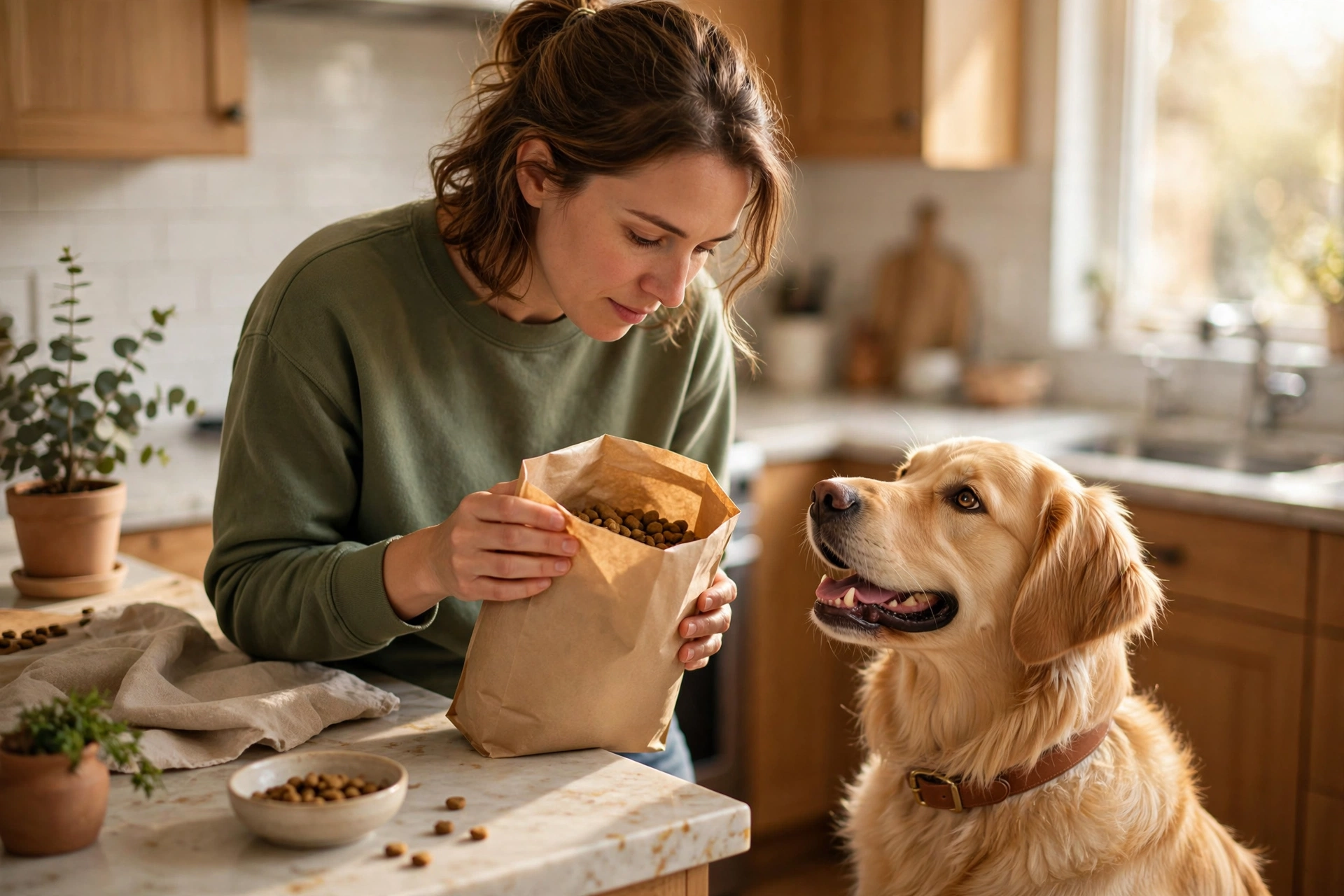
You don’t need a chemistry degree to buy good dog food — you need one habit. Flip the bag, scan the first five ingredients for named proteins, then sweep the full list for the 12 offenders above. If the protein is named, the preservatives are natural, and nothing on this list appears, you’re holding a food worth feeding.
If I had to pick the single highest-impact change: ditch anything preserved with BHA/BHT and anything containing xylitol. Those two swaps alone remove the most serious risks most dogs face from commercial food. Everything else on this list is about raising the bar from “not harmful” to “genuinely good.”
This guide is for information only — check with your vet for your dog’s specific needs.
What is the single most dangerous ingredient in dog food?
Xylitol — also labeled “birch sugar.” It is acutely toxic to dogs: even small amounts can trigger a dangerous insulin surge, seizures, and liver failure. Check treats, dental products, and peanut-butter-flavored snacks especially, and treat any xylitol listing as an instant reject.
Are BHA and BHT really that bad?
Both are synthetic preservatives classified as possible or suspected carcinogens, with animal studies linking them to liver and kidney damage. They are legal in small amounts in the US, but quality brands switched to natural preservatives like mixed tocopherols years ago — so their presence is a reliable marker of budget manufacturing.
Is “meat meal” always bad in dog food?
No — named meat meals like “chicken meal” or “salmon meal” are concentrated, legitimate protein sources. The problem is unnamed ones: “meat meal,” “meat and bone meal,” or “animal digest” reveal nothing about the source animal, allowing the cheapest rendered material with inconsistent quality.
Are artificial colors harmful to dogs?
They add zero nutrition and exist only to impress the human buyer. Red 40, Blue 2, and Yellow 5/6 have been linked to allergic reactions and hyperactivity in sensitive animals, and their presence usually signals a formula built for shelf appeal rather than nutrition.
What is the difference between natural and artificial preservatives in dog food?
Natural preservatives like mixed tocopherols (vitamin E), rosemary extract, and ascorbic acid (vitamin C) prevent fats from going rancid without the health concerns attached to synthetics like BHA, BHT, and ethoxyquin. Always choose the natural option on the label.
Can I trust “natural” on a dog food label?
Not by itself — “natural,” “premium,” and “holistic” have no legal definition in pet food, so they are marketing claims, not guarantees. The ingredient panel is the only claim that matters: named proteins, natural preservatives, and none of the 12 ingredients in this guide.
How do I read a dog food label quickly?
Use the 30-second rule: check that a named animal protein is first (and ideally two of the first five ingredients), sweep the list for BHA, BHT, xylitol, artificial colors, and unnamed meat meals, and confirm the AAFCO nutritional adequacy statement is present.
Should I avoid corn, wheat, and soy too?
They are fillers and common allergens rather than toxins, so they sit a tier below the 12 ingredients in this guide. Many dogs digest them fine, but sensitive dogs often do better without them — my sensitive-stomach guides cover gentler alternatives if your dog reacts.