

Senior Dog Feeding Guide: How Much, How Often & What to Feed (2026)
The day your dog stops sprinting to the doorbell and starts waddling there is the day feeding becomes a whole new job. This senior dog feeding guide covers everything you need to know: when to switch to a senior formula, how much to feed, how often to serve meals, and the nutrition tweaks that keep an aging dog strong, sharp, and comfortable. Based on current US nutrition guidance, veterinarian advice, and what actually works at the bowl, here is how to feed your senior dog well through their golden years.
Key Takeaways
- Most dogs become seniors around age 7, but large breeds can hit senior status at 6 and giant breeds as early as 5.
- Senior dogs typically need about 20-30% fewer calories than active adults, but they still need plenty of high-quality protein to protect muscle.
- Two meals a day is the sweet spot for most senior dogs; some older dogs do better with three smaller meals.
- Wet food, softened kibble, and raised bowls help seniors with dental issues, weak jaws, or stiff necks.
- Transition to any new food gradually over 7-10 days to avoid digestive upset.
When Does a Dog Become a Senior?
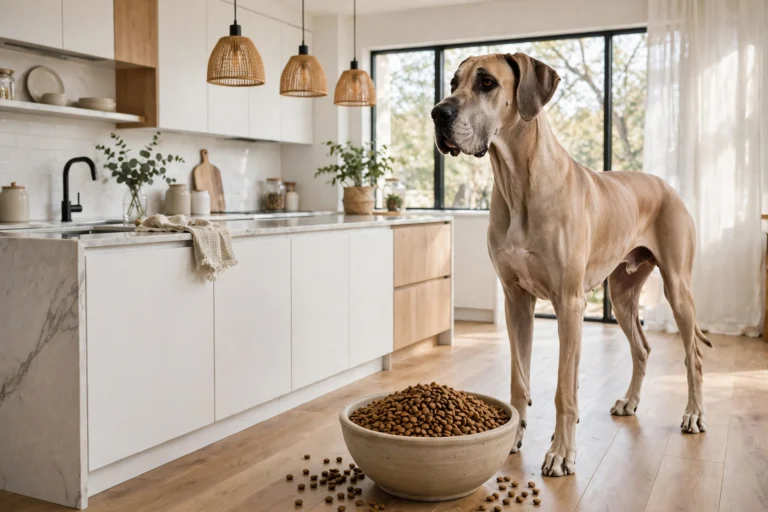
There is no single birthday when a dog becomes a senior, because size changes everything. Giant breeds age fast — a Great Dane may be considered senior at 5 or 6 — while a Chihuahua might not earn the label until 10 or 12. A useful rule of thumb:
- Giant breeds (90+ lbs): senior at 5-6 years
- Large breeds (50-90 lbs): senior at 6-7 years
- Medium breeds (20-50 lbs): senior at 7-8 years
- Small breeds (under 20 lbs): senior at 8-10 years
Watch for the signs rather than the calendar: greying muzzle, slower walks, napping through the afternoon, weight creeping up despite eating the same amount, or a dog that seems stiff after rest. When you notice these changes, it is time to rethink the feeding routine — not necessarily the day they turn seven.
How Senior Nutrition Differs From Adult Nutrition
Aging changes your dog’s metabolism, digestion, and body composition. Senior feeding is not about feeding less food — it is about feeding smarter food. Here is how the targets shift:
| Nutrient | Adult target | Senior target | Why it changes |
|---|---|---|---|
| Calories | 100% baseline | 20-30% less | Slower metabolism and lower activity |
| Protein | 18-25% | 25-30% high quality | Fights age-related muscle loss; older dogs digest protein less efficiently |
| Fat | 10-15% | 8-12% | Easier weight management with less activity |
| Fiber | 2-4% | 3-5% | Supports digestion, bowel regularity, and satiety on fewer calories |
| Phosphorus | Standard | Reduced | Supports kidney function, which declines with age |
| Omega-3 fatty acids | Standard | Increased (EPA + DHA) | Joint health, reduced inflammation, cognitive support |
| Antioxidants | Moderate | Enhanced | Immune support and cellular protection |
| Glucosamine / chondroitin | Optional | Often included | Mobility and joint comfort |
The biggest myth to unlearn: that seniors need less protein. Research consistently shows the opposite — aging dogs need generous, highly digestible protein (think chicken, fish, eggs, lamb) to slow muscle wasting. What they need less of is empty calories from fat and fillers.
How Much to Feed Your Senior Dog
Start with the feeding chart on your dog’s food bag — it is calibrated for that exact formula’s calorie density — then adjust for your dog’s reality. An 8-year-old Lab who still swims daily eats more than a 9-year-old couch-bound Dachshund. As a rough framework, senior dogs in the US generally need:
- Small dogs (under 20 lbs): roughly 300-450 calories per day
- Medium dogs (20-50 lbs): roughly 600-900 calories per day
- Large dogs (50-90 lbs): roughly 1,200-1,800 calories per day
- Giant dogs (over 90 lbs): roughly 1,800-2,400 calories per day
The far better gauge than any chart is your dog’s body condition. You should be able to feel (not see) their ribs with light pressure, see a visible waist from above, and see a tucked belly from the side. Weigh your senior monthly — slow, silent weight loss in an old dog can signal dental pain, kidney issues, or reduced nutrient absorption, and it is one of the most commonly missed problems in senior dogs.
How to calculate portions from the bag
Every food lists its calorie content as kcal/kg or kcal/cup. Take your dog’s estimated daily calorie need, divide by the kcal-per-cup figure, and you get the day’s total in cups. Then split that total across the day’s meals. If your dog is gaining weight on the chart amount, cut the total by 10% and re-weigh in two weeks. If they are losing unwanted weight, increase by 10%. Never eyeball it for long — use a measuring cup or, better, a kitchen scale.
How Often to Feed Your Senior Dog
Most senior dogs do best on two meals a day, spaced about 12 hours apart — breakfast after the morning bathroom break and dinner in the evening. A smaller third meal (or two healthy snacks) helps seniors who:
- Lose energy between meals or get nauseous on an empty stomach
- Are on medications that need to be taken with food
- Get overwhelmed by large portions and walk away from the bowl half-finished
- Are managing blood sugar or early kidney disease under vet guidance
A sensible daily rhythm for a two-meal senior looks like this: morning bathroom break, then breakfast; a short, gentle walk mid-morning; an afternoon rest; a second gentle walk or some yard time in the late afternoon; then the evening meal around 6-7 pm. Consistency matters more than the clock — senior dogs settle into routine, and predictable mealtimes reduce anxiety and digestive surprises.
Avoid free-feeding (leaving food down all day) with seniors. It makes calorie tracking impossible, hides appetite changes that are important health signals, and in large breeds it can encourage the fast gorging linked to bloat.
Wet Food vs. Dry Food for Senior Dogs
Both formats can work for seniors, and many owners land on a mix. Here is the honest trade-off:
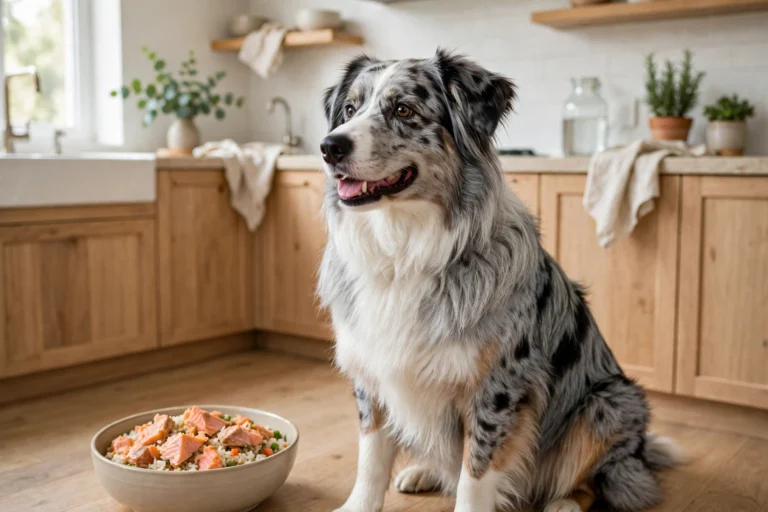
Wet food is the friend of older teeth and older kidneys. Its high moisture content supports hydration — important because total body water declines with age — and it is effortless to chew for dogs with dental disease or missing teeth. It is usually more aromatic, which helps seniors whose sense of smell is fading. The downsides: it costs more per calorie, needs refrigeration after opening, and does nothing to scrape teeth.
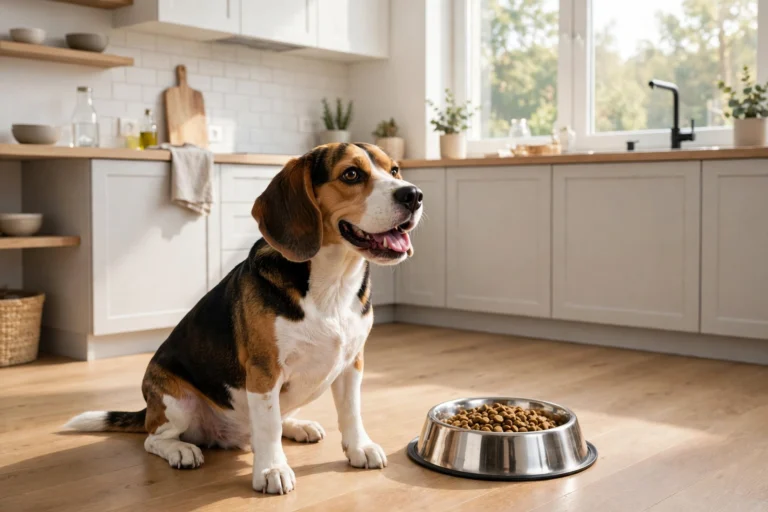
Dry food is economical, calorie-dense (helpful for seniors that tire of large portions), and has some mild tooth-cleaning action. The downsides: it can be hard to chew for dogs with dental problems, and some seniors simply find it boring.
The middle path: soak dry kibble in warm water for 10-15 minutes before serving, or top kibble with a spoonful of wet food. You get the economy and nutrient density of dry food with the softness, aroma, and hydration of wet food. Adding water to kibble at roughly three times the kibble’s weight meaningfully boosts moisture intake.
6 Senior Dog Food Formulas Worth Considering
Choosing the right formula is half the feeding guide. Based on ingredient analysis, brand reputation, feeding-trial backing, and owner reviews, these six senior formulas each solve a different aging-dog challenge:
| Product | Best for | Key feature |
|---|---|---|
| Purina Pro Plan Bright Mind Adult 7+ | Brain health | Botanical oils (MCTs) shown to support memory in dogs 7+ |
| Hill’s Science Diet Adult 7+ | Everyday balanced nutrition | Highly digestible small kibble with controlled minerals for kidneys |
| Blue Buffalo Basics Senior Turkey & Potato | Sensitive stomachs | Single animal protein, no chicken/beef/dairy/corn/wheat/soy |
| Royal Canin Small Aging 12+ | Small senior breeds | Tiny aromatic kibble, DHA for cognition, urinary support |
| Orijen Senior | Active seniors | 38% protein from poultry, beef, and fish for muscle maintenance |
| Purina ONE SmartBlend Vibrant Maturity 7+ | Budget-friendly senior care | MCT oils and glucosamine at a supermarket price |
Purina Pro Plan Bright Mind Adult 7+ — Best for Brain Health
Around age 7, a dog’s brain starts metabolizing glucose less efficiently, which can dull memory and awareness. Bright Mind is built around enhanced botanical oils (medium-chain triglycerides) that give the aging brain an alternative fuel source — Purina’s research linked them to measurably better memory scores within about 30 days. Chicken is the first ingredient, protein sits around 29%, and glucosamine plus EPA support joints alongside the brain blend. If your senior seems “foggy” or less engaged, this is the formula to try first. Widely available at vet clinics, pet stores, and online.
Hill’s Science Diet Adult 7+ — Best Everyday Workhorse
If your senior is healthy and you just want to keep things that way, this is the steady choice. A moderate 19% protein preserves lean tissue without overloading kidneys, fat is kept in check to prevent weight creep, and minerals are calibrated for aging kidneys. The small, highly digestible kibble rarely upsets sensitive stomachs. Hill’s feeding-trial backing and long track record with veterinarians make this the baseline senior diet many vets default to.
Blue Buffalo Basics Senior Turkey & Potato — Best for Sensitive Stomachs
Some seniors develop new food sensitivities — gas, loose stool, or itchy skin that was not there at age four. This limited-ingredient formula uses turkey as the single animal protein and skips chicken, beef, dairy, corn, wheat, and soy entirely. At 26% protein it is gentle without being thin, and it includes glucosamine, chondroitin, and omega fatty acids so you do not trade digestion for joint health. The small kibble softens quickly in warm water.
Royal Canin Small Aging 12+ — Best for Small Senior Breeds
Tiny dogs live long, and by 12 their appetite often fades faster than their spirit. Royal Canin engineered this one for small senior mouths: extra-small kibble, a porous texture, and an aromatic fat coating that releases more scent with warm water — a real help for fussy eaters with fading smell. DHA and antioxidants support the brain and immune system, balanced phosphorus protects kidneys, and 28% protein keeps aging muscles strong.
Orijen Senior — Best for Active Seniors
For the senior who still chases the ball, protein matters more than ever. Orijen Senior packs 38% protein from free-run poultry, ranch beef, and wild-caught fish, with organs and cartilage in the mix supplying natural glucosamine and chondroitin. The formula is nutrient-dense, so portions run smaller. One caution: it is rich, so transition slowly over 10 days, and it is not the pick for couch-potato seniors or dogs with a pancreatitis history — ask your vet first.
Purina ONE SmartBlend Vibrant Maturity 7+ — Best Budget Pick
Good senior nutrition should not require a luxury budget. This formula pairs real chicken with the same brain-supporting botanical oils as Bright Mind, plus 28% protein and natural glucosamine — at roughly a dollar a pound. Purina backs it with feeding trials, and many owners report perkier dogs within a month. If you want the MCT brain benefit without the premium price, this is the sweet spot.
Buying Guide: What to Look for in Senior Dog Food
Ignore the marketing poetry on the front of the bag and check these five things on the label:
- Named protein first: Look for a named meat (chicken, salmon, lamb, turkey) as the first ingredient, not “meat meal” or vague “poultry by-products.” Protein quality matters more than ever for seniors.
- AAFCO statement: The label should say the food is formulated to meet AAFCO nutrient profiles for adult maintenance (there is no official “senior” AAFCO profile, so “for adult maintenance” plus senior-appropriate nutrition is the right standard).
- Calories per cup: Senior formulas should be less calorie-dense so your dog can eat a satisfying volume. Anything dramatically higher than their current food means you will feed a smaller-looking portion.
- Joint and brain extras: Glucosamine, chondroitin, EPA/DHA omega-3s, L-carnitine, and antioxidants (vitamins E and C, beta-carotene) are the senior-specific add-ons worth paying for.
- Texture: Smaller kibble pieces, or kibble that softens quickly in warm water, makes life easier for dogs with dental issues. When in doubt, go softer.
This guide is for information only — check with your vet for your dog’s specific needs, especially if your senior has kidney disease, heart disease, or is taking medication.
What to Avoid When Feeding a Senior Dog
- Cutting protein to “rest” the kidneys. Unless your vet has diagnosed kidney disease and prescribed a specific diet, reducing protein just accelerates muscle loss. Healthy seniors need protein.
- Sudden food switches. Transition over 7-10 days, mixing increasing amounts of the new food with the old. Abrupt changes commonly cause vomiting and diarrhea in older dogs.
- Grain-free diets without a reason. The FDA flagged a potential link between some grain-free formulas and heart disease (dilated cardiomyopathy). Feed grains unless your vet says otherwise.
- Table scraps and high-fat treats. Senior pancreases are less forgiving; one fatty meal can trigger pancreatitis. Keep treats under 10% of daily calories.
- Supplements on autopilot. Omega-3s, glucosamine, and multivitamins are useful, but dose matters and some interact with medications. Ask your vet before adding anything.
- Ignoring slow weight loss. A pound a month off a 40-lb dog is not “getting slim” — it can be dental pain, kidney issues, or reduced absorption. Weigh monthly and call your vet about steady losses.
Switching to Senior Food: The 7-10 Day Transition
Older digestive systems react more strongly to abrupt changes, so go slow:
- Days 1-3: 25% new food, 75% old food
- Days 4-6: 50% new food, 50% old food
- Days 7-9: 75% new food, 25% old food
- Day 10: 100% new food
Watch stool quality, appetite, and energy at each stage. If you see soft stool or refusal, hold at the current ratio for two extra days before moving on. If vomiting or prolonged diarrhea appears, pause the transition and call your vet.
Helping a Senior Dog That Won’t Eat
Reduced appetite is one of the most common — and most worrying — senior feeding problems. Before anything else, rule out dental pain, nausea, or illness with a vet visit, because a sudden appetite drop is a symptom, not a personality quirk. If the vet gives the all-clear, try these:
- Warm the food. Warming releases aroma and makes meals dramatically more appealing to dogs with fading smell.
- Add a topper. A spoonful of wet food, a splash of low-sodium bone broth, or warm water over kibble.
- Feed smaller, more frequent meals. Three or four small meals can be less intimidating than two full ones.
- Try a raised feeder. Dogs with neck, back, or joint stiffness eat more comfortably without stooping.
- Hand-feed or change the bowl. Sometimes a shallower dish, a different texture, or food from your hand breaks a refusal cycle.
Conclusion: Keep It Simple and Consistent
Feeding a senior dog well comes down to a few unglamorous habits: switch to a senior-appropriate formula at the right age for their size, feed about 20-30% fewer calories than their adult prime, serve two (or three) predictable meals a day, keep protein high and quality good, weigh them monthly, and transition foods slowly. For most owners, a formula like Hill’s Science Diet Adult 7+ or Purina Pro Plan Bright Mind Adult 7+ handles the heavy lifting, and the feeding routine handles the rest. If you found this guide helpful, read our best senior dog food roundup for detailed product picks, our puppy feeding schedule if you also have a young dog at home, and our senior German Shepherd food guide for large-breed specifics.
When should I switch my dog to senior food?
Most dogs become seniors around age 7, but it depends on size. Giant breeds may need senior food at 5-6, large breeds at 6-7, medium breeds at 7-8, and small breeds not until 8-10. Switch when you notice slowing down, weight changes, greying, or stiffness — and transition gradually over 7-10 days.
How much should I feed my senior dog per day?
Roughly 20-30% fewer calories than their active adult days. As a guide: small dogs 300-450, medium 600-900, large 1,200-1,800, giant 1,800-2,400 calories daily. Start from the food bag’s chart, then adjust using monthly weigh-ins and body condition.
How many times a day should a senior dog eat?
Two meals a day works best for most seniors, about 12 hours apart. Some older dogs do better with three smaller meals, especially if they have reduced appetite, take medication with food, or get nauseous on an empty stomach. Avoid free-feeding so you can track intake.
Is wet food better than dry food for senior dogs?
Wet food helps with hydration and is easier to chew for dogs with dental issues, but costs more per calorie. A good middle ground is soaking dry kibble in warm water for 10-15 minutes or mixing a spoonful of wet food into kibble.
Should senior dogs eat more protein or less?
More, not less — as long as the dog has healthy kidneys. Aging dogs need 25-30% high-quality protein to fight muscle loss, since they digest protein less efficiently. Only reduce protein if your vet prescribes it for diagnosed kidney disease.
How do I switch my senior dog to new food?
Gradually over 7-10 days: 25/75 new/old for days 1-3, 50/50 for days 4-6, 75/25 for days 7-9, then 100% new on day 10. Hold at a ratio for two extra days if stool softens; call the vet if vomiting or diarrhea persists.
My senior dog is losing weight — what should I do?
Do not ignore slow, steady weight loss — it can signal dental pain, kidney issues, or reduced nutrient absorption. Weigh monthly, and contact your vet about consistent losses. They may recommend a calorie-dense, highly digestible formula or smaller, more frequent meals.
How can I get my senior dog to eat when their appetite drops?
Warm the food to release aroma, add a wet-food topper or low-sodium bone broth, feed smaller more frequent meals, try a raised feeder for stiff necks, or hand-feed. If appetite drops suddenly, see your vet first to rule out dental pain or illness.



6 Comments