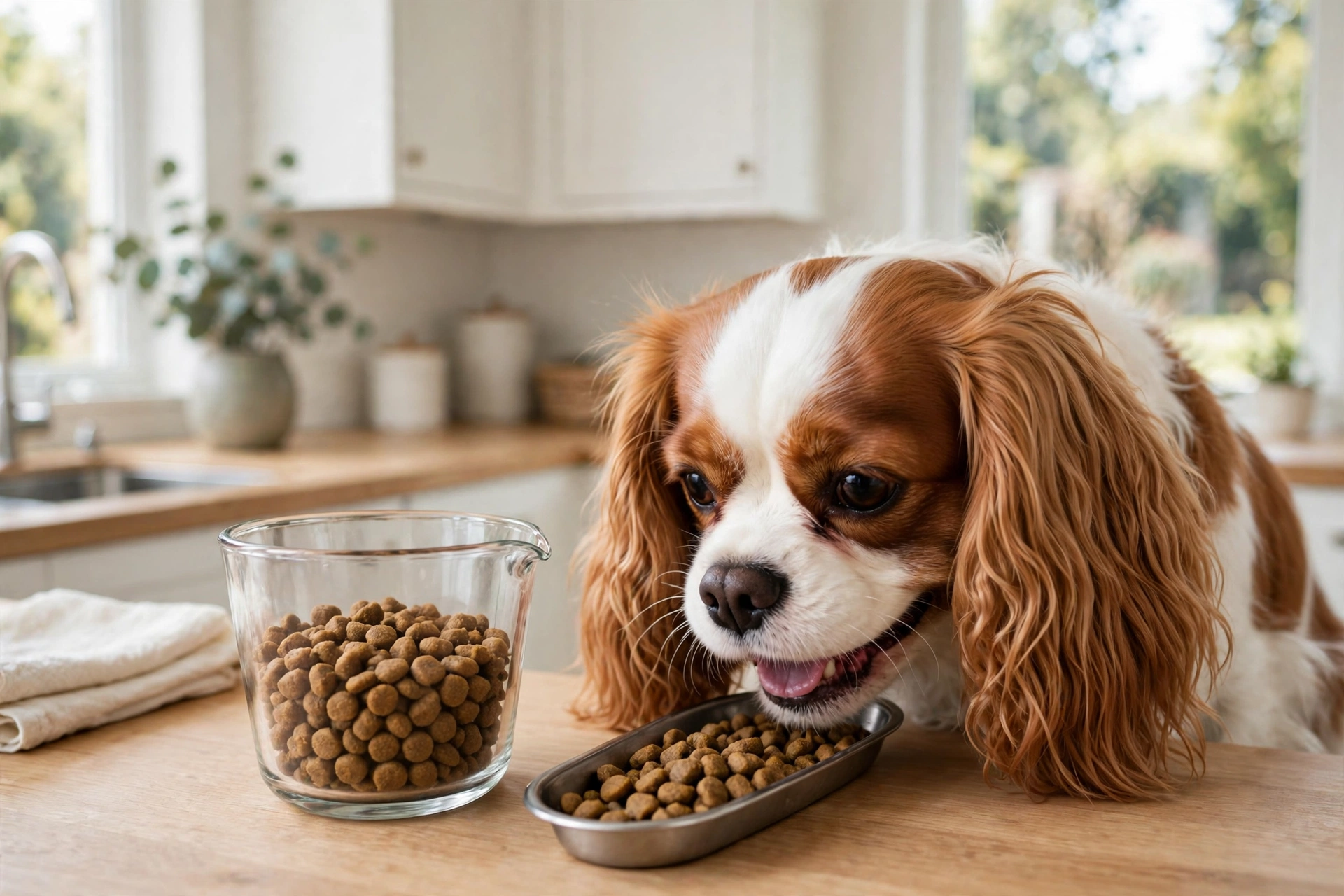
Cavalier King Charles Spaniel Feeding Guide: How Much, How Often & What to Feed (2026)
Cavalier King Charles Spaniels are famously easy to love and famously easy to overfeed. Those big, pleading eyes, that silky feathered coat, and a lap-dog lifestyle all work together to make portion control harder than it looks. Yet getting feeding right matters more for this breed than for most small dogs: Cavaliers are prone to weight gain, and extra weight puts added strain on a heart that is already the breed’s best-known weak spot. This cavalier king charles spaniel feeding guide covers exactly how much to feed, how often, and what to feed at every life stage, from a tiny 8-week-old puppy to a slowing-down senior.
In this guide you will find daily portion tables by age and weight, a simple calorie method you can use with any brand, a sample daily feeding schedule, and practical advice on food types, treats, switching foods, and the feeding mistakes Cavalier owners make most often. Use the tables as a starting point, then adjust for your own dog’s body condition, activity level, and your veterinarian’s advice.
Quick Answer: Most adult Cavaliers need 1/2 to 1 cup of food a day, split into two meals, or around 400 to 550 calories. Puppies eat 3 to 4 small meals a day, and seniors do best on two smaller meals. Weigh the food, watch the ribs and waist, and keep treats under 10 percent of calories. Lean weight protects their heart.
In This Guide
- Key Takeaways
- How Much to Feed a Cavalier: At a Glance
- How Many Calories Does a Cavalier Need?
- Feeding Your Cavalier Puppy
- Feeding Your Adult Cavalier
- Feeding Your Senior Cavalier
- What to Feed: Dry, Wet, or a Mix?
- A Sample Daily Feeding Schedule
- Heart Health, Weight, and the Cavalier
- Treats, Chews, and Foods to Avoid
- Switching Foods Safely
- Cavalier-Specific Feeding Tips
- Common Feeding Mistakes to Avoid
- Pros and Cons
- Conclusion
- Grain-Free Food and Your Cavalier’s Heart
Key Takeaways
- Most adult Cavaliers do well on roughly 1/2 to 1 cup of dry food per day, split into two meals, but calories, not cups, are what actually count, because kibbles vary widely in energy density.
- Feed puppies 4 meals a day until about 3 months, 3 meals until about 6 months, then 2 meals a day for life.
- Weigh food with a kitchen scale or measuring cup every time; free-feeding is the fastest route to an overweight Cavalier.
- Keep treats under 10% of daily calories, and count them. A few “small” treats a day can quietly add 15% or more to intake.
- Watch body condition, not just the scale: you should be able to feel the ribs with light pressure but not see them, and your dog should have a visible waist from above.
How Much to Feed a Cavalier: At a Glance
| Life Stage | Meals per Day | Typical Daily Amount (Dry Food) | Typical Daily Calories |
|---|---|---|---|
| Puppy, 8 to 12 weeks | 4 | 1/3 to 2/3 cup | 250 to 400 kcal |
| Puppy, 3 to 6 months | 3 | 1/2 to 3/4 cup | 300 to 450 kcal |
| Puppy, 6 to 12 months | 2 to 3 | 2/3 to 1 cup | 350 to 500 kcal |
| Adult, 1 to 7 years | 2 | 1/2 to 1 cup | 400 to 550 kcal |
| Senior, 8+ years | 2 | 1/2 to 3/4 cup | 350 to 500 kcal |
These ranges come from published breed feeding guides and manufacturer feeding charts. They are starting points, not prescriptions. A very active 18-pound Cavalier that hikes daily may need more than a couch-loving 13-pound senior, and two kibbles with different calorie densities can differ by 100 calories per cup or more. Always check the calorie content (kcal per cup) printed on your own bag and adjust from there.
How Many Calories Does a Cavalier Need?
Calories are the honest way to compare foods and portions. A widely used rule of thumb for this breed is about 35 to 45 calories per pound of body weight per day for adults, with puppies needing more per pound because they are growing, and less active or older dogs needing less. For a typical 15-pound adult Cavalier, that works out to roughly 525 to 675 calories a day before treats, with most moderately active adults landing in the 400 to 550 range once you account for the fact that pet-food calorie figures and activity levels vary.
The practical way to use this: find the kcal-per-cup figure on your food’s packaging, divide your dog’s daily calorie target by it, and you have your daily cup amount. If the food has 360 kcal per cup and your target is 500 calories, that is about 1 and 1/3 cups, noticeably more than the “half a cup” some guides suggest, which is exactly why competing guides disagree so much. They are often describing different foods. Weigh the food for a week or two until you can eyeball portions accurately, and re-weigh whenever you change brands.
Feeding Your Cavalier Puppy
Cavalier puppies grow fast and have small stomachs, so little-and-often feeding works best. Start with four evenly spaced meals a day at 8 to 12 weeks, drop to three meals at around 3 to 6 months, and move to two meals a day from about 6 months onward. Keep mealtimes consistent. The same times each day help with house training, because a puppy usually needs to go out within 20 to 30 minutes of eating.
| Puppy Age | Weight (Approx.) | Daily Amount (Dry Food) | Meals |
|---|---|---|---|
| 8 weeks | 3 to 4 lb | 1/3 cup | 4 |
| 3 months | 4 to 6 lb | 1/2 cup | 3 to 4 |
| 6 months | 7 to 10 lb | 2/3 cup | 3 |
| 9 months | 10 to 13 lb | 3/4 to 1 cup | 2 |
| 12 months | 12 to 16 lb | 3/4 to 1 cup | 2 |
Feed a food formulated for puppies (an AAFCO growth or all-life-stages formula) until your veterinarian advises the switch to adult food, usually around 10 to 12 months for this small breed. Do not rush the change: growing puppies need different levels of protein, fat, calcium, and phosphorus than adults, and adult maintenance food is not designed for growth. Equally, do not add calcium or vitamin D supplements to a complete puppy food unless your veterinarian tells you to; more is not better with minerals, and excess calcium during growth can do real harm. A healthy Cavalier puppy should be lean and steadily gaining, not round. A “chubby puppy” is not a healthy puppy, and overfeeding during growth can set up weight problems that last a lifetime.
If you are choosing your puppy’s first food, our guide to puppy food for small breeds explains what to look for in a growth formula, from protein levels to kibble size.
Feeding Your Adult Cavalier
Adult Cavaliers, roughly 1 to 7 years old, typically weigh 12 to 18 pounds, with the breed standard sitting around 13 to 18 pounds. Two meals a day, morning and evening, about 12 hours apart, suits most adults far better than one large meal, which can leave a small dog hungry, begging, and prone to gulping. Split the daily amount evenly, and pick the food up after 15 to 20 minutes rather than leaving it down all day.
| Adult Weight | Low Activity | Moderate Activity | High Activity |
|---|---|---|---|
| 12 lb (5.5 kg) | 3/4 cup | 1 cup | 1 1/8 cups |
| 15 lb (7 kg) | 1 cup | 1 1/4 cups | 1 1/2 cups |
| 18 lb (8 kg) | 1 1/8 cups | 1 1/3 cups | 1 2/3 cups |
These figures assume a typical dry food at around 350 to 380 kcal per cup; adjust up or down for your own brand’s calorie density. The single most useful habit is a weekly body-condition check. Run your hands along your dog’s sides: ribs should be easy to feel under a thin layer of fat, with a visible waist when viewed from above and a tummy tuck from the side. If you cannot feel the ribs without pressing hard, reduce the daily amount by about 10% and add a little extra walking, then reassess in two weeks. If ribs are prominent and your dog seems constantly hungry, increase slightly. Small changes, made gradually, beat dramatic cuts.
Feeding Your Senior Cavalier
From around 8 years old, Cavaliers slow down, lose some muscle, and burn fewer calories, but they still need good-quality protein to maintain that muscle. Senior formulas typically offer slightly fewer calories, added joint support such as glucosamine, and omega-3 fatty acids for coat and cognitive health. Most seniors do well on two smaller meals a day rather than one, which is easier on digestion and helps keep energy steady.
Watch for two opposite problems in seniors: weight gain from inactivity, and weight loss from dental pain, reduced appetite, or illness. A senior that suddenly eats less, drops weight, or leaves food unfinished deserves a veterinary check rather than a food change. Dental disease is common in small breeds and can make crunching kibble painful. Softening kibble with a little warm water, or mixing in some wet food, can help a senior with sore teeth keep eating while the underlying problem is treated. For more detail on portion and schedule changes in later life, see our senior dog feeding guide.
For a senior Cavalier, choose the best senior cavalier king charles spaniel food for age-appropriate nutrition and joint support.
What to Feed: Dry, Wet, or a Mix?
There is no single right answer, and the best choice is the complete, balanced food your Cavalier eats happily and thrives on. Dry food is convenient, economical, and helps scrape teeth as your dog chews; wet food is more aromatic, hydrating, and often more appealing to picky eaters; a mix of the two gives variety and can help a fussy dog finish their meals. If you combine them, remember that both contribute calories. A common mistake is adding a full tin of wet food on top of a full portion of kibble, effectively doubling dinner. Reduce the kibble portion by roughly the calorie equivalent of the wet food you add.
Whatever format you choose, look for an AAFCO nutritional adequacy statement on the packaging confirming the food is complete and balanced for your dog’s life stage, a named animal protein (such as chicken, lamb, or salmon) as the first ingredient, and a calorie statement you can actually use to calculate portions. Be cautious with foods that hide behind vague terms like “meat meal” with no species named, or that bulk out the recipe with corn, wheat, and soy as primary ingredients.
Foods That Suit Cavaliers Well
| Food | Best For | Key Feature |
|---|---|---|
| Royal Canin Cavalier King Charles Adult | Adult Cavaliers | Breed-specific kibble shape plus taurine, L-carnitine, EPA and DHA to support cardiac function |
| Hill’s Science Diet Adult Small Paws | Small-breed adults | Small kibble, balanced minerals, and omega-6 fatty acids for skin and coat |
| Purina Pro Plan Small Breed Chicken & Rice | Active small adults | High protein with live probiotics for digestive health |
| Blue Buffalo Life Protection Small Breed Adult | Adults needing variety | Real meat first, plus antioxidant-rich LifeSource Bits |
| Purina Pro Plan Sensitive Skin & Stomach Small Breed | Sensitive stomachs | Salmon and rice with probiotics, no corn, wheat, or soy |
These recommendations are based on ingredient analysis, brand reputation, and owner reviews, not on feeding trials of our own. The breed-specific Royal Canin formula is the only one designed around this breed’s jaw shape and cardiac risk, which makes it a natural starting point, but any complete small-breed formula from a reputable manufacturer can work well. If your Cavalier has a sensitive stomach, a salmon-and-rice formula with probiotics is often better tolerated than a rich, multi-protein recipe. Our broader small breed food guide compares more options if you want to shop around.
A Sample Daily Feeding Schedule
A routine helps both digestion and house training. Here is a simple schedule for a healthy adult Cavalier, which you can shift to fit your own day:
- 7:00 a.m.: Morning meal (half the daily amount), fresh water, then a walk and toilet break.
- 12:30 p.m.: A small training treat allowance or a dental chew, counted within the daily calorie budget.
- 5:30 p.m.: Evening meal (the other half of the daily amount), fresh water, then a walk.
- Evening: A couple of low-calorie treats for training or bonding, still inside the 10% treat limit.
- Before bed: A final toilet break; no late-night feeding, which can lead to overnight accidents.
For puppies, add a midday and late-afternoon meal to the same pattern, and keep the last meal at least two to three hours before bedtime. Consistency matters more than perfection: dogs thrive on predictable mealtimes, and a steady routine makes appetite changes, often the first sign of illness, much easier to spot.
Heart Health, Weight, and the Cavalier
Mitral valve disease (MVD) is the breed’s most serious inherited health problem, affecting a large proportion of Cavaliers as they age. Diet cannot prevent a genetic heart condition, and no food should ever be sold to you as a heart cure, but keeping your dog lean is one of the few things fully in your control, and it genuinely matters. Extra weight forces the heart to work harder, worsens breathlessness, and makes anesthesia and medication dosing more complicated.
Practically, that means three things: feed for a lean body condition rather than the top of the portion range, keep daily exercise gentle but regular (short walks, play, swimming where tolerated), and ask your veterinarian about cardiac screening. A yearly heart listen is widely recommended for this breed, with more frequent checks once a murmur is found. If your veterinarian prescribes a cardiac diet or medication, follow that plan rather than anything in a general feeding guide. For a structured approach to slimming a dog down safely, see our guide on how to help your dog lose weight safely.
Treats, Chews, and Foods to Avoid
Treats are where most Cavalier feeding plans quietly fall apart. A few biscuits, a dental stick, a bite of cheese, and a training treat or two can easily add 100 calories, a fifth of a small dog’s day, without anyone noticing. Use your dog’s own kibble as training rewards where possible, choose low-calorie treats such as small pieces of carrot, apple (no seeds), or blueberries, and always subtract treats from the day’s food if you have given a lot of them.
Some foods are genuinely dangerous and should never be given: chocolate, grapes and raisins, onions and garlic, macadamia nuts, xylitol (found in some sugar-free products), cooked bones, alcohol, and caffeine. Fatty table scraps are a subtler risk. They can trigger pancreatitis, a painful and sometimes serious condition, and they teach begging that makes every future meal a negotiation. If you want to share food, stick to plain, dog-safe options in small amounts, and never as a replacement for a balanced meal.
Switching Foods Safely
Change foods gradually over 7 to 10 days: roughly 25% new food for two to three days, then 50%, then 75%, then fully switched. A sudden change is the most common cause of loose stools in an otherwise healthy dog, and Cavalier stomachs are not famously robust. If soft stools persist beyond a few days, or you see vomiting, blood, or refusal to eat, slow the transition or speak to your veterinarian. The new food may simply not suit your dog. Puppies, seniors, and dogs with sensitive stomachs may need an even slower transition of up to two weeks.
If your Cavalier still has digestive trouble, try the best food for cavalier with sensitive stomach for gentler, easy-to-digest recipes.
Cavalier-Specific Feeding Tips
A few breed quirks are worth knowing. Those long, feathered ears dip into food and water bowls, so a narrow, deep “spaniel bowl” (or simply tying the ears back with a snood at mealtimes) keeps ears cleaner and reduces the risk of ear infections. A slow-feeder bowl helps the enthusiastic gulpers that many Cavaliers are, reducing the risk of vomiting after meals and giving some mental stimulation. Always provide fresh water alongside meals and throughout the day; as a rough guide, dogs need about half an ounce to an ounce of water per pound of body weight daily, more in hot weather or on a dry-food-only diet.
Finally, measure food every time. Eyeballing portions is the single most common reason well-meaning owners overfeed small dogs, and the difference between a level scoop and a heaped one can be 20% or more. A cheap kitchen scale or a marked measuring cup, used consistently, is the best weight-management tool you will ever buy.
Common Feeding Mistakes to Avoid
- Free-feeding: leaving food down all day removes portion control entirely and is strongly linked to obesity in this breed.
- Feeding by the bowl, not the dog: package guidelines are averages; your dog’s body condition is the real measure.
- Forgetting treats in the calorie count: treats, chews, and table scraps all count.
- Switching foods abruptly: always transition over 7 to 10 days.
- Feeding a puppy adult food, or an adult puppy food, past the right life stage.
- Ignoring appetite changes: a sudden loss of appetite, or a sudden ravenous hunger, can signal illness and deserves attention.
Pros and Cons
Feeding a Cavalier well is a trade between strict measuring and a happy, lean dog. Here is the honest balance.
Pros
- Two measured meals a day keep portions steady and stop a food-loving Cavalier from grazing all day.
- Weighing food and using the rib test beats the bag chart for a breed that gains weight so easily.
- A small-breed formula with the right kibble size suits a Cavalier jaw and a small stomach.
- Senior food keeps protein up to hold muscle while calories come down.
Cons
- Cavaliers beg well and gain weight fast, so portions need watching every single day.
- Cup measures vary by brand and by scoop, so cups alone can overfeed or underfeed.
- Grain-free formulas carry a heart question mark for a breed with the highest heart risk.
- Treats, chews, and table scraps add up fast and can undo a careful meal plan.
Conclusion
Feeding a Cavalier King Charles Spaniel well comes down to a few unglamorous habits done consistently: two measured meals a day, a complete food matched to your dog’s life stage, treats kept under 10% of calories, and a regular hands-on body-condition check. Start with the tables in this guide, adjust for your dog’s weight, activity, and appetite, and let your veterinarian fine-tune the plan, especially if your dog has a heart murmur, a sensitive stomach, or a weight problem.
Our overall recommendation: a breed-specific or small-breed adult formula such as Royal Canin Cavalier King Charles Adult for most adults, fed in two measured meals with a spaniel bowl and a slow feeder if your dog gulps. Keep your Cavalier lean, keep mealtimes predictable, and you will be doing more for their long-term health than any single “superfood” ever could. This guide is for information only. Check with your vet for your dog’s specific needs.
Grain-Free Food and Your Cavalier’s Heart
Grain-free food sounds healthier, and the bags often promise it. For a Cavalier, it can be the wrong choice. In 2018 the FDA started looking into a possible link between grain-free diets, mostly ones heavy in peas, lentils, and chickpeas, and a heart muscle disease called dilated cardiomyopathy, or DCM. The link is not proven, and the FDA has not banned grain-free food. But the pattern was real enough to study, and it matters more for this breed than for most dogs. Cavaliers already carry the highest heart risk of any small breed, because mitral valve disease touches most of them as they age. Adding a food choice with a question mark over heart health makes little sense when safe choices are easy to find. Whole grains such as brown rice, oatmeal, and barley are healthy, easy to digest, and carry no such warning. Check the label before you buy. If peas, lentils, or chickpeas sit near the top of the ingredient list and the bag says grain-free, pick a grain-inclusive formula instead. If your Cavalier already eats grain-free food, ask your vet whether a switch makes sense, and never change food to chase a trend without a reason your vet would agree with.
How much should I feed my Cavalier King Charles Spaniel per day?
Most adults do well on 1/2 to 1 cup of dry food per day, split into two meals, but calories matter more than cups. Check the kcal-per-cup figure on your bag and adjust for your dog’s weight, activity, and body condition.
How many times a day should a Cavalier puppy eat?
Four meals a day at 8 to 12 weeks, three meals at 3 to 6 months, and two meals a day from about 6 months onward, at consistent times each day.
When do Cavaliers switch from puppy to adult food?
Usually around 10 to 12 months, on your veterinarian’s advice, switching gradually over 7 to 10 days.
Are Cavaliers prone to obesity?
Yes. They gain weight easily, and extra weight strains their hearts, so measure every meal, keep treats under 10% of daily calories, and never free-feed.
What food is best for a Cavalier with a sensitive stomach?
A salmon-and-rice formula with probiotics, such as Purina Pro Plan Sensitive Skin & Stomach Small Breed, is often well tolerated; transition slowly and ask your vet if problems persist.
Can Cavaliers eat wet food, dry food, or both?
All three can work if the food is complete and balanced for your dog’s life stage; if you mix wet and dry, reduce the kibble portion so total calories stay the same.
How much water should a Cavalier drink?
Roughly half an ounce to an ounce of water per pound of body weight per day, with fresh water available at all times, more in hot weather.
Should I feed my Cavalier a heart-supporting diet?
Diet cannot prevent genetic mitral valve disease, but keeping your dog lean helps; formulas with taurine, L-carnitine, and omega-3s, such as Royal Canin Cavalier King Charles Adult, are designed with cardiac support in mind. Follow your vet’s plan if a murmur is diagnosed.
Do spayed or neutered Cavaliers need less food?
Yes, often. Spayed or neutered dogs usually need 20 to 30 percent fewer calories than intact dogs of the same weight, because the procedure slows metabolism. If your Cavalier was recently spayed or neutered, cut portions back a little at a time and weigh your dog each month. Judge by the ribs and waist, not by begging, and ask your vet if weight keeps climbing.
Can I feed my Cavalier a raw diet?
You can, but most vets advise against it. The American Veterinary Medical Association and the American Animal Hospital Association both warn that raw diets carry a risk of bacterial contamination and unbalanced nutrition. A complete small-breed kibble or wet food is a safer everyday choice. If you still want to feed raw, do it only with guidance from your vet or a board-certified veterinary nutritionist.
3 Comments