
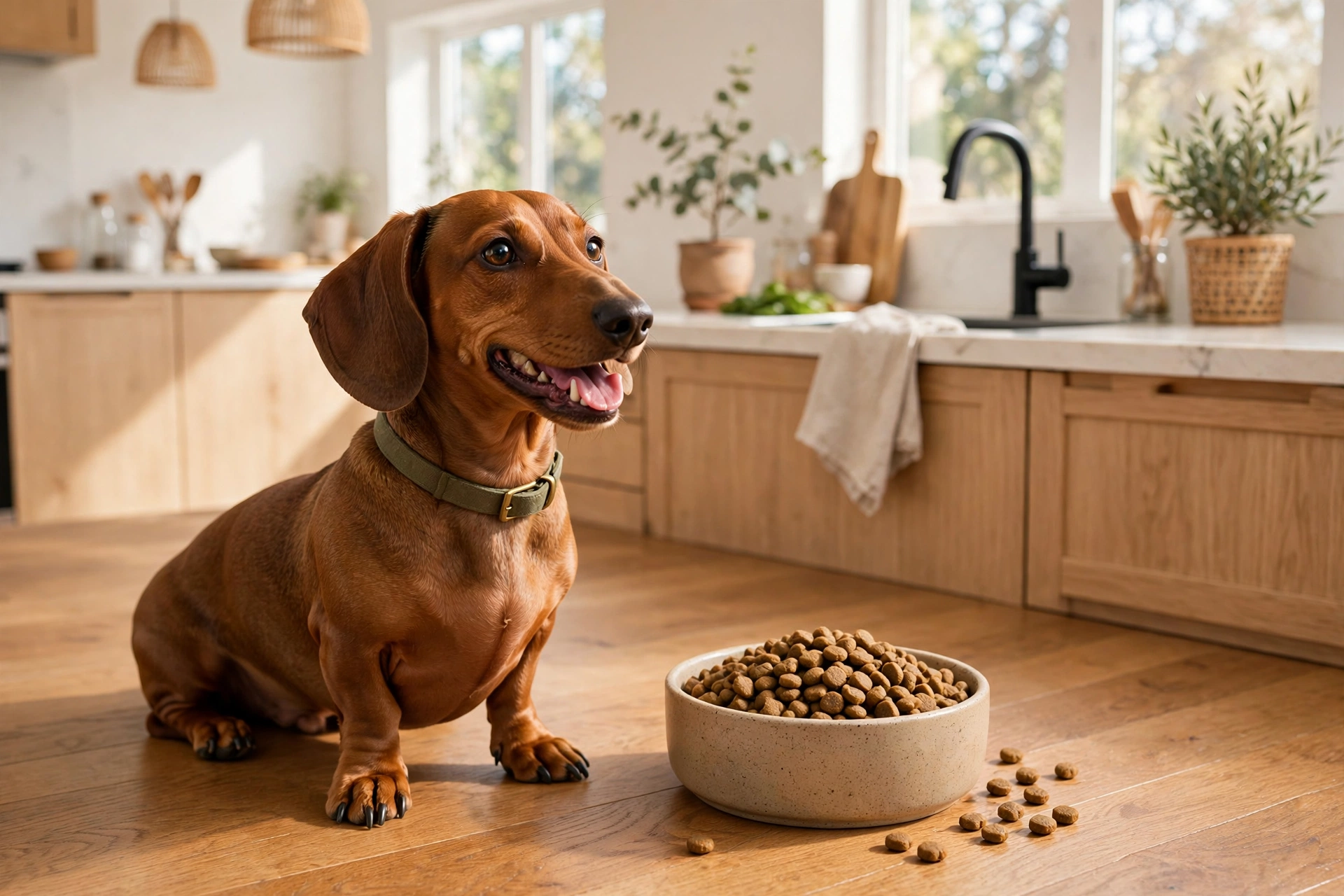
Best Dog Food for Dachshunds: Lean Feeding That Protects a Long Back (6 Picks 2026)
Dachshunds may be small, but their nutritional needs are anything but ordinary. That long back, those short legs, and a famously hearty appetite add up to a breed that needs food chosen with real care. Pick the wrong formula and you are not just risking an upset stomach. Extra weight strains a Dachshund’s spine directly, and this breed already carries one of the highest risks of intervertebral disc disease (IVDD) of any dog. The best dog food for Dachshunds is one that keeps your Doxie lean, supports their joints and back, and fits their small jaw, all while actually getting eaten, because Dachshunds can be famously picky.
In this guide, I break down what makes a food right for a Dachshund, compare six strong options for different needs and budgets, and answer the questions Dachshund owners ask most. Every pick below is based on label values, small-breed fit, and owner reviews. No fake testing claims, and no food here is presented as a cure for any disease. If your Dachshund has a diagnosed condition such as IVDD, your vet should always have the final say on diet. For the wider picture, see our best dog food hub.
Key Takeaways
- Weight control is the number one job of a Dachshund’s food. Even a couple of extra pounds add real strain to a long spine.
- Look for a named meat as the first ingredient, moderate calories, and joint-supporting nutrients such as glucosamine and omega-3 fatty acids.
- Small-breed or breed-specific kibble suits the Dachshund jaw better than large-breed kibble and helps with dental health.
- Royal Canin Dachshund Adult is the best overall pick for purebred adult Dachshunds; Hill’s Science Diet Perfect Weight Small Bites is the best pick for Doxies who need to slim down.
Best Dog Food for Dachshunds: Quick Comparison
| Product | kcal/cup | Protein | Fat | Price (bag, store, date checked) | Daily feeding (15 lb adult) | Cost / month |
|---|---|---|---|---|---|---|
| Royal Canin Dachshund Adult, Dry, 10 lb | 293 | 26% | 12% | $62.99 / 10 lb, PetSmart, Nov 2026 | 1 cup/day (293 kcal); 55 cups/bag, 55 days | ~$34/mo |
| Hill’s Science Diet Perfect Weight Small Bites, Dry, 12 lb | 317 | 28.6% (DM) | 11.2% (DM) | $62.99 / 12 lb, Chewy, Nov 15, 2026 | 1 cup/day (317 kcal); 55 cups/bag, 55 days | ~$34/mo |
| Wellness CORE Small Breed Original, Dry, 12 lb | 412 | 36% | 15% | $47.98 / 12 lb, Chewy, Nov 15, 2026 | 1 cup/day (412 kcal); 49 cups/bag, 49 days | ~$29/mo |
| Blue Buffalo Life Protection Healthy Weight Small Breed Chicken & Brown Rice, Dry, 15 lb | 347 | 25% | 10 to 13% | $43.98 / 15 lb, Chewy, Nov 15, 2026 | 1 cup/day (347 kcal); 65 cups/bag, 65 days | ~$20/mo |
| Eukanuba Adult Small Breed, Dry, 15 lb | 425 | 28% | 17% | $44.99 / 15 lb, Chewy, Nov 15, 2026 | 1 cup/day (425 kcal); 63 cups/bag, 63 days | ~$21/mo |
| Royal Canin Dachshund Adult Wet, Loaf in Sauce, 3 oz cans, 24-pack | 79 kcal/can | 7.0% | 4.4% | $74.16 / 24-pack, Chewy, Nov 15, 2026 | 4 cans/day (316 kcal); 6 days per 24-pack | ~$371/mo as sole diet |
Royal Canin Dachshund Adult Dry Dog Food
Royal Canin Dachshund Adult is the only formula on this list made for the breed itself, and it shows in the details. The kibble is shaped for a small, narrow Dachshund jaw, so your dog can pick it up and chew it instead of swallowing it whole or leaving it in the bowl. The formula is built around the breed’s two biggest concerns: weight and the long back.
Nutritionally, the formula is built around the breed’s two biggest concerns. It uses highly digestible proteins and prebiotic fibers to promote firm stools with less odor, something every Dachshund owner appreciates. It also includes joint support and a controlled calorie content to help maintain a lean body condition, which matters more than it sounds: Dachshunds are prone to dental crowding, and a kibble that actually gets chewed helps there too.
The 10 lb bag is the common US size, at $62.99 at PetSmart (Nov 2026), and it lasts about 55 days at one cup a day for a 15-pound adult. It is the priciest dry pick here per pound, but for a purebred adult Dachshund it is the most tailored formula you can buy. On label values and track record, this is the pick I recommend first.
Hill’s Science Diet Perfect Weight Small Bites
Hill’s Science Diet Perfect Weight Small Bites is the weight-control pick. The single most important thing for a Dachshund’s long-term health is the same on every page of this guide: keep them lean. This formula is built for that job, with a clinically proven recipe that helps dogs lose weight safely while preserving lean muscle.
It uses a clinically studied blend shown to support healthy weight loss, with a moderate calorie density that makes portion control easier to get right. Most owners see results within a few weeks when the food is fed in measured portions, which is the key caveat. No weight-control food works if you overfill the bowl.
Hill’s Small & Mini is the non-weight-control alternative from the same brand if your Dachshund is already lean. If your Dachshund is already at a healthy weight and very active, a standard adult formula may fit better. For more on safe slimming, see our guide on how to help your dog lose weight safely.
Wellness CORE Small Breed Original Dry Dog Food
Wellness CORE Small Breed Original is the high-protein, grain-free option for Dachshunds that do well on a richer recipe. Deboned turkey and chicken meal lead the ingredient list, and at 36% protein it is the highest-protein food on this list. That protein supports lean muscle, which matters for a breed where every pound counts toward back strain.
The formula also includes glucosamine and chondroitin for joint and back support, probiotics for digestion, and omega fatty acids for skin and coat health. The kibble is small and easy to pick up for a narrow Dachshund jaw, and the brand has a strong reputation for ingredient quality.
Two cautions are worth knowing. First, the 412 kcal per cup makes this the second most calorie-dense dry pick here, so measuring is essential: a small scoop error adds up quickly on a small dog. Second, the grain-free recipe is a preference, not a requirement. The FDA has investigated a possible link between grain-free diets high in legumes and a heart condition called DCM, and the science is still unsettled. If you are considering this food, talk to your vet, and a grain-inclusive version of the same brand is a good alternative for owners who prefer grain-inclusive food.
Blue Buffalo Life Protection Healthy Weight Small Breed Chicken & Brown Rice
Blue Buffalo Life Protection Healthy Weight Small Breed is the weight-control pick for Dachshunds that need a lighter recipe without giving up flavor. Real chicken leads the ingredient list, and the formula is built to help dogs lose weight gradually and keep it off, with L-carnitine to support lean muscle and a moderate calorie content that makes measured portions easier to manage.
The kibble is small enough for a Miniature Dachshund to chew comfortably, and the recipe includes Blue Buffalo’s LifeSource Bits, a blend of antioxidants, vitamins, and minerals that support immune health. It also avoids corn, wheat, and soy, and it is widely available in the US at a price that is easier on the wallet than the breed-specific options.
Choose this one if your Dachshund needs to slim down but you do not want a prescription or therapeutic formula, or if you want a weight-control recipe that your dog will actually enjoy eating. It is a solid everyday choice for owners who want weight-control food without the premium price.
Eukanuba Adult Small Breed
Eukanuba Adult Small Breed is the everyday value pick. It offers dependable food, small kibble, and a price that makes it easy to feed every day. It is also the most calorie-dense dry pick here, at 425 kcal per cup, so it suits active Dachshunds and owners who want a small serving that still delivers plenty of energy.
It also carries a dental benefit: the kibble design is made to reduce tartar buildup, which matters for small breeds like Dachshunds that are prone to dental disease. The formula includes glucosamine and chondroitin for joint support, plus omega fatty acids for skin and coat health.
It is not a breed-specific formula, so it does not have the tailored calorie and joint tuning of Royal Canin Dachshund Adult, but it is a solid everyday choice. Some dogs do not tolerate the chicken-based recipe well, so watch for itchy skin or loose stools in the first few weeks. If you want another everyday option, Purina Pro Plan Small Breed is a widely available small-breed formula. Compare it on protein and price in our small-breeds guide.
Royal Canin Dachshund Adult Wet Dog Food
Royal Canin Dachshund Adult Wet Dog Food, a soft loaf in sauce in small 3 oz cans, covers all three cases where wet food makes sense: a picky eater that will not touch kibble, a senior or post-dental dog that cannot chew hard food, or a mostly-dry diet that needs a topper.
Wet food has the usual downsides: it is more expensive per calorie, it does not clean teeth the way kibble does, and an opened can must be refrigerated and used quickly. At one can a day as a topper, the 24-pack lasts 24 days, about $93 a month. The wet formula also matches the dry Dachshund recipe in its nutrient approach, so mixing the two keeps the overall diet consistent.
If your Dachshund eats dry food happily, there is no need to switch to wet food. Use the wet food as a topper or a transition tool instead, especially if your dog is recovering from dental work or has lost interest in kibble. If you want to keep the feeding consistent, stick with the same brand’s dry recipe as the base.
What to Look for in Dachshund Food
Calorie control comes first
A Dachshund’s daily calorie needs are modest, roughly 300 to 500 calories for most adults, depending on size and activity, and their appetite is famously larger than their requirement. Dry picks here run 293 to 425 kcal per cup, so there is no single right density. Use the per-pick table below, not one range, and measure every meal. Free-feeding is one of the fastest routes to an overweight Dachshund. Beagles face the same weight-watch challenge; our best dog food for Beagles guide compares another small breed that gains weight easily.
Named meat as the first ingredient
Look for a specific animal protein, such as chicken, turkey, lamb, or salmon, listed first, followed by a named meal or a second animal protein. A vague first ingredient such as “meat by-products” or “animal fat” tells you little about quality, and highly digestible protein means more nutrients absorbed from every cup.
Joint and back support nutrients
Glucosamine and chondroitin support cartilage and joint function, and omega-3 fatty acids from fish oil (EPA/DHA) help as well. Together they are worth looking for on the label, especially for an adult Dachshund whose back is already under strain. A food that includes them is a better starting point than adding supplements on top of a food that has none.
Kibble size and dental health
Small-breed kibble is sized for a small jaw and a narrow mouth, which means your Dachshund can chew it properly instead of swallowing it whole or leaving it in the bowl. A kibble that gets chewed is better than large kibble they swallow whole, and chewing itself helps clean teeth. Dental chews are a useful extra, but they do not replace a food your dog can chew well.
Fiber for steady digestion
A moderate fiber level (around 3 to 5% crude fiber for dry food) helps keep stools firm and digestion steady, which is useful for a breed that is prone to digestive upsets. Probiotics and prebiotic fiber can help too, but if loose stools last more than a few days, check with your vet rather than switching foods every week.
An AAFCO statement for the right life stage
Every food you consider should carry an AAFCO nutritional adequacy statement on the label, for example “formulated to meet the nutritional levels established by the AAFCO Dog Food Nutrient Profiles for adult maintenance.” For older Dachshunds, see our best senior dachshund food guide.
What to Avoid
- Overfeeding, whatever the food: the best food in the world will not help if portions are guessed. Use the bag’s feeding guide as a starting point, then adjust to your dog’s body condition and the rib test in the section below.
- Vague ingredient lists: if the first ingredient is “meat by-products” or the label reads like a chemistry list, keep shopping. A named meat first is a simple, useful filter.
- Too many treats: keep treats under 10% of daily calories. For a 350-calorie day that is about 35 calories, roughly two or three small training treats, not a biscuit the size of a meal. Fatty human foods can trigger pancreatitis. Keep table scraps out of the bowl.
- Grain-free by default: grain-free is a preference, not a requirement. Unless your vet advises otherwise, a grain-inclusive food with named grains is a safer default.
- Foods marketed for “all life stages” for a Dachshund puppy: puppies need a formula made for small-breed growth. Excess calories during growth put weight on a developing spine. Use a puppy or all-life-stage formula that is appropriate for small-breed growth, and transition to adult food around 10 to 12 months. For the growth stage, see our best puppy food for Dachshunds guide.
- Sudden food changes: switch foods gradually over 7 to 10 days. A sudden change upsets a small stomach fast, and loose stools make it harder to tell whether the new food agrees with your dog.
How Much Should a Dachshund Eat?
Portions depend on whether your Dachshund is a Standard (16 to 32 lb), a Miniature (up to 11 lb), or somewhere in between, plus age and activity. Miniatures (up to 11 lb) need roughly half the daily calories of Standards (16 to 32 lb). Feed to your dog’s weight, not the breed average. The table below works from a 15-pound adult, between a Miniature and a Standard, at 1 cup a day for the dry picks, and every pick lands inside the 300 to 500 calorie range for most adults.
| Pick | kcal/cup | Cups/day (15 lb) | kcal/day | Days per bag | Cost/month |
|---|---|---|---|---|---|
| Royal Canin Dachshund Adult Dry (10 lb) | 293 | 1 | 293 | 55 | ~$34 |
| Hill’s Perfect Weight Small Bites (12 lb) | 317 | 1 | 317 | 55 | ~$34 |
| Wellness CORE Small Breed Original (12 lb) | 412 | 1 | 412 | 49 | ~$29 |
| Blue Buffalo Healthy Weight Small Breed (15 lb) | 347 | 1 | 347 | 65 | ~$20 |
| Eukanuba Adult Small Breed (15 lb) | 425 | 1 | 425 | 63 | ~$21 |
| Royal Canin Dachshund Adult Wet (24-pack) | 79/can | 4 cans | 316 | 6 | ~$371 sole diet |
These are starting points, not prescriptions. The bag’s feeding guide is your first reference, and your vet can help you set a target weight and calorie budget. The rib test is the simplest check: you should be able to feel (but not see) your Dachshund’s ribs with light pressure, and they should have a visible waist when viewed from above. Weigh your Dachshund monthly. Small dogs gain weight silently, and catching a pound early is far easier than losing five later.
The Bottom Line
For most adult Dachshunds, Royal Canin Dachshund Adult Dry is the best starting point: it is the only pick here made for the breed, with the right kibble size and a calorie level that helps keep a long back lean. If your Dachshund needs to lose weight, Hill’s Science Diet Perfect Weight Small Bites is the best tool for the job, and Eukanuba Adult Small Breed is the best everyday value. The formula matters less than the routine: measured meals, two feedings a day, treats kept under 10% of calories, and a monthly weigh-in.
Whichever food you choose, give it a full month and judge it the same way every time: a lean waist, firm stools, a healthy coat, good energy, and a dog that finishes the bowl. And remember that weight control is the real back protection: a lean Dachshund is a Dachshund with the best chance of a long, active life. This guide is for information only. A vet who knows your Dachshund’s back and weight can set the exact portion.
For Dachshunds over 8 years, our senior Dachshund guide covers the 8+ formulas.
Frequently Asked Questions
What is the best dog food for Dachshunds?
Royal Canin Dachshund Adult is the best overall pick for most adult Dachshunds, thanks to its breed-specific formula, small kibble, and controlled calories; Hill’s Science Diet Perfect Weight Small Bites is the best pick for Dachshunds that need to lose weight.
How much food should a Dachshund eat per day?
Most Miniature Dachshunds need about 1/3 to 2/3 cup of dry food per day, and most Standards need about 3/4 to 1 1/2 cups, split into two meals. Use the bag’s feeding guide as a starting point and adjust to keep your dog lean. For the exact amount by food, see the portion table above.
Should Dachshunds eat grain-free food?
Grain-free food can work for some Dachshunds, but it is not automatically better than grain-inclusive food, and questions remain about a possible link between grain-free diets and heart disease (DCM). Unless your vet advises otherwise, a grain-inclusive food is a safe default.
What food helps prevent IVDD in Dachshunds?
No food prevents IVDD, but keeping your Dachshund lean is the single most effective dietary step you can take. A weight-control formula, measured portions, and treats kept under 10% of calories all help. Avoid jumping and use ramps alongside a good diet.
What should I feed a Miniature Dachshund vs a Standard?
The foods are the same, but the portions differ. Standards (16 to 32 lb) typically need roughly twice the daily calories of a Miniature (up to 11 lb). Feed to your dog’s weight, age, and activity, not to the breed average, and adjust the amount as your dog grows.
How often should I feed my Dachshund?
Two meals a day works well for most adult Dachshunds: morning and evening. Two smaller meals are easier on digestion than one large meal, and they make it easier to keep portions measured.





3 Comments