

Best Food for Pembroke Welsh Corgi Sensitive Stomach: Salmon-based Picks for weight gain tendency
Finding the best food for a Pembroke Welsh Corgi with a sensitive stomach can feel like a guessing game. One week the stools look fine, the next week there is gas, gurgling, or a skipped meal, and it is hard to tell whether the problem is the food, the portion, or the extra treats slipped in between meals. This guide is built for that exact situation: a Corgi whose stomach is touchy, but who still needs complete, balanced feeding and diet and careful weight control. That last part matters more than it sounds, because the AKC and the parent club both note that Corgis tend to gain weight, and a 27 lb adult that creeps up to 30 lb is carrying a lot of extra load on a short, long-backed frame. Our guide to the Best Dog Food for Sensitive Stomachs covers the general rules, and this page applies them to Corgis, with measured portions at the center of it.
In this guide we compare six gentle, widely available formulas that suit sensitive Corgis, explain what makes a food genuinely easy to digest, and cover the feeding habits that matter just as much as the bag you buy: portion size, a slow transition, and treat limits. Our picks are based on ingredient analysis, brand reputation, and owner reviews, not on feeding trials of our own. This guide is for information only, so check with your vet for your dog’s specific needs.
Key Takeaways
- Start simple: one named animal protein plus a gentle carbohydrate such as rice, barley, oatmeal, or sweet potato. Short lists make triggers easier to find.
- Salmon and lamb formulas are often easier on a touchy stomach than chicken-heavy recipes, because chicken is one of the foods dogs most often react to. For a Corgi, the same gentle formula has to come in measured portions, since extra weight makes everything worse.
- Look for prebiotic fiber, and ideally probiotics, plus an AAFCO statement for complete and balanced adult feeding and diet.
- Portion control matters as much as ingredients: Corgis gain weight easily, so weigh the food and keep treats under 10% of daily calories.
- Switch foods slowly over 7 to 10 days, keep treats to 10 percent of daily calories or less, and split the day’s food into two measured meals so a Corgi never gets one large bowl.
Top Picks at a Glance
| Product | Best for | Protein | Fat | kcal/cup | Bag size | Chewy price | Cost/month |
|---|---|---|---|---|---|---|---|
| Purina Pro Plan Sensitive Skin & Stomach, Salmon & Rice (adult standard) | Everyday gentle staple | 26% | 16% | 449 | 30 lb | $77.48 | ~$26 to $39/mo |
| Hill’s Science Diet Adult Sensitive Stomach & Skin, Chicken & Barley (standard) | Skin and stomach together | 20% | 13% | 391 | 30 lb | $89.99 | ~$38/mo |
| Royal Canin Medium Digestive Care | Soft stools, digestion-first | 23% | 16% | 321 | 30 lb | $109.99 | ~$44/mo |
| Blue Buffalo Basics Limited Ingredient Diet, Turkey & Potato, GRAIN-FREE (adult) | Single-protein elimination | 20% | 12% | 352 | 24 lb | $69.58 | ~$39 to $53/mo |
| Natural Balance L.I.D. Limited Ingredient Diets, Salmon & Sweet Potato (dry, adult) | Budget limited-ingredient | 24% | 10% | 365 | 24 lb | $72.99 | ~$33 to $49/mo |
| Wellness Simple Limited Ingredient Diet, Grain-Free Small Breed Salmon & Potato | Small-breed limited-ingredient | 29% | 13% | 450 | 10.5 lb | $53.97 | ~$59 to $74/mo |
Prices checked on Chewy on Nov 13, 2026. Protein and fat are the minimums from each label’s guaranteed analysis, and kcal per cup comes from the official brand label.
Purina Pro Plan Sensitive Skin & Stomach Salmon & Rice
Purina Pro Plan Sensitive Skin & Stomach Salmon & Rice is the most natural starting point for a sensitive Corgi. Salmon is the first ingredient, oatmeal is the first carbohydrate, and the formula uses only a few, purposeful ingredients that are easy to digest. As a bonus, the recipe is designed to support healthy skin and a shiny coat, which is a pleasant side effect for a breed whose double coat needs regular brushing.
What makes this formula especially useful for Corgis is what it leaves out as much as what it includes. The recipe contains no chicken as a main protein, which helps owners who suspect chicken is part of the problem, and its nutritional adequacy for adult maintenance is supported by AAFCO animal feeding tests rather than formulation alone. It also contains live probiotics for digestion and omega-3 and omega-6 fatty acids for skin and coat. The measuring matters: a Corgi that grazes from an unmeasured scoop can quietly gain weight, so this food rewards a kitchen scale. At 449 kcal per cup, the label gives 1.33 to 2 cups a day for a 27 lb adult, and it is widely stocked in US pet stores, which makes it easy to stick with.
Price and kibble: $77.48 for a 30 lb bag on Chewy (checked Nov 13, 2026), about $26 to $39 a month at 1.33 to 2 cups a day, or $2.58 a pound. Kibble size: standard size, not a small-breed kibble.
Pros: cheapest per pound at $2.58; salmon first with live probiotics; no chicken as a main protein; widely available in a big 30 lb bag.
Cons: standard-size kibble; 16% fat is the joint-highest on this list; not a limited-ingredient recipe, so it cannot help you isolate a trigger.
Hill’s Science Diet Adult Sensitive Stomach & Skin Chicken & Barley
Hill’s Science Diet Adult Sensitive Stomach & Skin is built around digestibility. The brand describes the formula as highly digestible, with prebiotic fiber that feeds the friendly bacteria in the gut. Chicken is the first ingredient, and the recipe includes an exclusive blend of fiber sources designed to improve stool quality, plus omega-6 fatty acids and vitamin E for skin and coat. The recipe is also available as a small bites formula, which uses smaller kibble.
Owners often choose Hill’s when skin and stomach problems appear together. The formula includes omega fatty acids for skin health, and at roughly 391 kcal per cup it is more moderately calorie-dense than some sensitive-stomach rivals, which helps with the portion control Corgis need. If your Corgi’s stools firm up on a bland diet but loosen again on a regular chicken kibble, this is a sensible middle step: still chicken-based, but formulated specifically for digestion rather than general adult maintenance.
Price and kibble: $89.99 for a 30 lb bag on Chewy (checked Nov 13, 2026), about $38 a month at 1.81 cups a day, or $3.00 a pound. Kibble size: standard kibble, with a small bites version available.
Pros: prebiotic fiber aimed at stool quality; skin and coat support from omega-6 and vitamin E; 882 ppm glucosamine on the label; moderate calorie density for portion control.
Cons: chicken-based, so it is no good if chicken is the suspect; 20% protein is the joint-lowest here; not a limited-ingredient recipe.
Royal Canin Medium Digestive Care
Royal Canin takes a different approach from brands that sell digestive foods mainly on their protein. Medium Digestive Care is designed for adult medium-size dogs, the size band most adult Pembroke Welsh Corgis fall into, at roughly 25 to 30 pounds, with highly digestible proteins, prebiotics, and a tailored mixture of dietary fibers. At about 321 kcal per cup it is also one of the less calorie-dense options here, which is a real advantage for a weight-prone Corgi.
The trade-off is ingredient philosophy: the recipe includes chicken by-product meal and corn alongside rice, which some owners prefer to avoid on principle. Judged on digestibility rather than ingredient fashion, though, this is a well-researched formula from a company with deep veterinary nutrition infrastructure, and its fiber blend is specifically aimed at stool quality. If your Corgi’s main problem is persistently soft stools rather than a suspected protein allergy, this size-specific, digestion-first recipe deserves a place on the shortlist.
Price and kibble: $109.99 for a 30 lb bag on Chewy (checked Nov 13, 2026), about $44 a month at 2.18 cups a day, or $3.67 a pound. Kibble size: not published.
Pros: lowest calorie density here at 321 kcal per cup, the best weight-control pick; digestion-first fiber blend; made for the medium size band most Corgis fall into.
Cons: the most expensive pick here at $109.99; contains chicken by-product meal and corn; kibble size not published.
Blue Buffalo Basics Limited Ingredient Turkey & Potato
When a Corgi’s stomach reacts to many different foods, shortening the ingredient list is often more helpful than switching brands at random. Blue Buffalo Basics Limited Ingredient Turkey & Potato uses turkey as its single animal protein, with potato as a gentle, grain-free carbohydrate, and it contains no chicken or poultry by-product meals, no corn, wheat, or soy, and no artificial colors or preservatives. That simplicity makes it easier to work out what your dog actually tolerates.
Turkey is a useful middle ground: it is a novel protein for dogs that have eaten chicken or beef for years, but it is usually more palatable and affordable than exotic proteins such as kangaroo or venison. The formula also includes pumpkin and probiotics for digestive support. The main watch-out is calories and fat, limited-ingredient foods are not automatically low-calorie, so measure portions against your Corgi’s weight and body condition, not against the appetite at the bowl.
Price and kibble: $69.58 for a 24 lb bag on Chewy (checked Nov 13, 2026), about $39 to $53 a month at 2 to 2.75 cups a day, or $2.90 a pound. Kibble size: not published.
Pros: single turkey protein in a grain-free recipe; no chicken, corn, wheat, or soy; pumpkin and probiotics for digestion; good value per pound.
Cons: 352 kcal per cup and a wide feeding band mean portions need care; kibble size not published; 20% protein is the joint-lowest here.
Natural Balance L.I.D. Limited Ingredient Salmon & Sweet Potato
Natural Balance Limited Ingredient Salmon & Sweet Potato is the budget-friendly way to try a true limited-ingredient diet. Salmon is the single animal-protein source, sweet potato provides a gentle, digestible carbohydrate, and the formula is poultry-free, which suits Corgis that need to step away from chicken entirely. It is a simpler, friendlier-priced alternative to premium limited-ingredient brands, and it is widely stocked in US pet stores.
For a Corgi owner, the appeal is the elimination-diet logic at an everyday price: fewer ingredients means fewer suspects, and a wide protein choice means you can rotate to a new one without leaving the brand. At 365 kcal per cup, it is also light enough for a weight-prone dog, which is useful during a food trial. At $72.99 for a 24 lb bag on Chewy, it works out to $3.04 a pound, and the label gives 1.5 to 2.25 cups a day for a 25 to 30 pound dog. It still contains the essential amino acids and omega fatty acids your dog needs, so the saving does not come from cutting corners on the basics.
Price and kibble: $72.99 for a 24 lb bag on Chewy (checked Nov 13, 2026), about $33 to $49 a month at 1.5 to 2.25 cups a day, or $3.04 a pound. Kibble size: not published.
Pros: true limited-ingredient recipe at a friendly price; poultry-free salmon and sweet potato; light at 365 kcal per cup; widely stocked.
Cons: 10% fat is the lowest here, which suits some dogs and not others; kibble size not published; not for dogs that need a grain-inclusive formula.
Wellness Simple Limited Ingredient Small Breed Salmon & Potato
Wellness Simple Limited Ingredient Salmon & Potato, in its small-breed recipe, is the pick that fits a Corgi best when you need a short list and a small kibble. Salmon and potato are gentle, easily digested ingredients, and the formula includes prebiotics and probiotics to support the gut. The small-breed kibble suits a smaller mouth, and the salmon brings omega fatty acids for the coat. The recipe also lists glucosamine and chondroitin for joints, which is a nice extra as your dog gets older.
This is a good choice for smaller or older Corgis, for dogs that struggle with large kibble, or for anyone who wants a single-protein food without paying for a prescription diet. The only downside is the price tag: at $53.97, it is not cheap for a 10.5 lb bag, and it is the most expensive way to feed a sensitive Corgi on this list, at about $59 to $74 a month. One more thing to know: the label’s feeding table stops at 25 lb, so the 1.33 to 1.67 cups a day in the table below uses the last band as an approximation for a 27 lb dog.
Price and kibble: $53.97 for a 10.5 lb bag on Chewy (checked Nov 13, 2026), about $59 to $74 a month at 1.33 to 1.67 cups a day, or $5.14 a pound. Kibble size: small-breed kibble, per Wellness, with no published dimension.
Pros: single salmon protein and a short list, ideal for a food trial; prebiotics plus probiotics; small-breed kibble; glucosamine and chondroitin on the label.
Cons: only a 10.5 lb bag, so the monthly cost is the highest here; the feeding table stops at 25 lb, so the 27 lb amount is an approximation; no grain-inclusive version if you want grains.
Why Corgis Get Sensitive Stomachs
It is worth saying plainly: no major source, not the AKC, the VCA, Merck, or the breed club, lists Corgis as prone to sensitive stomachs as such. What those sources do list is more useful. First, Corgis tend to gain weight, a tendency the AKC and the parent club both note, and the AKC’s weight maxima are 30 lb for males and 28 lb for females. A Corgi that creeps past those numbers is carrying extra load on a long back and short legs, so measured portions are the breed-specific angle here. Second, the VCA lists Welsh Corgis among the breeds predisposed to exocrine pancreatic insufficiency, or EPI, a condition where the pancreas cannot make enough digestive enzymes. If a Corgi has chronic loose stools and weight loss despite a good appetite, the vet should rule out EPI, because no food change fixes it.
True food allergies are less common than food intolerances, but both show up in similar ways. An allergy usually involves the immune system and often brings itching alongside stomach trouble, while an intolerance is a digestive reaction to a specific ingredient: soft stools, gas, or vomiting that follows a particular food. If the main problem is itching, red ears, or sore paws, the issue may be skin, not stomach; our guide to the Best Food for Pembroke Welsh Corgi Skin Allergies covers that side of things.
It also helps to separate a sensitive stomach from an illness. Occasional soft stools, mild gas, or a skipped meal can follow a sudden change of food, too many treats, or a new chew. But persistent weight loss, repeated vomiting, blood in the stool, or diarrhea that lasts more than a day or two points to a problem a food change cannot fix. If you notice any of those, your dog needs a quick check rather than another feeding experiment, because a stomach problem left alone can make a dog reluctant to eat at all. Our earlier guide to the best dog food for Pembroke Welsh Corgis covers the breed’s general feeding and diet, while this guide focuses on the gentler end of that range.
How Much to Feed: Daily Amounts for a 27 lb Adult
These amounts come from the feeding guides on each label, and amounts are for a 27 lb adult dog, the middle of the 22 to 30 lb adult range. Your dog’s exact need depends on age and activity, so treat the label as the starting point and adjust by body condition. Treats stay under 10 percent of daily calories.
| Product | kcal/cup | Cups/day | kcal/day | Chewy price | Cost/month |
|---|---|---|---|---|---|
| Purina Pro Plan Sensitive Skin & Stomach, Salmon & Rice (adult standard) | 449 | 1.33 to 2 | 597 to 898 | $77.48 / 30 lb | ~$26 to $39/mo |
| Hill’s Science Diet Adult Sensitive Stomach & Skin, Chicken & Barley (standard) | 391 | 1.81 | 708 | $89.99 / 30 lb | ~$38/mo |
| Royal Canin Medium Digestive Care | 321 | 2.18 | 700 | $109.99 / 30 lb | ~$44/mo |
| Blue Buffalo Basics Limited Ingredient Diet, Turkey & Potato, GRAIN-FREE (adult) | 352 | 2 to 2.75 | 704 to 968 | $69.58 / 24 lb | ~$39 to $53/mo |
| Natural Balance L.I.D. Limited Ingredient Diets, Salmon & Sweet Potato (dry, adult) | 365 | 1.5 to 2.25 | 548 to 821 | $72.99 / 24 lb | ~$33 to $49/mo |
| Wellness Simple Limited Ingredient Diet, Grain-Free Small Breed Salmon & Potato | 450 | 1.33 to 1.67 | 599 to 752 | $53.97 / 10.5 lb | ~$59 to $74/mo |
Amounts are for a 27 lb adult dog. Prices checked on Chewy on Nov 13, 2026. Hill’s and Royal Canin amounts are interpolated between label rows, and Wellness uses the label’s last band (to 25 lb) as an approximation for a 27 lb dog.
Puppies and seniors: these six recipes are adult maintenance formulas. A Corgi puppy needs a growth formula and more frequent meals, and a senior usually needs fewer calories than the label’s adult amount, so ask your vet for a target and weigh the food.
Buying Guide: What to Look for in a Sensitive-Stomach Corgi Food
The general rules behind this list are covered in our hub guide to the Best Dog Food for Sensitive Stomachs. Here is the short version, with the Corgi details.
Protein. Start with a single, named animal protein, salmon, lamb, or turkey, as the first ingredient. A useful target range for this guide is 25 to 30% protein, and most picks here land in or near it; Hill’s is lower at 20%, and its digestibility, not its protein number, is the reason to choose it.
Fat. A useful target range is 12 to 16% fat. The picks here run from 10% for Natural Balance to 16% for Pro Plan and Royal Canin, so the range is more of a guide than a rule, and the fat source should be named, such as salmon oil or chicken fat, rather than a generic animal fat.
Carbohydrates. Gentle, digestible options include rice, barley, oatmeal, and sweet potato. A grain-free food is not automatically gentler: many Corgis digest grains like rice, oats, and barley very well. The real question is the specific recipe and the ingredients it uses, and a limited-ingredient recipe with a named protein is usually a better starting point than either grain-free or grain-inclusive.
Digestive support. Then look for digestive support and a complete feeding and diet statement. Prebiotic fiber feeds the gut bacteria, probiotics add live cultures, and the AAFCO statement tells you the formula is complete and balanced. The bag should carry an AAFCO statement for complete and balanced adult maintenance, that is the baseline assurance that the recipe is nutritionally complete, not just gentle.
Joint support. If your Corgi is older or already heavy, look at the label extras. Hill’s lists 882 ppm of glucosamine on this recipe’s label. There is no published standard threshold for glucosamine in dog food, so compare the label figures rather than trusting a front-of-bag claim, and a stiff or slow dog still needs a vet visit.
What to Avoid
- Long ingredient lists packed with fillers, artificial colors, and unnamed meat meals. You cannot test what you cannot name.
- Sudden food changes, even to a better food. A sensitive stomach needs a slow handover, not a cold swap.
- Rich, fatty treats and table scraps during a food trial. They can undo a week of careful feeding in one sitting.
- Feeding from an unmeasured scoop. Overfeeding is an easy mistake with this breed, and a measuring cup is the cheapest fix.
- Rotating foods every week. A sensitive stomach needs stability to settle, and changing foods too often makes it impossible to see what helped.
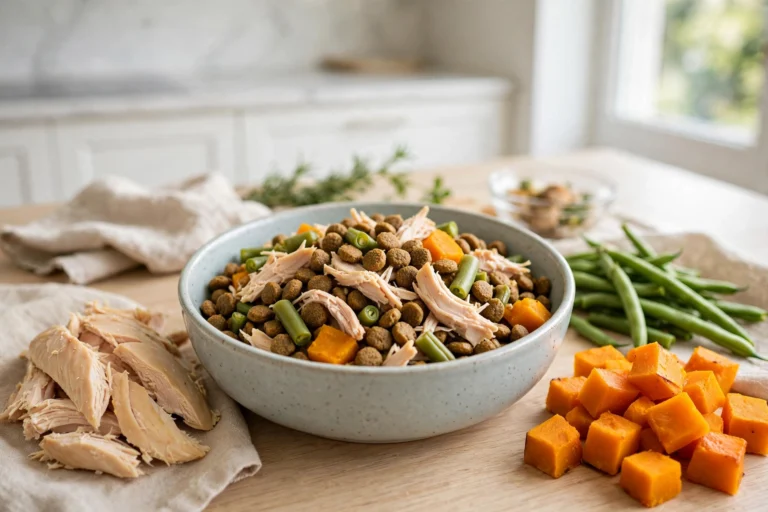
- And avoid home-cooked or raw diets as a long-term fix without veterinary nutrition guidance; a plain chicken-and-rice meal can calm a stomach for a few days, but it is not nutritionally complete for weeks on end.
Plain chicken and rice can calm a stomach for a few days, but it is not nutritionally complete for weeks on end.
Warning: fatty meals and table scraps can trigger a pancreatitis flare. A rich, fatty meal is the classic trigger for pancreatitis in dogs, and a Corgi that gets into the trash or is handed fatty scraps can go from fine to vomiting and painful within a day. Keep fatty foods out of reach and skip table scraps entirely during a sensitive period.
If your Corgi is already overweight: aim for a slow, steady loss of about 1 to 2% of body weight a week, the rate most veterinary guidance treats as safe, and do not crash-diet. Feed measured meals, two a day, keep treats under 10% of calories, and add daily walks. Royal Canin Medium Digestive Care is the natural pick here at 321 kcal per cup, the lowest calorie density on this list, and keeping weight off is one of the most useful things you can do for a Corgi’s back, hips, and lifespan.
Feeding a second low-slung breed? Our guides to the Best Food for Dachshund Sensitive Stomach and the Best Food for Australian Shepherd Sensitive Stomach use the same measured-portion, limited-ingredient approach.
How to Switch Foods Without Upsetting the Stomach
Switch over 7 to 10 days, not overnight: a quarter new food for two to three days, half and half for the next three, three quarters new for two to three days, then fully new food. If stools loosen, hold at that step for two more days. Two Corgi-specific habits help more than most owners expect: use a slow-feeder bowl or scatter part of the meal on the floor to slow a fast eater, and keep treats inside the 10% calorie budget so they never become a second meal. The general rules are covered in our hub guide to the Best Dog Food for Sensitive Stomachs.
Back and Joints: Why Extra Weight Strains a Corgi
Corgis are long and low, with short legs carrying a long spine, so every extra pound is carried by that back and those hips. Veterinary guidance is clear that extra weight loads joints, and for a breed built the way a Corgi is, weight control is joint care. Keep the food measured, keep the walks daily, and if your Corgi is stiff, slow to rise, or reluctant on stairs, that is a vet visit, not a food change.
When to See Your Vet
See your vet promptly if vomiting or diarrhea lasts more than a day or two, if there is blood in the stool, or if your dog is losing weight for no clear reason. Those signs need a check, not another bag. And if a Corgi has chronic loose stools and weight loss despite a good appetite, ask the vet to rule out EPI, exocrine pancreatic insufficiency, which the VCA lists Welsh Corgis among the breeds predisposed to.
Conclusion: Our Recommendation
For most Pembroke Welsh Corgis with a sensitive stomach, start with Purina Pro Plan Sensitive Skin & Stomach Salmon & Rice. It is salmon-first, widely available, and the cheapest way to feed a sensitive Corgi well, and most Corgis do well on it. If stools stay soft, Royal Canin Medium Digestive Care is the next step, and if you are still hunting for a trigger, Blue Buffalo Basics Turkey & Potato or Natural Balance Salmon & Sweet Potato give you a short list at a fair price. Whichever pick you choose, remember that the food is only half the plan. Measured portions, a slow switch, and treats inside the calorie budget are what make a gentle food work. For more breed guidance, see our Best Dog Food for Pembroke Welsh Corgi and our general Best Dog Food for Sensitive Stomachs.
Frequently Asked Questions
What is the best food for a Pembroke Welsh Corgi with a sensitive stomach?
When choosing food for a sensitive Corgi, look for a formula with a single named animal protein (salmon, lamb, or turkey) and a gentle carbohydrate, plus added dietary fibers to support digestion. Protein matters for a Corgi’s build, and the food should also fit the Corgi’s feeding habits and activity level. Purina Pro Plan Sensitive Skin & Stomach Salmon & Rice is the most natural starting point on this page.
What ingredients should I avoid for a Corgi with a sensitive stomach?
Avoid foods with long ingredient lists, fillers such as corn, wheat and soy, and artificial additives and preservatives, because these make it harder to spot the real trigger. Also avoid feeding rich, fatty treats and table scraps, which can irritate a sensitive stomach even when the main food is right. If your Corgi’s stools improve on a limited-ingredient food, the change usually points to a specific ingredient in the earlier diet.
Is grain-free food better for a sensitive stomach?
Not necessarily. Grain-free foods do not automatically suit every sensitive stomach, because many Corgis digest grains like rice, oats, and barley very well. The real question is the specific recipe and the ingredients it uses: a limited-ingredient recipe with a named protein is usually a better starting point than either grain-free or grain-inclusive.
How much should I feed a Corgi with a sensitive stomach?
Start with the feeding guide on the bag, then adjust for body condition and age. For a 27 lb adult, the labels on this page give roughly 1.3 to 2.75 cups a day depending on the food, so weigh portions on a kitchen scale rather than guessing from a scoop, and split the day’s food into two measured meals.
Can I still give treats to a Corgi with a sensitive stomach?
Yes, but keep them small and simple: small pieces of single-protein treats or plain, single-ingredient snacks are safest, and treats should stay below 10% of daily calories. Avoid rich, fatty treats such as bacon, sausage, or cheese, which are harder to digest and may trigger a flare.
When should I take my Corgi to the vet for stomach problems?
See your vet without delay if your Corgi has repeated vomiting, blood in the stool, unexplained weight loss, or diarrhea that persists for more than a couple of days, especially in puppies and senior dogs. Those signs are not just a sensitive stomach, and they need a prompt veterinary check rather than another food change. If a Corgi has chronic loose stools and weight loss despite a good appetite, the vet should also rule out EPI (exocrine pancreatic insufficiency), which the VCA lists Welsh Corgis among the breeds predisposed to.





2 Comments