
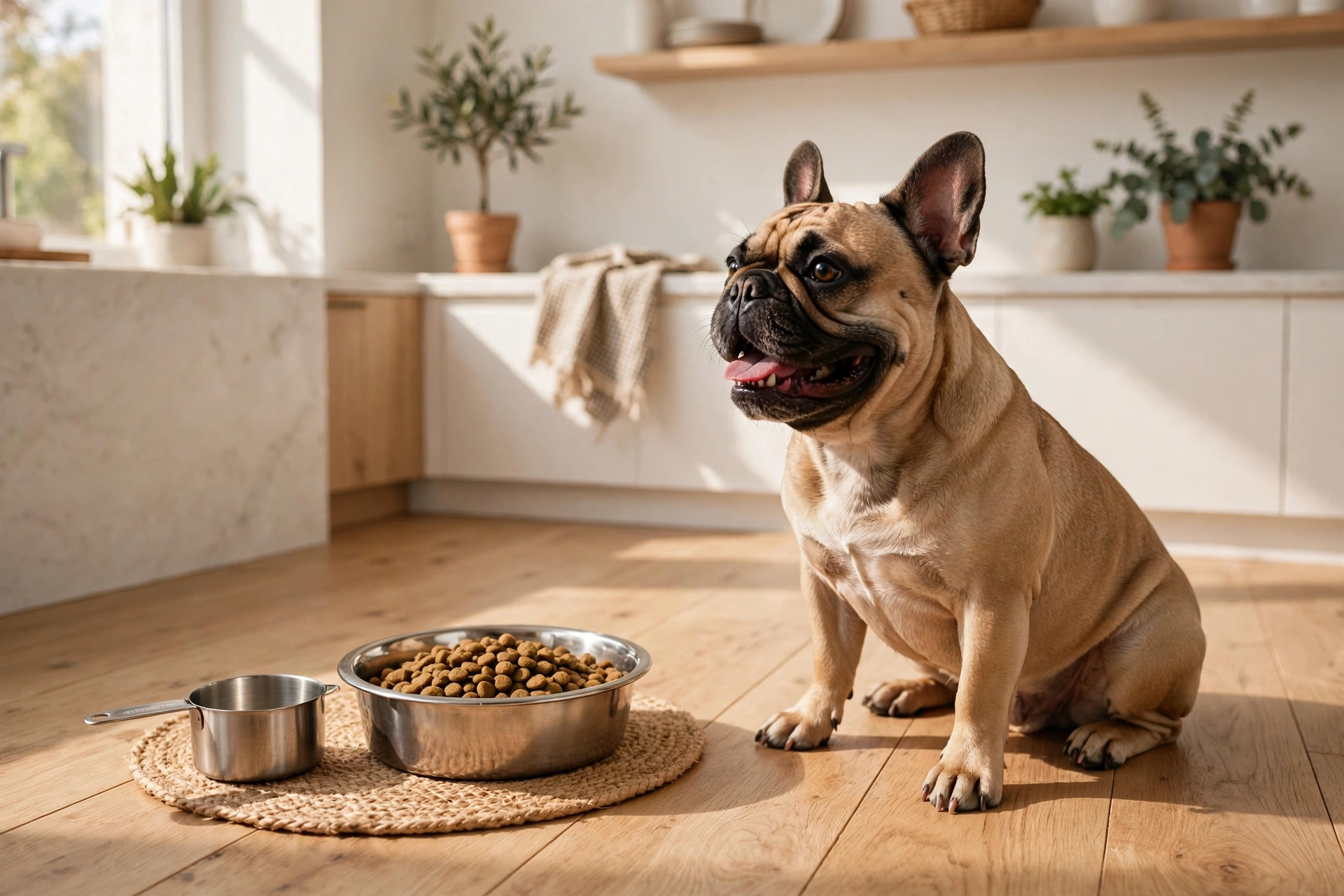
How Much Should a French Bulldog Eat? Portion Guide (2026)
If you’ve ever watched your French Bulldog inhale dinner and then beg like he hasn’t eaten in a week, you’ve probably asked yourself: how much should a French Bulldog eat? Frenchies are notorious for acting starving no matter how much they get, and they’re one of the breeds where extra weight hurts the most, because every extra pound makes their breathing, joints, and digestion work harder.
This portion guide covers exactly how much a French Bulldog should eat at every life stage (puppy, adult, and senior) with portion charts by age and weight, the simple calorie math behind those numbers, and how to adjust for activity level, spaying or neutering, and treats. You’ll also find four portion-friendly foods that make measuring easier. Use the charts below as your starting point, then fine-tune with the body-condition checks so your Frenchie stays in the healthy 16 to 28 pound range most adults land in.
Quick Answer: Most adult French Bulldogs need 1 to 1 1/2 cups of dry food a day, split into two meals, or about 450 to 700 calories. Puppies need about 1/2 to 1 1/2 cups across 3 to 4 meals, and seniors often need 10 to 20% fewer calories. Feed by calories, not scoops, and keep treats under 10% of the total.
In This Guide
- Key Takeaways
- French Bulldog Feeding Chart by Age
- How Much Should an Adult French Bulldog Eat by Weight?
- The Simple Calorie Math (So You Never Guess Again)
- How Much Should a French Bulldog Puppy Eat?
- How Much Should a Senior French Bulldog Eat?
- Portion-Friendly Foods for French Bulldogs
- Buying Guide: What to Look For
- What to Avoid
- How Activity Level Changes Portions
- How to Tell If Your French Bulldog Is Eating the Right Amount
- A Sample Day of French Bulldog Meals
- Pros and Cons
- Conclusion: The Right Portion for Your Frenchie
- Red Flags: When Food Trouble Means a Vet Visit
Key Takeaways
- Most adult French Bulldogs need 1 to 1½ cups of dry food per day, split into two meals, roughly 450 to 700 calories depending on weight and activity.
- French Bulldog puppies need about ½ to 1½ cups daily across 3 to 4 meals; seniors often need 10 to 20% fewer calories than adults.
- Feed by calories, not scoops: kibble calorie density varies a lot (roughly 350 to 465 kcal per cup), so check your bag’s label.
- Keep treats under 10% of daily calories and skip free-feeding. Measured meals are the easiest way to prevent weight gain.
- Use body condition (feel the ribs, see a waist), not begging, to fine-tune portions.
French Bulldog Feeding Chart by Age
This chart is a starting point based on the widely used 25 to 35 calories per pound rule for adult Frenchies and growth-stage needs for puppies. Cup estimates assume standard kibble at roughly 380 calories per cup. Always adjust using your own food’s calories-per-cup number.
| Age | Typical Weight | Daily Calories | Cups/Day | Meals/Day |
|---|---|---|---|---|
| 8 weeks to 4 months | 5 to 12 lb | 185 to 440 | 1/2 to 1 1/4 | 3 to 4 |
| 4 to 6 months | 12 to 18 lb | 360 to 595 | 1 to 1 1/2 | 3 |
| 6 to 12 months | 18 to 25 lb | 425 to 665 | 1 1/4 to 1 3/4 | 2 to 3 |
| Adult (12+ months) | 20 to 28 lb | 460 to 725 | 1 to 1 3/4 | 2 |
| Senior (7+ years) | 20 to 28 lb | 330 to 520 | 3/4 to 1 1/4 | 2 |
How Much Should an Adult French Bulldog Eat by Weight?
For adults, a quick rule of thumb is 25 to 30 calories per pound of body weight per day for a neutered dog at low-to-moderate activity. Less active or weight-prone Frenchies do better toward the lower end; intact or very active dogs toward the higher end.
| Adult Weight | Daily Calories (low to moderate activity) |
|---|---|
| 16 to 20 lb | ~400 to 550 kcal |
| 20 to 24 lb | ~500 to 650 kcal |
| 24 to 28 lb | ~575 to 750 kcal |
| 28+ lb (over breed standard, see your vet) | Vet-guided weight-loss plan |
To turn calories into cups, divide the daily calorie target by your kibble’s calories per cup (printed on the bag or the brand’s website). Example: a 22-pound Frenchie needing ~550 kcal/day on a kibble with 380 kcal/cup gets about 1.45 cups per day, roughly ¾ cup per meal.
The Simple Calorie Math (So You Never Guess Again)
For a more precise target, many owners use the standard resting-energy formula:
RER = 70 × (body weight in kg)0.75, then multiply by a lifestyle factor: × 1.4 for a neutered adult, × 1.6 for an intact adult, × 1.2 for a senior, × 1.0 for weight loss.
Example for a 10 kg (22 lb) neutered Frenchie: RER ≈ 70 × 5.62 ≈ 394 kcal → × 1.4 ≈ 550 kcal/day. That’s a solid estimate to bring to your vet, who can fine-tune it based on your dog’s actual body condition. For more on daily timing, see our French Bulldog feeding schedule.
How Much Should a French Bulldog Puppy Eat?
Frenchie puppies grow fast, so their needs change every few months:
- 8 weeks to 4 months: 3 to 4 meals daily, about 1/2 to 1 1/4 cups total. Choose a small-breed puppy formula with at least 22% protein and 8% fat.
- 4 to 6 months: 3 meals daily, about 1 to 1 1/2 cups total.
- 6 to 12 months: 2 to 3 meals daily, about 1 1/4 to 1 3/4 cups total. Growth slows but they’re still filling out.
Feed scheduled, measured meals, not free-feeding. Puppies that run heavy tend to stay heavy as adults, and extra weight is hardest on a breed already prone to joint and breathing strain. For food picks, see our guide to the best French Bulldog puppy food.
How Much Should a Senior French Bulldog Eat?
Around age 7, most Frenchies become seniors and their metabolism slows. A common starting point is 10 to 20% fewer calories than their adult amount, roughly 330 to 520 kcal/day for a 20 to 28 lb dog, split into two smaller meals for easier digestion. Watch for chewing difficulty (softer kibble or a wet-food mix can help) and adjust based on monthly weigh-ins rather than appetite, since seniors often get less active while eating the same amount.
Portion-Friendly Foods for French Bulldogs
These picks are chosen because they suit French Bulldog portion control: clear calorie information, appropriate kibble size, and formulas that fit the breed’s common needs. This is based on ingredient analysis, brand reputation, and owner reviews, not feeding trials.
| Product | Best For | Key Feature |
|---|---|---|
| Royal Canin French Bulldog Adult | No-guesswork breed-specific feeding | Curved kibble shaped for flat faces; 26% protein, 18% fat with prebiotics |
| Hill’s Science Diet Adult Small Paws Chicken Meal & Rice | Easy calorie math | 371 kcal/cup printed clearly; small nibble-size kibble |
| Purina Pro Plan Sensitive Skin & Stomach Small Breed, Salmon & Rice | Sensitive Frenchies | 465 kcal/cup; no corn, wheat, or soy; prebiotic fiber |
| Nutro Ultra Small Breed Adult (Chicken, Lamb & Salmon) | Premium whole-food option | Real chicken first; no by-product meal, corn, wheat, or soy |
Royal Canin French Bulldog Adult: Best Breed-Specific Formula
Royal Canin makes one of the few formulas built specifically for this breed. The curved kibble is shaped for a Frenchie’s short muzzle and jaw, which can slow down gulping. At 26% protein and 18% fat with L-carnitine for muscle maintenance, plus digestible proteins and prebiotics aimed at reducing flatulence, it fits the breed’s digestive quirks. It’s a good choice if you want a formula where the feeding guide is written for French Bulldogs specifically.
Hill’s Science Diet Adult Small Paws Chicken Meal & Rice: Best for Easy Portion Math
This small-breed adult formula lists 371 kcal per cup clearly, which makes the calorie-to-cup conversion in this guide painless. The nibble-size kibble suits small jaws, and the recipe is built around digestible ingredients with omega-6s and vitamin E for skin and coat. If you like precision feeding, a clearly labeled kcal/cup like this is a real advantage.
Purina Pro Plan Sensitive Skin & Stomach Small Breed, Salmon & Rice: Best for Sensitive Frenchies
French Bulldogs are prone to both sensitive stomachs and itchy skin, and this formula targets both: salmon as the first ingredient, oat meal for easy digestion, and prebiotic fiber plus omega fatty acids for gut and skin support. At 465 kcal per cup, it’s calorie-dense, so portions look smaller than average; measure carefully and don’t eyeball it. If your Frenchie has digestive or skin flare-ups, our guides to sensitive stomach food and allergy-friendly food go deeper.
Nutro Ultra Small Breed Adult (Chicken, Lamb & Salmon): Best Premium Whole-Food Option
Nutro Ultra’s small-breed adult recipe starts with real chicken, adds lamb and salmon, and includes a blend of superfoods like coconut, chia, kale, and blueberries. It contains no chicken by-product meal, corn, wheat, or soy, and is made in the USA. A good fit if you want a premium ingredient list in a small-breed kibble size.
Buying Guide: What to Look For
- Calories per cup on the label: this is the single most useful number for portion control. It varies widely between brands, so never assume one scoop equals another food’s scoop.
- AAFCO statement: look for “complete and balanced” for your dog’s life stage (growth/all life stages for puppies, adult maintenance for adults).
- Protein and fat levels: puppy formulas need at least 22% protein and 8% fat; adult formulas generally do well around 22 to 26% protein and 12 to 18% fat.
- A printed feeding guide: use the bag’s guide as your starting point, then adjust with the charts in this article and your vet’s advice.
- A measuring cup or kitchen scale: a $10 scale removes all guesswork. Grams are more consistent than cups.
What to Avoid
- Free-feeding: leaving food out all day makes it nearly impossible to track intake and almost always leads to gradual weight gain.
- Feeding by scoops alone: cup sizes and kibble density differ; convert to calories first.
- Over-treating: keep treats under 10% of daily calories. Training treats add up fast. Break them into pea-sized pieces.
- Table scraps: high-fat human food is a fast track to obesity and digestive upset in this breed.
- Sudden portion changes: adjust up or down gradually over a week so digestion stays settled.
- Adult food for young puppies: puppies under 12 months need growth-formula nutrition (different protein, fat, and mineral balance).
- Judging by the bowl: a “full-looking” bowl means nothing. A calorie-dense kibble can deliver a whole day’s food in what looks like a small serving. Always weigh or measure.
- Comparing with other dogs: your Frenchie’s 1¼ cups is not your neighbor’s Lab’s 1¼ cups. Portions are individual.
How Activity Level Changes Portions
Not all Frenchies burn the same calories. A couch-loving apartment Frenchie and one that gets two long walks plus playtime daily can differ by 150 to 200 calories a day. That’s a quarter of the daily budget.
- Low activity (most apartment Frenchies): stick to the lower end of the calorie ranges above. Extra weight worsens breathing in this brachycephalic breed, so err conservative.
- Moderate activity (daily walks, regular play): the middle of the range is usually right.
- High activity (hiking, agility, very playful young adults): you can feed toward the upper end, but re-check body condition monthly, because activity often drops as Frenchies age.
- Spayed/neutered dogs: typically need about 10 to 15% fewer calories than intact dogs of the same weight, since metabolism slows after the procedure.
Season matters too: many Frenchies are far less active in summer heat (they overheat easily), so a portion that was perfect in spring may be too much in August. Adjust with the weather.
How to Tell If Your French Bulldog Is Eating the Right Amount
Use this quick body-condition check monthly:
- Rib check: you should feel the ribs under a thin layer of fat without pressing hard.
- Waistline: viewed from above, there should be a visible waist behind the ribs, not a straight or barrel shape.
- Side profile: the belly should tuck up slightly behind the rib cage.
- Energy: tiring quickly on walks or reluctance to play can signal excess weight before it’s obvious.
- The scale: weigh monthly. A 2 to 3 pound gain on a 20 to 28 pound dog is significant.
If you’re unsure, your vet can assign a body condition score (1 to 9; aim for 4 to 5) and set an exact calorie target.
A Sample Day of French Bulldog Meals
Here’s what a day can look like for a 22-pound neutered adult Frenchie needing ~550 kcal/day on a 380 kcal/cup kibble:
- Morning (7 to 8 am): ¾ cup kibble (~285 kcal), served in a slow-feeder bowl if he gulps.
- Training/play: a few pea-sized training treats or baby carrots: budget ~30 to 40 kcal.
- Evening (5 to 6 pm): ¾ cup kibble (~285 kcal). Keep the timing consistent day to day.
- Total: ~600 kcal including treats. Then trim slightly if the monthly weigh-in trends upward.
Notice the treats are counted, not extra. That one habit, budgeting treats inside the daily total, prevents most accidental overfeeding.
Pros and Cons
A measured feeding routine is the best tool a Frenchie owner has, but it needs daily care. Here is the honest balance.
Pros
- Two measured meals a day keep weight steady in a breed that gains fast.
- Portion charts by age and weight make the daily amount clear.
- Calorie math from the bag label lets you compare foods fairly.
- A slow-feeder bowl and a set routine help a dog that gulps and begs.
Cons
- Frenchies act hungry all the time, so begging tests every owner.
- Extra weight strains breathing, joints, and digestion, so there is little room for error.
- Sensitive stomachs and gas are common, so some foods need a careful trial.
- Calorie-dense kibble makes portions look small, so eyeballing leads to overfeeding.
Conclusion: The Right Portion for Your Frenchie
For most adult French Bulldogs, the answer to “how much should a French Bulldog eat” is simple: about 1 to 1½ cups of dry food per day, split into two measured meals, adjusted for weight, activity, and the calorie density of your chosen food. Feed by calories rather than scoops, keep treats under 10% of the daily total, and let body condition, not begging, guide your adjustments. If you want a no-guesswork starting point, Royal Canin French Bulldog Adult’s breed-specific feeding guide is the easiest option, while Hill’s Science Diet Adult Small Paws makes calorie math straightforward.
This guide is for information only. Check with your vet for your dog’s specific needs.
Red Flags: When Food Trouble Means a Vet Visit
Most feeding problems in French Bulldogs are fixed with smaller portions and a steady routine. Some signs mean the problem is bigger than portions, and those need a vet, not a new food. Call your vet if your Frenchie suddenly refuses food or eats much less for more than a day. Repeated vomiting or diarrhea, a bloated belly with pain, or retching with nothing coming up also need prompt care. The same goes for rapid weight loss or gain, drinking far more water than usual, or seeming weak and tired for no clear reason. Choking, gagging, or trouble swallowing after meals is urgent in a flat-faced breed. Watch the skin too: itching, ear infections, or skin flare-ups that keep coming back after meals can point to a food issue, and random food switches only make it harder to find the cause. If any of these signs show up, write down when they started and what your dog ate, then call your vet with those notes in hand.
How many cups of food should a French Bulldog eat per day?
Most adult French Bulldogs eat 1 to 1½ cups of dry food per day, split into two meals. Puppies eat about ½ to 1½ cups across 3 to 4 meals depending on age. Always convert using your kibble’s calories per cup, since calorie density varies between brands.
How many times a day should I feed my French Bulldog?
Adults do best on two measured meals per day, morning and evening. Puppies under 6 months need 3 to 4 meals daily, dropping to 2 to 3 meals from 6 to 12 months. Seniors do well on two smaller meals for easier digestion.
How many calories does a French Bulldog need per day?
A rough guide is 25 to 30 calories per pound of body weight for a neutered adult at low-to-moderate activity, about 450 to 700 calories per day for most 20 to 28 lb adults. Active or intact dogs need more; seniors typically need 10 to 20% less.
Why is my French Bulldog always hungry?
Frenchies are notorious beggars and will act starving even when well-fed. Feed by measured calories and body condition, not by begging, and keep treats under 10% of daily calories. If begging suddenly increases, check with your vet.
Can I free-feed my French Bulldog?
It’s not recommended. Free-feeding makes it nearly impossible to track intake and usually leads to gradual weight gain in this obesity-prone breed. Two measured meals per day work much better.
How do I know if my French Bulldog is overweight?
You should be able to feel the ribs under a thin layer of fat and see a waist from above. Weigh your Frenchie monthly. Even a 2 to 3 pound gain is significant on a 20 to 28 pound dog. Your vet can assign a body condition score (aim for 4 to 5 out of 9).
Should treats count toward my French Bulldog’s daily food?
Yes. Treats should stay under 10% of daily calories, so subtract them from meal portions rather than adding them on top. Break training treats into pea-sized pieces and favor low-calorie options like baby carrots.
When should I switch my French Bulldog from puppy to adult food?
Most French Bulldogs transition from puppy to adult food between 10 and 12 months of age. Switch gradually over 7 to 10 days to avoid digestive upset, since this breed is prone to sensitive stomachs.
My French Bulldog suddenly stopped eating. What should I do?
Call your vet rather than waiting it out, especially if the change lasts more than a day. A sudden loss of appetite can point to pain or illness. Note when it started, what your dog ate, and whether there is vomiting, diarrhea, or a bloated belly, and share those notes with your vet.
Why is my French Bulldog so gassy?
Gas is common in Frenchies. Their short muzzle means they swallow air when they eat fast, and rich food or a sudden food change can add to it. A slow-feeder bowl, measured meals, and one steady food help. If gas comes with loose stools, vomiting, or itchy skin, talk to your vet about a structured plan.






One Comment