
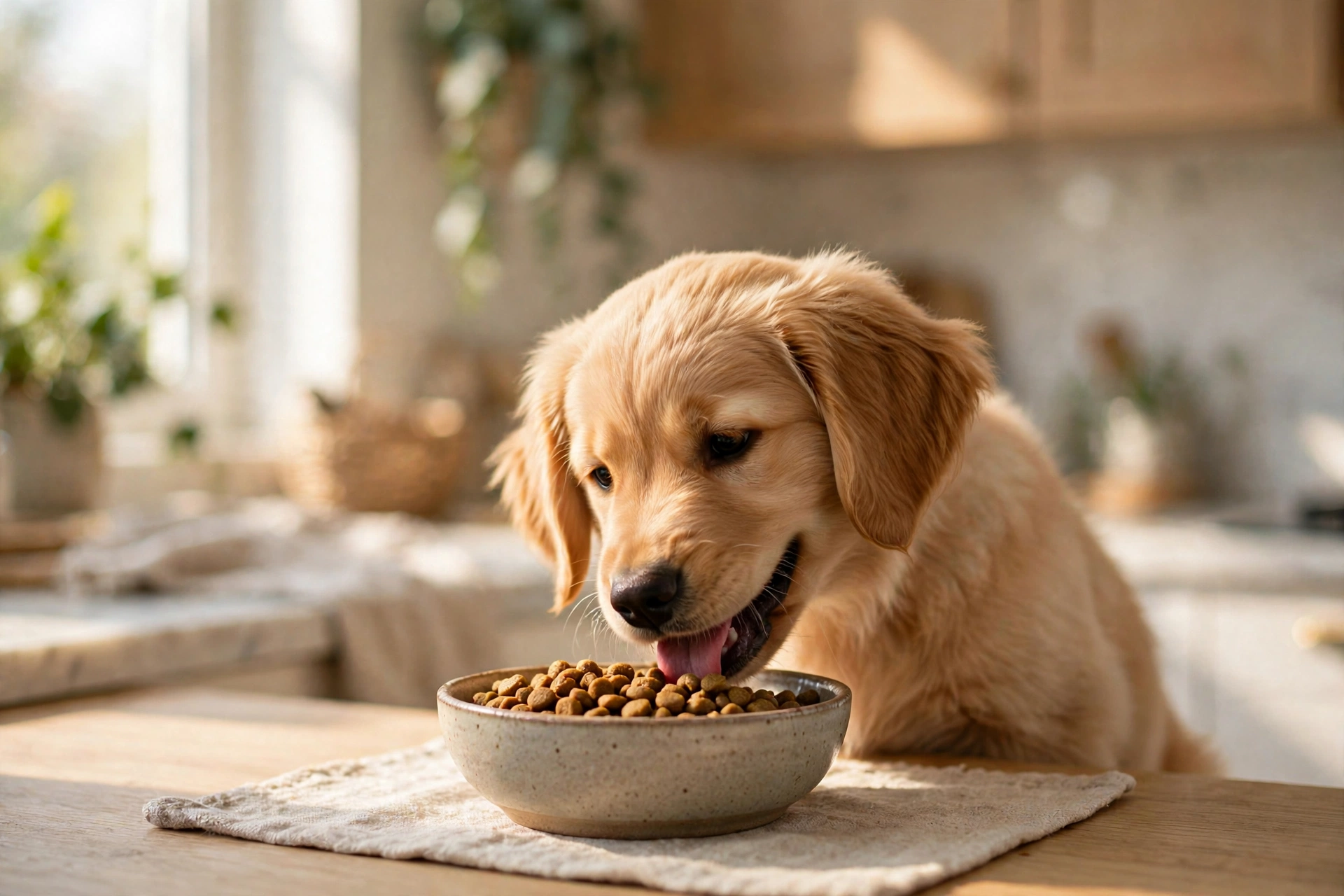
Best Puppy Food for Golden Retrievers: Controlled growth and joint support for 55 to 75 lb Goldens (6 Picks 2026)
Bringing home a golden retriever puppy is pure joy. Those floppy ears, the soft puppy coat, and the wagging tail that never quite stops. But along with all the excitement comes a big responsibility: choosing the best golden retriever puppy food to fuel healthy growth. Golden retrievers grow fast, and what you feed them during their first 12 to 18 months shapes their bones, joints, coat, and immune system for life.
Golden retriever puppies are not like average puppies. As a large breed that will grow to 55 to 75 pounds, they need controlled calcium and phosphorus levels to prevent the too-rapid growth that can trigger developmental joint problems. They are also prone to food sensitivities, easy weight gain, and, according to research on the breed, low taurine levels that have been linked to heart issues like dilated cardiomyopathy (DCM). The right puppy food addresses all of this. For the general large-breed background, see our guide to the best puppy food for large breeds.
In this guide, I break down the 6 best golden retriever puppy foods for 2026, chosen based on ingredient analysis, brand reputation, and real owner reviews. You will also find a full buying guide covering protein, fat, calcium, and AAFCO standards, plus what to avoid on the label. Whether you want a breed-specific formula, a budget-friendly kibble, or a large-breed recipe with probiotics, one of these picks will fit your pup.
Key Takeaways
- Large-breed puppy formulas matter: Golden retrievers need controlled calcium and phosphorus for steady, safe bone growth. Standard puppy food can grow them too fast.
- Look for named animal protein first (chicken, lamb, or salmon) with at least 22% protein and 8% fat to meet AAFCO growth standards.
- Joint and coat support help this breed: glucosamine, chondroitin, omega-3 fatty acids (EPA/DHA), and taurine are especially valuable for golden retriever puppies.
- Breed-specific option: Royal Canin Golden Retriever Puppy is the only widely available formula made exclusively for golden puppies from 8 weeks to 15 months.
- Budget-friendly does not mean low quality: Purina ONE Plus and Diamond Naturals deliver strong large-breed feeding and diet at much lower prices than premium brands.
Quick Comparison: The 6 Best Golden Retriever Puppy Foods
| Product | Best For | kcal/cup | Protein | Price (Chewy, 2026-11-14) | Cost/month |
|---|---|---|---|---|---|
| Royal Canin Golden Retriever Puppy | Best breed-specific pick | 339 | 27% | $104.99 / 30 lb | ~$83/mo |
| Purina Pro Plan Puppy Large Breed Chicken & Rice | Best overall value | 419 | 28% | $74.98 / 34 lb | ~$57 to $82/mo |
| Hill’s Science Diet Puppy Large Breed Chicken & Brown Rice | Best for steady growth | 391 | 24% | $78.99 / 27.5 lb | ~$82/mo |
| Purina ONE Plus Healthy Puppy Formula | Best budget pick | 374 | 28% | $49.98 / 31.1 lb | ~$45 to $54/mo |
| Blue Buffalo Life Protection Formula Large Breed Puppy Chicken & Brown Rice | Best natural ingredients | 385 | 26% | $79.97 / 34 lb | ~$45/mo |
| Diamond Naturals Large Breed Puppy Lamb & Rice | Best lamb-based pick | 414 | 27% | $54.99 / 40 lb | ~$39/mo |
A quick credibility check: Purina, Hill’s, and Royal Canin all employ veterinary nutritionists and run feeding trials, which is the heart of the WSAVA checklist for choosing a brand. Blue Buffalo and Diamond Naturals do not publish feeding-trial details, so they do not clear that checklist on the public evidence available.
The 6 Best Golden Retriever Puppy Foods (2026)
Royal Canin Golden Retriever Puppy Dry Dog Food
If you want a formula designed exclusively for golden retrievers, this is the standout choice. Royal Canin makes this recipe specifically for golden retriever puppies from 8 weeks to 15 months, and the attention to breed-specific detail shows everywhere in the formula.
The kibble itself is shaped for the golden’s straight muzzle and scissor bite, encouraging slower chewing, helpful for a breed known for inhaling food, which also lowers the risk of gulping-related digestive upset. The ingredient list includes an exclusive complex of antioxidants (including vitamin E) to support the developing immune system, plus taurine, an amino acid that supports heart health. That last point matters for goldens: the breed has shown a higher rate of dilated cardiomyopathy and low taurine levels, so taurine in the ingredient list is something I always look for with this breed.
The formula also delivers omega-3 fatty acids (EPA and DHA) and glucosamine with chondroitin for healthy joints and a shiny coat. Calorie content is adapted to the breed’s tendency toward weight gain, which helps keep a growing puppy lean without shortchanging its diet.
The downsides are real: it is one of the priciest puppy kibbles on this list, and it is only suitable until 15 months, so you will switch to the adult golden formula sooner than with most large-breed puppy foods. But for owners who want breed-specific feeding and diet from a company with deep feeding-trial experience, it is hard to beat.
Key ingredients: Royal Canin Golden Retriever Puppy
- Chicken by-product meal as the concentrated protein source
- Brown rice and oat groats for digestible grain-based energy
- Fish oil (EPA/DHA), glucosamine, chondroitin, taurine, vitamin E
Who it is for: Royal Canin Golden Retriever Puppy
Golden retriever owners who want a formula built around the breed’s specific needs, with muzzle-friendly kibble, heart support, joint support, and immune development, and who are comfortable paying a premium for it.
Purina Pro Plan Puppy Large Breed Chicken & Rice
Purina Pro Plan Puppy Large Breed is one of the most widely recommended puppy foods by breeders, and it is easy to see why.
What sets it apart is the inclusion of live probiotics, which support a healthy digestive system, a genuine plus for golden puppies.
Purina is one of the few brands that runs extensive feeding trials, and this formula carries a complete-and-balanced AAFCO statement for growth including large-breed growth. It comes in several bag sizes, so you can scale up as your puppy’s appetite grows, and it is priced very reasonably for the quality. The chicken-based recipe will not suit puppies with chicken sensitivities, but for the majority of golden puppies, this is the safest all-around pick.
Key ingredients: Purina Pro Plan Puppy Large Breed Chicken & Rice
- Chicken as the first ingredient, followed by rice and poultry by-product meal
- Fish oil (DHA/EPA), dried chicory root (prebiotic), live probiotics
- Glucosamine, vitamin A, linoleic acid
Who it is for: Purina Pro Plan Puppy Large Breed Chicken & Rice
Owners who want large-breed feeding and diet with digestive support at a fair price. An excellent default choice if you are unsure where to start.
Hill’s Science Diet Puppy Large Breed Chicken & Brown Rice
Hill’s Science Diet Puppy Large Breed is another veterinarian favorite, formulated to support controlled growth in large-breed puppies. One detail I appreciate: it is designed to be fed until 18 months, which matches how slowly large breeds like goldens mature compared with smaller dogs.
The recipe uses chicken meal as a concentrated protein source alongside oats and other grains, delivering high protein for healthy development. It includes natural sources of glucosamine and chondroitin for joint health, plus prebiotic fiber to support digestion. The mineral balance is tuned for large-breed growth, helping bones develop at a safe, steady rate rather than too quickly.
Hill’s backs its formulas with clinical research into feeding and diet, which gives many owners confidence. The bag does not list omega-3 content as prominently as some competitors, and the ingredient list includes chicken by-product meal, worth knowing if you prefer named whole meats.
Key ingredients: Hill’s Science Diet Puppy Large Breed Chicken & Brown Rice
- Chicken meal, whole grain wheat, oats, and barley
- Fish oil, flaxseed, dried beet pulp (fiber)
- Glucosamine, chondroitin, vitamins C and E (antioxidants)
Who it is for: Hill’s Science Diet Puppy Large Breed Chicken & Brown Rice
Owners who want a science-backed large-breed formula with a longer feeding window (up to 18 months) and are fine with a grain-inclusive recipe.
Purina ONE Plus Healthy Puppy Formula
Feeding a golden retriever puppy does not have to break the bank. Purina ONE Plus Healthy Puppy Formula delivers an impressive nutrient profile for the price: real chicken as the first ingredient, solid protein content, and a complete-and-balanced AAFCO statement for growth.
One practical feature is versatility: the kibble can be offered dry or moistened with warm water, which helps with weaning and teething. The formula is nutrient-dense, so you can feed slightly smaller portions without sacrificing nutrient value, stretching the bag further.
It is not a large-breed-specific formula, so it lacks the precisely controlled mineral ratios of the top two picks, but at less than half the price of Royal Canin, that tradeoff is easy to accept for most owners. But as an affordable, widely available puppy food with strong nutrient content, it is an excellent budget option.
Key ingredients: Purina ONE Plus Healthy Puppy Formula
- Chicken as the first ingredient, with chicken meal and beef fat
- Rice, corn gluten meal, and soybean meal for energy and protein
- DHA, calcium, phosphorus, vitamin E
Who it is for: Purina ONE Plus Healthy Puppy Formula
Budget-conscious owners who want quality feeding and diet at a low price and do not mind a general puppy formula rather than a large-breed-specific one.
Blue Buffalo Life Protection Formula Large Breed Puppy Chicken & Brown Rice
Blue Buffalo’s Life Protection Large Breed Puppy formula appeals to owners who want a more natural ingredient panel. Deboned chicken leads the ingredient list, followed by wholesome grains like oatmeal and brown rice, with no poultry by-product meals, corn, wheat, soy, artificial flavors, or preservatives.
The formula includes DHA and ARA for cognitive development, plus the brand’s signature LifeSource Bits, a blend of antioxidants, vitamins, and minerals selected to support immune system health. Omega-3 and omega-6 fatty acids support skin and coat, which matters for goldens and their famous feathered coats. It also contains glucosamine and chondroitin for developing joints.
A few honest caveats: the ingredient list is long, and it does include peas and pea fiber fairly prominently, plus garlic, ingredients some owners watch carefully.
Key ingredients: Blue Buffalo Life Protection Formula Large Breed Puppy Chicken & Brown Rice
- Deboned chicken, chicken meal, oatmeal, brown rice, barley
- Flaxseed, fish oil (DHA), dried chicory root, turmeric, dried kelp
- Glucosamine, chondroitin, LifeSource Bits (antioxidant blend)
Who it is for: Blue Buffalo Life Protection Formula Large Breed Puppy Chicken & Brown Rice
Owners who prioritize natural ingredients and no by-product meals, and who will feed the grain-inclusive (not grain-free) recipe after checking with their vet.
Diamond Naturals Large Breed Puppy Lamb & Rice
Diamond Naturals Large Breed Puppy Lamb & Rice is a sleeper hit for golden retriever owners. It uses pasture-raised lamb as the first ingredient, a useful alternative for puppies that do not do well on chicken-heavy recipes, and pairs it with rice and other digestible ingredients.
What makes it stand out at its price point: each serving includes species-specific probiotics (proprietary K9 strain) for digestive and immune support, plus glucosamine and chondroitin for joints and omega fatty acids for skin and coat. It is formulated for large-breed growth with controlled minerals, and it is one of the most affordable large-breed puppy foods available in the US.
Diamond had recalls in its past (as have many large manufacturers), so buy from reputable retailers and check bag dates. But the current Diamond Naturals line has a strong reputation among breeders and sporting-dog owners, and owner reviews for the lamb large-breed puppy recipe are consistently positive.
Key ingredients: Diamond Naturals Large Breed Puppy Lamb & Rice
- Lamb and lamb meal as the primary protein sources
- Ground rice, cracked pearled barley, oatmeal
- K9 strain probiotics, glucosamine, chondroitin, omega-6 and omega-3 fatty acids, DHA
Who it is for: Diamond Naturals Large Breed Puppy Lamb & Rice
Owners who want a chicken-free-leaning, lamb-first large-breed puppy food with probiotics at a genuinely affordable price.
Fresh food is the one option this list does not cover: it costs several times more per month than kibble for a 65 lb puppy, and none of the fresh brands publishes a Golden-specific puppy formula with label feeding amounts, so I have kept this list to kibble.
Also considered: IAMS Large Breed Puppy and American Journey Large Breed Puppy both show up on competitor lists. I left both out of the final six: IAMS covers the same budget ground as Purina ONE Plus and Diamond Naturals, and American Journey adds no Golden-specific benefit over the six picks above.
Buying Guide: What to Look for in Golden Retriever Puppy Food
Large-breed growth formulation
This is the single most important thing for a golden retriever puppy. Large-breed puppy formulas control calcium and phosphorus levels and moderate calorie density so your puppy grows at a steady, safe rate, since growing too fast is linked to hip dysplasia and osteochondrosis. Look for a formula labeled for large-breed puppies with an AAFCO statement that mentions growth of large dogs. For the full explainer, see our guide to the best puppy food for large breeds.
Quality protein source (first ingredient)
The first ingredient should be a named animal protein, chicken, lamb, salmon, or a named meal like chicken meal. Puppies need a minimum of 22% protein on a dry-matter basis (AAFCO), and most quality large-breed puppy foods land between 26% and 32%. For owners who prefer cooking at home, see our homemade golden retriever food guide. For the full breakdown, see our guide to the best puppy food for large breeds.
Balanced fat levels
AAFCO’s minimum is 8% fat for growth, and most golden puppy formulas sit around 12% to 16%. Fat provides energy and supports coat health, but golden retrievers gain weight easily, so avoid excessively rich formulas unless your vet recommends them. For the full breakdown, see our guide to the best puppy food for large breeds.
Joint-support nutrients
Given the breed’s joint risks, glucosamine and chondroitin in the formula are genuinely valuable, since they support cartilage and joint development during the rapid-growth months. Omega-3s (EPA/DHA) add anti-inflammatory support. For the full breakdown, see our guide to the best puppy food for large breeds.
Taurine and heart support
Golden retrievers have shown higher rates of dilated cardiomyopathy and low taurine levels, so taurine in the ingredient list is a smart checkbox for this breed. Grain-inclusive formulas are generally the safer default here, given the FDA’s ongoing investigation into grain-free diets and DCM. For the full breakdown, see our guide to the best puppy food for large breeds.
Digestive support
Prebiotic fiber (like dried chicory root or beet pulp) and live probiotics help keep digestion steady through the food transitions, new-home stress, and vaccination schedules of puppyhood. For the full breakdown, see our guide to the best puppy food for large breeds.
AAFCO nutritional adequacy statement
Every food you consider should carry an AAFCO statement confirming it is complete and balanced for growth (or all life stages). This is the baseline guarantee that the food meets established nutrient profiles for puppies, so skip any food that does not carry one. For the full breakdown, see our guide to the best puppy food for large breeds.
What to Avoid in Golden Retriever Puppy Food
- Adult maintenance formulas: They do not have the protein, fat, or mineral balance a growing large-breed puppy needs.
- Grain-free diets as a default: Unless your vet diagnoses a grain allergy (rare in dogs), grain-inclusive formulas are the safer choice for goldens given the DCM concerns. Talk to your vet before going grain-free.
- Vague ingredients: “Meat and bone meal,” “animal fat,” or “poultry by-products” without a named species tell you nothing about quality. Named sources only.
- Artificial colors, flavors, and preservatives: BHA, BHT, ethoxyquin, and artificial dyes add nothing for your puppy.
- Excessive calcium supplementation: skip calcium supplements in a balanced puppy food. Too much calcium is as dangerous for growing large-breed bones as too little.
- Overfeeding: This is not a label issue but the most common feeding mistake with goldens. Follow the bag’s large-breed feeding chart by expected adult weight, weigh food if you can, and keep your puppy lean. You should feel (not see) the ribs.
How Much Should You Feed a Golden Retriever Puppy?
The table below is for a 6-month-old Golden Retriever puppy expected to reach 65 lb as an adult and weighing about 40 lb now. Daily amounts come from each label’s feeding guide, and cost per month is a 30-day month at the Chewy price checked on 2026-11-14. For the day-by-day schedule, see our puppy feeding schedule.
| Product | kcal/cup | Price (Chewy, 2026-11-14) | Daily feeding | Cost/month |
|---|---|---|---|---|
| Royal Canin Golden Retriever Puppy | 339 | $104.99 / 30 lb | 3.83 cups/day | ~$83/mo |
| Purina Pro Plan Puppy Large Breed Chicken & Rice | 419 | $74.98 / 34 lb | 3.67 to 5.25 cups/day | ~$57 to $82/mo |
| Hill’s Science Diet Puppy Large Breed Chicken & Brown Rice | 391 | $78.99 / 27.5 lb | 4.0 cups/day | ~$82/mo |
| Purina ONE Plus Healthy Puppy Formula | 374 | $49.98 / 31.1 lb | 4.5 to 5.33 cups/day | ~$45 to $54/mo |
| Blue Buffalo Life Protection Formula Large Breed Puppy Chicken & Brown Rice | 385 | $79.97 / 34 lb | 2.75 cups/day | ~$45/mo |
| Diamond Naturals Large Breed Puppy Lamb & Rice | 414 | $54.99 / 40 lb | 3.75 cups/day | ~$39/mo |
Golden puppy feeding works in expected-adult-weight bands: the labels group puppies by the weight they will reach as adults, and the daily amount rises with the band. At 6 months, a puppy tracking toward 55 lb eats less than one tracking toward 75 lb. The Purina Pro Plan label, for example, gives 3.67 to 5.25 cups a day across its 50 to 75 lb band, and the Royal Canin Golden Puppy label steps up from its 55 lb row to its 66 lb row. Use the table above for a 65 lb adult as your middle reference, then move up or down within the range if your puppy is tracking lighter or heavier.
Watch the body, not just the chart: a healthy golden puppy should have a visible waist from above and you should feel the ribs easily under a thin layer of fat. Puppies that grow too fast or carry extra weight put more stress on developing joints. For a full breed-specific breakdown, see my guide to the best dog food for golden retrievers, and if you are still choosing between formulas, the best dog food for puppies guide covers top all-breed picks. On a tight budget, the best affordable dog food for sensitive stomachs guide shows how to feed well for less.
Conclusion: My Recommendation
For most golden retriever puppies, Purina Pro Plan Puppy Large Breed Chicken & Rice is the pick I recommend first: it is large-breed formulated with controlled minerals, includes live probiotics for digestion, and costs far less than premium brands. It is the safest default if you are overwhelmed by choice.
If you want feeding and diet built specifically around the breed, Royal Canin Golden Retriever Puppy is the only formula designed exclusively for golden puppies, with muzzle-shaped kibble, taurine, antioxidants, and joint support included, and it is worth the premium if your budget allows.
On a budget, Purina ONE Plus Healthy Puppy and Diamond Naturals Large Breed Puppy Lamb & Rice both deliver strong nutrient value for much less money. Whichever you choose, transition gradually over 7 to 10 days, keep portions measured, and schedule a vet check a few weeks after the switch to confirm your puppy is growing at a healthy rate. The same controlled-growth rules apply to other large breeds, so if you also feed a Labrador or a Cane Corso, see our guides to the best puppy food for Labradors and the best puppy food for Cane Corsos.
This guide covers feeding and diet for Golden Retriever puppies only. Your puppy’s exact portions depend on its weight and growth, so check anything unusual with your vet.
Frequently Asked Questions
What is the best food for a golden retriever puppy?
For most golden puppies, a large-breed puppy formula like Purina Pro Plan Puppy Large Breed Chicken & Rice is the best starting point: it has controlled calcium and phosphorus for steady bone growth, live probiotics for digestion, and glucosamine for joints. Royal Canin Golden Retriever Puppy is the top breed-specific alternative.
How much should I feed my golden retriever puppy?
Most golden puppies need 2 to 4 cups of quality large-breed puppy food per day, split into three meals until 6 months, then two meals daily. Always follow the feeding chart on your specific bag based on current weight and expected adult weight, and adjust to keep your puppy lean.
When should I switch my golden retriever puppy to adult food?
Most goldens transition to adult food between 12 and 15 months; large-breed formulas like Hill’s Science Diet can be fed until 18 months. Switch when your puppy reaches about 80 to 90 percent of expected adult weight, and transition gradually over 7 to 10 days.
Does my golden retriever puppy need large-breed puppy food?
Yes. Goldens grow to 55 to 75 pounds, and large-breed puppy formulas control calcium, phosphorus, and calories to prevent too-rapid growth, which is linked to hip dysplasia and other developmental joint problems this breed is prone to.
Can golden retriever puppies eat grain-free food?
Grain-free is not recommended as a default for golden retrievers. The FDA is investigating a potential link between grain-free diets and dilated cardiomyopathy (DCM), a heart condition goldens are already prone to. Unless your vet diagnoses a grain allergy, choose a grain-inclusive formula and discuss any concerns with your vet.
What ingredients should I avoid in golden retriever puppy food?
Avoid foods without an AAFCO growth statement, vague ingredients like “meat and bone meal,” artificial colors and preservatives (BHA, BHT), and grain-free formulas heavy in peas and lentils unless your vet advises otherwise.



3 Comments