

Pomeranian Feeding Guide: How Much, How Often & What to Feed (2026)
Pomeranians may look like cuddly lap dogs, but they are small athletes with fast metabolisms, tiny stomachs, and big opinions about food. These little dogs burn energy fast, have stomachs the size of a walnut, and can swing from bouncing to shaky if a meal is missed, especially as puppies.
This guide gives you clear, practical answers: what to feed a Pomeranian at each age, how much, how often, and how to handle the tricky cases like puppies, picky eaters, and food switches. It also clears up the confusing part (why different feeding charts disagree) so you can stop guessing and start measuring with confidence.
Quick Answer: A Pomeranian puppy needs 3 to 4 small meals a day, while most adults do best on 2 measured meals about 12 hours apart. Use a small-breed formula, measure every meal, and keep treats under 10 percent of daily calories. Never skip a puppy meal at all, since a missed meal can trigger low blood sugar.
In This Guide
- Key Takeaways
- Why Pomeranians Need a Different Feeding Routine
- How Much to Feed a Pomeranian: The Charts
- The Calorie Method: A Worked Example
- How Often Should You Feed a Pomeranian?
- What to Feed: Choosing the Right Food
- Sample Day Menus
- Mixing Wet and Dry Food Without Overfeeding
- Treats, Training, and the 10% Rule
- Switching Foods: Puppy to Adult, and Brand to Brand
- Feeding a Picky Pomeranian
- Puppy Hypoglycemia: The Warning Every New Pom Owner Needs
- Weight, Body Condition, and When to Adjust
- Foods Pomeranians Should Never Eat
- Common Feeding Mistakes to Avoid
- Pros and Cons
- Conclusion: A Simple Routine That Works
- How Food Affects Your Pomeranian’s Teeth, Joints, and Coat
Key Takeaways
- Most adult Pomeranians (3 to 7 lb) do well on roughly 1/4 to 3/4 cup of dry food per day, split into 2 meals. But always start from your food bag’s guide and your dog’s body condition, not from a chart alone.
- Feed puppies 3 to 4 small meals a day, adults 2 meals, and seniors 2 smaller meals; never leave food down all day for a Pomeranian.
- Use the 40-calories-per-pound rule only as a starting point: a moderately active 5 lb adult needs around 150 to 200 calories a day, and puppies, active dogs, and spayed or neutered dogs all need different amounts.
- Treats count. Keep them to 10% or less of daily calories, and subtract them from meals on training-heavy days.
- Switch foods slowly over 7 to 10 days, and watch for the warning signs in this guide (wobbliness in a puppy, steady weight gain, or a dull coat) rather than waiting for a problem to become obvious.
Why Pomeranians Need a Different Feeding Routine
Pomeranians are a toy breed, usually weighing 3 to 7 lb (about 1.4 to 3.2 kg) as adults, with a fast metabolism for their size.
Their small jaws matter too. Standard kibble can be hard for a Pomeranian to pick up and chew, especially for puppies and older dogs with dental problems. Small-breed or toy-breed kibble, with smaller pieces and a higher calorie density, is made for exactly this problem: your dog gets the energy it needs without having to eat a large volume. That is also why weight control is so unforgiving in this breed. A pound gained on a 5 lb dog is a 20% increase in body weight, enough to put extra strain on the knees, worsen a collapsing trachea, and make breathing harder on warm days.
How Much to Feed a Pomeranian: The Charts
Wet food is less calorie-dense per gram, so the same dog will need a larger weight of wet food. Check the can’s feeding guide and the mixing section below rather than swapping cup for cup.
Feeding chart by age
| Life stage | Meals per day | Typical daily amount (dry food) | Notes |
|---|---|---|---|
| 8 to 12 weeks | 4 | 1/4 to 1/2 cup | Very small, frequent meals; keep a regular schedule to protect against low blood sugar. |
| 3 to 6 months | 3 to 4 | 1/4 to 3/4 cup | Drop to 3 meals as growth steadies; use a small-breed puppy formula. |
| 6 to 12 months | 3, then 2 to 3 | 1/2 to 3/4 cup | Begin the gradual switch toward adult food near 10 to 12 months. |
| Adult (1 to 7 years) | 2 | 1/4 to 3/4 cup | Morning and evening meals work best; measure every meal. |
| Senior (8+ years) | 2 | 1/4 to 1/2 cup | Slightly fewer calories, easy-to-chew food, and joint-supporting nutrients. |
Feeding chart by weight (adult dogs)
| Adult weight | Daily dry food | Rough daily calories |
|---|---|---|
| 3 to 4 lb (1.4 to 1.8 kg) | 1/4 to 1/2 cup | 120 to 160 calories |
| 4 to 5 lb (1.8 to 2.3 kg) | 1/3 to 1/2 cup | 150 to 200 calories |
| 5 to 6 lb (2.3 to 2.7 kg) | 1/2 to 2/3 cup | 180 to 240 calories |
| 6 to 7 lb (2.7 to 3.2 kg) | 1/2 to 3/4 cup | 210 to 280 calories |
Those ranges are wide for a reason: two 5 lb Pomeranians can genuinely need different amounts if one is active all day and the other sleeps on the sofa. Pick a starting point in the middle, feed it for two weeks, weigh weekly, and adjust by about 10% at a time.
The Calorie Method: A Worked Example
If charts disagree (and they often do), calories settle the argument. A widely used starting point for Pomeranians is about 40 calories per pound of body weight per day for a moderately active adult. Puppies need more per pound, up to around 50, because they are growing. Less active, older, or spayed and neutered adults often need closer to 30 to 35 calories per pound.
Here is how that works for three typical dogs:
- A 4 lb adult, moderately active: 4 × 40 = about 160 calories a day. On a kibble with roughly 350 calories per cup, that is just under 1/2 cup a day, split into two 1/4-cup meals.
- A 6 lb adult, very active: 6 × 40 = about 240 calories a day, or roughly 2/3 cup of the same kibble. If this dog were neutered and less active, 6 × 32 = about 190 calories, or just over 1/2 cup, would be a better starting point.
- A 3 lb puppy, 4 months old: 3 × 50 = about 150 calories a day, but split into 4 small meals of roughly 38 calories each, a few tablespoons of puppy kibble per meal, not one big bowl.
Two things matter more than the exact number. Start by using your dog’s ideal weight, not its current weight, if it is already overweight. Then always cross-check against your food bag’s guide, because calorie density varies a lot between brands: a rich small-breed kibble can pack 400 calories per cup while a weight-management formula may hold closer to 300.
How Often Should You Feed a Pomeranian?
Meal frequency matters more for Pomeranians than for most breeds, because their small stomachs and fast metabolisms leave little room for long gaps. Young puppies are the clearest case: four meals a day up to about 3 months, three to four meals from 3 to 6 months, then three meals until near adulthood. Skipping meals at this age is not just a missed dinner. It can trigger low blood sugar, with wobbliness, lethargy, or disorientation that needs prompt veterinary attention.
Adults do best on two meals a day, roughly 12 hours apart: morning and evening. That rhythm keeps energy steadier than one large meal, and it makes portion control possible: you can see exactly what was eaten and what was left. Seniors usually stay on two meals, just slightly smaller, though a senior that struggles to finish a full meal or has dental pain may do better on two meals plus a small midday snack taken out of the daily total.
Free feeding (leaving the bowl full all day) is one of the most common mistakes. It hides appetite changes, an early sign something is wrong, and lets a food-motivated little dog graze its way to obesity. Put the bowl down for 15 to 20 minutes, then pick up what is left.
What to Feed: Choosing the Right Food
Look for a food that carries an AAFCO statement for your dog’s life stage (growth for puppies, adult maintenance for adults, or all life stages) and lists a named animal protein, such as chicken, lamb, or salmon, as the first ingredient. Small-breed or toy-breed formulas are worth considering because their kibble size and calorie density suit a 3 to 7 lb adult, but they are a convenience, not a requirement: any food that meets the AAFCO statement and the right life stage works.
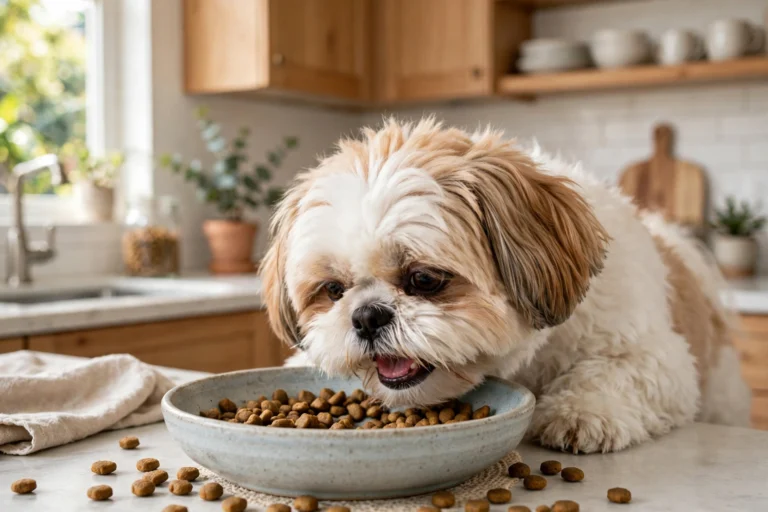
choosing for a Pomeranian: the kibble is sized for tiny jaws, the calorie density suits small portions, and many include added omega-3 fatty acids for coat health and dental-supporting texture.
| Food type | Best for | Key feature |
|---|---|---|
| Small-breed dry kibble | Most Pomeranians, daily feeding | Small pieces, easy to measure, helps clean teeth as your dog chews |
| Wet food | Picky eaters, seniors, dogs that drink little | Strong smell and soft texture, plus extra moisture, but watch total calories |
| Mixed wet + dry | Dogs bored of plain kibble | Flavor and hydration from wet food with the portion control of kibble |
| Homemade (vet-guided) | Dogs with allergies or specific needs | Full control over ingredients, but only balanced with veterinary guidance |
On nutrients, the benchmarks are straightforward. Puppies need around 25 to 30% protein and 12 to 18% fat. Adults generally do well around 18 to 30% protein and 15 to 20% fat, depending on activity. Seniors benefit from slightly fewer calories with easily digestible protein, added fiber, and glucosamine and chondroitin for joints. Omega-3s from fish oil or flaxseed help keep the dense double coat full and the skin comfortable.
For a closer look at specific products for each life stage, see our guide to the best dog food for Pomeranians and our best puppy food for Pomeranians. If your Pom shares a home with larger dogs, the portion logic in our best dog food for small breeds guide applies just the same.
Sample Day Menus
These menus use a typical small-breed kibble at about 350 calories per cup, plus a small treat allowance. Adjust the totals to your own food’s calorie count and your dog’s weight.
Puppy, 4 months old, about 3 lb (4 meals, ~150 calories)
- 7:00 a.m.: 2 tablespoons puppy kibble, softened with a splash of warm water if needed
- 11:30 a.m.: 2 tablespoons puppy kibble
- 4:00 p.m.: 2 tablespoons puppy kibble
- 8:00 p.m.: 2 tablespoons puppy kibble, plus one tiny training treat during the day
Adult, 5 lb, moderately active (2 meals, ~190 calories)
- 7:30 a.m.: 1/4 cup kibble
- 6:30 p.m.: 1/4 cup kibble, with a teaspoon of wet food mixed in for flavor if you like
- Treats through the day: no more than about 19 calories total, for example, a few small carrot pieces or two tiny training treats
Senior, 6 lb, less active (2 meals, ~200 calories)
- 8:00 a.m.: 1/4 cup senior small-breed kibble, softened if teeth are sore
- 6:00 p.m.: 1/4 cup senior kibble, with a spoonful of plain pumpkin for fiber if stools are loose
- Midday: a small dental chew or a few blueberries, counted inside the daily total
Mixing Wet and Dry Food Without Overfeeding
Mixed feeding is a good tool for picky Pomeranians, but it is also the easiest way to accidentally double-feed. The rule is simple: wet food replaces part of the kibble, it does not sit on top of it. A typical 3 oz tray of wet food holds roughly 80 to 100 calories, about a quarter to a third of an adult Pom’s whole day. So if you add half a tray at dinner, take roughly 1/8 to 1/4 cup of kibble out of that day’s total.
Treats, Training, and the 10% Rule
Treats should make up no more than 10% of daily calories. For a 5 lb adult eating 190 calories a day, that is just 19 calories, about two small commercial training treats, or a small handful of carrot sticks, or a tablespoon of plain cooked chicken. A single large biscuit can blow the whole allowance, and a day of generous training treats can quietly add 30 to 50% to a small dog’s intake.
The fix is not to stop training. Use pea-sized treats, break larger treats in half, and on heavy training days, measure out the day’s kibble in the morning and use part of it as training rewards. That way your dog still earns plenty of rewards, and dinner is simply a little smaller. Keep a small kitchen scale or a dedicated measuring cup by the food bin: eyeballing a 1/4 cup is where most overfeeding starts.
Switching Foods: Puppy to Adult, and Brand to Brand
Pomeranians usually move from puppy to adult food around 10 to 12 months, when growth slows. Some owners switch a little earlier, around 9 to 10 months, if their puppy is already at adult size and gaining too fast. But do not rush it for a slow-growing or very small puppy. Seniors move to a senior formula around 8 years, or sooner if weight, kidney, or joint concerns make a lower-calorie, joint-supporting diet sensible.
Any switch, at any age, should take 7 to 10 days: start with roughly 25% new food and 75% old for two to three days, move to half and half, then 75% new, then fully new. Pomeranians often have sensitive stomachs, and an abrupt change is a common cause of loose stools and vomiting that owners blame on the new food itself. If loose stools last more than a few days after a slow switch, or you see blood, vomiting, or lethargy, stop and talk to your vet rather than trying another brand straight away.
Feeding a Picky Pomeranian
Pomeranians have a reputation for fussiness, and it is often learned: a dog that refuses kibble and is immediately offered chicken, cheese, and hand-feeding learns that holding out works. The kinder fix is a boring routine. Serve the meal, leave it for 15 to 20 minutes, pick it up uneaten, and serve fresh food at the next scheduled meal. No extras in between. Most healthy dogs eat within a day or two, and a vet check is wise if refusal lasts longer than 24 hours, or if a puppy refuses even one meal.
Warming food slightly, adding a spoonful of warm water or low-sodium broth, or rotating flavors within the same brand can help without spoiling the routine. Avoid table scraps as a bribe: fatty or salty scraps can trigger stomach upset or pancreatitis in a small dog.
Puppy Hypoglycemia: The Warning Every New Pom Owner Needs
Toy-breed puppies can develop low blood sugar if they go too long without eating, get chilled, or burn a lot of energy playing. Warning signs include wobbliness, weakness, disorientation, trembling, or unusual sleepiness. This is the one feeding topic where you should not wait and see: keep a small amount of a fast sugar source your vet has recommended on hand, follow their instructions if an episode happens, and get veterinary help promptly, especially if the puppy does not recover quickly or the episode repeats. Prevention is mostly routine: frequent small meals, a warm resting place, and no long gaps between feeds for puppies under 6 months.
Weight, Body Condition, and When to Adjust
The scale tells part of the story, but your hands tell the rest. You should be able to feel your Pomeranian’s ribs under a thin layer of fat without pressing hard, see a visible waist from above, and see a slight tuck at the belly from the side. If ribs are hard to find, the waist has vanished, or your dog pants heavily on short walks, portions are too generous or treats have crept up. If ribs and hip bones are clearly visible, energy is low, or the coat looks dull, portions may be too small or the food may not suit your dog.
Weigh your dog every one to two weeks while you are settling a routine. A kitchen scale works for puppies, and a bathroom scale (weigh yourself, then yourself holding the dog, and subtract) works for adults. Change portions by only about 10% at a time and give each change two weeks before judging it. Rapid weight loss in a small dog is not a success; it is a reason to call your vet. Our senior dog food guide covers the lower-calorie formulas that help older Pomeranians stay lean without losing muscle.
Foods Pomeranians Should Never Eat
Some everyday foods are dangerous for a dog this small, where even a small amount is a large dose. Never feed chocolate, caffeine, grapes, raisins, onions, garlic, macadamia nuts, or anything sweetened with xylitol (also listed as birch sugar), including sugar-free gum. Cooked bones can splinter and choke or injure the gut, and fatty scraps, salty snacks, and alcohol are all off the menu. Dairy in quantity often upsets a Pomeranian’s stomach, so keep cheese and milk to rare, tiny amounts at most, if your dog tolerates them at all.
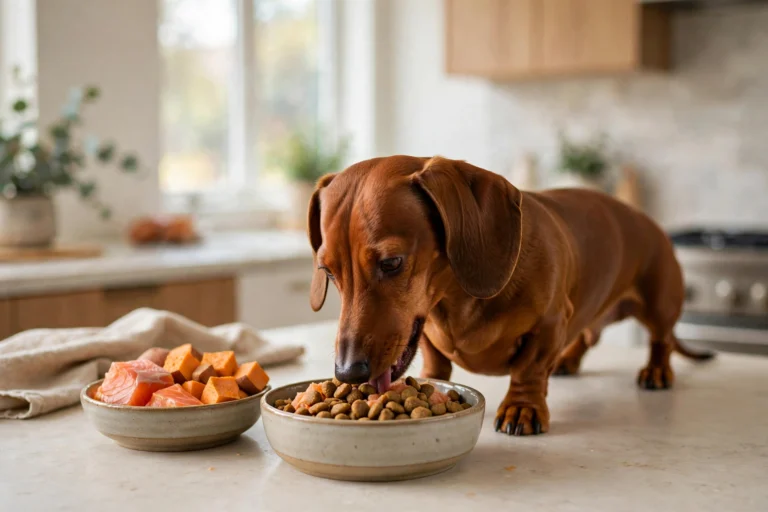
Safe extras, in moderation and inside the treat allowance, include boiled chicken, turkey, lean beef, boneless fish, carrots, pumpkin, sweet potato, peas, green beans, blueberries, and apple slices without seeds. Plain cooked rice and oats can settle a mildly upset stomach for a day or two, but a bland diet is a short-term measure, not a permanent feeding plan.
Common Feeding Mistakes to Avoid
- Free feeding. Leaving food down all day hides appetite changes and quietly fattens a small dog.
- Measuring by eye. A heaped scoop instead of a level 1/4 cup can add 20 to 30% to a meal.
- Counting treats as free. Treats are calories, and in a Pomeranian they are a large share of the day.
- Switching food abruptly. A 7 to 10 day transition protects a sensitive stomach.
- Feeding for current weight when overweight. Base portions on ideal weight, and adjust slowly.
- One meal a day. A Pomeranian’s tiny stomach and fast metabolism make one large meal a poor fit.
- Ignoring water. Fresh water should always be available; wet food and broth can help dogs that drink little, but they never replace a water bowl.
Pros and Cons
A set feeding routine keeps a Pomeranian steady, but tiny portions leave little room for error. Here is the honest balance.
Pros
- Small, measured meals keep blood sugar steady in puppies.
- Two set meals a day make it easy to spot a lost appetite early.
- Small-breed kibble suits tiny jaws and helps clean teeth.
- Short meal times build a routine that helps with house training.
Cons
- Portions are so small that one extra scoop can mean real weight gain.
- Puppies must never skip a meal, so someone has to be there to feed them.
- Free feeding is risky, so food cannot just be left out all day.
- Picky eating is common, so some meals need patience and a slow switch.
For older Pomeranians, see our guide to the best senior food for Pomeranians.
Conclusion: A Simple Routine That Works
The best Pomeranian feeding routine is not complicated: a complete small-breed food, measured meals twice a day for adults (three to four for puppies), treats kept inside 10% of calories, and a weekly weigh-in to catch drift early. Start from the charts above, give any change two weeks, and let body condition decide the next adjustment.
Your vet can confirm an ideal weight and daily calorie target in a single visit. This guide is for information only. Check with your vet for your dog’s specific needs.
How Food Affects Your Pomeranian’s Teeth, Joints, and Coat
Pomeranians may be small, but their teeth need real care. Tiny jaws and crowded teeth put them among the breeds most at risk for plaque buildup and gum infections. Dry kibble made for toy breeds helps clean teeth with every bite, and dental formulas can cut tartar further. Soft food alone does little to clean teeth, so a Pom that eats only soft food needs extra dental care.
Weight matters for more than looks. Extra pounds put more strain on the knees and can make a collapsing trachea worse, so a calorie-controlled diet helps keep your Pom lean and takes pressure off the airway. The same care helps the joints: diets with omega-3 fatty acids, glucosamine, and chondroitin can support joint health, especially in seniors.
Food shows in the coat too. A dull coat, dry skin, or extra shedding can point to a diet that is missing something. Diets rich in omega-3s, zinc, and biotin help restore coat condition and calm the skin. Fish oil and flaxseed are good sources of omega fatty acids, and they help keep that thick double coat full and glossy.
How many times a day should I feed a Pomeranian?
Puppies under 6 months need 3 to 4 small meals a day, and adults do best on 2 meals about 12 hours apart. Seniors usually stay on 2 slightly smaller meals. Avoid one large meal a day, which does not suit a Pomeranian’s tiny stomach.
How much food does a Pomeranian eat per day?
Most adults (3 to 7 lb) eat roughly 1/4 to 3/4 cup of dry food a day, split into 2 meals. Start in the middle of the range for your dog’s weight, weigh weekly, and adjust by about 10% at a time.
How many calories does a Pomeranian need?
A moderately active adult needs about 40 calories per pound per day, so a 5 lb Pom needs around 150 to 200 calories. Puppies need up to 50 per pound, while less active or spayed/neutered adults may need only 30 to 35 per pound.
When should I switch my Pomeranian puppy to adult food?
Most Pomeranians move to adult food around 10 to 12 months, when growth slows. Switch over 7 to 10 days, gradually increasing the new food, to protect a sensitive stomach.
Can Pomeranians eat once a day?
No, it is not recommended. Their tiny stomachs and fast metabolisms need smaller, more frequent meals (2 a day for adults and 3 to 4 for puppies) to keep energy and blood sugar steady.
What if my Pomeranian puppy refuses food or seems wobbly?
A puppy refusing even one meal, or showing wobbliness, weakness, or unusual sleepiness, may have low blood sugar and needs prompt veterinary attention. Keep meals frequent and regular for puppies under 6 months.
Can I mix wet and dry food for a Pomeranian?
Yes, but wet food replaces part of the kibble. It does not sit on top of it. A 3 oz tray holds roughly 80 to 100 calories, so subtract a matching amount of kibble from that day’s total.
What foods should Pomeranians never eat?
Never feed chocolate, caffeine, grapes, raisins, onions, garlic, macadamia nuts, or anything sweetened with xylitol. Cooked bones, fatty scraps, salty snacks, and alcohol are also off the menu for this small breed.
Do Pomeranians need special small-breed food?
Yes. Small-breed formulas suit toy dogs like Pomeranians. They pack more calories into a small amount of food, so your Pom gets the energy it needs without a big portion, and the kibble size fits tiny jaws. Many small-breed foods also support dental health, which matters a lot for this breed.
Should I rotate my Pomeranian’s food for variety?
You can, but you do not have to. Rotation can work if your dog handles it well, but it is not needed for good health. If you do change foods, switch slowly over 7 to 10 days and watch for signs of a sensitive stomach. Talk to your vet first if your Pom has a history of stomach upset or food allergies.
2 Comments