
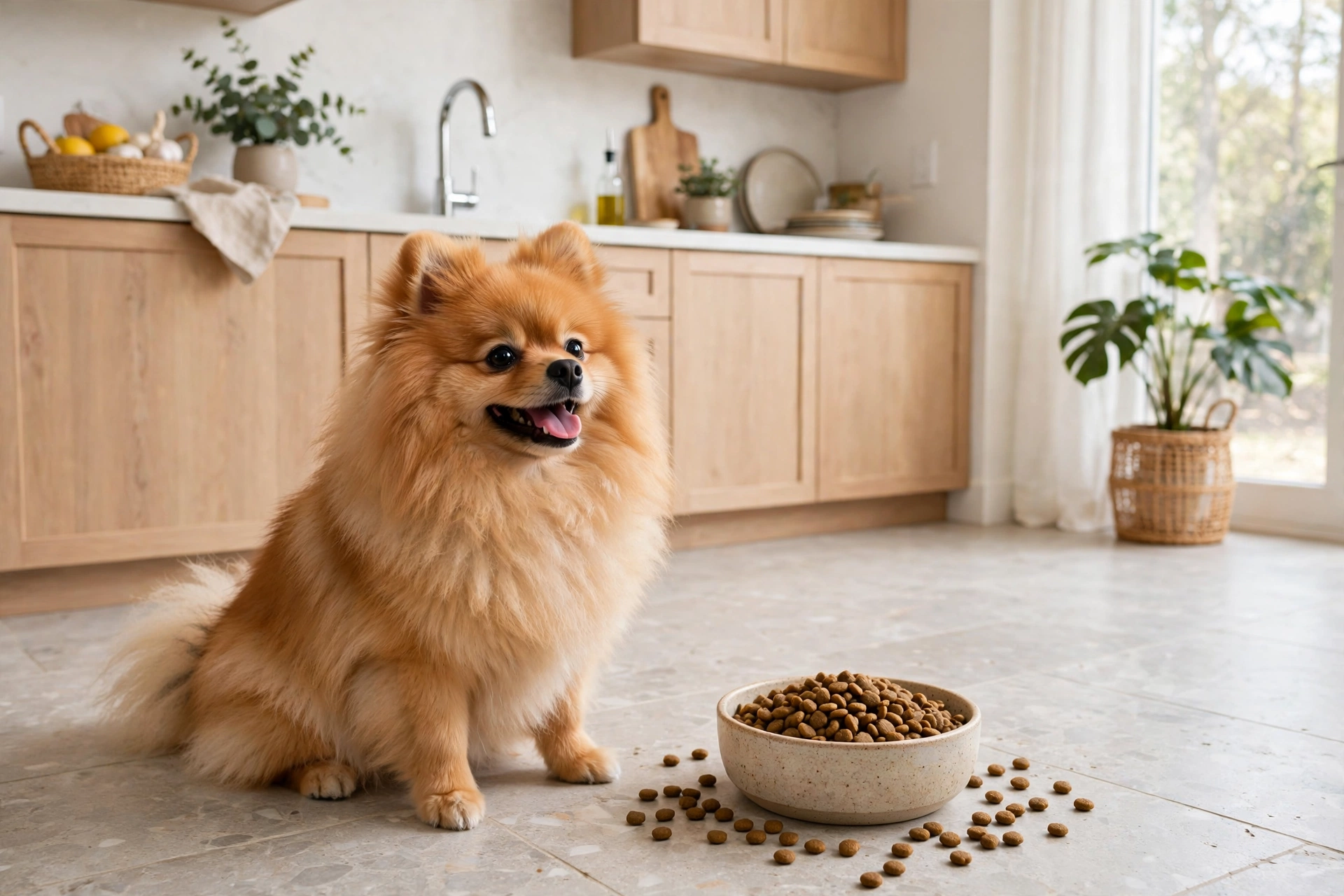
Best Food for Pomeranian Sensitive Stomach: Chicken-based Picks for tiny-breed feeding
A Pomeranian with a sensitive stomach can turn every mealtime into a guessing game, but the part that matters most is the size of the dog, not the breed. A Pomeranian weighs 3 to 7 lb (AKC), so a few extra grams of food matter more than they would for a bigger dog, and a rich treat can set a sensitive stomach off for days. This guide sticks to chicken-based and other gentle tiny-breed picks, the feeding amounts for a 5 lb adult, and what the month actually costs. The method behind it is in our guide to the best dog food for sensitive stomachs.
This guide is for information only. Check with your vet before you change food for a puppy, a senior, or a dog with a medical condition, and seek care promptly if your dog has ongoing vomiting, diarrhoea, weight loss or blood in the stool.
Key Takeaways
- Portions are the real issue for a Pomeranian: a 3 to 7 lb dog (AKC) needs precise feeding, and even a small overfeed or a rich treat can trigger loose stools and gas.
- Chicken-based small-breed food with rice or oatmeal and prebiotics is the best first try: it is easy to digest, gentle on the gut, and comes in a kibble size Poms can chew.
- If chicken seems to be the problem, move to lamb or salmon, or a limited-ingredient diet with a single novel protein, and change one thing at a time so you can see what helps.
- Measure every meal, split the daily food into two to three small meals, and keep treats under 10% of daily food. A slow 7 to 10 day transition matters as much as the food itself.
- If it gets worse over time, switch to a different food.
Best Food for Pomeranians With Sensitive Stomachs: Quick Comparison
| Product | Kcal/cup | Price | Price/lb | Daily feeding (5 lb adult) | Cost/month | Best for |
|---|---|---|---|---|---|---|
| Hill’s Science Diet Sensitive Stomach & Skin, Small & Mini Adult 1 to 6, Chicken | 380 | $62.99 / 15 lb | $4.20 | 0.5 cups/day | ~$14/mo | Best overall |
| Natural Balance L.I.D. Limited Ingredient Diets, Small Breed Lamb & Brown Rice | 400 | $47.98 / 12 lb | $4.00 | 0.5 to 1 cups/day | ~$15 to $30/mo | Best limited ingredient |
| Purina Pro Plan Sensitive Skin & Stomach, Small Breed Salmon & Rice | 478 | $54.48 / 16 lb | $3.41 | 0.33 to 1 cups/day | ~$9 to $27/mo | Small breed |
| Blue Buffalo Basics Limited Ingredient Diet, Skin & Stomach Care, Turkey & Potato (adult) | 352 | $69.58 / 24 lb | $2.90 | 0.5 to 1.25 cups/day | ~$10 to $24/mo | Best grain-free |
| Wellness Simple Limited Ingredient Diet, Grain-Free Salmon & Potato (standard adult) | 446 | $88.98 / 24 lb | $3.71 | 0.25 to 1 cups/day | ~$8 to $31/mo | Best for picky eaters |
| Royal Canin Pomeranian Adult | 352 | $61.99 / 10 lb | $6.20 | 0.44 to 0.66 cups/day | ~$17 to $26/mo | Picky Poms and breed-specific feeding and diet |
Prices checked on Chewy on November 13, 2026. Amounts are for a 5 lb adult dog. Kcal/cup and feeding amounts come from the brands’ own labels: Hill’s (hillspet.com, label row 5 lb: 50 g), Natural Balance (naturalbalanceinc.com, 400 kcal/cup, 3,520 kcal/kg), Purina Pro Plan (purina.com label, 3 to 12 lb band), Blue Buffalo (grain-free label via directionsforme.org product 273057, band up to 15 lb), Wellness (Wellness official AAFCO profile: 446 kcal/cup, 3,487 kcal/kg, cup 128 g; shared Wellness Simple chart, 3 to 17 lb), Royal Canin (royalcanin.com/us, 0.44 to 0.66 cups a day interpolated between the 4.4 and 6.6 lb rows; the 2.5-lb bag is $24.99). For a fuller feeding schedule by age and weight, see our Pomeranian Feeding Guide.
Feeding Amounts by Weight
| Product | 3 lb | 5 lb | 7 lb |
|---|---|---|---|
| Hill’s Science Diet Sensitive Stomach & Skin, Small & Mini, Chicken | 1/3 cup, 127 kcal | 1/2 cup, 190 kcal | 2/3 cup, 253 kcal |
| Natural Balance L.I.D. Small Breed Lamb & Brown Rice | 1/2 cup, 200 kcal | 1/2 to 1 cup, 200 to 400 kcal | 1 cup, 400 kcal |
| Purina Pro Plan Sensitive Skin & Stomach, Small Breed Salmon & Rice | 1/3 cup, 158 kcal | 1/3 to 1 cup, 158 to 478 kcal | 1 cup, 478 kcal |
| Blue Buffalo Basics Limited Ingredient Diet, Turkey & Potato, Grain-Free | 1/2 cup, 176 kcal | 1/2 to 1 1/4 cups, 176 to 440 kcal | 1 1/4 cups, 440 kcal |
| Wellness Simple Limited Ingredient Diet, Grain-Free Salmon & Potato | 1/4 cup, 112 kcal | 1/4 to 1 cup, 112 to 446 kcal | 1 cup, 446 kcal |
| Royal Canin Pomeranian Adult | 0.30 to 0.47 cups, 106 to 165 kcal | 0.44 to 0.66 cups, 155 to 232 kcal | 0.63 to 0.80 cups, 220 to 282 kcal |
Calories are cups times the food’s kcal/cup. Hill’s amounts are interpolated between the label rows nearest your dog’s weight (2 lb, 5 lb, and 8 lb rows). Royal Canin amounts are interpolated between its label rows (2.2 lb, 4.4 lb, 6.6 lb, and 7.7 lb rows). The other four foods publish a feeding band, so the 3 lb column uses the low end and the 7 lb column the high end. Use the label amount for your Pom’s weight, split it into two to three small meals, and adjust by body condition.
Hill’s Science Diet Sensitive Stomach & Skin Small & Mini: Best First Try
The best first try for most Poms. Hill’s Science Diet Sensitive Stomach and Skin Small and Mini is my top pick, and the reason starts with the size of the dog: a 5 lb adult eats about half a cup a day, so a food that is gentle, easy to digest, and made in small kibbles a tiny mouth can chew earns its place. It contains prebiotic fibre for gut health, vitamin E and omega-6 for skin and coat, and it is gentle on sensitive stomachs. It is AAFCO-approved for adult maintenance.
I rate this as the strongest starting point for a picky or sensitive Pom. It checks all the boxes: gentle ingredients, supports the gut and immune health, and the flavour is usually a hit. The small kibble is easy to chew, which matters more than it sounds when the whole day’s food is half a cup. What to watch: the price is at the higher end, and some picky eaters may prefer a different protein.
Who it is for: Best for most Poms, especially the picky eaters.
Natural Balance L.I.D. Small Breed Lamb & Brown Rice: Best Limited Ingredient
A limited-ingredient diet is a strong choice when you do not know the exact trigger. Natural Balance L.I.D. Small Breed Lamb and Brown Rice keeps the recipe short: lamb as the single protein, brown rice as the gentle carbohydrate, and no corn, wheat, soy, or artificial colours and flavours. The small-breed kibble suits a Pom’s mouth, and the formula meets AAFCO standards for adult maintenance. At 400 kcal/cup and 3,520 kcal/kg (Natural Balance official figures), a 5 lb adult eats 0.5 to 1 cups a day.
What to watch: lamb is still a rich protein, so start at the low end of the feeding band and move up slowly, and check the price per pound against the other picks before you commit to a bag.
Who it is for: Best for a Pom that needs a short ingredient list, or a chicken-free trial.
Purina Pro Plan Sensitive Skin & Stomach Small Breed Salmon & Rice: Best for Fish Lovers
Purina Pro Plan Sensitive Skin and Stomach, Small Breed Salmon and Rice is the salmon-based option in this list, and the one to try when chicken is the suspect. The recipe is built around salmon, with rice and oatmeal for gentle fibre, and it carries live probiotics. The small-breed kibble is sized for a Pom’s mouth. At 478 kcal/cup, it is the most calorie-dense food on this list, so a 5 lb adult needs only 0.33 to 1 cups a day: measure carefully, because a little extra goes a long way at this size.
I like this for Poms who do better on fish. It is a straightforward formula, and the calorie density means a tiny portion still covers the day, which is handy when the whole meal is a few spoonfuls. What to watch: at 478 kcal/cup, this is the easiest food on this list to overfeed, so use a measuring cup, not a scoop, and watch the waistline.
Who it is for: Small-breed Poms, especially those who do better on fish or need a chicken-free trial.
Blue Buffalo Basics Limited Ingredient Diet, Skin & Stomach Care, Turkey & Potato: Best Grain-Free
Blue Buffalo Basics Limited Ingredient Diet, Skin and Stomach Care, Turkey and Potato is the turkey-based, grain-free option here. One animal protein (turkey), one main carbohydrate (potato), plus pumpkin for gentle fibre, and no chicken, beef, corn, wheat, soy, dairy, or eggs. The limited list makes it easier to spot a trigger. At 352 kcal/cup, a 5 lb adult eats 0.5 to 1.25 cups a day.
Use the grain-free Turkey and Potato recipe for this pick: it is the one with 352 kcal/cup in the table above. What to watch: turkey can bore a picky eater over time, and the 24-lb bag is a lot of food for a dog that eats half a cup a day, so check the use-by date once it is open.
Who it is for: Best for a Pom that needs a grain-free trial, or a single-protein recipe without chicken.
Wellness Simple Limited Ingredient Diet, Grain-Free Salmon & Potato: Best for Picky Eaters
Wellness Simple Limited Ingredient Diet, Grain-Free Salmon and Potato is the pick for a Pom that turns its nose up at most foods. One protein (salmon), one main carbohydrate (potato), plus flaxseed and vitamins, and no gluten, wheat, corn, soy, dairy, eggs, chicken, beef, or artificial preservatives. Note the product here is the standard adult recipe, not the Small Breed variant. At 446 kcal/cup (Wellness official AAFCO profile: 3,487 kcal/kg, cup 128 g), a 5 lb adult eats 0.25 to 1 cups a day.
What to watch: this is the priciest food per bag on this list at $88.98 for 24 lb, and the salmon flavour is not a hit with every dog. The standard adult kibble is also bigger than a small-breed kibble, so check your Pom can chew it comfortably.
Who it is for: Best for picky eaters, or a Pom that needs a short salmon-based recipe.
Royal Canin Pomeranian Adult: Best Breed-Specific
Royal Canin Pomeranian Adult is the only breed-specific food on this list, and the one to try when a Pom refuses everything else. The kibble is made for a Pomeranian’s jaw, and the recipe is built around the breed: omega-3 fatty acids (EPA and DHA) for skin and coat, and a blend of fibres for digestive health. It is AAFCO-approved for adult maintenance. At 352 kcal/cup, a 5 lb adult eats 0.44 to 0.66 cups a day (interpolated between the 4.4 and 6.6 lb label rows). The 10-lb bag is $61.99 on Chewy, checked November 13, 2026, and the 2.5-lb bag is $24.99.
I like this because it is made for the breed: the kibble size suits a Pom’s mouth, and the recipe is designed around the things Poms are known for, coat and digestion. What to watch: it is the priciest food per pound here at $6.20/lb, and it contains chicken, so it is not the pick if chicken is the suspect.
Who it is for: Picky Poms and breed-specific feeding and diet.
Why Pomeranians Get Sensitive Stomachs
Here is the honest starting point: no major veterinary source lists Pomeranians as prone to sensitive stomachs. There is no verified breed predisposition, and this guide does not pretend there is one. What is verified is simpler, and it shapes everything else on this page. A Pomeranian weighs 3 to 7 lb (AKC), so the dog is a toy breed, and the feeding is a tiny-breed job: portions are small, every gram counts, and a rich treat can undo a careful diet. If the issue is skin, not stomach, see our guide to the best food for Pomeranian skin allergies.
Pom puppies and hypoglycaemia: toy-breed puppies can suffer low blood sugar if they go too long without food, so a Pom puppy must not skip meals. Feed 3 to 4 small meals a day, and see your vet promptly if a puppy refuses food, seems wobbly or weak, or will not eat. This is a puppy fact only: adult Pomeranians do not carry the same risk.
Two more Pom-specific reasons kibble size and weight control matter: Poms are prone to dental crowding, so a kibble a small jaw can actually chew helps keep teeth cleaner, and they are prone to patellar luxation (a slipping kneecap), so keeping weight down takes load off the knees. A food that is easy to chew and easy to measure serves both.
Stress plays a bigger role than most owners expect. A new home, a visitor, a grooming appointment, or a house move can loosen stools for a day or two even when the food has not changed. That is why transitions work best on quiet days, and why you should change only one thing at a time.
Our earlier guides cover the wider picture for the breed: the Pomeranian feeding guide covers daily amounts by age and Best food for Pomeranians covers the wider range of foods.
Sensitive Stomach vs Allergy vs Intolerance: What Is Actually Going On?
A sensitive stomach and a food allergy are not the same thing, and the difference matters, because the fix is different. A sensitive stomach is a digestive problem: food moves through too fast, or the gut reacts to fat, fibre, or a sudden change, and the result is loose stools, gas, or gurgling. It often improves with a highly digestible diet, smaller meals, and a slower transition, and it does not necessarily mean any one ingredient must be avoided forever.
A food allergy is an immune response, usually to a protein such as chicken, beef, or dairy, and it often brings itchy skin, ear infections, or paw licking alongside stomach trouble. It needs a vet, and usually an elimination diet, to pin down.
A food intolerance sits in between: no immune response, but the gut still reacts to a particular ingredient. The practical approach is the same either way: change one thing, watch the stools, and give it time. If they do not settle, you have ruled out a whole set of common ingredients in one move.
Probiotics are a bonus rather than a cure: they support gut balance, they do not replace a digestible recipe or a proper transition.
What to Look For in a Sensitive-Stomach Food for a Pom
Start with a single, named animal protein (chicken, lamb, or salmon) rather than a generic meat meal, ideally paired with a single easily digestible carbohydrate like rice or oatmeal. Limited-ingredient recipes reduce cross-reactions and help identify the trigger faster.
Fibre is the second thing to get right. Soluble fibre from oatmeal, psyllium, or beet pulp firms up loose stools, while insoluble fibre can do the opposite. Look for recipes where the fibre source is named and purposeful, not just filler.
Fat deserves attention for Poms specifically. Fat is calorie-dense, so a rich food can overshoot a tiny daily portion fast, and very high-fat foods can soften stools. Moderate fat suits most sensitive Poms better than a rich, performance-style recipe.
Probiotics help once the recipe is right, not before it. Look for a named strain on the label, such as Enterococcus faecium, rather than a vague probiotics added line, and do not lean on a CFU count the label does not give. If chicken, lamb, and salmon have all failed, the next step is a novel protein: a venison or rabbit limited-ingredient diet, changed one thing at a time, so you can tell what helped.
What to Avoid
- Artificial colours and flavours add nothing nutritionally and are a common, avoidable irritant.
- Rich, fatty treats and table scraps: at 3 to 7 lb, a couple of fatty treats can undo a week of careful feeding.
- Sudden food changes: a new food swapped in overnight is the fastest route to loose stools. Give it 7 to 10 days.
- Unnamed meat meals: if the protein is not named, you cannot tell what to avoid next time.
- High-fibre fillers: corn bran and cellulose bulk up the stool without feeding the gut.
- Too many treats: treats should stay under 10% of daily food, and at Pom size that is a very small handful.
- Fasting or skipping meals: a Pom that skips meals can go wobbly fast, especially a puppy. Keep feeding times regular.
The through-line is size: at 3 to 7 lb, every extra gram and every rich treat lands harder than it would on a bigger dog. If you share your home with another small breed, the same idea applies with different details: see our guides to the best food for a Yorkshire Terrier with a sensitive stomach and the best food for a Shih Tzu with a sensitive stomach.
Treats, Toppers, and Chews: The Hidden Saboteurs
Treats are where most sensitive-stomach Poms come unstuck. At 3 to 7 lb, a treat is not a small extra: it is a real share of the day’s food. Keep treats under 10% of the day’s food, count them in the daily amount, and pick single-protein treats your Pom already tolerates. Skip rawhide, fatty chews, and anything heavily flavoured during a trial.
The same goes for toppers and wet food. A small, consistent wet topper can help a picky Pom eat, but keep the same flavour every day during a trial and count it in the daily amount, or you will not know what helped and what did not.
How to Switch Food Without Upsetting a Pom’s Stomach
Switch over 7 to 10 days, mixing a little more of the new food in each day, and keep everything else constant while you do it: same treats, same feeding times, same exercise. Start a new food on a quiet day, not the same day as a vet visit, grooming appointment, or house move: stress plus a new diet makes it impossible to judge either one. The full day-by-day method is in our guide to the best dog food for sensitive stomachs.
The Two-Week Stool Diary: How to Know If a Food Is Working
A diary sounds fussy, but it is the only way to tell if a food is working. For two weeks, note the stool quality, gas, vomiting, itching, appetite, and energy each day. Judge the pattern over the full two weeks, not a single bad day.
What counts as an improvement? Firmer stools, less gas, less gurgling, and a dog that eats happily. If nothing changes in two weeks, the trigger is probably not the food, or not that food: go back to your vet rather than trying another bag at random.
Feeding a Picky Pom With a Sensitive Stomach
Some Poms are fussy eaters, and a fussy Pom with a sensitive stomach is a double problem: you cannot tell whether the food disagrees with them or they simply do not like it. Keep the routine steady: same food, same bowl, same place, same times. Warm the food slightly, or add a spoonful of warm water, to bring out the smell.
If your Pom walks away from a food it used to eat, do not chase it with a new bag every week. That teaches the dog that refusing food brings something better, and it makes a food trial impossible. Two to three small meals a day, offered for 15 to 20 minutes and then taken away, is a kinder routine than grazing all day.
When to See the Vet Instead of Changing Food
Food is not always the answer, and some signs should never be managed by diet alone.
Seek care promptly for vomiting, diarrhoea lasting more than a day or two, blood in stool or vomit, refusal to eat for more than 24 hours, weight loss, or lethargy.
Also see your vet if the pattern keeps repeating despite careful food trials: chronic diarrhoea, recurring ear infections, or itching that never fully settles can point to parasites, infections, pancreatitis, inflammatory bowel disease, or a true food allergy that needs a proper elimination diet under veterinary guidance.
When Ordinary Food Is Not Enough
If two or three careful food trials have not helped, the next step is not another bag off the shelf. Ask your vet about Royal Canin Gastrointestinal, a prescription diet that is only available through a vet. It is the escalation step when an over-the-counter sensitive-stomach food is not enough, and the choice of formula and the feeding plan belong with your vet.
Conclusion: Our Recommendation
For most Poms with a sensitive stomach, start with Hill’s Science Diet Sensitive Stomach and Skin Small and Mini. It is the gentlest fit for a tiny breed: small kibble, prebiotic fibre, and a chicken and barley base that most Poms do well on. If chicken is the suspect, move to Natural Balance L.I.D. Lamb and Brown Rice or Purina Pro Plan Small Breed Salmon and Rice, one change at a time.
Whichever food you choose, the routine matters as much as the bag: measure every meal, split the day into two to three small meals, keep treats tiny, and give the new food a full two weeks before judging it. For the wider picture on feeding this breed, see our guide to the best dog food for Pomeranians.
Frequently Asked Questions
What food is best for a Pomeranian with a sensitive stomach?
Hill’s Science Diet Sensitive Stomach and Skin Small and Mini Chicken Recipe is the best first try for most adult Poms; if chicken is the suspect, switch to a lamb or salmon limited-ingredient recipe such as Natural Balance Lamb and Brown Rice.
How do I know if my Pom has a sensitive stomach or a food allergy?
A sensitive stomach usually means occasional loose stools, gas, or vomiting from rich food or sudden changes; a true allergy more often brings itchy skin, ear infections, and paw licking alongside stomach trouble, and needs a vet conversation.
How much should I feed a Pomeranian with a sensitive stomach?
Feed measured meals, usually two to three small meals a day. At 5 lb, the foods on this page run 0.25 to 1.25 cups a day depending on the recipe, so follow the label amount for your Pom’s weight, split it across the day, and adjust by body condition. Keep treats to 10% of daily food or less.
Is grain-free better for a Pomeranian with a sensitive stomach?
Not automatically; grain-free helps only dogs with a real grain sensitivity, so choose it for that reason, not as a reflex.
What treats are safe for a Pomeranian with a sensitive stomach?
One plain, single-protein treat the dog already tolerates, in small pieces; avoid rawhide, fatty chews, and heavily flavoured treats during a trial.
When should I see the vet about my Pomeranian’s stomach?
Promptly for blood in vomit or stool, black tarry stools, diarrhoea lasting more than a day or two, repeated vomiting, weight loss, refusal of food for more than 24 hours, or lethargy.


2 Comments