
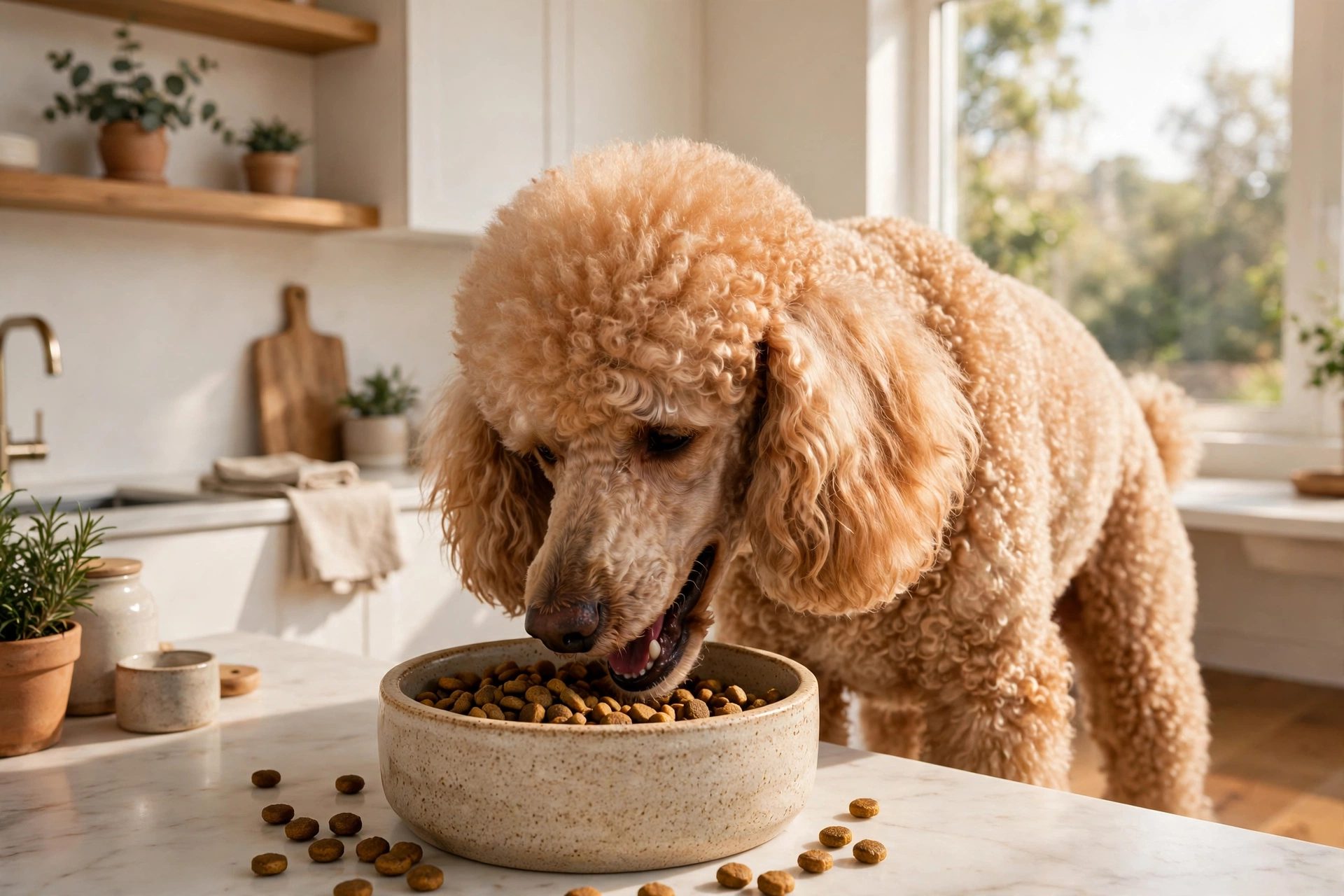
Best Food for Poodle Sensitive Stomach: Salmon-based Picks for Standard Poodle bloat safety
If your Poodle deals with loose stools, gassiness, or a tummy that seems upset after meals, you are not alone. Poodles come in three sizes, Toy at 4 to 6 lb, Miniature at 10 to 15 lb, and Standard at 40 to 70 lb, and the feeding that suits one can be wrong for another. For a Standard Poodle, the real breed issue is bloat, a stomach-twisting emergency, not a sensitive stomach as such. This guide sticks to what is verified: salmon-based gentle foods, the feeding amounts for each variety, and bloat-safe habits. Our wider guide to the best dog food for sensitive stomachs covers the general method behind these picks.
This guide is for information only. Check with your vet for your dog’s specific needs. Nothing here replaces professional veterinary advice.
In This Guide
- Key Takeaways
- Our Top Picks at a Glance
- How Much to Feed a Poodle by Variety
- Why Poodles Get Sensitive Stomachs
- Standard Poodles and Bloat (GDV)
- Toy and Miniature Poodles and Pancreatitis
- Purina Pro Plan Sensitive Skin and Stomach, Salmon and Rice: Best Overall
- Hill’s Science Diet Sensitive Stomach & Skin, Adult: Best for Daily Digestion
- Canidae PURE Limited Ingredient, Salmon & Sweet Potato: Best Limited Ingredient
- Blue Buffalo Basics Limited Ingredient, Turkey & Potato: Best Chicken-Free
- Wellness Simple Limited Ingredient, Lamb & Oatmeal: Best for Picky Sensitive Poodles
- Royal Canin Poodle Adult Dry: Best Breed-Specific
- Buying Guide: Salmon-First Food and Bloat-Safe Feeding for Poodles
- What to Avoid
- How to Switch Foods Without Upsetting Your Poodle’s Stomach
- Meal Timing Tips for a Sensitive-Stomach Poodle
- Stomach Flare-Up First Aid
- Pros and Cons
- Conclusion: Our Recommendation
- When Sensitive Food Is Not Enough: The Elimination Diet Trial
- Frequently Asked Questions
Key Takeaways
- Poodles are not on any verified list of breeds prone to sensitive stomachs. What is verified is different: Standard Poodles carry a real bloat risk, and Poodles show an increased prevalence of pancreatitis. Soft stools, gas, and gurgling after meals are still the usual signs owners notice.
- The best food for a Poodle with a sensitive stomach uses one easily digestible protein, salmon is a strong first choice, with soft fiber like oatmeal or rice and moderate fat.
- Limited-ingredient and probiotic or prebiotic formulas tend to calm sensitive digestion better than recipes with a long list of ingredients.
- Chicken, beef, and dairy are the most common food allergens in dogs generally, so a chronic case is worth trialling on a chicken-free recipe before blaming the breed.
- Keep any food change gradual: mix old and new over 7 to 10 days, and Toy/Miniature Poodles do better with small, frequent meals.
Our Top Picks at a Glance
| Product | Kcal/cup | Price | Price/lb | Daily feeding (55 lb adult) | Cost/month | Best for |
|---|---|---|---|---|---|---|
| Purina Pro Plan Sensitive Skin & Stomach, Salmon & Rice | 449 | $77.48 / 30 lb | $2.58 | 2.5 to 3.25 cups/day | ~$49 to $64/mo | Best overall |
| Hill’s Science Diet Adult Sensitive Stomach & Skin, Chicken & Barley | 391 | $89.99 / 30 lb | $3.00 | 3.17 cups/day | ~$66/mo | Best for daily digestion |
| Canidae PURE Limited Ingredient, Salmon & Sweet Potato | 484 | $74.79 / 22 lb | $3.40 | 2.25 to 3 cups/day | ~$69 to $92/mo | Best limited ingredient |
| Blue Buffalo Basics Limited Ingredient Diet, Turkey & Potato, Grain-Free | 352 | $69.58 / 24 lb | $2.90 | 2.75 to 3.75 cups/day | ~$53 to $72/mo | Best chicken-free |
| Wellness Simple Limited Ingredient Diet, Lamb & Oatmeal | 406 | $88.98 / 26 lb | $3.42 | 2.5 to 3.33 cups/day | ~$67 to $89/mo | Best for picky sensitive Poodles |
| Royal Canin Poodle Adult | 352 | $61.99 / 10 lb | $6.20 | No label amount for a 55 lb dog | Cannot compute | Best breed-specific |
Prices checked on Chewy on November 13, 2026. Amounts are for a 55 lb adult dog. Kcal/cup and feeding amounts come from the brands’ own labels: Purina Pro Plan (purina.com label, 51 to 75 lb band), Hill’s (hillspet.com, 3.17 cups a day interpolated between the 50 and 60 lb rows), Canidae (canidae.com, 50 to 75 lb band), Blue Buffalo (grain-free label via directionsforme.org product 273057, 41 to 60 lb band), Wellness (shared Wellness Simple chart via petcarerx.com, 46 to 65 lb band), Royal Canin (royalcanin.com/us; Chewy Q&A confirms 352 kcal/cup, 3,873 kcal/kg). Royal Canin Poodle Adult is made for Toy and Miniature Poodles only, and its feeding chart tops out at 26 lb, so no feeding amount or monthly cost exists for a 55 lb Standard Poodle.
How Much to Feed a Poodle by Variety
| Variety | Weight | Cups/day | Calories/day |
|---|---|---|---|
| Toy | 4 to 6 lb | 5/8 cup | 220 kcal |
| Miniature | 10 to 15 lb | 7/8 to 1 1/8 cups | 308 to 396 kcal |
| Standard | 40 to 70 lb | 2.5 to 3.25 cups | 1,123 to 1,459 kcal |
Toy and Miniature amounts use the Royal Canin Poodle Adult label (352 kcal/cup; the closest published row for a Toy is the 6.6 lb row at 5/8 cup, and the Miniature amounts use the 8.8 and 13.2 lb rows). Standard amounts use the Purina Pro Plan Sensitive Skin and Stomach label (449 kcal/cup, 51 to 75 lb band). The other five picks are labelled for dogs of 41 lb and up, so a Toy or Miniature Poodle should eat a small-breed recipe. Amounts are for medium activity; adjust by body condition. For a fuller feeding schedule, see our Poodle Feeding Guide.
Why Poodles Get Sensitive Stomachs
No major veterinary source lists Poodles as prone to sensitive stomachs, so this guide does not treat the breed as fragile. What the sources do say is more specific. Standard Poodles carry a real risk of bloat (gastric dilatation volvulus, or GDV), where the stomach fills with gas and can twist, and Poodles show an increased prevalence of pancreatitis. Those two facts shape the feeding advice on this page more than any idea of a sensitive stomach.
Poodles come in three sizes, and size changes the feeding. A Toy Poodle weighs 4 to 6 lb, a Miniature 10 to 15 lb, and a Standard 40 to 70 lb. A Standard eats several times what a Toy eats, and the label feeding amounts on this page use a 55 lb adult Standard as the basis. If your Poodle is a Toy or a Miniature, use the amounts in the variety table above, not the Standard amounts.
If the issue is skin, not stomach, the food may still be the same, but the reasoning is different. See our guide to the best food for Poodle skin allergies for that angle.
A sensitive stomach usually shows up as intermittent soft stools, gas, gurgling, or eating slowly and walking away from the bowl. If your Poodle has watery diarrhea for more than 24 hours, bloody stool, repeated vomiting, or refuses to eat, that is no longer a sensitive stomach. See your vet.
Standard Poodles and Bloat (GDV)
Bloat is the one feeding emergency every Standard Poodle owner should know. The stomach fills with gas and can twist on itself, cutting off blood flow. It comes on fast, and it needs a vet at once. Feed 2 to 3 smaller meals a day instead of one big one, and keep your Poodle calm for an hour either side of meals: no running, jumping, or rough play right before or after eating. A raised feeder and a slow-feeder bowl can help a dog that gulps. Watch for a swollen or tight belly, retching without bringing anything up, restlessness, pacing, drooling, or pale gums. If you see that combination, treat it as an emergency and get to a vet or an emergency clinic straight away.
Toy and Miniature Poodles and Pancreatitis
Pancreatitis, inflammation of the pancreas, shows up more often in Poodles than in the average dog, and it hits small Poodles too. Rich, fatty food and fatty treats are the usual triggers, so keep fat moderate and skip the rich extras: no fatty table scraps, no marrow bones, and no high-fat chews. If your Toy or Miniature Poodle vomits repeatedly and shows belly pain, hunched, a tender belly, or will not settle, call your vet promptly rather than waiting to see if it passes.
Purina Pro Plan Sensitive Skin and Stomach, Salmon and Rice: Best Overall
This is one of the most consistently recommended sensitive-stomach formulas in the US, and for good reason: it is built around salmon, not a generic fish meal, it is made in the USA and meets AAFCO nutrition standards for adult maintenance, and it contains live probiotics plus a prebiotic fiber blend that helps a sensitive gut. Oatmeal and barley provide digestible carbohydrates that keep the formula fairly gentle. At 449 kcal/cup, it works for all three Poodle varieties in their own amounts, and salmon suits a Poodle that turns its nose up at the usual chicken recipes. The omega-3 and omega-6 fatty acids also support a shiny coat, as they are naturally sourced from sunflower oil and fish oil. The recipe is also available as a small-breed formula for Toy and Miniature Poodles, and the standard 30-lb bag is $77.48 on Chewy, checked November 13, 2026.
What sets it apart for sensitive digestion is the addition of live probiotics, which support a balanced gut and help steady loose stools. For a Standard Poodle, it is also the easy pick for bloat-safe feeding: the feeding amount at 55 lb is 2.5 to 3.25 cups a day, which splits neatly into two or three smaller meals, and the moderate fat level is kinder than the rich, high-fat recipes that are harder to digest.
Keep in mind it does contain rice and barley (grains), but remember that true grain allergies are rare in dogs, so grains are not the enemy here. Watch out though: the adult bag uses kibble that is a bit big for puppies, and some dogs may need a slow-feeder bowl if they eat too fast. Also contains live probiotics that may not survive long-term storage; check the storage instructions.
Hill’s Science Diet Sensitive Stomach & Skin, Adult: Best for Daily Digestion
Hill’s builds this recipe around easy-to-digest ingredients and a prebiotic fiber blend designed to settle a sensitive stomach. It has been shown to improve stool quality in just 24 hours. The recipe’s chicken and barley base is very gentle, while omega-6 fatty acids and vitamin E help the skin and coat. Because it is a complete and balanced diet, you can use it as a daily food for your Poodle without having to mix and match. Flaxseed and vitamin E round out the diet.
The formula uses a moderate protein level with careful fat balance, which matters because overly rich food is the fastest way to loose stools. At 391 kcal/cup, the feeding amount at 55 lb is about 3.17 cups a day, which splits cleanly across two or three meals. This recipe also works well for a Standard Poodle that does better on chicken.
Canidae PURE Limited Ingredient, Salmon & Sweet Potato: Best Limited Ingredient
When a Poodle’s stomach is reacting and you cannot pin down the trigger, a limited-ingredient diet is the cleanest way to find out what is wrong. Canidae’s PURE range is built with just 10 key ingredients. Its salmon and sweet potato recipe offers lean protein plus probiotics and antioxidants. The limited number of ingredients makes it easier to work out what your dog reacts to, while the guaranteed probiotic content supports a healthy gut. At 484 kcal/cup, a 55 lb Standard Poodle needs only 2.25 to 3 cups a day, so the 22-lb bag goes further than you might expect, even at $74.79 on Chewy, checked November 13, 2026.
Fewer ingredients means fewer suspects. Canidae PURE is also manufactured in the USA and contains no corn, wheat, soy, or artificial flavours. What to watch: salmon as the sole protein might bore a picky eater over time, and the price per pound is a little higher than mainstream ranges.
Blue Buffalo Basics Limited Ingredient, Turkey & Potato: Best Chicken-Free
If you suspect chicken is your Poodle’s problem, and it is the likeliest single suspect when a food sensitivity is at play, this is the recipe to try. Blue Buffalo Basics is a limited-ingredient option with a turkey and potato recipe designed for sensitive stomachs. It uses only one animal protein, turkey, and avoids chicken, beef, corn, wheat, soy, dairy, and eggs. That narrow recipe makes it easier to pin down a trigger. The formula also includes pumpkin, which is naturally high in fiber and can help settle loose stools. At 352 kcal/cup, a 55 lb Standard Poodle needs 2.75 to 3.75 cups a day.
The inclusion of pumpkin as a fiber source is a nice touch: pumpkin is one of the gentlest digestible fibers and helps firm stools. Use the grain-free Turkey & Potato recipe for this pick: it is the one with 352 kcal/cup in the table above, and it is a good choice for Poodles with grain sensitivities. What to watch: the kibble is a little big for Toy Poodles, and some dogs may prefer a meatier taste once they get used to the recipe.
Wellness Simple Limited Ingredient, Lamb & Oatmeal: Best for Picky Sensitive Poodles
Some sensitive-stomach Poodles are also famously picky, which narrows the options fast. Wellness Simple is a straightforward limited-ingredient diet with lamb as the main protein source. It contains no gluten, wheat, corn, soy, dairy, eggs, chicken, beef, or artificial preservatives. The formula includes a single protein source plus easily digestible carbohydrates, along with flaxseed and vitamins. The probiotics and prebiotics in the recipe help to keep the gut healthy. At 406 kcal/cup, a 55 lb Standard Poodle needs 2.5 to 3.33 cups a day, and the 26-lb bag is $88.98 on Chewy, checked November 13, 2026.
The formula includes omega-3 and omega-6 fatty acids to support skin and coat, which matters for a breed whose coat shows every change. What to watch: Wellness is a little pricey relative to its weight, and the lamb flavor might not be a hit with every dog. It also contains oatmeal, which is naturally high in fiber and can help the gut.
Royal Canin Poodle Adult Dry: Best Breed-Specific
Royal Canin is one of the few brands with a recipe designed specifically for Poodles, and it accounts for the breed’s coat, jaw, and digestion. Its tailored kibble shape helps a Poodle grip and chew the food. It includes EPA and DHA (omega-3 fatty acids) for a healthy coat, plus a targeted antioxidant mix to support a healthy ageing process. Since this recipe is made for Poodles, it is worth considering if your dog has chronic stomach issues. One thing to note: this recipe contains chicken by-product meal, so it is not ideal if your Poodle has a chicken sensitivity.
It is not the cheapest option, and it is not grain-free (rice and corn feature in the ingredient list). The honest limit with this pick is size. Royal Canin Poodle Adult is made for Toy and Miniature Poodles only, and its feeding chart tops out at 26 lb, so there is no label feeding amount and no monthly cost to give for a 55 lb Standard Poodle. If you have a Standard, pick one of the five foods above. At 352 kcal/cup, Chewy’s product Q&A confirms the same figure, and the 10-lb bag is $61.99 on Chewy, checked November 13, 2026.
Buying Guide: Salmon-First Food and Bloat-Safe Feeding for Poodles
One clear, digestible protein
Salmon, turkey, duck, lamb, and venison are all gentler starting points than chicken or beef for a Poodle with a sensitive stomach. Start with a single, named animal protein, ideally paired with a single easily digestible carbohydrate like oatmeal or rice. Limited-ingredient recipes reduce cross-reactions and help identify the trigger faster.
Moderate fat, not ultra-rich
Fat slows stomach emptying, and high-fat foods are a common trigger for loose stools and vomiting in sensitive dogs. Very high-fat foods (many performance or raw-style recipes): rich food and sensitive stomachs do not mix. Stick to moderate fat levels. Very high-fat foods have been linked to pancreatitis, a painful inflammation of the pancreas. Look for a fat content within the 10% to 16% range.
Gentle fiber sources
Oatmeal, rice, beet pulp, sweet potato, and pumpkin are the fiber sources that tend to firm stools without upsetting the gut. Soluble fiber like oatmeal, psyllium, and beet pulp can firm up loose stools. Insoluble fiber like poorly digested grains can go the other way. Look for oat bran or barley for their soluble-fiber benefits, while avoiding formulas that rely on low-quality fiber like cellulose and corn bran.
Probiotics and prebiotics
Live probiotics (as in Purina Pro Plan’s sensitive formula) or prebiotic fibers help stabilize the gut after a change. However, probiotic manufacturing processes may not always guarantee that the bacteria are still alive when the food reaches your dog. Look for products that state their guaranteed probiotic strains (like Purina Pro Plan’s live probiotic), and beware formulas that do not list specific strains or guaranteed potency.
AAFCO complete-and-balanced statement
Every pick above carries an AAFCO nutritional adequacy statement for its life stage. This is your baseline guarantee that the food meets minimum nutrient profiles, so it is worth checking every time.
Kibble size for your Poodle variety
Toy Poodles (4 to 6 lb) and Miniatures (10 to 15 lb) have small mouths, and a kibble made for a Standard can be too big for a Toy to chew comfortably. Check the kibble size for your variety, and use small, frequent meals for the smaller Poodles. Standard Poodles, however, can manage most kibble sizes fine.
What to Avoid
- Chicken and beef as the main protein if symptoms are chronic: the two most common food allergens in dogs generally, and the first ones to trial out of the diet when the issues keep coming back.
- Dairy ingredients (whey, milk powder): a frequent source of gas and loose stools, and one of the most common food allergens in dogs generally.
- Sudden food switches: the number-one cause of avoidable digestive disasters. Always transition gradually over 7 to 10 days.
- Very high-fat foods (many performance or raw-style recipes): rich food and sensitive stomachs do not mix.
- Cheap fillers: corn gluten meal, soybean meal, and unnamed “meat and bone meal” add little digestible nutrients.
- Artificial colors and flavors: unnecessary additives with no nutritional value.
- Grain-free unless your vet confirms a grain allergy, as grains are rarely the problem: true grain allergy is uncommon, and rice and oatmeal are gentle fibers for most Poodles.
If your Poodle is a Standard, the feeding habits matter as much as the food: smaller meals and no exercise right around mealtimes are the bloat-safety basics. Other small and sensitive breeds have their own versions of this problem, so if you also share your home with one, see our guides to the best food for a Miniature Schnauzer with a sensitive stomach and the best food for a Yorkshire Terrier with a sensitive stomach.
How to Switch Foods Without Upsetting Your Poodle’s Stomach
Even the gentlest new food can cause trouble if swapped in overnight. Mix a little more of the new food in each day over 7 to 10 days: 25% new on days 1 to 2, 50% on days 3 to 4, 75% on days 5 to 6, then 100%. For Toy and Miniature Poodles, or dogs with a long history of upset, stretch this to 10 to 14 days. If stools loosen, pause at the current ratio for a couple of days. The full day-by-day method is in our guide to the best dog food for sensitive stomachs.
Meal Timing Tips for a Sensitive-Stomach Poodle
What you feed matters, but how you feed matters almost as much for a sensitive digestion. Feed two to three smaller meals daily rather than one large one, and keep the times regular. If you switch to once-a-day feeding, watch out for signs of digestive upset such as gas, bloating, or loose stool.
Feed well away from vigorous exercise, not right before or after it. For deep-chested breeds like the Standard Poodle, feeding close to exercise also raises the bloat risk, so keep an hour either side of meals calm.
Stomach Flare-Up First Aid
When a flare-up hits, keep it simple. Fast your Poodle for 8 to 10 hours with water available, then offer small bland meals: plain canned pumpkin, plain white rice, and boiled chicken, in small amounts, before moving back to the usual food. Skip rich food, treats, and table scraps until stools firm up, then return to the usual food slowly over a day or two. See your vet first, not after, if the vomiting or diarrhea is severe, if there is blood, or if your Poodle refuses food or water.
Pros and Cons
Feeding a sensitive-stomach Poodle well is a trade between a short ingredient list and the patience to test it.
Pros
- One gentle protein with moderate fat and soft fiber calms most mild stomach upsets.
- Limited ingredient recipes make it easy to spot which food is the problem.
- Live probiotics and prebiotic fiber help steady the gut after a food change.
- Small, frequent meals suit Toy and Miniature Poodles with tiny stomachs.
Cons
- Chicken, beef, and dairy hide in many treats and chews, so label checks never stop.
- Grain free food costs more and rarely helps, since true grain allergy is uncommon in Poodles.
- A food that suits a Standard Poodle may come in kibble too big for a Toy Poodle.
- Chronic cases may need a vet led food trial or prescription diet, which takes weeks.
Conclusion: Our Recommendation
For most Poodles with sensitive stomachs, Purina Pro Plan Sensitive Skin and Stomach, Salmon & Rice is the best place to start: salmon instead of chicken, gentle oatmeal, and live probiotics in a formula with a deep track record. If you need a cleaner reset, go with Canidae Pure Limited Ingredient, Salmon & Sweet Potato to cut the ingredient list down to the essentials. And if you want a food built specifically for the breed, Royal Canin Poodle Adult is worth the premium.
Whichever you choose, transition slowly, feed measured portions at consistent times, and give the new diet at least two weeks before judging it. Poodles reward patience, and the payoff is a happier tummy and a shinier coat.
Looking for broader nutrition guidance for your Poodle? See our best dog food for Poodles roundup, the complete Poodle feeding guide, and our tips on Poodle puppy food.
When Sensitive Food Is Not Enough: The Elimination Diet Trial
Some Poodles keep having loose stools even on a gentle limited ingredient food. That does not mean the food failed: it means the trigger has not been found yet. So the next step is a food trial run with your vet. Your vet then picks one food your dog has never had, often venison, rabbit, duck, or fish, or a prescription hydrolyzed diet where the protein is broken into pieces too small for the immune system to spot. Your Poodle eats only that food for 8 to 12 weeks, with no treats, table scraps, or flavored chews, while you keep a daily note of stools, gas, and itching. If a gentle over-the-counter food has not helped after 2 to 3 weeks, ask your vet about a prescription step: Royal Canin Hydrolyzed Protein and Hill’s Prescription Diet i/d Low Fat are the usual vet-only options, and the choice between them is one for your vet, not the shelf. Do not run a trial on your own if your Poodle is losing weight, vomiting often, or passing blood. Persistent mild symptoms that do not improve after 2 to 3 weeks on a new diet also deserve a vet visit.
Frequently Asked Questions
What is the best food for a Poodle with a sensitive stomach?
A salmon, turkey, or duck-based formula with gentle fiber like oatmeal or rice, moderate fat, and added probiotics or prebiotic fiber. Limited-ingredient recipes work well when the exact trigger is unknown. Avoid chicken and beef as the main protein if your Poodle has chronic issues, since these are the most common food allergens in dogs generally.
Are Poodles prone to sensitive stomachs?
Not as a breed trait. No major veterinary source lists Poodles as prone to sensitive stomachs. What is verified is different: Standard Poodles carry a real bloat (GDV) risk, and Poodles show an increased prevalence of pancreatitis. Soft stools, gas, and gurgling after meals are still the usual signs owners notice, so the feeding advice is the same: one easy-to-digest protein, moderate fat, soft fiber, and a slow switch. If symptoms keep coming back, ask your vet rather than assuming the breed is the cause.
What foods are Poodles most allergic to?
Chicken, beef, and dairy are the most common food allergens in dogs generally, and wheat and egg are less common causes. If your Poodle has chronic digestive or skin issues, a limited-ingredient diet built on a novel protein like salmon, duck, lamb, or venison is the usual first step.
Is grain-free food good for Poodles with sensitive stomachs?
Usually not necessary. True grain allergies are much rarer than protein sensitivities, and grains like rice and oatmeal provide gentle, useful fiber. Only go grain-free if your vet confirms a grain allergy, since the FDA is still investigating a possible link between some grain-free diets and heart disease (DCM) in dogs.
Should I avoid chicken in my Poodle’s food?
If your Poodle has chronic stomach issues, yes. Chicken is the most common food allergen in dogs generally, so a chicken-free recipe based on salmon, turkey, or lamb often makes a noticeable difference. For a one-off mild upset, chicken is not the automatic culprit, so test before assuming.
How do I switch my Poodle to a new food without upsetting its stomach?
Transition over 7 to 10 days: 25% new food on days 1 to 2, 50% on days 3 to 4, 75% on days 5 to 6, then 100%. For Toy or Miniature Poodles, stretch it to 10 to 14 days. If stools loosen, pause at the current ratio for a couple of days. Plain canned pumpkin (not pie filling) can help during the switch.




2 Comments