
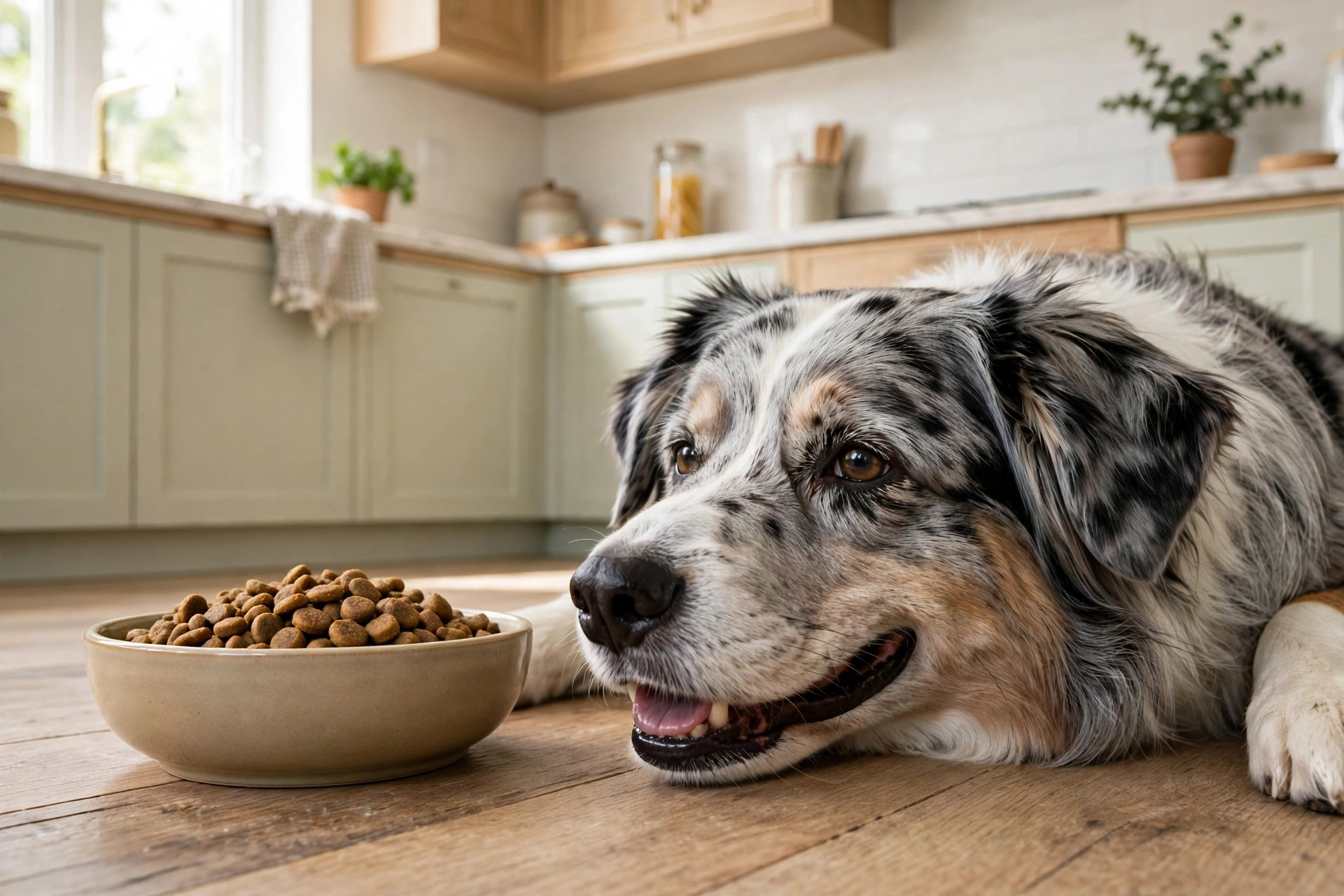
Best Senior Food for Australian Shepherds: Joint, Brain & Weight Care for 7+ Aussies (6 Picks 2026)
Your Australian Shepherd may be slowing down a little, but that bright, busy mind is still very much there. The best senior Australian Shepherd food supports that second act: enough quality protein to hold on to muscle, fewer calories than an adult working-dog formula, and targeted help for joints, digestion, and brain health. The tricky part is that “senior” on a bag does not mean the same thing from brand to brand. Some formulas simply cut calories, while others genuinely rethink the recipe for an aging dog.
This guide compares six senior foods that work well for aging Aussies. We compared the six senior formulas below on label values, joint support and how easy they are to portion for a 40 to 65 lb Aussie. You will learn what changes in a senior Aussie’s nutritional needs, how much to feed a less active older dog, and how to switch foods without upsetting a sensitive stomach. If you are still feeding an adult formula, our Australian Shepherd feeding guide covers portion sizes by life stage, and our guide to food for Australian Shepherds with sensitive stomachs is worth reading if your older dog’s digestion has become fussier. Whether your dog is a still-sprightly seven-year-old or a grey-muzzled twelve-year-old who prefers the sofa to the sheep pen, there is a pick here to match.
Key Takeaways
- Most Aussies count as seniors from around age 7. The right time to switch still depends on your dog’s weight, activity and mobility, not the birthday alone.
- For a 40 to 65 lb Aussie, look for named animal protein first, moderate fat, added glucosamine and chondroitin for joints, omega-3 fatty acids for coat and brain health, and fiber for steady digestion.
- Senior Aussies usually need fewer calories than they did as adults, so portion control matters more than ever. Measure meals instead of free-feeding, because an older Aussie that has retired from herding work gains weight quietly.
- Our top pick is Purina Pro Plan Adult 7+ Bright Mind Chicken & Rice, which covers joints, brain and immunity in one bag at a sensible price.
- Switch foods gradually over 7 to 10 days, and soften kibble with warm water if your older Aussie has sore teeth or a weaker jaw.
Our Top Picks at a Glance
| Product | kcal/cup | Protein | Fat | Price (bag, store, checked) | Cost / month |
|---|---|---|---|---|---|
| Purina Pro Plan Bright Mind Adult 7+ Chicken & Rice, dry | 423 | 29% | 14% | $86.98 / 30 lb, Chewy, 2026-11-15 | Cannot compute |
| Hill’s Science Diet Adult 7+ Chicken Meal, Barley & Brown Rice, dry | 352 | 15.5% | 10.5% | $86.99 / 33 lb, Chewy, 2026-11-15 | Cannot compute |
| ORIJEN Senior, dry | 427 | 38% | 15% | $106.99 / 23.5 lb, Chewy, 2026-11-15 | Cannot compute |
| Blue Buffalo Life Protection Formula Senior Chicken & Brown Rice, dry | 343 | 18% | 10% | $79.97 / 34 lb, Chewy, 2026-11-15 | Cannot compute |
| Nulo Freestyle Senior Grain-Free Trout & Sweet Potato, dry | 396 | 30% | 12% | $89.99 / 26 lb, Chewy, 2026-11-15 | Cannot compute |
| Diamond Naturals Senior Chicken, Egg & Oatmeal, dry | 347 | 25% | 11% | $33.99 / 18 lb, Chewy, 2026-11-15 | Cannot compute |
Prices are Chewy buy-once prices checked on November 15, 2026. Cost per month is listed as Cannot compute because cup weights are not published for these foods, so the number of cups in a bag cannot be worked out without guessing.
Purina Pro Plan Adult 7+ Bright Mind Chicken & Rice
If you want one bag that covers the main senior concerns in a single recipe, this is the strongest all-rounder for an aging Aussie. Real chicken leads the ingredient list, and the formula is built around the three things owners of older herding dogs worry about most: stiff joints, a slowing mind, and a waistline that creeps up as activity drops.
The recipe includes glucosamine and EPA, an omega-3 fatty acid, to support joint health and mobility, along with antioxidants for immune support and a blend of arginine, B vitamins, and DHA aimed at cognitive function. In plain terms, it is designed to help an older dog stay sharp and mobile rather than simply cutting calories and calling it a senior food. It is also widely available in the US and priced well below the premium brands on this list, which matters when you are feeding a medium-sized dog every day.
Who it is for: senior Aussies aged 7 and up who are still fairly active, owners who want joint and brain support without a premium price tag, and dogs who do well on chicken-based kibble. One honest drawback: the kibble is fairly firm, so if your dog has dental problems, soak it in warm water for a few minutes before serving.
Hill’s Science Diet Adult 7+ Chicken Meal, Barley & Brown Rice
Hill’s senior recipe takes a gentler, gut-friendly approach. Chicken meal is the first ingredient, supported by barley and brown rice for steady, digestible energy, and the formula includes prebiotic fiber to support a healthy gut microbiome. Naturally occurring glucosamine and chondroitin support joint health, which matters more with every year of running, jumping and herding behind a dog.
This is a good choice if your senior Aussie has a somewhat sensitive stomach or has started producing looser stools on richer foods. The moderate calorie level helps with weight control without feeling like a diet food, and the balanced vitamin and mineral profile supports organ health as dogs age. Based on ingredient analysis and owner reviews, dogs tend to accept the taste readily, and the kibble size suits a medium breed well.
Who it is for: older Aussies with sensitive digestion, dogs showing early stiffness, and owners who prefer a science-led, widely recommended brand. The main trade-off is that it is not the highest-protein food on this list, so very lean, still-muscular seniors may do better with a meat-richer option like ORIJEN Senior.
ORIJEN Senior
ORIJEN Senior is the pick for owners who believe senior dogs still need plenty of animal protein. The recipe is built around 85% animal ingredients, with chicken, turkey, and fish providing a varied amino acid profile, and it is designed to mirror a biologically appropriate, meat-rich diet. Protein helps an older dog hold on to lean muscle, which matters even more once daily mileage drops.
The formula also includes freeze-dried liver coating, which tends to win over picky older dogs whose appetites have faded. At 38% protein and 427 calories a cup, it is the richest food on this page, so a retired Aussie that mostly naps can put on weight fast if you scoop it like a lighter kibble. Portions run smaller than with most senior foods, so follow the feeding guide and weigh your dog regularly rather than eyeballing the bowl. This is the most expensive food on this list, and some owners report a fishy smell, but for a healthy senior who thrives on a rich, protein-forward diet, it is hard to beat.
Who it is for: lean, active seniors; dogs who have lost muscle tone on lower-protein foods; and picky eaters who need extra aroma and flavor to stay interested in meals. It is less suited to overweight seniors, since its calorie density rewards careful measuring.
Blue Buffalo Life Protection Formula Senior Chicken & Brown Rice
Blue Buffalo’s senior recipe is a solid, middle-of-the-road choice that does most things well. Deboned chicken is the first ingredient, followed by wholesome whole grains including brown rice, barley, and oatmeal. Glucosamine and chondroitin support joint health and mobility, and the brand’s LifeSource Bits add a cold-formed blend of antioxidants, vitamins, and minerals chosen to support immune health in older dogs.
At around 343 calories per cup, it is easy to portion for a less active senior, and the formula contains no corn, wheat, or soy and no poultry by-product meals. That makes it a reassuring everyday pick for owners who want a recognizable brand, a straightforward ingredient list, and a price that sits between budget and premium.
Who it is for: senior Aussies without special dietary needs, first-time senior-food buyers, and multi-dog households that want one senior bag for dogs of different sizes. Owners of dogs with confirmed grain sensitivities should look at the Nulo pick below instead.
Nulo Freestyle Senior Grain-Free Trout & Sweet Potato
Some senior Aussies do better without grains, whether because of a sensitivity or simply because their digestion has become fussier with age. Nulo’s Freestyle Senior recipe leads with trout, a lean fish protein that is easy on the stomach and rich in omega fatty acids for coat and skin health, paired with sweet potato for gentle, digestible carbohydrates.
The formula also includes L-carnitine, which supports fat metabolism in less active older dogs, and a blend of probiotics for digestive health. Fish-based foods can be a great reset for a senior who has eaten chicken-based kibble for a decade and started turning away from it. The honest downsides are the higher price and the fish aroma, which not every household loves.
Who it is for: seniors with grain sensitivities or chicken intolerance, dogs with dull coats or dry skin, and owners who want a grain-free senior recipe from an established US brand. If your dog has never shown a grain problem, there is no need to go grain-free on principle. A grain-inclusive senior food is fine.
Diamond Naturals Senior
Diamond Naturals Senior is the budget pick that still takes senior feeding and diet seriously. It is formulated for older dogs with controlled calories, added glucosamine and chondroitin for joints, and a probiotic blend to support digestion. Chicken-based protein keeps the recipe affordable without resorting to vague meat meals as the main protein source.
For owners feeding a larger senior Aussie, the lower price per bag adds up fast over a month, and the formula’s moderate fat level suits dogs that have retired from farm work to family life. On the label it runs 347 calories a cup with 25% protein and 11% fat, plus 650 mg/kg of glucosamine and 240 mg/kg of chondroitin, and at $33.99 for an 18 lb bag on Chewy it is the cheapest bag on this page by a clear margin. It is not as feature-rich as the Pro Plan or Hill’s recipes, and there is no dedicated cognitive-support blend, but as a dependable, wallet-friendly senior kibble, it earns its place.
Who it is for: budget-conscious owners, multi-dog households, and seniors who need a straightforward calorie-controlled food. If your Aussie is showing clear cognitive or mobility changes, one of the more targeted formulas above may serve them better.
One more name you may come across is CANIDAE Pure Farm to Bowl Senior. At 409 calories a cup with 28% protein, 400 mg/kg of glucosamine and 700 mg/kg of chondroitin, it is a solid grain-free senior, and at $70.36 for a 22 lb bag on Chewy it costs about $3.20 a pound, between Blue Buffalo and Nulo. It did not make the six because it has no clear edge for a 40 to 65 lb Aussie. It is richer than the weight-control picks and less targeted on brain health than Bright Mind, so it duplicates strengths the six already cover.
Buying Guide: What to Look for in Senior Australian Shepherd Food
Protein: enough, from named sources
Older dogs do not need less protein. In fact, many vets and nutritionists argue they need enough high-quality protein to defend against muscle loss. Look for a named animal protein (chicken, lamb, trout, turkey) as the first ingredient, and be wary of foods where the protein comes mostly from plant sources. Higher-protein recipes suit lean, active seniors, while moderate protein suits dogs prone to weight gain.
Calories and fat: lower than adult food, but not starvation rations
A retired Aussie who walks rather than herds burns far fewer calories than they did at three. Senior foods usually trim fat and calories, which helps prevent the slow weight gain that worsens joint problems. But do not over-restrict: an underweight senior loses muscle faster. Watch the ribs and waistline, weigh your dog monthly, and adjust portions by small amounts rather than making dramatic cuts.
Joint support: glucosamine, chondroitin, and omega-3s
Any dog that has spent years running, jumping and herding will have joints that have done a lot of work, so check the label for the actual numbers. Blue Buffalo Life Protection Formula Senior lists 400 mg/kg of glucosamine and 300 mg/kg of chondroitin, Diamond Naturals Senior lists 650 mg/kg of glucosamine and 240 mg/kg of chondroitin, and Nulo Freestyle Senior lists 350 mg/kg of each. These nutrients will not reverse arthritis, but they are a sensible part of a senior feeding plan alongside weight control and appropriate exercise. Our best senior dog food guide explains joint support for seniors in full.
Fiber and digestibility
Slower digestion and a more sensitive gut are common in older dogs. Moderate fiber from sources like beet pulp, pumpkin, or chicory root supports regular stools, while prebiotics and probiotics help maintain a healthy gut. If your senior’s stools have become unpredictable, a highly digestible formula with a short, familiar ingredient list is usually a better first step than a dramatic diet overhaul.
Brain and immune support
Some senior formulas add antioxidants (vitamins E and C, blueberries, spinach), DHA, and B vitamins aimed at cognitive health. While no kibble can promise a sharper mind, these nutrients are a reasonable part of senior feeding and diet, and they are one of the real differences between a dedicated senior formula and an adult food with a senior label.
AAFCO statement
Check the bag for an AAFCO statement confirming the food is complete and balanced for adult maintenance, or for the life stage it claims. Every food on this list meets AAFCO nutrient profiles. If a bag lacks that statement, skip it, no matter how appealing the marketing sounds.
Fresh food is another route if kibble stops working for your dog. Brands such as Ollie and The Farmer’s Dog cook meals to order, but they cost far more per month than any kibble on this page. We cover them in our best senior dog food guide rather than adding a fresh pick here.
What to Avoid
- Adult performance formulas for a retired dog. High-fat, high-calorie working-dog foods are designed for dogs burning serious energy. Fed to a sofa-based senior, they lead straight to weight gain.
- Generic “meat meal” or unnamed animal fat as the first ingredients. For a 40 to 65 lb Aussie you portion by the cup, so you need to know what is actually in that cup. Named proteins tell you; vague terms hide it.
- Switching on age alone. A fit, muscular eight-year-old who still hikes daily may do better staying on adult food a little longer. Let body condition and your vet guide the timing.
- Grain-free by default. Grain-free is useful for Aussies with a genuine sensitivity, but it is not automatically healthier, and the FDA has previously flagged a potential link between certain grain-free diets and heart disease in dogs. If your Aussie needs grain-free, our Nulo pick covers it. Choose it for a reason, not a trend.
- Sudden food changes. A hard switch is the fastest way to a week of loose stools, and a loose-stooled Aussie is easy to underfeed or overfeed while you guess at portions. Transition over 7 to 10 days, mixing increasing amounts of the new food into the old.
- Ignoring dental health. If your Aussie drops kibble, eats slowly, or chews on one side, sore teeth may be the issue. Soften kibble with warm water, and get the mouth checked rather than blaming the food.
For a smaller, food-motivated senior, our best senior Beagle food guide covers the same weight-control problem in a 20 to 30 lb dog.
How Much to Feed a Senior Australian Shepherd
For a senior Australian Shepherd, which runs 40 to 65 lb as an adult, most dogs settle at around two to three cups of dry food per day, split into two meals. The honest answer is that it depends on weight, body condition, and activity. A 45-pound senior who still walks several miles a day needs more than a 60-pound senior who mostly naps. Start with the feeding guide on the bag, then adjust: if you cannot easily feel the ribs under a thin layer of fat, trim the portion by about 10 percent and recheck in two weeks. If the spine and hip bones are prominent, add a little. Cups also depend on the food itself. ORIJEN Senior feeds a 40 to 60 lb dog 1 2/3 to 2 1/8 cups a day on its own label, because at 427 calories a cup it is far denser than a 343 calorie food such as Blue Buffalo.
Two smaller meals a day suit older dogs better than one large meal, and a consistent routine helps with digestion and house-training. Keep treats to under 10 percent of daily calories, and count them. Training treats, dental chews, and table scraps add up fast in a dog that no longer burns them off. Weigh your Aussie at least monthly, and bring a weight trend, not just a single number, to vet visits. For a broader comparison of senior formulas across breeds, see our best senior dog food guide.
Feeding a 7+ Aussie vs an 11+ Aussie: What Changes
We count 7 as the senior starting point for an Aussie. The breed is medium-large, and by 7 most Aussies have slowed enough that a senior recipe earns its place, even if the dog still works stock on weekends. Some guides put senior onset at 9, which fits a dog that is still herding daily, but the average Aussie is no longer burning working-dog calories by 7, and that is when weight creeps up. So 7 is our line, not a rule from a registry. If your 7-year-old still runs all day, the adult food can stay a while longer.
From 7 to 10, the job is weight control, steady protein to hold muscle, and joint support. Keep portions measured and keep the dog moving. From 11 on, the picture changes. Appetite often fades, teeth wear down, and digestion slows, so softer food, smaller and more frequent meals, and watching for weight loss, not just weight gain, all matter more. The AKC puts the Aussie lifespan at 12 to 15 years, so an 11-year-old still has good years ahead, and the food should make eating easy rather than a chore.
The split above follows our best senior dog food guide, which covers the 7 to 10 and 11 and up stages in full. Large breeds reach senior status earlier, so if you also feed a giant breed, our best senior Bernese Mountain Dog food guide compares senior feeding at the other end of the size scale.
Switching to a Senior Food
Move slowly, even if your dog seems enthusiastic about the new bag. Give the switch 7 to 10 days, starting with mostly old food and working up to the new bag, and watch stools and energy at each step. If stools loosen, hold at that ratio for a few extra days before moving on. Dogs with sensitive stomachs may need a full two-week transition, and that is fine. Weigh the portions while you switch, because an older Aussie gains weight quietly once the herding work drops off, and a new food is no excuse for a heavier scoop. Add a spoonful of warm water to the bowl for seniors with dental discomfort, and keep fresh water available at all times, since older dogs can be less diligent drinkers.
Conclusion: Our Recommendation
For most senior Australian Shepherds, Purina Pro Plan Adult 7+ Bright Mind Chicken & Rice is the best starting point. It combines joint, cognitive, and immune support with a sensible calorie level and a price that does not punish you for feeding a medium-sized dog well. If your Aussie has a sensitive stomach or early stiffness, Hill’s Science Diet Adult 7+ is the gentler alternative, and if your dog is still lean and muscular, ORIJEN Senior’s protein-rich recipe is worth the premium.
Whichever food you choose, remember that the bag is only part of senior care. Measured portions, regular weighing, gentle daily exercise, and a vet check when weight, mobility, or appetite changes will do more for your old friend than any single formula. This guide covers general senior feeding for Aussies. Your vet knows your dog’s joints, weight and teeth, so check the shortlist with them before you switch.
Frequently Asked Questions
When should an Australian Shepherd switch to senior food?
Most Aussies count as seniors from around age 7, but timing should follow weight, activity, and mobility rather than age alone. A fit, active 8-year-old may stay on adult food a little longer, while a slowing 7-year-old may benefit from switching sooner. Ask your vet if you are unsure.
How much should I feed a senior Australian Shepherd?
Most senior Aussies eat around 2 to 3 cups of dry food per day split into two meals, for a dog in the 40 to 65 lb range. The right amount depends on weight and activity. Start with the bag’s feeding guide, check body condition monthly, and adjust by about 10 percent at a time.
What is the best food for a senior Aussie with joint problems?
Look for a senior formula with added glucosamine and chondroitin plus omega-3 fatty acids from fish oil, and keep your dog at a healthy weight, since extra weight worsens joint strain. On this page, Blue Buffalo lists 400 mg/kg of glucosamine and 300 mg/kg of chondroitin, and Diamond lists 650 mg/kg of glucosamine and 240 mg/kg of chondroitin. Purina Pro Plan Adult 7+ Bright Mind and Hill’s Science Diet Adult 7+ both include joint-support nutrients.
How do I switch my senior Aussie to a new food?
Give the switch 7 to 10 days, starting with mostly old food and working up to the new bag, and watch stools and energy at each step. If stools loosen, hold at that ratio for a few extra days before moving on. Weigh the portions while you switch, because an older Aussie gains weight quietly once the herding work drops off. If your senior Aussie has a sensitive stomach, extend the transition to two weeks.
Why is my senior Australian Shepherd gaining weight?
Older Aussies burn fewer calories as activity drops, so an adult or performance formula quickly overshoots their needs. Switch to a calorie-controlled senior food, measure meals instead of free-feeding, and keep treats under 10 percent of daily calories.
Can I soften kibble for a senior dog with bad teeth?
Yes. Soaking kibble in warm water for a few minutes makes it much easier to eat, and it is a good short-term fix. If your dog drops kibble or chews on one side, get their teeth checked rather than only blaming the food.




One Comment