
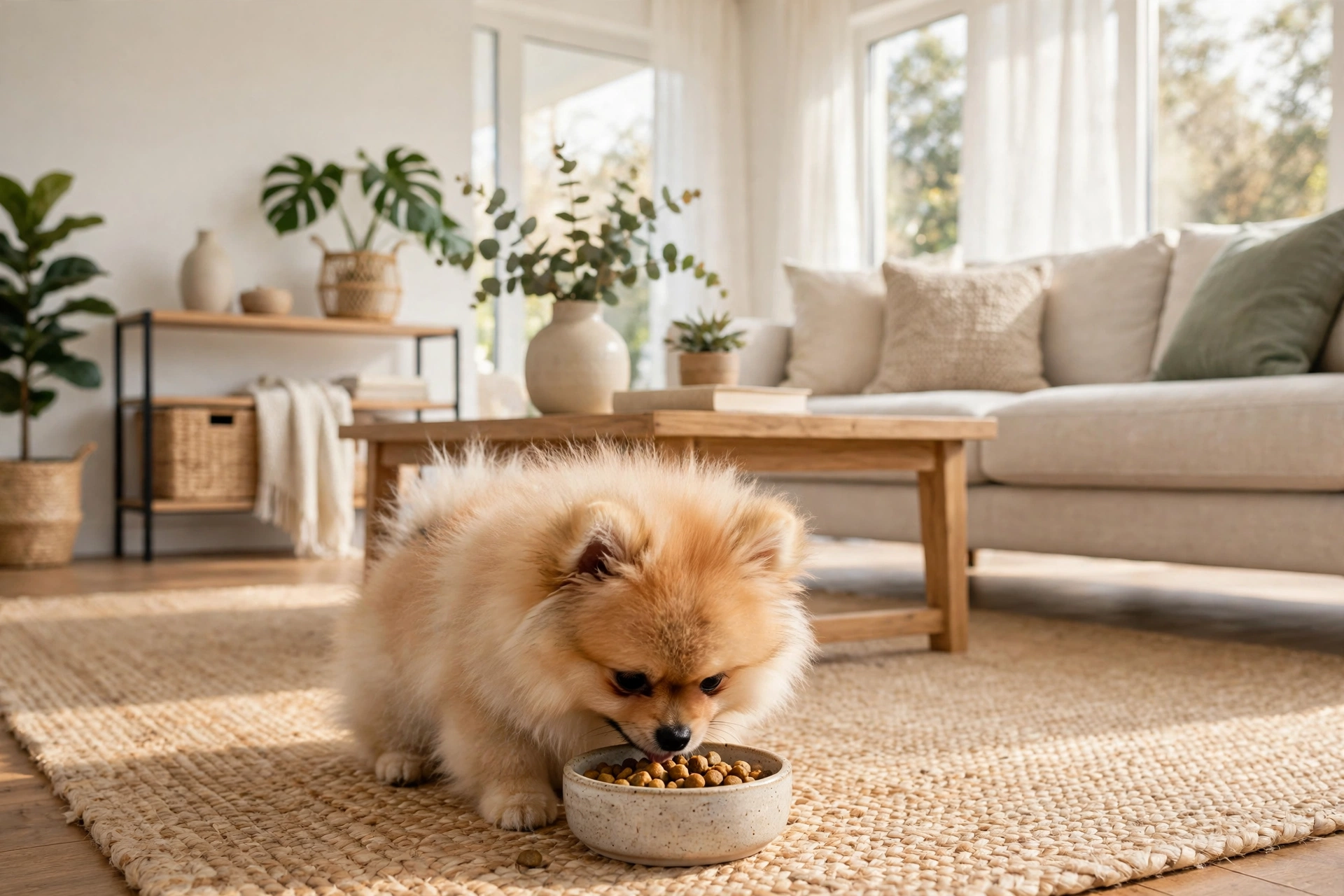
Best Puppy Food for Pomeranians: Tiny-breed feeding that protects blood sugar (6 Picks 2026)
Choosing the best puppy food for Pomeranians matters more than it does for most breeds, because a Pomeranian puppy is a tiny dog with a very fast metabolism, a very small stomach, and very little room for error. An adult Pomeranian usually weighs only 3 to 7 pounds, so a puppy that skips meals, eats kibble it cannot chew properly, or gets too many calories from treats can run into trouble quickly. The right food is therefore not just a bag labelled “puppy”. It is a small-breed or toy-breed puppy formula with tiny kibble, enough protein and fat for growth, DHA for brain and eye development, and balanced calcium for growing bones. Small, frequent meals are what keep a tiny puppy’s blood sugar steady between meals, and this guide is built around that rhythm.
This guide covers exactly that. Below you will find six real, widely sold US puppy foods that suit Pomeranian puppies, a comparison table to shortlist them fast, a feeding schedule by age, a portion guide by weight, and honest answers to the questions most rival guides skip: how to protect a tiny puppy from low blood sugar, what to do with a picky Pom puppy, when to switch to adult food, and which ingredients are not worth paying for. Picks are based on ingredient analysis, brand reputation, and owner reviews. For the general puppy-feeding method behind these picks, see our hub guide, Best Puppy Food for Large Breeds.
For most Pomeranian puppies, Hill’s Science Diet Puppy Small Paws is the best all-round pick, with small kibble and DHA. Royal Canin X-Small Puppy suits the smallest puppies, up to 8 pounds adult weight. Feed 4 meals at 8 to 12 weeks, then 3 meals, then 2 to 3 meals, and keep a young puppy from skipping a meal.
In This Guide
- Key takeaways
- Best puppy food for Pomeranians at a glance
- Why Pomeranian puppies need a different kind of puppy food
- Low blood sugar: the safety issue other guides underplay
- Royal Canin X-Small Puppy Dry Dog Food
- Hill’s Science Diet Puppy Small Paws
- Purina Pro Plan Puppy Small Breed Chicken & Rice
- Blue Buffalo Life Protection Formula Small Breed Puppy Chicken & Oatmeal
- Wellness Complete Health Small Breed Puppy
- IAMS ProActive Health Smart Puppy Small & Toy Breed
- How much to feed a Pomeranian puppy
- A feeding schedule that protects blood sugar
- Buying guide: what to look for in a Pomeranian puppy food
- What to avoid
- What to do with a picky Pomeranian puppy
- Switching foods, and switching to adult food
- Pros and Cons
- Your Pomeranian Puppy’s First Week Home: Do Not Change the Food Yet
- Conclusion: our recommendation
Key takeaways
- Pick a formula made for a puppy that will top out at 3 to 7 lb, with an AAFCO statement for growth. Adult food is not made for growth, so it is not a substitute.
- Feed 3 to 4 small meals a day up to about 6 months, then 3 meals, then 2 to 3 meals. One large meal is a bad idea for a tiny puppy, because tiny puppies are prone to low blood sugar.
- Look for a named animal protein first, DHA from fish oil, balanced calcium and phosphorus, and kibble small enough for a toy-breed mouth.
- Most Pomeranian puppies eat only about 1/4 to 1/2 cup of dry food per day in total. Measure it, split it, and count treats inside that total.
- Switch to adult food gradually at around 10 to 12 months, over 7 to 10 days, unless your vet advises a different timing for your puppy.
Best puppy food for Pomeranians at a glance
| Product | Best for | Key feature | kcal/cup | Price | Cost/month |
|---|---|---|---|---|---|
| Royal Canin X-Small Puppy Dry Dog Food | Smallest Pomeranian puppies | Made for puppies with an expected adult weight up to 8 lbs, with tiny kibble | 405 | $23.99 / 3 lb, Chewy, 2026-11-15 | ~$35/mo |
| Hill’s Science Diet Puppy Small Paws | All-round reliability | Small-breed puppy feeding with DHA from fish oil and small kibble | 397 | $23.99 / 4.5 lb, Chewy, 2026-11-15 | ~$26/mo |
| Purina Pro Plan Puppy Small Breed Chicken & Rice | Digestion and picky eaters | Guaranteed live probiotics plus bite-sized kibble | 482 | $19.98 / 6 lb, Chewy, 2026-11-15 | ~$15/mo |
| Blue Buffalo Life Protection Formula Small Breed Puppy Chicken & Oatmeal | Natural ingredients | Deboned chicken first, DHA and ARA, no by-product meals, corn, wheat or soy | 417 | $39.58 / 15 lb, Chewy, 2026-11-15 | ~$10/mo |
| Wellness Complete Health Small Breed Puppy | Coat and gentle digestion | Deboned turkey, oatmeal and salmon meal, with DHA and omega fatty acids | 489 | $19.99 / 4 lb, Chewy, 2026-11-15 | ~$21/mo |
| IAMS ProActive Health Smart Puppy Small & Toy Breed | Budget-friendly feeding | Small, easy-to-eat kibble at a lower price, with DHA for brain development | 445 | $18.25 / 7 lb, Chewy, 2026-11-15 | ~$14/mo |
Prices checked on Chewy on 2026-11-15. Cost per month is for a 6-month-old Pomeranian puppy expected to reach 5 lb as an adult.
Why Pomeranian puppies need a different kind of puppy food
Pomeranians are a toy breed, and that changes feeding in four practical ways. Their stomachs are tiny, so they need small, frequent meals. Their mouths are tiny, so kibble size matters. Their growth is fast but finishes early, so the food has to be calorie-dense and rich in protein. And their blood sugar is less stable than a larger puppy’s, so the feeding schedule matters as much as the food itself. Pomeranians reach adult size at about 6 to 8 months, and most move to adult food at around 10 to 12 months.
Low blood sugar: the safety issue other guides underplay
Toy-breed puppies, including Pomeranians, are prone to hypoglycemia (low blood sugar), especially in the first 6 months of life. The Merck Veterinary Manual notes that puppy hypoglycemia is seen especially in toy breeds at this age, when their livers are still maturing and their glycogen stores are small, so a missed meal or a stressful day can drop blood sugar fast. A small meal every few hours keeps blood sugar steadier than one or two big meals a day.
Watch for unusual sleepiness, weakness, wobbliness, confusion, shaking, or a puppy that suddenly will not eat. That list is short because it has to be: those are the signs that matter, and waiting is the risk, so call your vet right away if you see any of them. A serious episode is a vet visit, not something to diagnose or treat at home. Prevention, though, is mostly feeding: regular small meals, a very young puppy eating every day without a whole day’s gap, keeping fresh water available, and keeping your vet’s number handy. This guide covers feeding and diet for Pomeranian puppies in general terms; your own puppy’s needs may differ, so check portions and any health worries with your vet.
Royal Canin X-Small Puppy Dry Dog Food
Royal Canin X-Small Puppy is the closest thing on this list to a toy-breed specialist. It is made for puppies from 2 to 10 months old with an expected adult weight of no more than 8 pounds, which covers almost every Pomeranian puppy. That matters because most “small breed” puppy foods are really aimed at dogs up to 22 pounds. That is a big difference when your puppy may top out at 5 pounds.
The kibble is small and crunchy, which suits tiny jaws and helps with the chewing habit that supports dental health. The formula includes antioxidants including vitamins E and C for immune support, DHA for brain development, and a blend of prebiotics and digestible proteins aimed at smaller, firmer stools. Its first ingredients are chicken meal and brewers rice, so it is not a “real meat first, grain-free” recipe. It is a science-led, growth-tested formula, and owners who prefer that approach tend to like it. At $23.99 for the 3 lb bag on Chewy, it looks pricey per pound, but a Pomeranian puppy eats so little that it works out near $35 a month.
Hill’s Science Diet Puppy Small Paws
Hill’s Science Diet Puppy Small Paws (Chicken Meal, Barley & Brown Rice), also sold as Puppy Small & Mini, is the steady, widely recommended choice on this list. It is built for small and mini breed puppies that will top out at 3 to 7 lb, with small kibble, DHA from fish oil for brain and eye development, and balanced minerals for growing bones. Chicken meal is the lead protein, and the recipe is designed to be easy to digest, helpful for a breed that can have sensitive stomachs.
What stands out in owner reviews is consistency: puppies tend to eat it without drama, stools tend to stay firm, and the small bag sizes suit a household feeding a few tablespoons at a time. Based on ingredient analysis, brand reputation, and owner reviews, this is the pick to shortlist first if you want the fewest surprises. At $23.99 for a 4.5 lb bag on Chewy, it works out near $26 a month for a Pomeranian puppy.
Purina Pro Plan Puppy Small Breed Chicken & Rice
Purina Pro Plan Puppy Small Breed is a strong choice when digestion or fussy eating is the main worry. It lists real chicken first, includes DHA from fish oil, and its real differentiator is guaranteed live probiotics, which are added to support digestive and immune health. For a Pomeranian puppy whose stomach is easily upset by a change of food, that probiotic support is a practical bonus rather than marketing decoration.
The kibble is bite-sized for small mouths, and the chicken-and-rice flavour profile is one most puppies accept readily. As with every food here, transition slowly: a sudden switch is the most common cause of loose stools in puppies, and probiotics do not cancel out a rushed change. At $19.98 for the 6 lb bag on Chewy, it works out near $15 a month.
Blue Buffalo Life Protection Formula Small Breed Puppy Chicken & Oatmeal
Blue Buffalo’s small-breed puppy formula is the pick for owners who read ingredient panels first. Deboned chicken is the first ingredient, followed by chicken meal, oatmeal, barley, and fish meal. It includes DHA and ARA (fatty acids found in mother’s milk) for cognitive and retinal development, and the brand’s LifeSource Bits, a cold-formed blend of antioxidants, vitamins, and minerals. It contains no chicken or poultry by-product meals and no corn, wheat, or soy.
Its guaranteed analysis is notably protein-rich for a small-breed puppy food, at around 29% protein minimum, with 17% fat minimum, which suits an active, fast-growing toy puppy. Owners report good palatability, though, as with any food, a truly picky Pom may still need the warming and wet-food tricks in the section below. At $39.58 for the 15 lb bag on Chewy, it works out near $10 a month.
Wellness Complete Health Small Breed Puppy
Wellness Complete Health Small Breed Puppy is built around deboned turkey, chicken meal, oatmeal, salmon meal, and barley. That mix gives it two things Pomeranian owners care about: a gentle, grain-inclusive base (oatmeal and barley) and fish-derived omega fatty acids for skin and coat. It carries an AAFCO growth profile, around 28% protein and 19% fat, and includes DHA for brain development, plus prebiotics for digestion and glucosamine for joints.
For a Pomeranian puppy, the coat benefit is not cosmetic fluff: a thick double coat that is dry, dull, or shedding heavily is often an early sign that diet, grooming, or health needs attention. A food with steady omega-6 and omega-3 fatty acids, plus enough total fat for growth, supports coat condition from the inside while you handle brushing on the outside. At $19.99 for the 4 lb bag on Chewy, it works out near $21 a month.
IAMS ProActive Health Smart Puppy Small & Toy Breed
IAMS ProActive Health Smart Puppy Small & Toy Breed is the value pick that does not force you into an all-life-stages compromise. It is made for small and toy breed puppies, with small kibble pieces a Pomeranian puppy can actually pick up and chew, real chicken first, and DHA for brain development. Owner reviews consistently call it out as a genuinely affordable puppy food that puppies eat willingly, which is the whole point of a budget pick.
Be honest about the trade-off: the ingredient panel is less premium than the foods above, including chicken by-product meal and whole-grain corn further down the list. That does not make it unsafe. It is a complete and balanced growth formula, but if you prefer a chicken-first, by-product-free panel, spend the extra on Blue Buffalo or Wellness. At $18.25 for the 7 lb bag on Chewy, it works out near $14 a month.
How much to feed a Pomeranian puppy
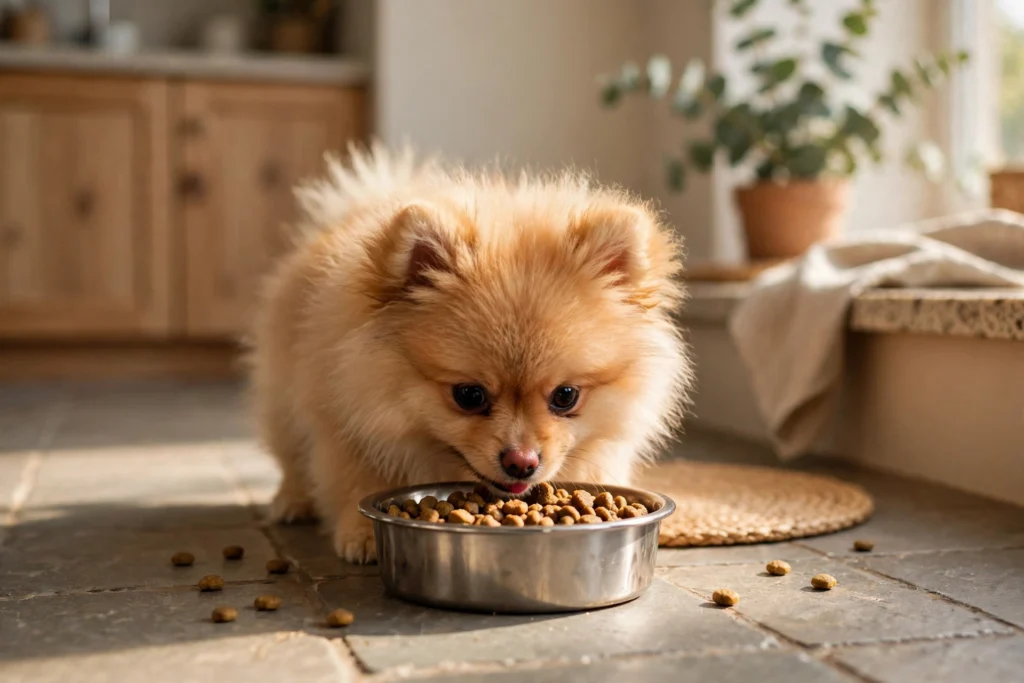
Bag labels give a range, not a prescription, and for a toy breed the range is wide because adult weight varies so much. The table below is a starting point for a healthy Pomeranian puppy on a typical dry puppy food, using the total daily amount split across the meals shown. Always follow the specific bag you buy, adjust for body condition, and ask your vet if your puppy is underweight, overweight, or exceptionally small.
| Puppy age | Meals per day | Typical total per day |
|---|---|---|
| 8 to 12 weeks | 4 small meals | About 1/4 to 1/3 cup |
| 3 to 6 months | 3 meals | About 1/4 to 1/2 cup |
| 6 to 12 months | 2 to 3 meals | About 1/3 to 1/2 cup |
Portions and cost per month at 5 lb adult weight
Basis: a 6-month-old Pomeranian puppy expected to reach 5 lb as an adult (the middle of the 3 to 7 lb adult range). At 6 months the puppy weighs about 3.9 lb. Daily feeding comes from each food’s label feeding guide, and cost per month uses the Chewy prices checked on 2026-11-15.
| Product | kcal/cup | Price | Daily feeding | Cost/month |
|---|---|---|---|---|
| Royal Canin X-Small Puppy | 405 | $23.99 / 3 lb, Chewy | 0.625 cup | ~$35/mo |
| Hill’s Science Diet Puppy Small Paws | 397 | $23.99 / 4.5 lb, Chewy | 0.7 cup | ~$26/mo |
| Purina Pro Plan Puppy Small Breed Chicken & Rice | 482 | $19.98 / 6 lb, Chewy | 0.625 cup | ~$15/mo |
| Blue Buffalo Life Protection Formula Small Breed Puppy Chicken & Oatmeal | 417 | $39.58 / 15 lb, Chewy | 0.5 cup | ~$10/mo |
| Wellness Small Breed Complete Health Puppy (Turkey, Oatmeal & Salmon Meal) | 489 | $19.99 / 4 lb, Chewy | 0.5 cup | ~$21/mo |
| IAMS ProActive Health Smart Puppy Small & Toy Breed | 445 | $18.25 / 7 lb, Chewy | 0.67 cup | ~$14/mo |
For the full feeding guide, see the Pomeranian Feeding Guide.
Those amounts look tiny, and that is the point. A Pomeranian puppy that looks “still hungry” after a measured meal is often just a puppy being a puppy. They are famously food-motivated. Judge by body condition, not by begging: you should be able to feel ribs under a thin layer of fat but not see them prominently, and your puppy should have a visible waist from above. If you cannot feel ribs, cut back slightly; if ribs and hip bones are sharp, increase slightly and check with your vet. Weigh your puppy weekly. A kitchen scale works, because a small gain on a 2-pound puppy is easy to miss by eye.
A feeding schedule that protects blood sugar
For a very young Pomeranian puppy, timing matters as much as the food itself. A simple schedule that works for most households is: breakfast soon after waking, a midday meal, a late-afternoon meal, and a final small meal in the early evening for puppies under 6 months. Drop to three meals at around 3 to 6 months, and to two or three meals from 6 months onward, based on your puppy’s weight, appetite, and your vet’s advice.
Buying guide: what to look for in a Pomeranian puppy food
A growth statement, not just “puppy” on the bag
Look for an AAFCO statement that the food is formulated to meet the nutritional levels for growth, or for all life stages including growth. That statement is the legal baseline that the recipe covers puppy needs. Our hub guide, Best Puppy Food for Large Breeds, explains what the growth statement covers and why it matters.
A named animal protein first
Deboned chicken, chicken, turkey, lamb, or salmon as the first ingredient is a good sign. Meat meals (chicken meal, salmon meal) are also concentrated protein sources and are not a red flag on their own. What you want to avoid as a lead ingredient is a vague term like “meat meal” with no animal named, or a grain taking the top spot in a growth formula.
DHA, calcium, and phosphorus in balance
DHA from fish oil supports brain and eye development, and a complete puppy food already balances calcium and phosphorus, so there is nothing to add. Bone meal, calcium powder, or vitamin D supplements do not belong in the bowl unless your vet specifically prescribes them. Our hub guide, Best Puppy Food for Large Breeds, has the full picture on DHA, calcium, and phosphorus.
Kibble size you can test in your hand
Pour a few pieces into your palm. If they are wider than your puppy’s back molars, or your puppy crunches, drops, and abandons them, the kibble is too big. Toy and small-breed puppy formulas exist precisely for this, and a small-breed adult kibble is still not the same as a small-breed puppy kibble. If a food is otherwise perfect but the kibble is slightly large, soaking it in warm water for a few minutes for a young puppy is a reasonable short-term fix, but soaked food is not a long-term plan without a dental plan, since crunchy kibble helps clean teeth.
Fat, calories, and digestibility
Puppy foods are normally higher in fat than adult foods, and that is correct for growth. Compare calories per cup when switching brands, because a cup of one food can carry far more calories than a cup of another. Moderate fibre from oatmeal, barley, or beet pulp, plus digestible proteins, helps keep stools firm; probiotics and prebiotics can help during transitions, but persistent diarrhoea, vomiting, or blood in the stool needs veterinary attention, not a new bag. Some older guides still quote half a cup per pound per day, which would mean 1.5 cups a day for a 3 lb puppy. That is far too much. The 1/4 to 1/2 cup per day total in the portion tables is the right scale for this breed.
What to avoid
- Adult maintenance food for a puppy under 10 to 12 months is not formulated for growth, however good the brand is.
- One large daily meal for a young toy puppy raises low-blood-sugar risk and makes it harder to spot a missed meal.
- Raw or home-cooked diets without veterinary nutritionist input make it very hard to balance calcium, phosphorus, and micronutrients for a growing toy puppy by guesswork.
- Grain-free food chosen by default is not automatically healthier, and the FDA has investigated a possible link between certain grain-free diets and heart disease in dogs. Choose grain-free only for a specific, vet-identified reason.
- Calcium or vitamin supplements added to a complete puppy food can harm growing bones, since excess calcium harms them.
- Foods with artificial colours, flavours, or chemical preservatives as a selling point add nothing a puppy needs.
- “Teacup” marketing as a feeding claim is not a real standard. There is no separate teacup feeding standard; judge the food by its AAFCO statement, kibble size, and calorie density, not by the word on the bag.
What to do with a picky Pomeranian puppy
Pomeranians have a well-earned reputation for pickiness, and puppies learn fast that refusing kibble sometimes produces something tastier. Before you switch foods for the third time in a month, try the boring fixes first. Warm the food slightly to release aroma, add a spoonful of warm water or a small amount of wet puppy food from the same brand, and feed in a calm spot without an audience. Put the bowl down for 15 to 20 minutes, then pick it up. Grazing all day teaches a puppy that food is always available and never urgent.
See also our puppy feeding schedule guide, best dog food for Pomeranians, and best puppy food for small breeds guides.
Switching foods, and switching to adult food
Switch any food over 7 to 10 days: roughly 25% new food for 2 to 3 days, 50% for 2 to 3 days, 75% for 2 to 3 days, then 100%. If stools loosen, hold at the current ratio for a day or two before moving on. Keep the same feeding times during a switch. Changing food and schedule at once makes it impossible to tell which change caused a problem.
Pros and Cons
Six real puppy formulas cover the main Pomeranian needs, but the list has gaps a buyer should know about. Here is the honest balance.
Pros
- Six real US puppy formulas, all made for small or toy breeds, with kibble sized for a tiny mouth.
- Low blood sugar guidance is stronger than in most rival guides, with a full feeding schedule by age and portion tables to match.
- Tables shortlist the picks and the daily portions fast, so an owner can compare without reading the whole guide.
- Picky eating, switching foods, and grain-free food are all answered in the same guide, with a 7 to 10 day switch plan.
Cons
- No chicken-free pick: four of the six picks lead with chicken, so a puppy with a chicken sensitivity has no named alternative here.
- No treat or topper list beyond counting treats in the daily total.
- No wet food pick, so owners who want to mix wet and dry food have to guess a match themselves.
- Royal Canin X-Small Puppy covers puppies only from 2 to 10 months, so the smallest puppies need another puppy food before the switch to adult food at 10 to 12 months.
Your Pomeranian Puppy’s First Week Home: Do Not Change the Food Yet

Your puppy’s first days are stressful enough without a new food on top of it. Moving house, new people, new sounds, and being away from littermates can upset a small stomach, and a sudden food change makes loose stools and refused meals far more likely. Ask the breeder what food your puppy has been eating, how much per meal, and how many meals a day, and keep feeding exactly that for the first week while your puppy settles in. Buy a small bag of the same food before pickup day so you are not caught short. Watch the basics in that first week: is your puppy eating every meal, drinking water, passing firm stools, and gaining a little weight? If the answer is yes, the food is doing its job, even if it is not the brand you planned to buy. Once your puppy is eating well and seems settled, usually after a week, you can start a slow switch to your chosen food over 7 to 10 days, mixing in a little more of the new food each day. Change only the food in that week. Adding new treats, toppers, or supplements all at once makes it impossible to tell which change caused a problem if stools loosen. If your puppy refuses more than one meal, seems weak or sleepy, or has repeated diarrhoea in the first days home, call your vet the same day.
Conclusion: our recommendation
For most Pomeranian puppies, start with Hill’s Science Diet Puppy Small Paws if you want the most dependable all-round food, or Royal Canin X-Small Puppy if your puppy is exceptionally small and you want a formula sized for dogs up to 8 pounds. If digestion is the main concern, Purina Pro Plan Puppy Small Breed with its live probiotics is the best shortlist pick; if ingredient quality matters most, Blue Buffalo Life Protection Small Breed Puppy is the strongest chicken-first option; for coat support, Wellness Complete Health Small Breed Puppy earns its place; and on a tight budget, IAMS ProActive Health Smart Puppy Small & Toy Breed covers the essentials without a premium price. If you also have a Yorkie at home, see our Best Puppy Food for Yorkshire Terriers guide, and for the wider small-breed shortlist, see Best Puppy Food for Small Breeds. For adult Pomeranians, see Best Dog Food for Pomeranians.
Frequently Asked Questions
What is the best puppy food for Pomeranians?
A small-breed or toy-breed puppy formula with an AAFCO growth statement, a named animal protein first, DHA for brain development, balanced calcium, and kibble small enough for a toy-breed mouth. Adult food is not a substitute.
How much should I feed a Pomeranian puppy?
Most Pomeranian puppies eat about 1/4 to 1/2 cup of dry food per day in total, split across meals, but always follow the specific bag and adjust for body condition and your vet’s advice.
How often should I feed a Pomeranian puppy?
Feed 4 small meals a day at 8 to 12 weeks, 3 meals at 3 to 6 months, then 2 to 3 meals from 6 months onward. One large daily meal is not enough for a very young toy puppy.
When should I switch my Pomeranian puppy to adult food?
Most Pomeranians switch at around 10 to 12 months, once they have reached adult weight and stopped growing. Transition over 7 to 10 days and ask your vet if you are unsure about timing.
What should I do if my Pomeranian puppy is picky?
Warm the food slightly, add a spoonful of warm water or wet puppy food from the same brand, feed in a calm spot, and put the bowl down for 15 to 20 minutes then pick it up. Give a food at least a week before judging it, and see a vet if pickiness comes with vomiting, diarrhoea, or weight loss.
How can I help prevent low blood sugar in my Pomeranian puppy?
Feed small, frequent, measured meals, keep a very young puppy eating every day, and watch for unusual sleepiness, weakness, wobbliness, confusion, or shaking.

3 Comments