

Labrador Feeding Guide: How Much, How Often & What to Feed (2026)
If you share your home with a Labrador Retriever, you already know the mealtime ritual: the soulful stare, the tail thumping the floor, the theatrical sigh that suggests you haven’t fed your dog in weeks. Labs are famously food-obsessed, and that appetite is exactly why feeding them correctly matters more than almost any other decision you make as a Lab owner. This Labrador feeding guide covers everything that matters: how much to feed at every life stage, how often to feed, how to measure portions accurately, what to look for in a food, and the mistakes that quietly turn a lean, athletic dog into an overweight one.
Here’s what makes Labs different from most breeds: many of them carry a variation of the POMC gene that weakens the brain’s “I’m full” signal. Your dog isn’t greedy. It genuinely feels hungry most of the time. That means your Labrador will never reliably self-regulate. Portion control is entirely your job, and getting it right is the single most effective way to protect your Lab’s joints, waistline, and lifespan.
Quick Answer: Most adult Labs need about 2 to 4 cups of food a day, split into two meals. Puppies eat 3 to 4 meals a day, and seniors do best on two smaller meals with more protein. Weigh the food and judge portions by the rib test and waist, not the bag alone. Treats stay under 10 percent of daily calories.
In This Guide
- Key Takeaways
- How Much Should a Labrador Eat Per Day? (Quick Chart)
- Feeding a Labrador Puppy: Controlled Growth Matters Most
- Feeding an Adult Labrador: Two Meals, Every Day
- Feeding a Senior Labrador (7+ Years)
- Measuring Portions Correctly: The Accuracy Habit
- Managing the “Always Hungry” Labrador
- What to Look for in a Labrador’s Food
- What to Avoid When Feeding Your Labrador
- A Sample Daily Feeding Routine
- Pros and Cons
- Conclusion: The Lean Lab Is the Healthy Lab
- Feeding a Working Labrador
Key Takeaways
- Most adult Labs need roughly 2 to 4 cups of dry food per day, split into two meals, but calories per cup vary widely, so weigh food rather than scooping by volume.
- Feed puppies 3 to 4 times daily, adults twice daily, and seniors once or twice depending on appetite and body condition.
- Labradors are genetically prone to obesity because many carry a gene variant that blunts their satiety signal, so never free-feed a Lab.
- Judge portions by the body condition score (ribs felt but not seen, visible waist) rather than the number on the bag alone.
- Treats count: keep them under 10% of daily calories, and cut the dinner portion to match training days.
How Much Should a Labrador Eat Per Day? (Quick Chart)
Every dog is an individual, so treat these numbers as starting points. Always cross-check against your food’s calorie content and your dog’s body condition, then adjust up or down over two to three weeks.
| Life Stage | Daily Amount (Dry Food) | Meals Per Day |
|---|---|---|
| Puppy, 2 to 4 months | 2 to 3 cups | 4 |
| Puppy, 4 to 6 months | 3 to 4.5 cups | 3 |
| Puppy, 6 to 12 months | 3.5 to 5 cups | 2 |
| Adult, 55 to 65 lbs | 2 to 2.5 cups | 2 |
| Adult, 65 to 75 lbs | 2.5 to 3 cups | 2 |
| Adult, 75 to 85+ lbs | 3 to 4 cups | 2 |
| Senior, 7+ years | 2 to 2.75 cups | 2 |
One important caution about “cups”: a heaping cup versus a level cup can differ by around 15% in calories, and kibble calorie density varies enormously between brands. A high-protein formula can pack 450 kcal per cup while a basic one sits near 320. If you switch brands and keep scooping the same number of cups, you may be over- or underfeeding your Lab without realizing it. For breed-level product guidance, see our guide to the best dog food for Labradors.
Feeding a Labrador Puppy: Controlled Growth Matters Most
Lab puppyhood is a balancing act. Puppies need plenty of calories and nutrients to grow, but too much food is worse than slightly too little. Rapid growth from overfeeding is linked to developmental orthopedic problems, exactly the joint issues Labs are already prone to. The goal is slow, steady growth: a lean puppy with visible muscle, not a round one.
Puppy meal schedule by age
- 8 weeks to 4 months: 4 meals per day, spaced evenly. Soak kibble in warm water at first to soften it.
- 4 to 6 months: drop to 3 meals per day.
- 6 to 12 months: 2 meals per day. Large-breed puppy formula is the right choice throughout. It’s calibrated with controlled calcium (around 0.8 to 1.2%) and balanced phosphorus to support bone development at a safe pace.
- 12 to 15 months: most Labs can transition to adult food. Giant-framed or late-maturing dogs may stay on puppy food a touch longer, so check with your vet.
Never free-feed a Labrador puppy. Leaving food down all day removes your control over portions, spoils the meal-routine structure puppies thrive on, and makes it impossible to notice if a puppy’s appetite drops, often the first sign of illness. Our detailed puppy feeding schedule walks through portion-by-age tables in more depth.
What to look for in a puppy formula
Choose a food formulated for large-breed puppies (AAFCO statement should say “formulated to meet the nutritional levels established by the AAFCO Dog Food Nutrient Profiles for growth” or “all life stages”). Protein in the 30 to 35% range (dry matter), moderate fat, and DHA from fish oil for brain and eye development are the hallmarks of a quality puppy food.
Feeding an Adult Labrador: Two Meals, Every Day
For a healthy adult Lab (roughly 12 to 15 months to 7 years), the gold standard routine is simple: two meals per day, morning and evening, at consistent times. Splitting the day’s food stabilizes energy, reduces begging between meals, and lowers the risk of gastric dilatation-volvulus (bloat), a serious concern for deep-chested breeds that can follow one huge daily meal.
Dialing in the right portion
Rather than trusting the bag alone, calculate from your dog’s energy needs. A moderately active adult Lab typically needs maintenance energy in the range of 95 to 105 kcal per kilogram of ideal body weight^0.75 per day, then adjust for the individual. The factors that push portions up or to own:
- Activity level: a field-working or swimming Lab can need 20 to 40% more food than a couch companion.
- Spay/neuter status: metabolism often dips after the procedure, so plan on feeding 10 to 20% less and reassess the waistline in a month.
- Individual metabolism: two Labs of identical weight can maintain condition on different amounts. The body condition score beats the calculator every time.
The body condition test (better than the scale)
Labs vary in height and bone structure, so weight numbers are only a starting point. Learn the two quick checks:
- The rib test: run your hands along your dog’s sides with light pressure. You should feel the ribs easily, like the back of your hand, not have to press hard to find them.
- The waist check: viewed from above, your Lab should have a visible waist behind the ribs (a gentle hourglass). Viewed from the side, the belly should tuck upward behind the ribcage, not hang level with the chest.
If the waist disappears, trim the daily portion by 10 to 15% and re-check in two to three weeks. If the ribs become visible through the coat or hip bones protrude, increase gradually. Our guide to the best dog food for Labradors includes picks that suit different energy levels and budgets.
Feeding a Senior Labrador (7+ Years)
Around age seven, most Labs shift into senior territory: metabolism slows, muscle mass declines, and joints ask for gentler treatment. The right senior feeding strategy isn’t about drastically cutting food. It’s about feeding smarter. For older Labs, see our senior labrador feeding guide.
- Portions: start by reducing the adult amount by 10 to 15% and monitor body condition monthly. Many seniors settle around 2 to 2.75 cups of senior-formula kibble per day.
- Protein stays high: seniors actually need more protein (around 28 to 32% dry matter) to fight age-related muscle loss, unless your vet says otherwise for kidney reasons.
- Joint and anti-inflammatory support: look for glucosamine, chondroitin, and omega-3 fatty acids (EPA/DHA from fish oil) on the label.
- Meal frequency: keep two smaller meals rather than one large one; older dogs with smaller appetites sometimes do better on two modest meals than one big bowl they won’t finish.
- Weight is everything: extra pounds multiply the force on arthritic hips and elbows. For a stiff senior, trimming even a few pounds can make a bigger difference than any supplement.
Measuring Portions Correctly: The Accuracy Habit
Precision matters more for Labs than for almost any breed, because their hunger never tells you when to stop. Adopt these habits and you’ll remove most of the guesswork:
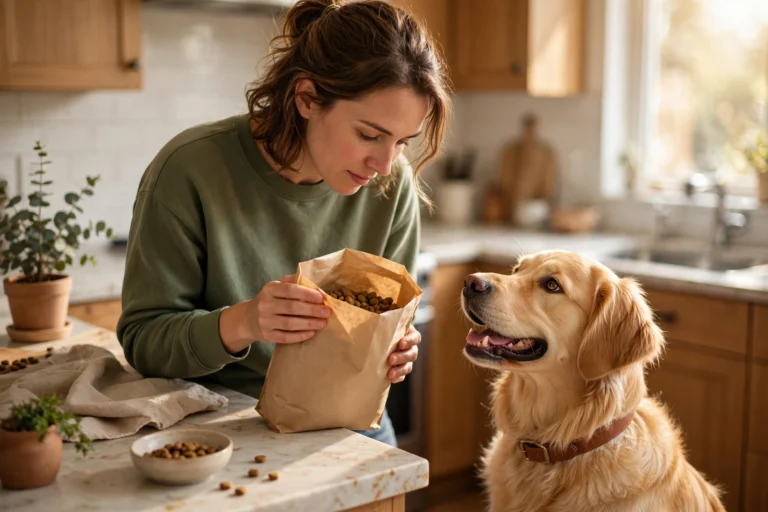
- Weigh, don’t scoop: a kitchen scale with grams is the most accurate way to portion dry food. Bags list feeding guidelines in grams as well as cups, so use them.
- Level every cup: if you must use a cup measure, level it flat every time. A heaping scoop repeated daily adds hundreds of hidden calories per week.
- Recalibrate when you switch brands: match by calories per day, not cups per day. Check the kcal/kg (or kcal/cup) figure on both bags and do the math.
- One person measures: in multi-person households, agree on who portions each meal. Double-dinners are a classic Lab weight-gain story.
- Store kibble properly: once opened, fats oxidize and nutritional value degrades. Reseal the bag tightly or transfer to an airtight container, and keep it in a cool, dry place.
Managing the “Always Hungry” Labrador
A Lab at a healthy weight can still act starving, so remember the POMC gene. Rather than giving in (and steadily widening the waist), use these satiety strategies:
- Add volume, not calories: mix steamed, unsalted green beans or plain pumpkin purée into meals. Fiber adds physical fullness for minimal calories.
- Slow the eating: slow-feeder bowls and snuffle mats stretch a meal from 60 seconds to 10 minutes, which increases satisfaction.
- Use meals as training currency: set aside a handful of the day’s measured kibble as training rewards instead of adding extra treats on top.
- Keep the routine boring: consistent meal times reduce food anxiety and frantic begging. Labs thrive on predictability.
- Never feed from the table: every scrap teaches your Lab that begging pays. The one time it works erases weeks of training.
What to Look for in a Labrador’s Food
Whether you feed kibble, wet food, fresh, or a mix, a Lab-appropriate food checks these boxes:
- A named animal protein first: chicken, salmon, lamb, or beef, ideally followed by a named meat meal, which concentrates protein efficiently.
- Protein 25 to 30% and fat 12 to 15% (dry matter) for adults: enough to hold muscle without piling on calories.
- Joint support: glucosamine and chondroitin matter for a breed prone to hip and elbow dysplasia.
- Omega-3s: fish oil or flaxseed for skin, coat, and anti-inflammatory support.
- Digestible fiber: beet pulp, pumpkin, or chicory root for gut health and satiety.
- An AAFCO statement: “complete and balanced” for the correct life stage. This is the single most important line on the bag.
- Controlled calcium in puppy formulas: excess calcium during growth is linked to skeletal problems in large breeds.
For feeding style, many owners combine approaches: a quality dry food as the base, a spoonful of wet food for palatability, and fresh toppers like plain cooked egg or sardines a few times a week. That’s a practical, affordable pattern that works well for Labs.
What to Avoid When Feeding Your Labrador
- Free-feeding: food available all day is the fastest route to an obese Lab.
- Overfeeding treats: training treats, dental chews, table scraps, and stuffed Kongs all count. Keep extras under 10% of daily calories, and cut the evening meal to compensate on heavy training days.
- Toxic foods: chocolate, grapes and raisins, xylitol (birch sugar) in peanut butter, onions, garlic, macadamia nuts, and alcohol. When in doubt, don’t share.
- Sudden food changes: transition to a new food over 7 to 10 days, mixing gradually increasing proportions of the new food into the old. See our guide to changing dog food safely for the full schedule.
- Exercise right after big meals: avoid vigorous play for at least an hour after eating to reduce bloat risk, and don’t let your Lab gulp water excessively right after meals either.
- Generic “one size fits all” charts: bag guidelines are averages. Your Lab’s body condition is the final authority, so adjust until the ribs feel right.
- Cheap filler-heavy foods: formulas where corn, wheat, or unnamed by-products dominate the first ingredients rarely keep a Lab lean and satisfied.
A Sample Daily Feeding Routine
Here’s what a healthy routine looks like for a typical 70-lb adult Lab:
| Time | What | Amount |
|---|---|---|
| 7:00 AM | Breakfast, dry food, level-measured | ~1.5 cups (or weighed equivalent) |
| Midday | Training rewards from a measured handful of the day’s kibble allowance | ~1/4 cup total |
| 6:00 PM | Dinner, dry food plus a spoonful of wet food or fresh topper | ~1.25 cups dry + topper |
| Throughout | Fresh water, available at all times | No set amount |
Keep the schedule consistent day to day. If your Lab skips a meal or leaves food behind, unusual for the breed, take note: a Lab that won’t eat is often a Lab that isn’t feeling well.
Pros and Cons
Feeding a Labrador well is a trade between strict measuring and a happy, lean dog. Here is the honest balance.
Pros
- Two measured meals a day keep energy steady and cut bloat risk in a deep-chested breed.
- Weighing food and using the rib test beats the bag chart for a breed that always feels hungry.
- Large-breed puppy food with controlled calcium protects growing joints.
- Senior food keeps protein high to hold muscle while calories come down.
Cons
- The POMC gene means your Lab will beg for more even at a healthy weight, so portions need constant watch.
- Cup measures vary by brand and by scoop, so cups alone can overfeed or underfeed.
- One big meal a day raises bloat risk, and feeding right before hard exercise adds to it.
- Treats, chews, and table scraps add up fast and can undo a careful meal plan.
Conclusion: The Lean Lab Is the Healthy Lab
Feeding a Labrador well comes down to a few unglamorous habits done consistently: two measured meals a day, food matched to your dog’s life stage and calorie content, treats that count toward the total, and the body condition score as your compass. The bag’s chart is a starting line, not a verdict. Because your Lab’s appetite can’t be trusted to regulate itself, your consistency is the whole system, and a lean, energetic Labrador is the proof it works. For product-level guidance across every life stage, browse our best dog food for Labradors and best puppy food for Labradors guides next.
This guide is for information only. Check with your vet for your dog’s specific needs.
Feeding a Working Labrador
A family pet Lab and a working Lab eat like two different dogs. A Lab that hunts, trains for field trials, or runs dog sports can burn far more energy than a house pet, so the same bowl that keeps a couch companion lean will leave a working dog thin and tired. The fix is not a bigger breakfast on work days. A full stomach and hard exercise are a bad mix for a deep-chested breed, and a big meal right before work raises the bloat risk. Feed a small breakfast on hunting or training days, then serve the main meal after the work is done and your dog has cooled down and rested for about an hour. Carry water and offer small drinks through the day instead of letting your Lab gulp a full bowl at the end. A performance formula with more calories per cup can help too, since it feeds more energy without a huge volume of food. Watch weight across the season, not day to day. Many working Labs lose a little shape during hunting season and fill out again after it, and that swing is normal. Cut portions back as soon as the work stops, or the extra food will turn into winter weight.
How much should a Labrador eat per day?
Most adult Labs (55 to 85 lbs) need about 2 to 4 cups of dry food daily, split into two meals, depending on calorie density, weight, and activity level. Puppies eat more per pound but in 3 to 4 smaller meals. Always adjust using the body condition score rather than cups alone.
How many times a day should I feed my Labrador?
Feed puppies under 4 months four times daily, puppies 4 to 6 months three times, and dogs over 6 months (adults and seniors) twice daily. Two meals a day is the standard for adult and senior Labs.
Is 4 cups of food too much for a Labrador?
For many adult Labs, 4 cups is on the high side unless the dog is large (85+ lbs), very active, or the food is low in calories. For a large growing puppy or a working dog it can be appropriate. Check kcal per cup and body condition.
Why is my Labrador always hungry?
Many Labs carry a POMC gene variant that weakens the brain’s fullness signal, so they genuinely feel hungry even at a healthy weight. Stick to measured portions and use low-calorie fillers like green beans, slow feeders, and meal-time training treats instead of adding food.
When should I switch my Lab puppy to adult food?
Most Labs transition around 12 to 15 months. Switch gradually over 7 to 10 days. Late-maturing or very large-framed dogs may stay on large-breed puppy food a little longer, so ask your vet.
Can I feed my Labrador once a day?
It’s not recommended. One large meal raises bloat risk in deep-chested breeds like Labs, and splitting into two meals keeps energy stable and reduces begging. Seniors and puppies need at least two smaller meals.
How do I know if my Labrador is overweight?
Do the rib test: you should feel the ribs easily under a thin fat layer without pressing hard. From above, your Lab should have a visible waist; from the side, the belly should tuck up behind the ribs. No visible waist means it’s time to trim portions.
Should I leave food out all day for my Labrador?
No. Free-feeding is one of the fastest ways to make a Lab overweight because the breed rarely self-regulates. Measure each meal, feed on a schedule, and pick the bowl up after 15 to 20 minutes.
How much should I feed my working Labrador?
A working Lab can need far more food than a house pet on heavy work days, so feed to body condition, not to the chart alone. Give a small breakfast on work days and the main meal after your dog has cooled down and rested for about an hour. A performance formula with more calories per cup feeds more energy without a huge volume of food. Cut portions back when the work season ends.
Can I mix wet food with dry food for my Labrador?
Yes. Wet food adds water and taste, but it still counts toward the daily calories, so cut back the dry food to match. A spoonful of wet food as a topper needs only a small cut, while a half wet and half dry split needs a bigger one. Check the calories on both packs and weigh the portions, or the mix can quietly push your Lab over its daily total.

4 Comments