
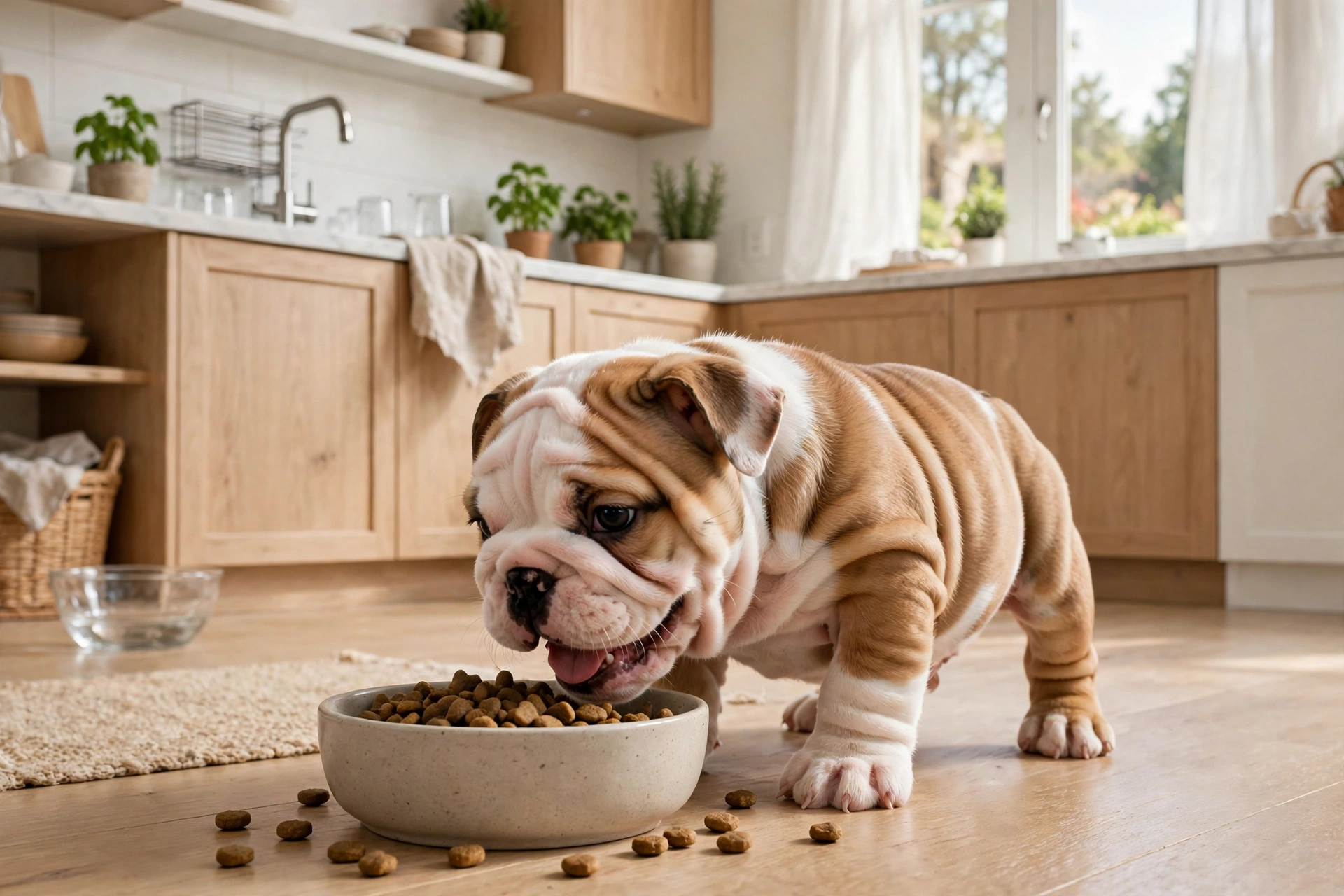
Best Puppy Food for Bulldogs: Stocky-frame, joint-aware feeding for 40 to 50 lb pups (6 Picks 2026)
Bringing home a Bulldog puppy is equal parts joy and responsibility. Those wrinkles, that flat face, and that sturdy little body all come with very specific feeding needs, which is why choosing the best puppy food for Bulldogs matters more than picking any bag labelled puppy off the shelf. Bulldogs grow fast, gain weight easily, and are famous for sensitive stomachs, gassy tummies, and skin folds that flare up when their diet does not suit them.
In this guide, we compare six real puppy foods sold in the United States, explain what makes each one work (or not) for Bulldogs, and help you choose based on your puppy’s needs rather than the marketing on the bag. Every pick below has been assessed for protein quality, digestibility, ingredients, calorie content, and whether it suits a flat-faced, stocky puppy that gains weight easily. You will also find a comparison table, a feeding guide, and the most common questions answered at the end. Prices are Chewy prices checked November 14, 2026, and the cost per month is worked out for a 6-month-old pup headed for 45 lb as an adult.
Key Takeaways
- Pick a puppy food (not adult food) with an AAFCO statement for growth or all life stages, so the formula matches a Bulldog’s 40 to 50 lb adult frame and steady, joint-aware growth.
- For most Bulldog puppies, the breed-specific Royal Canin Bulldog Puppy is the easiest starting point, thanks to its flat-face-friendly kibble shape.
- If your puppy has loose stools or itchy skin, a salmon-based, chicken-free sensitive stomach formula is the first change worth trying.
- Control portions from day one: Bulldogs gain weight easily, and extra weight makes breathing, joints, and skin folds worse.
- Switch foods slowly over 7 to 10 days, and keep treats to no more than 10% of daily calories.
Best Puppy Food for Bulldogs at a Glance
| Product | Best for | Key feature |
|---|---|---|
| Royal Canin Bulldog Puppy Dry Dog Food | Most Bulldog puppies | Wave-shaped kibble made for flat faces, plus antioxidants and joint support |
| Purina ONE +Plus Natural High Protein Healthy Puppy Formula | Budget-friendly feeding | High protein with DHA, widely available, mixed kibble and tender morsels |
| Purina Pro Plan Puppy Sensitive Skin & Stomach Salmon & Rice | Sensitive stomachs and skin | Salmon first, no chicken, with live probiotics and easily digestible rice |
| Hill’s Science Diet Puppy Chicken & Brown Rice Recipe | Easy digestion | Highly digestible ingredients with DHA and antioxidants, no artificial colours or flavours |
| IAMS ProActive Health Smart Puppy (Chicken & Whole Grains) | Everyday value | Real chicken first with DHA, at the lowest price on this list |
| Taste of the Wild High Prairie Puppy Formula | Chicken-free diets | Buffalo, bison, and venison proteins with probiotics and no chicken |
Royal Canin Bulldog Puppy Dry Dog Food
Royal Canin Bulldog Puppy is the only pick on this list made specifically for Bulldog puppies, and that focus shows in the details that matter day to day. The kibble is wave-shaped, which helps a flat-faced puppy with an undershot jaw actually pick it up instead of pushing it around the bowl and gulping air. Less gulping often means less gas, and Bulldog owners know how welcome that is.
The formula is designed for puppies from 8 weeks to 15 months, covering the whole Bulldog puppy stage. It includes an antioxidant complex to support developing immunity, precise calcium and phosphorus levels for bone growth, and glucosamine for joints that will carry a heavy, stocky frame as an adult. Prebiotics support gut health, which is useful for a breed prone to soft stools.
The main trade-offs are price and ingredients: it costs more than a general puppy food, and chicken by-product meal is the leading protein source rather than whole chicken. That will not bother most puppies, but owners who prefer whole-meat-first formulas may prefer one of the options below. If you want the simplest, most Bulldog-specific starting point, this is it.
Who it is for: First-time Bulldog owners, puppies that struggle to pick up round kibble, and anyone who wants a formula built around their puppy’s needs rather than a generic puppy food. Pros: the only breed-specific pick, with wave-shaped kibble and joint support built in. Cons: the priciest pick on this list, and it does contain chicken. Label and price: 338 kcal/cup (3,713 kcal/kg, 91 g cup), 28% protein, 15% fat. Chewy, November 14, 2026: $104.99 for the 30 lb bag, about $76 a month at about 3.6 cups a day.
Purina ONE +Plus Natural High Protein Healthy Puppy Formula
Purina ONE +Plus Natural High Protein Healthy Puppy Formula is the pick for owners who want solid puppy feeding and diet without a premium price tag. The recipe is built around chicken as the first ingredient, with a mix of crunchy kibble and tender, meaty morsels that most puppies find easy to eat, and it includes DHA for brain and eye development, plus antioxidants for a developing immune system.
The recipe is high in protein for growth and includes DHA, the fatty acid found in a mother’s milk that supports brain and vision development. The mix of crunchy kibble and softer, tender morsels can be easier for a flat-faced puppy to chew than a single hard kibble, and many owners find fussy puppies accept the texture well.
It does contain chicken, so it is not the right choice if your puppy already shows signs of a chicken sensitivity, such as persistent itchy ears, paw licking, or loose stools that do not settle. Some owners also report their dogs are less enthusiastic about the taste than with richer formulas. For a healthy Bulldog puppy with no known sensitivities, though, this is excellent value.
Who it is for: Budget-conscious owners, multi-dog households, and puppies with no known food sensitivities. Pros: solid growth food at a friendly price, widely stocked, with DHA. Cons: it does contain chicken, so it is not the pick for a suspected chicken sensitivity. Label and price: 374 kcal/cup (3,937 kcal/kg, 95 g cup), 28% protein, 17% fat. Chewy, November 14, 2026: $49.98 for the 31.1 lb bag, about $24 to $34 a month at 2 1/3 to 3 1/3 cups a day.
Purina Pro Plan Puppy Sensitive Skin & Stomach Salmon & Rice
If your Bulldog puppy already has a grumbly stomach, itchy skin, or soft stools, Purina Pro Plan Puppy Sensitive Skin & Stomach Salmon & Rice is the first formula to try. Salmon is the first ingredient, and the recipe contains no chicken, removing the protein most commonly linked to food sensitivities in dogs.
Rice and oatmeal are gentle, easily digestible carbohydrate sources, and the formula includes live probiotics to support gut balance, plus omega fatty acids for skin and coat health. That combination matters for Bulldogs, where stomach and skin problems so often appear together, a puppy that scratches a lot and has loose stools may be reacting to the same ingredient.
The honest downsides are a noticeable fishy smell that some owners dislike, and a mid-range price that is higher than basic puppy foods. A few puppies also take time to accept a fish-based kibble if they are used to chicken. Give it a proper trial of several weeks, with a slow transition, before judging it, gut changes rarely settle in a day or two.
Who it is for: Puppies with sensitive stomachs, suspected chicken sensitivity, itchy skin, or recurring soft stools. Pros: salmon first with no chicken, live probiotics, and rice that is easy to digest. Cons: a noticeable fishy smell, and a mid-range price. Label and price: 479 kcal/cup (3,976 kcal/kg, 120 g cup), 28% protein, 18% fat. Chewy, November 14, 2026: $74.98 for the 24 lb bag, about $43 to $66 a month at 1 3/4 to 2 2/3 cups a day.
Hill’s Science Diet Puppy Chicken & Brown Rice Recipe
Hill’s Science Diet Puppy Chicken & Brown Rice Recipe is a long-established, highly digestible puppy food with steady, gentle feeding and diet, and it is a natural first step for a Bulldog puppy with a sensitive stomach. It is a well-known, widely stocked brand for puppies that need something easy to digest.
What stands out here is digestibility. Bulldogs are prone to gas and loose stools, and a formula built around easy-to-digest ingredients, with balanced fibre, can make mealtimes, and clean-up, noticeably calmer. The kibble is on the smaller side, which many flat-faced puppies manage well, and it comes in several bag sizes so you are not forced into a huge bag for a small puppy.
It is not a limited-ingredient or chicken-free food, so it will not suit a puppy with a confirmed chicken sensitivity. Some owners also mention a strong smell from the bag. For a Bulldog puppy with a generally settled stomach and no known allergies, this is a dependable, widely available choice.
Who it is for: Puppies that need a gentle, digestible everyday food and owners who want a well-known, widely stocked brand. Pros: highly digestible, easy on gassy stomachs, and a long-established brand. Cons: it does contain chicken, and the feeding amount is generous, so a bag goes fast. Label and price: 393 kcal/cup (3,747 kcal/kg, 105 g cup), 23% protein, 15% fat. Chewy, November 14, 2026: $78.99 for the 27.5 lb bag, about $87 a month at about 4 1/3 cups a day.
IAMS ProActive Health Smart Puppy (Chicken & Whole Grains)
IAMS ProActive Health Smart Puppy is the value pick on this list: a grain-inclusive recipe that starts with real chicken, with DHA for brain development and a crunchy kibble that helps keep teeth clean. It replaces the Merrick Classic Healthy Grains pick, which Merrick has delisted from its current range, and it does the same job for less money.
For Bulldog puppies specifically, this formula covers the basics well: chicken first, whole grains for steady energy, and added vitamins and minerals for growing bones and teeth. It is not a limited-ingredient food, so it will not suit a puppy with a confirmed chicken sensitivity, and it is a simpler recipe than the breed-specific pick.
The practical drawback is bag size: the largest bag is only 15 pounds, so a growing Bulldog puppy will go through it quickly, and the feeding amount is generous at about 3 1/4 cups a day for a 30 lb puppy at 6 months.
Who it is for: Owners who want a dependable, affordable puppy food from a big, well-tested brand without paying a premium. Pros: the lowest price on this list, real chicken first, and DHA. Cons: a small largest bag, and it does contain chicken. Label and price: 397 kcal/cup (~3,781 kcal/kg, 105 g cup), 29% protein, 17.5% fat. Chewy, November 14, 2026: $29.97 for the 15 lb bag, about $45 a month at 3 1/4 cups a day.
Taste of the Wild High Prairie Puppy Formula
Taste of the Wild High Prairie Puppy Formula takes a different approach: roasted bison, venison, and buffalo provide the protein, with no chicken at all. That makes it useful for Bulldog puppies with suspected chicken sensitivity, or for owners who simply want to rotate proteins and see whether a novel-protein diet settles their puppy’s stomach or skin.
Beyond the protein choice, the formula includes fatty acids, antioxidants, and a blend of probiotics for gut health. Many owners report their puppies find the roasted-meat flavour very palatable, which helps with fussy eaters.
There are two things to weigh before choosing it. It is grain-free, and grain-free diets are not automatically better. Unless your vet has identified a grain issue, a grain-inclusive food is usually the simpler choice, and legume-heavy grain-free diets have been part of an ongoing investigation into canine heart health. The rich, high-protein recipe can also be too rich for some puppies. If you choose this one, watch stools closely during the transition and talk to your vet if you have any heart-health concerns.
Who it is for: Puppies that may be sensitive to chicken, and owners who want a novel-protein, grain-free option after trying more common formulas. Pros: novel proteins with no chicken, plus probiotics, at a mid-range price. Cons: it is grain-free, which is not automatically better for Bulldogs, and the protein is rich, so watch portions. Label and price: 415 kcal/cup (3,656 kcal/kg, 113.5 g cup), 28% protein, 17% fat. Chewy, November 14, 2026: $59.99 for the 28 lb bag, about $48 to $59 a month at 3 to 3 2/3 cups a day.
Wet food note: if dry kibble is hard for a flat-faced pup to manage, a canned puppy food can help. Purina Pro Plan Development Variety Pack Puppy wet food, 13-oz cans in a case of 12, is $34.44 on Chewy (November 14, 2026). Mix it with dry kibble or serve it alone, within the daily feeding guide.
How Much Should You Feed a Bulldog Puppy?
Feeding guides on the bag are a starting point, not a rule. Bulldog puppies vary a lot in size, activity, and metabolism, so use the guide to find your starting point, then adjust. Weigh your puppy weekly and check body condition every few days. At 45 lb adult weight, a Bulldog puppy will eat significantly more than a smaller breed, and that is normal. For portion schedules by age, see our Bulldog feeding guide.
As a rough guide, most Bulldog puppies do well on three to four small meals a day up to about six months, then three meals a day until around twelve months, and two meals a day as adults.
The best check is your puppy’s body, not the bowl. You should be able to feel ribs under a thin layer of fat but not see them clearly, and your puppy should have a visible waist when viewed from above. If stools are consistently soft, you may be feeding too much, even if the bag guide says otherwise. Adjust in small steps and give each change a few days before judging it.
Daily portions at 6 months (45 lb adult weight)
Daily calories, worked out from this table: the six picks’ own feeding guides put a 6-month-old Bulldog headed for 45 lb at roughly 1,200 to 1,300 kcal a day in practice, with the full spread running about 840 to 1,700 kcal a day because each brand portions differently. Use the guide on your bag, and check the amount with your vet.
| Product | kcal/cup | Daily feeding at 6 months | Cost/month |
|---|---|---|---|
| Royal Canin Bulldog Puppy | 338 | about 3.6 cups a day | ~$76 |
| Purina ONE +Plus Healthy Puppy Formula | 374 | 2 1/3 to 3 1/3 cups a day | ~$24 to $34 |
| Purina Pro Plan Puppy Sensitive Skin & Stomach Salmon & Rice | 479 | 1 3/4 to 2 2/3 cups a day | ~$43 to $66 |
| Hill’s Science Diet Puppy Chicken & Brown Rice Recipe | 393 | about 4 1/3 cups a day | ~$87 |
| IAMS ProActive Health Smart Puppy (Chicken & Whole Grains) | 397 | 3 1/4 cups a day | ~$45 |
| Taste of the Wild High Prairie Puppy Formula | 415 | 3 to 3 2/3 cups a day | ~$48 to $59 |
Prices are Chewy prices checked November 14, 2026. Cost per month assumes the daily amount above and a 30-day month. Where a guide works by current weight, the 6-month-old is assumed to weigh about 30 lb.
Bulldog Puppy Buying Guide: What to Look For
An AAFCO statement for growth
Check the label for an AAFCO nutritional adequacy statement for growth or all life stages. This confirms the food is formulated to meet a puppy’s needs, not just an adult dog’s. Adult-only food does not have the right calcium, phosphorus, and calorie balance for a growing Bulldog. For the full calcium, DHA and AAFCO explainers, see our guide to the best puppy food for large breeds.
Named animal protein first
Look for a named protein, chicken, salmon, lamb, or beef, as the first ingredient, or at least among the first few. Protein builds muscle and supports growth, but more protein is not always better for a Bulldog puppy: very high-protein, high-calorie foods can push growth too fast and add fat. Moderate, steady growth is healthier than rapid weight gain.
Controlled calcium and steady calories
Bulldog puppies are stocky and heavy-boned, so calcium and phosphorus levels matter for skeletal development. A puppy formula handles this for you, so calcium supplements are best left out. Watch calorie density too, Bulldog puppies do not need the highest-calorie food on the shelf. That is joint-aware feeding in practice: steady calories, no calcium supplements, and a weekly weight check, so extra weight does not load growing joints.
DHA, fatty acids, and joint support
DHA supports brain and eye development, while omega-3 and omega-6 fatty acids help skin and coat, a real benefit for a wrinkly breed. Glucosamine and chondroitin are a bonus for joint support, though they are not a substitute for keeping your puppy at a healthy weight.
Kibble size and shape for flat faces
This is the detail generic puppy guides miss. Bulldogs have undershot jaws and flat faces, so very small or very large kibble can be tricky. The right size makes meals less messy and less stressful. Royal Canin’s Bulldog Puppy formula has a wave-shaped kibble designed for Bulldog jaws, and many owners find it easier to manage than standard round kibble. If your puppy struggles, try a slow feeder bowl, moisten the kibble, or switch to wet food. Also see: Best Puppy Food for French Bulldogs and Best Puppy Food for Beagles, the closest flat-faced cousins to the Bulldog.
How to Switch Your Bulldog Puppy to a New Food
Switch slowly over 7 to 10 days: start with about 25% new food mixed with 75% old food for a few days, then move to a 50/50 mix, then 75% new, then fully new. If stools loosen, pause at the current ratio for a few extra days rather than pushing ahead. If your puppy is switching from the breeder’s food, ask what they were feeding and start from there, even if you plan to change, a new home plus a new food on day one is a recipe for an upset stomach.
When to Switch From Puppy to Adult Food
Most English Bulldogs move to adult food between 12 and 15 months old. Royal Canin’s Bulldog Puppy food is made for puppies up to 15 months, so you can switch any time from 12 months. Take the switch slowly: moving too early can short-change late bone and muscle development, while staying on puppy food too long adds unnecessary calories. For a fuller look at adult feeding and diet, see our guide to the best dog food for Bulldogs.
Conclusion: Our Recommendation
For most Bulldog puppies, start with Royal Canin Bulldog Puppy Dry Dog Food. It is the only formula here built around the Bulldog’s jaw, growth curve, and joint needs, and it is the pick most owners will be happiest with long term. If your budget is tight, Purina ONE +Plus Healthy Puppy gives you solid growth feeding and diet for much less. And if your puppy’s stomach or skin is already telling you something is wrong, Purina Pro Plan Puppy Sensitive Skin & Stomach Salmon & Rice is the chicken-free change most likely to help.
Whichever food you choose, measure every meal, keep treats small, switch foods slowly, and watch your puppy’s body condition week by week. Good feeding in the first year pays off for a Bulldog’s whole life. For portion schedules by age, our puppy feeding schedule is a useful companion, and if you ever need to change foods, follow our guide on how to change dog food safely. If your puppy has persistent diarrhoea, vomiting, or skin problems, see your vet rather than cycling through foods on your own.
When your puppy reaches senior age, choose the best senior bulldog food for age-appropriate feeding and diet and joint support.
This guide covers Bulldog puppies only. Your vet knows your Bulldog’s weight and digestion best, so check portions with them.
Frequently Asked Questions
When should I switch my Bulldog puppy to adult food?
Most English Bulldogs switch between 12 and 15 months old. Your vet can confirm the timing, and the change itself should be gradual over 7 to 10 days.
How much should I feed a Bulldog puppy?
Follow the bag guide as a starting point, then adjust to your puppy’s body condition. Most Bulldog puppies do best on measured meals, with ribs easy to feel but not clearly visible, and a visible waist from above.
How often should a Bulldog puppy eat?
Three to four small meals a day up to about six months, then three meals a day until around twelve months. Smaller, more frequent meals also help reduce gulping and gas in flat-faced puppies.
What is the best puppy food for a Bulldog with a sensitive stomach?
A salmon-based, chicken-free formula with easily digestible rice and probiotics, such as Purina Pro Plan Puppy Sensitive Skin & Stomach Salmon & Rice, is a good first try. Give it several weeks before judging it.
Is grain-free food better for Bulldog puppies?
Not by default. Unless your vet identifies a grain sensitivity, a grain-inclusive food is usually the simpler choice, and grain-free diets carry their own questions around legumes and heart health.
Can Bulldog puppies eat large-breed puppy food?
Bulldogs are stocky, medium-sized dogs, so a general puppy or breed-specific Bulldog formula is usually a better fit than a large-breed formula designed for much bigger dogs. Check the AAFCO growth statement on any food you choose.






3 Comments