
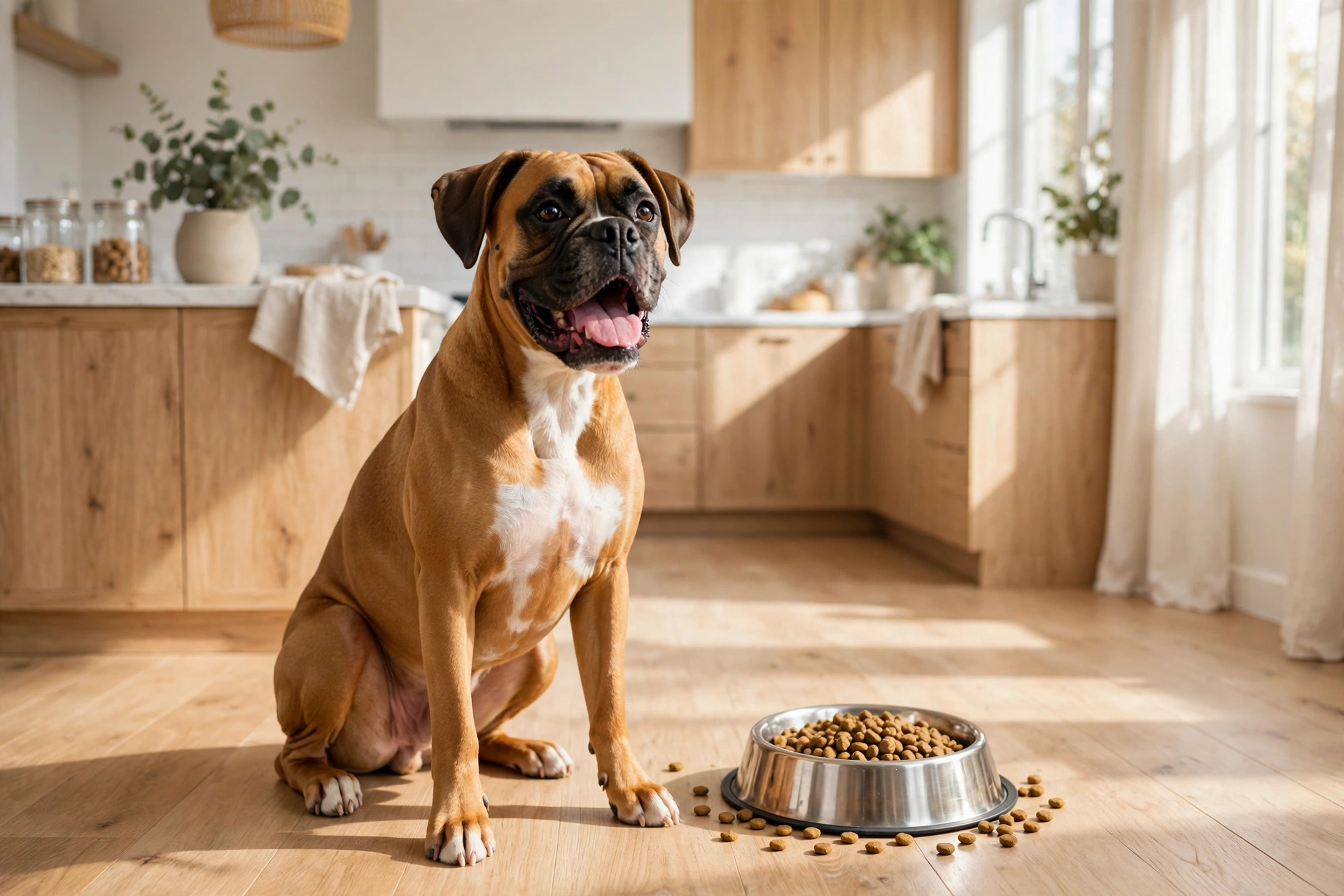
Boxer Feeding Guide: How Much, How Often & What to Feed (2026)
Feeding a Boxer is not as simple as filling the bowl and hoping for the best. These muscular, high-energy dogs grow fast, stay lean through a famously awkward “skinny phase,” and are prone to bloat, sensitive stomachs, and weight gain once they slow down. Get the portions right and you support steady growth, firm stools, and a healthy weight. Get them wrong and you will see it quickly in the waistline, the stool, and the energy level.
This Boxer feeding guide covers exactly how much to feed a Boxer at every life stage, how often to feed, how to work out calories from your dog’s weight, and how to adjust when life changes. It also covers the Boxer-specific traps: bloat-safe feeding, the grain-free question for a heart-risk breed, and what to do when your Boxer is picky, gassy, or gaining weight.
An adult Boxer eats 3 to 5 cups of quality dry food a day, split into two meals 12 hours apart. Puppies need 3 to 4 small meals a day on a large-breed puppy formula until 12 to 15 months. Start from the bag guide, convert cups to calories, and adjust by body condition. Never feed one giant meal.
In This Guide
- Key Takeaways
- Boxer Feeding at a Glance
- How Much Should a Boxer Eat? Work It Out From Weight
- Feeding Schedule by Life Stage
- A Sample Feeding Day for an Adult Boxer
- How to Tell If You Are Feeding the Right Amount
- What to Feed a Boxer: Choosing the Right Food
- Wet Food, Fresh Food, and Raw: How Portions Change
- Bloat-Safe Feeding: The Boxer Rule That Matters Most
- Switching Foods, Treats, and Special Situations
- What to Avoid
- Pros and Cons
- Conclusion: The Simple Boxer Feeding Formula
- Feeding for a Healthy Boxer Heart
Key Takeaways
- Most adult Boxers eat 3 to 5 cups of quality dry food per day, split into two meals, but your dog’s weight and the food’s calorie density matter more than any cup number.
- Feed puppies 3 to 4 meals a day, adults twice a day, and seniors twice a day on smaller, joint-friendly portions.
- Start from the feeding guide on the bag, weigh your Boxer monthly, and adjust by body condition: visible waist from above, ribs you can feel but not see.
- Never feed one giant meal, and avoid hard exercise in the hour before and after eating. Both raise bloat risk in this deep-chested breed.
- Keep treats to about 10% of daily calories, switch foods over 7 to 10 days, and ask your vet before going grain-free, given the breed’s heart risk.
Boxer Feeding at a Glance
| Life Stage | Age | Meals per Day | Daily Amount (Dry Food) | Approx. Calories per Day |
|---|---|---|---|---|
| Puppy | 8 to 12 weeks | 4 | 1.5 to 2 cups | 550 to 800 |
| Puppy | 3 to 6 months | 3 to 4 | 2 to 3 cups | 800 to 1,200 |
| Adolescent | 6 to 12 months | 3, then 2 to 3 | 3 to 4 cups | 1,200 to 1,600 |
| Adult | 1 to 7 years | 2 | 3 to 5 cups | 1,400 to 2,100 |
| Senior | 7+ years | 2 (sometimes 3 small) | 2.5 to 4 cups | 1,100 to 1,700 |
These are starting points, not prescriptions. A 50-pound female Boxer and an 80-pound male on the same food will not eat the same amount, and a kibble at 300 calories per cup feeds very differently from one at 420 calories per cup. Always read the calorie content (kcal per cup) on your own bag first.
How Much Should a Boxer Eat? Work It Out From Weight
Cup ranges from different guides disagree wildly: some say 2 to 3 cups for an adult, others say 4 to 6. The reason is simple: cups are not a unit of energy. Calories are. Use this method instead:
Step 1: Weigh your Boxer. Do not guess. Step on the scale holding your dog, then subtract your own weight, or use the vet’s scale at your next visit. Adult Boxers typically weigh 50 to 80 pounds, with males at the heavier end.
Step 2: Estimate daily calories. As a rough guide, a growing puppy needs around 55 calories per pound of body weight, a healthy adult around 35 to 45 calories per pound, and a less active or senior dog around 25 to 35 calories per pound. Then check the bag: divide the calorie target by the food’s kcal per cup to get cups per day.
Worked examples (adult, food at 380 kcal per cup):
- 50-pound Boxer: about 1,750 calories per day, roughly 4.5 cups.
- 65-pound Boxer: about 2,000 calories per day at a moderate activity level, roughly 5 cups; a very active dog may need closer to 2,200.
- 80-pound Boxer: about 2,000 calories per day if quiet, roughly 5 cups; a very active 80-pound dog may need around 2,400 calories, roughly 6 cups.
These examples show why the bag matters more than any chart: the same dog needs fewer cups of a calorie-dense food and more cups of a lighter one. If you switch brands, recalculate. Do not carry the old cup amount over.
Feeding Schedule by Life Stage
Boxer Puppies (8 Weeks to 12 Months)
Feed a large-breed puppy formula until 12 to 15 months. Controlled calcium and a steady growth rate protect young joints, and switching to adult food too early is one of the most common mistakes new Boxer owners make.
Very young puppies (8 to 12 weeks) do best on 4 small meals a day; some breeders free-feed for the first few weeks at a new home, but a schedule is better as soon as the puppy settles, because it makes house training far easier. Drop to 3 meals from about 3 to 6 months, then to 2 or 3 meals through adolescence. Expect appetite to swing during growth spurts. That is normal, as long as the overall trend is steady gain and firm stools.
The Boxer “Skinny Phase” (12 to 24 Months)
Many young Boxers look ribby between one and two years old even when they are eating well. They grow tall before they fill out, and owners often panic and overfeed. Resist that urge. If your young Boxer is energetic, has firm stools, and is gaining slowly, a lean look at this age is usually normal. Keep 3 meals a day through this phase if it helps, and let your vet judge body condition at check-ups rather than adding extra cups on your own.
Adult Boxers (1 to 7 Years)
Two measured meals a day (morning and evening, roughly 12 hours apart) suits most adults. Two meals keep energy steady through the day. They keep the stomach emptier than one large feed and stop most Boxers from hunting through the bin between meals.
Senior Boxers (7 Years and Older)
Move to a senior formula around age 7, or sooner if your dog is slowing down or showing joint trouble. Seniors need fewer calories but still need good-quality protein to hold muscle, plus joint support (glucosamine and chondroitin) and omega-3s for heart and brain health. Two meals still works, but some older dogs with touchy stomachs do better on 3 smaller meals. Watch weight closely in both directions: seniors lose muscle fast when underfed and gain fat fast when overfed.
A Sample Feeding Day for an Adult Boxer
Here is what a typical day looks like for a healthy 65-pound adult Boxer on dry food, with treats counted inside the daily total:
- 7:00 a.m. Morning meal: about 2 cups of kibble, plus fresh water. No vigorous play for an hour after eating.
- 12:30 p.m. A small training treat or chew, counted toward the 10% treat budget, not on top of it.
- 6:00 p.m. Evening meal: about 2 cups of kibble. Keep the evening calm for an hour afterwards.
- All day: Fresh water available. Boxers generally need roughly 0.5 to 1 ounce of water per pound of body weight daily, so a 65-pound dog drinks around 32 to 65 ounces. But do not let your dog gulp a huge bowlful right after a meal.
Shift the clock times to fit your routine, but keep the spacing even and the times consistent. Boxers thrive on routine, and a predictable schedule reduces food-seeking behaviour and frantic mealtimes.
How to Tell If You Are Feeding the Right Amount
The scale and your hands beat any chart. Check body condition every couple of weeks:
- From above: you should see a visible waist behind the ribs.
- From the side: the belly should tuck up, not hang level with the chest.
- By touch: you should feel the ribs easily under a thin layer of fat, without pressing hard. If you have to dig, trim food by 10 to 15%. If ribs are sharp and prominent, add the same amount.
Weigh your Boxer once a month and keep a simple note of the number. A change of more than about 5% of body weight in a month deserves attention, and a vet call if it comes with appetite loss, vomiting, or diarrhoea. Stools are the other daily report card: consistently loose stools after a food change usually mean the switch was too fast or the food does not suit your dog, not that you need to feed more.
What to Feed a Boxer: Choosing the Right Food
Look for a named animal protein (chicken, beef, lamb, or fish) as the first ingredient, moderate fat, digestible carbohydrates such as rice, oats, or sweet potato, and an AAFCO statement saying the food is complete and balanced for your dog’s life stage. For Boxers specifically, foods with added taurine and L-carnitine, omega-3 fatty acids from fish oil, and joint nutrients earn extra points, given the breed’s heart and joint risks.
Four widely available US formulas that fit this guide’s criteria, and that also appear in our breed guides, are:
- Royal Canin Boxer Adult, the only breed-specific kibble here, with kibble shaped for the Boxer’s jaw and added taurine, EPA, and DHA. See our best dog food for Boxers guide for the full comparison.
- Purina Pro Plan Large Breed Adult, a budget-friendly, widely available large-breed formula with live probiotics for digestion.
- Hill’s Science Diet Adult Large Breed, a vet-recommended staple with glucosamine and chondroitin for joint support.
- Wellness Complete Health Large Breed Adult, a natural-ingredient option with omega fatty acids for skin and coat.
For puppies, use the large-breed puppy version of a similar line. Our best puppy food for Boxers guide compares the options. If your Boxer has a sensitive stomach, start from our best food for Boxers with sensitive stomachs guide instead of guessing, and for older dogs see best senior Boxer food.
Wet Food, Fresh Food, and Raw: How Portions Change
Dry food is the easiest to measure and helps keep teeth cleaner, but many Boxers prefer wet food or a mix. Wet food is mostly water, so it carries far fewer calories per cup. A dog that eats 4 cups of kibble might need roughly three times that volume in wet food alone, which is why most owners use wet food as a topper rather than the whole diet. If you mix, subtract: every quarter-can of wet food replaces roughly a quarter-cup of kibble, but check the can’s kcal label and do the maths rather than guessing.
Fresh-food services ship pre-portioned meals, so follow their plan and resist adding kibble on top. Raw diets can suit some Boxers, but only when properly balanced. An unbalanced raw diet can cause deficiencies that take months to show, so talk to a veterinary nutritionist before committing. Whatever the format, the same rules apply: measured meals, a consistent schedule, and no exercise right around mealtimes.
Bloat-Safe Feeding: The Boxer Rule That Matters Most
Boxers are deep-chested and at higher risk of bloat (gastric dilatation-volvulus), a genuine emergency in which the stomach twists. Feeding habits are one of the few risk factors you can control:
- Split food into 2 or 3 smaller meals instead of one large one.
- Use a slow-feeder bowl if your Boxer inhales food, since gulping air along with kibble is part of the problem.
- Keep hard exercise out of the hour before and after meals.
- Do not let your dog drink a huge volume of water immediately after eating.
- Know the warning signs (a swollen, tight belly, restlessness, pacing, drooling, and retching without vomiting) and treat them as an emergency vet visit, not a wait-and-see.
Switching Foods, Treats, and Special Situations
Switching foods: take 7 to 10 days. Start at 25% new food and 75% old for three days, go 50/50 for three more, then 75/25 before the full swap. Change overnight and you will almost always get loose stools, even when the new food is the better one. The same gradual approach applies when moving from puppy to adult food (around 12 to 15 months) and from adult to senior food (around age 7).
Treats: keep them to about 10% of daily calories. For a Boxer eating 1,800 calories a day, that is roughly 180 calories of treats: a few training treats, not a handful of biscuits plus table scraps. Fatty table scraps are a particular problem for this breed: rich meats and sauces can trigger pancreatitis in a dog with an already touchy gut.
Spaying and neutering: neutered dogs typically need about 10 to 20% fewer calories than intact dogs of the same weight, because metabolism drops. If your Boxer was neutered recently and weight is climbing, trim the portion before assuming the food is wrong.
Picky eaters: try mixing in a spoonful of wet food from the same brand, or a splash of low-sodium broth, rather than switching brands every week. A healthy dog will rarely starve itself, but a dog that refuses food for more than 24 hours, or that is also lethargic or vomiting, needs a vet check.
Grain-free caution: the FDA has flagged a possible link between certain grain-free diets and dilated cardiomyopathy, and Boxers already carry cardiomyopathy risk. That does not mean every grain-free food is dangerous, but it does mean you should ask your vet before going grain-free, especially if heart problems run in your dog’s line. Healthy grains such as rice and oats are well tolerated by most Boxers.
What to Avoid
- One giant meal a day, and exercise right before or after eating (bloat risk).
- Free-feeding, which hides overeating and makes weight control guesswork.
- Feeding by the cup number from another brand’s chart without checking kcal per cup.
- Toxic foods: chocolate, grapes and raisins, onions, garlic, xylitol (in many sugar-free products), and macadamia nuts.
- Cheap fillers leading the ingredient list: corn gluten meal, generic “meat meal,” and artificial colours and preservatives such as BHA and BHT.
- Switching foods overnight, or switching brands every time your Boxer turns up its nose.
- Going grain-free without a vet conversation, given the breed’s heart risk.
Pros and Cons
Two measured meals and a calorie-based plan suit a Boxer well, but the breed leaves little room for guesswork. Here is the honest balance.
Pros
- Two measured meals a day keep energy steady and cut bloat risk.
- The calorie method works from your dog’s weight, not cup numbers that change by brand.
- A large-breed formula with joint support suits a muscular, fast-growing breed.
- A simple monthly weigh-in catches weight gain before it becomes a problem.
Cons
- Portions need recalculating every time you switch brands or foods.
- Puppies need 3 to 4 meals a day, so someone has to be home to feed them.
- The skinny phase tempts owners to overfeed a healthy, lean young dog.
- Grain-free diets need a vet conversation first, given the breed’s heart risk.
Conclusion: The Simple Boxer Feeding Formula
Feed a large-breed formula for your Boxer’s life stage, start from the bag’s guide, convert to calories rather than trusting cups alone, and split the day into two measured meals. Weigh your Boxer monthly, check body condition with your hands, and adjust by 10 to 15% at a time. That routine (plus bloat-safe timing and a 10% treat budget) covers almost everything a Boxer owner needs, from the first puppy meal to the senior years. This guide is for information only. Check with your vet for your dog’s specific needs.
Feeding for a Healthy Boxer Heart
Boxers carry a higher risk of heart disease than most breeds, above all dilated cardiomyopathy, so what goes in the bowl matters for the heart as well as the waistline. Foods made for large breeds often add taurine and L-carnitine, two nutrients that help the heart muscle do its job. Taurine and L-carnitine can run low in some grain-free diets, which is one more reason to ask your vet before going grain-free, above all if heart problems run in your dog’s line.
Fish oil earns its place in a Boxer diet for the same reason. Omega-3 fatty acids from fish oil or salmon oil support heart health, and many Boxer formulas add them for that purpose. Aim for a food with about 25 to 30 percent protein and 8 to 15 percent fat, which suits a muscular, active breed without overloading it with calories. A named animal protein as the first ingredient is still the simplest check that the food is built for a dog like this.
Food alone cannot prevent heart disease, and no supplement replaces a vet check. Ask your vet to listen to your Boxer’s heart at each visit, and tell them about any coughing, tiredness, or trouble breathing, since those signs call for a prompt check. A heart-friendly diet, steady weight, and regular vet visits together give your Boxer the best chance of a long, active life.
How much should a Boxer eat per day?
Most adult Boxers eat 3 to 5 cups of quality dry food per day, split into two meals. The exact amount depends on weight, activity, and the food’s calories per cup, so start from the bag’s guide and adjust by body condition.
How many times a day should I feed my Boxer?
Feed puppies 3 to 4 meals a day, adults twice a day, and seniors twice a day (or 3 smaller meals if their stomach is touchy). Two measured meals is the simplest bloat precaution for adults.
When should I switch my Boxer from puppy to adult food?
Around 12 to 15 months, using a large-breed puppy formula until then. Switch gradually over 7 to 10 days to avoid loose stools.
Why is my young Boxer so skinny?
Boxers often go through a lean ‘skinny phase’ between 1 and 2 years old as they grow tall before filling out. If your dog is energetic with firm stools, this is usually normal. Let your vet judge body condition rather than overfeeding.
How do I know if I am overfeeding my Boxer?
Check from above for a visible waist and feel the ribs. You should feel them easily without pressing hard. Weigh your Boxer monthly and trim food by 10 to 15% if the ribs hide under padding.
Can Boxers eat grain-free food?
They can, but ask your vet first. The FDA has flagged a possible link between certain grain-free diets and heart disease, and Boxers already carry cardiomyopathy risk, so healthy grains like rice and oats are the safer default.
How do I switch my Boxer’s food safely?
Take 7 to 10 days: 25% new food for three days, 50/50 for three more, then 75/25 before the full swap. Switching overnight almost always causes loose stools.
What foods are toxic to Boxers?
Chocolate, grapes and raisins, onions, garlic, xylitol in sugar-free products, and macadamia nuts are all toxic to dogs. Fatty table scraps should also be avoided, as they can trigger pancreatitis.
Should I feed my Boxer food with taurine for heart health?
It can help. Taurine and L-carnitine support the heart muscle, and Boxers carry a higher risk of cardiomyopathy than most breeds. Many large-breed and Boxer formulas add both nutrients, and fish oil adds omega-3s that support the heart too. Ask your vet before adding a supplement on your own, above all if heart problems run in your dog’s line.
Should I use a raised bowl for my Boxer?
Most vets now say no. Some observations suggest raised bowls may raise bloat risk in deep-chested dogs, so feed from a floor-height bowl unless your vet advises a raised bowl for a specific condition such as megaesophagus. A slow-feeder bowl at floor height is the safer choice if your Boxer gulps food.
4 Comments