
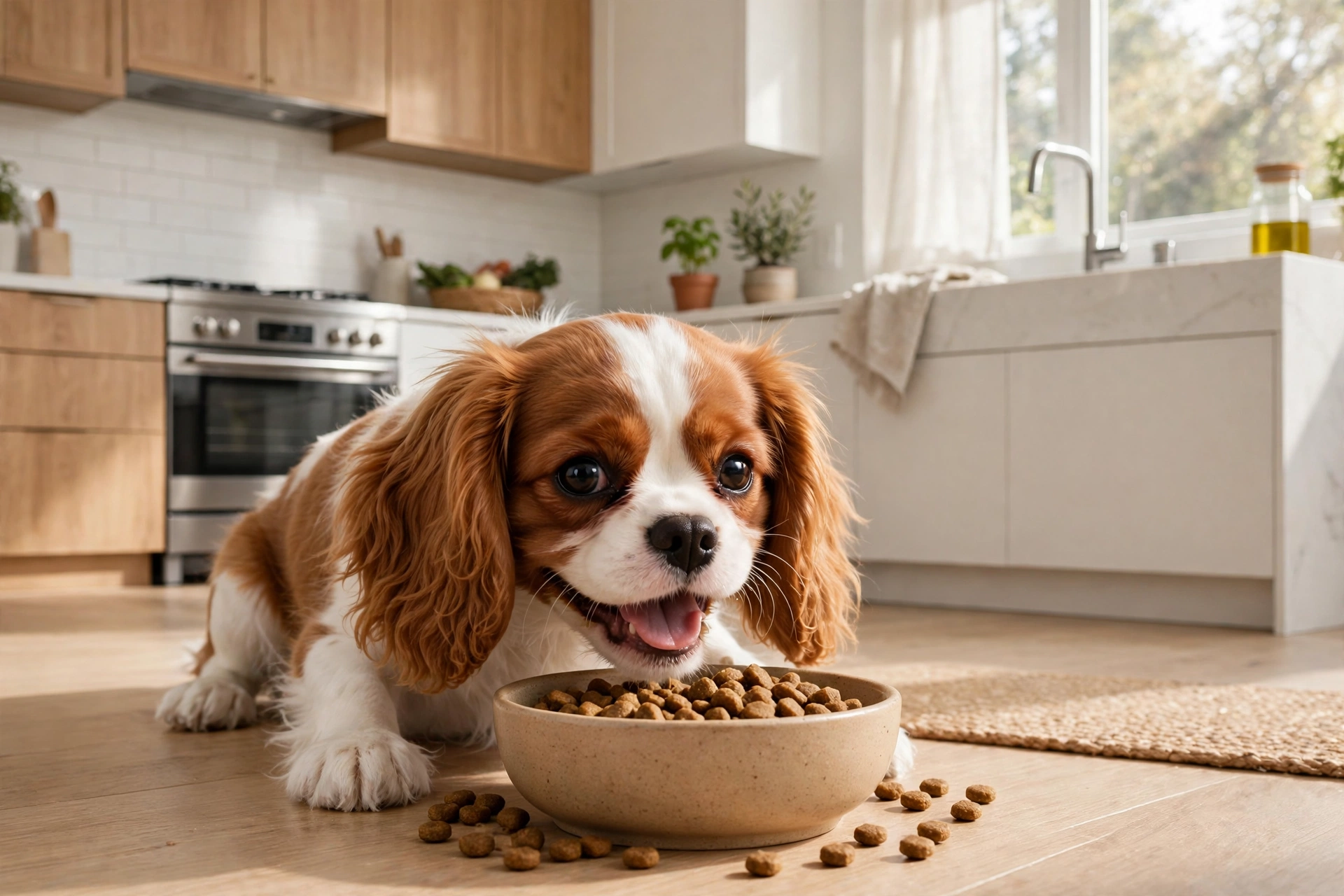
Best Puppy Food for Cavalier King Charles Spaniels: Small-breed portions for a 13 to 18 lb puppy (6 Picks 2026)
Choosing the best puppy food for Cavalier King Charles Spaniels is one of the most important decisions you will make in your puppy’s first year. Cavaliers are small, affectionate, food-loving dogs, most growing to 13 to 18 lb as adults, with a few breed quirks that really do change what should go in the bowl: a small jaw and a tendency to gulp, a silky coat that shows dietary gaps quickly, a sensitive stomach in many puppies, and, as they grow, a breed predisposition to heart problems and weight gain that makes portion control matter from day one.
This guide covers six top picks for Cavalier puppies in 2026, chosen based on ingredient analysis, brand reputation, and owner reviews. Every food here is a real product sold in the US, formulated for puppies, and made to meet AAFCO nutrient profiles for growth. You will also find a comparison table, a buying guide, what to avoid, and how to switch foods without upsetting a small stomach. If your puppy is still on the breeder’s food, take the change slowly, over 7 to 10 days. The transition plan near the end of this guide will help. For the deeper background on calcium, DHA, and AAFCO standards behind these picks, see our best puppy food for large breeds guide.
For most Cavalier puppies, Royal Canin Cavalier King Charles Spaniel Puppy is the best starting point: breed-specific kibble for a small muzzle, plus taurine and fish oil for heart support. Feed 3 to 4 meals a day up to about six months, then 2 to 3 meals. Switch to adult food at around 10 months, over 7 to 10 days.
In This Guide
- Key Takeaways
- Best Puppy Food for Cavalier King Charles Spaniels at a Glance
- Royal Canin Cavalier King Charles Spaniel Puppy Dry Dog Food
- Blue Buffalo Life Protection Formula Puppy Chicken & Brown Rice
- Wellness Complete Health Puppy Deboned Chicken, Oatmeal & Salmon Meal
- Purina Pro Plan Puppy Chicken & Rice Formula
- Merrick Grain Free Puppy Recipe
- The Honest Kitchen Whole Grain Chicken Clusters for Puppies
- How Much to Feed a Cavalier Puppy
- Buying Guide: What to Look for in Cavalier Puppy Food
- What to Avoid
- How to Switch Foods Safely
- Pros and Cons
- Calcium and Phosphorus: The Ratio Behind Healthy Bones
- Conclusion: Our Recommendation
- Frequently Asked Questions
Key Takeaways
- Pick a puppy-specific formula made for a small muzzle, with real meat first, DHA for brain and eye development, and an AAFCO statement for growth. Adult food is not a like-for-like swap.
- Cavaliers do best on small, easy-to-pick-up kibble, with steady portions split into 3 to 4 small meals a day while they are young.
- Heart and weight health start in puppyhood: omega-3s, taurine-containing ingredients, and strict portion control matter more than any single “superfood” claim.
- Switch foods slowly over 7 to 10 days, and watch stool quality, coat condition, and energy. Those three tell you more than the bag’s marketing.
- The breed-specific Royal Canin Cavalier Puppy is the most tailored pick, but Blue Buffalo and Wellness are strong, widely available alternatives.
Best Puppy Food for Cavalier King Charles Spaniels at a Glance
| Product | Best For | kcal/cup | Price | Cost/month | Key Feature |
|---|---|---|---|---|---|
| Royal Canin Cavalier King Charles Spaniel Puppy | Best overall for Cavaliers | 368 | $26.99/3 lb | ~$87/mo | Breed-specific kibble, heart-supporting nutrients, for 8 weeks to 10 months |
| Blue Buffalo Life Protection Formula Puppy Chicken & Brown Rice | Best widely available pick | 401 | $39.58/15 lb | ~$24/mo | Real chicken first, DHA and ARA, antioxidant LifeSource Bits |
| Wellness Complete Health Puppy Deboned Chicken, Oatmeal & Salmon Meal | Best for coat and digestion | 450 | $69.98/30 lb | ~$25/mo | Salmon oil DHA, oatmeal for gentle digestion, no by-product meals |
| Purina Pro Plan Puppy Chicken & Rice Formula | Best value from a big brand | 456 | $74.98/34 lb | ~$14/mo | Live probiotics, DHA, and consistent small-breed-friendly kibble |
| Merrick Grain Free Puppy Recipe | Best grain-free option | 400 | $72.98/22 lb | ~$48/mo | Deboned chicken first, DHA, sweet potato and potato for steady energy |
| The Honest Kitchen Whole Grain Chicken Clusters for Puppies | Best human-grade pick | 417 | $93.09/20 lb | Cannot compute | Human-grade chicken and oats, cold-pressed clusters, added probiotics |
Prices are Chewy prices checked November 14, 2026. Cost per month uses the feeding amounts in the portion table below.
Royal Canin Cavalier King Charles Spaniel Puppy Dry Dog Food
This is the only food on this list designed specifically for Cavalier puppies, and that matters more here than it does for most breeds. Royal Canin formulates it for purebred Cavaliers from 8 weeks to 10 months old, for a puppy growing toward 13 to 18 lb as an adult. That is roughly when a Cavalier moves to adult food, earlier than many larger breeds, and a detail many generic puppy guides miss.
The kibble shape is the first thing owners notice: it is sized and shaped so a small, flat-ish Cavalier muzzle can pick it up and chew it rather than inhaling it whole. That alone can slow down the gulping that leads to vomiting and loose stools in greedy Cavalier puppies. Inside the bag, the formula includes an antioxidant complex with vitamin E to support immune development, high-quality proteins and prebiotics for digestion and stool quality, and, unusually relevant for this breed, taurine plus EPA and DHA from fish oil and L-carnitine to support cardiac function.
No food can prevent heart disease, and no honest guide should claim otherwise. But given that mitral valve disease is the best-known health concern in adult Cavaliers, choosing a puppy food that already supports heart health with recognised nutrients is a sensible, low-effort step. The trade-offs are real: it comes in a small 3 lb bag, it costs more per pound than supermarket puppy food, and it contains chicken by-product meal, so it is not the pick if your puppy has a confirmed chicken sensitivity. For most Cavalier puppies, though, this is the most tailored starting point on the list.
Blue Buffalo Life Protection Formula Puppy Chicken & Brown Rice
Blue Buffalo Life Protection Formula Puppy is the easiest of these foods to find in US stores, it is a solid all-rounder for a Cavalier puppy. Real chicken is the first ingredient, followed by wholesome grains including brown rice and oatmeal, and the recipe contains no chicken or poultry by-product meals, corn, wheat, or soy. That clean, simple ingredient panel is exactly what you want when you are still learning what your puppy tolerates.
For growth, it includes DHA and ARA for brain and eye development, plus calcium and phosphorus in puppy-appropriate balance for bone growth. Blue’s LifeSource Bits, a separate blend of antioxidants, vitamins, and minerals mixed into the kibble, support immune health during the months when a puppy is meeting the world, other dogs, and new germs for the first time.
The kibble size works well for small mouths, and the 5 lb bag is a sensible trial size for a puppy that will eat only a cup or so a day. If your Cavalier puppy is a fussy eater, the chicken-and-rice flavour profile tends to be well accepted, and the food mixes easily with a spoonful of warm water or wet puppy food for puppies still learning to crunch. Watch portions carefully, though: this is a calorie-dense puppy food, and Cavaliers gain weight easily once they are neutered and less frantic.
Wellness Complete Health Puppy Deboned Chicken, Oatmeal & Salmon Meal
If your Cavalier puppy’s coat is your early warning system (dull, dry, or flaky), Wellness Complete Health Puppy deserves a close look. Deboned chicken is the first ingredient, oatmeal provides a gentle, digestible carbohydrate, and salmon meal plus salmon oil supply DHA for brain development and omega fatty acids for skin and coat health. The recipe contains no poultry by-products, wheat, wheat gluten, corn, soy, artificial colours, or preservatives, and it is made in the USA.
What sets this one apart for Cavaliers is the combination of coat support and digestive gentleness. Oatmeal is easier on many small stomachs than heavier grain blends, and the added calcium and phosphorus support steady bone growth without the excess that can come from over-supplementing. The AAFCO statement covers growth including large-size dogs, which is a sign of a thoroughly formulated recipe even though your Cavalier will stay small.
Owners of sensitive puppies often report firmer stools on this formula, though every puppy is different and a slow transition still matters. It is also a good choice if you plan to rotate proteins later: Wellness’s adult small-breed and limited-ingredient lines make the eventual step up to adult food straightforward. As with all puppy foods, measure with a cup, not a scoop from the bag, and adjust to body condition rather than the bag’s maximum.
Purina Pro Plan Puppy Chicken & Rice Formula
Purina Pro Plan Puppy Chicken & Rice is the workhorse pick: widely stocked, reasonably priced, and backed by one of the largest feeding-research programmes in pet food. Real chicken is the first ingredient, rice and oatmeal provide digestible energy, and the formula includes DHA for brain and vision development and live probiotics to support digestive and immune health, a genuinely useful addition for puppies whose stomachs are still settling.
For Cavalier owners, the practical advantages matter. The kibble is small and consistent from bag to bag, which helps a puppy that is learning to chew rather than gulp. The food is also easy to find in small-breed and sensitive-skin variants later, so you are not locked into a brand you cannot buy locally. Pro Plan’s puppy feeding charts are clear, and the brand’s long history means your vet is very likely to know the formula well if you need feeding advice.
It is not the most premium ingredient list here. It is a mainstream, grain-inclusive recipe, not a boutique one, but for a healthy Cavalier puppy with no diagnosed sensitivities, that is not a drawback. Grain-inclusive puppy foods are appropriate for most puppies, and the current evidence does not support grain-free feeding for every dog. If your puppy does well on it, eats eagerly, and produces firm stools, there is no reason to pay more for a fancier bag.
Merrick Grain Free Puppy Recipe
Some Cavalier puppies do better without grains, whether because of a diagnosed sensitivity or simply because their stomach settles better on a potato-and-sweet-potato-based recipe. Merrick Grain Free Puppy is a strong grain-free choice: deboned chicken is the first ingredient, around three-quarters of the protein comes from animal sources, and the recipe includes DHA for brain development, omega fatty acids for skin and coat, and glucosamine and chondroitin for developing joints.
The fruit and vegetable content (apples, blueberries, sweet potatoes, and potatoes) adds antioxidants and digestible carbohydrates without grains, and the food is cooked in the USA. For a Cavalier puppy, the kibble size is manageable, and the chicken-led flavour is usually a hit with a breed that rarely needs encouragement to eat.
A word of honest caution: grain-free is a dietary choice, not a universal upgrade. If your puppy has no grain sensitivity, a grain-inclusive food like the Blue Buffalo or Pro Plan picks above is equally good, and in some cases easier to digest. Choose grain-free because your puppy does better on it, not because the bag looks more premium, and mention the choice to your vet, especially given the ongoing discussion around diet and heart health in dogs. If your puppy’s stools firm up and their coat shines on Merrick, though, it is a genuinely good food.
The Honest Kitchen Whole Grain Chicken Clusters for Puppies
The Honest Kitchen takes a different approach: 100% human-grade ingredients, made in a human food facility, cold-pressed into bite-sized clusters and then gently slow-roasted and dehydrated. The puppy recipe uses cage-free chicken, oats, vegetables, and salmon oil, with boosted DHA for brain health, enhanced protein for muscle development, and double the probiotics of the brand’s adult recipes for digestive support.
For Cavalier puppies, the cluster format is a real plus. The small, crunchy pieces are easy for a tiny mouth to manage, and the minimal processing preserves flavour that picky puppies (yes, even some Cavaliers) respond to. The food is free of feed-grade ingredients, rendered meat meals, fillers, potatoes, legumes, and artificial flavours or preservatives, and it carries a full AAFCO statement for puppies of all sizes.
The honest downside is price: human-grade, small-batch food costs more, and a growing puppy eats a surprising amount for its size. This is a dry cluster food, not a fresh or frozen meal, despite the brand’s fresh-food reputation. That is actually an advantage for busy owners, since it stores like kibble and portions like kibble. If your budget allows it and your puppy loves it, it is one of the cleanest puppy foods you can buy in the US.
How Much to Feed a Cavalier Puppy
Cavaliers grow to 13 to 18 lb as adults, so portions stay small. The table below uses a 6-month-old puppy expected to reach 15 lb as an adult, the middle of the breed’s 13 to 18 lb range, weighing about 11.5 lb at 6 months. Amounts come from each food’s own feeding chart.
Daily Amounts at 6 Months
| Product | kcal/cup | Price | Daily feeding (6 mo, 15 lb adult) | Cost/month |
|---|---|---|---|---|
| Royal Canin Cavalier King Charles Spaniel Puppy | 368 | $26.99/3 lb | 1.5 cups | ~$87/mo |
| Blue Buffalo Life Protection Formula Puppy Chicken & Brown Rice | 401 | $39.58/15 lb | 1.25 cups | ~$24/mo |
| Wellness Complete Health Puppy Deboned Chicken, Oatmeal & Salmon Meal | 450 | $69.98/30 lb | 1.4 cups | ~$25/mo |
| Purina Pro Plan Puppy Chicken & Rice Formula | 456 | $74.98/34 lb | 0.875 cup | ~$14/mo |
| Merrick Grain Free Puppy Recipe | 400 | $72.98/22 lb | 2 cups | ~$48/mo |
| The Honest Kitchen Whole Grain Chicken Clusters for Puppies | 417 | $93.09/20 lb | 1.4 cups | Cannot compute |
Daily Amounts by Age
The lead pick’s own label gives amounts by age, for a puppy expected to reach 15.4 lb as an adult. Other foods differ, so use each bag’s own chart and adjust by body condition.
| Age | Daily amount (Royal Canin Cavalier Puppy) |
|---|---|
| 8 to 12 weeks | 1⅛ to 1⅜ cups/day |
| 3 to 6 months | 1⅜ to 1½ cups/day |
| 6 to 10 months | 1 to 1½ cups/day |
For more detail on Cavalier portions, meal frequency, and weight checks, see our Cavalier King Charles Spaniel Feeding Guide.
Buying Guide: What to Look for in Cavalier Puppy Food
Start with the AAFCO statement: it should say the food is formulated to meet AAFCO nutrient profiles for growth or for all life stages. If the statement is missing, skip the food, however appealing the packaging looks. Our best puppy food for large breeds guide has the full background on AAFCO standards.
Next, check the first ingredient. Look for a named animal protein (chicken, salmon, lamb) rather than a vague “meat meal” or a grain. Protein supports muscle growth, but the total matters less than the quality and digestibility: most good puppy foods sit in a sensible protein range, and more is not automatically better for a small breed.
Look for DHA, ideally from fish oil or salmon oil, for brain and eye development, and for omega-3 and omega-6 fatty acids for the silky Cavalier coat. Calcium and phosphorus should be present in balanced amounts. Calcium supplements on top of a complete puppy food can do more harm than good, since excess calcium can harm growing bones. Finally, consider kibble size and your puppy’s eating style: a Cavalier that gulps will do better with a smaller kibble and a slow-feeder bowl than with a large, hard biscuit.
Feeding amounts deserve the same attention as the food itself. Most Cavalier puppies do best on 3 to 4 small meals a day up to about six months, dropping to 2 to 3 meals as they approach adulthood, and to two meals a day as adults. Use the bag’s chart as a starting point, then adjust by body condition: you should be able to feel ribs under a thin fat layer but not see them prominently. Cavaliers are notorious for begging, and extra treats count, so keep treats to around 10% of daily calories. For more on portion sizes by age, our small-breed puppy food guide and Beagle puppy guide cover the same small-breed portion logic in more depth. One more thing the rival guides get wrong: adult foods and fresh-food subscriptions are not like-for-like swaps for a Cavalier puppy formula.
What to Avoid
Avoid adult dog food for a puppy under 10 months: it is lower in the protein, fat, calcium, and DHA a growing Cavalier needs, and the gap matters most in the first year. Avoid foods with unnamed meat meals, artificial colours, or preservatives such as BHA, BHT, and ethoxyquin as a matter of routine. They add nothing your puppy needs. Be wary of foods that promise to prevent disease, “boost immunity” beyond normal feeding and diet, or cure allergies: those are marketing claims, not feeding and diet.
Measured meals suit a Cavalier puppy better than free-feeding. A bowl left down all day makes it impossible to track intake, encourages grazing and weight gain, and hides appetite changes that are often the first sign of illness. Similarly, raw meat, bones, or unprescribed supplements do not belong on top of a complete puppy food unless your vet advises it. The recipe is already balanced, and additions can unbalance it. Finally, avoid sudden food changes, table scraps, and rich treats in the first weeks home: a Cavalier puppy’s stomach is small, and a single rich meal can mean days of loose stools.
How to Switch Foods Safely
Switch over 7 to 10 days: roughly 25% new food for days 1 to 3, 50% for days 4 to 6, 75% for days 7 to 9, then fully new food from day 10. If stools loosen, hold at the current ratio for an extra day or two rather than pushing on. Keep the same meal times, measure both foods, and resist the urge to add extras during the switch. You want to know whether the new food itself agrees with your puppy. If vomiting, diarrhoea, or refusal to eat lasts more than a day or two, stop the switch and call your vet.
Remember that Royal Canin itself places the Cavalier puppy-to-adult switch at around 10 months, earlier than many breeds. When that time comes, use the same slow transition to an adult formula (our Poodle puppy guide and small-breed adult guide explain the adult-food step in more detail) and keep the same portion discipline, since adult Cavaliers gain weight even more easily than puppies.
If your puppy still has digestive trouble, try the best food for cavalier with sensitive stomach for gentler, easy-to-digest recipes.
Pros and Cons
Six real puppy formulas cover the main Cavalier needs, but the list has gaps a buyer should know about. Here is the honest balance.
Pros
- Six real US puppy formulas, including the only food made for Cavalier puppies, with kibble shaped for a small, flat muzzle.
- Heart support is covered honestly: taurine plus EPA and DHA in the lead pick, with a clear statement that no food can prevent heart disease.
- Gulping, begging, and weight gain get practical fixes: small kibble, slow-feeder bowls, measured meals, and a 10 percent treat limit.
- A full switch plan with a day-by-day ratio table, plus feeding amounts by age and a sensitive-stomach FAQ.
Cons
- All six picks are chicken-led, so a puppy with a chicken sensitivity has no named alternative here.
- No wet food pick, so owners who want to mix wet and dry food have to choose a match themselves.
- No limited-ingredient puppy pick for sensitive stomachs, even though rival guides name one.
- Royal Canin covers puppies only to 10 months, so owners need an adult food sooner than with most breeds.
Calcium and Phosphorus: The Ratio Behind Healthy Bones
Bone growth is the work a puppy food has to get right. Aim for about 1.2 parts calcium to 1 part phosphorus, inside a safe band of 1.2 to 1.4 to 1, and a complete puppy food with an AAFCO statement for growth already carries that balance, so there is no need to top it up with calcium supplements, bone meal, or calcium-rich extras such as yogurt, kefir, milk, or cottage cheese. Our best puppy food for large breeds guide has the full calcium explainer.
Conclusion: Our Recommendation
For most Cavalier King Charles Spaniel puppies, Royal Canin Cavalier King Charles Spaniel Puppy is the best starting point: it is breed-specific, the kibble suits a small muzzle, and it supports the heart, digestion, and immune development this breed needs most. If you want a widely available, well-priced alternative, Blue Buffalo Life Protection Formula Puppy Chicken & Brown Rice is the pick, and Wellness Complete Health Puppy is the best choice if coat condition or a sensitive stomach is your main concern. If you are comparing other small breeds, our Best Puppy Food for Shih Tzus and Best Puppy Food for Miniature Schnauzers guides follow the same small-breed portion logic.
Whichever food you choose, the habits matter as much as the bag: a puppy formula with an AAFCO growth statement, small measured meals, a slow transition, and regular weight checks. This guide covers feeding and diet for Cavalier puppies in general terms; your own puppy’s needs may differ, so check portions and any health worries with your vet, especially if your puppy has ongoing digestive problems, a diagnosed heart murmur, or a food allergy. Get the food right in puppyhood, and you give your Cavalier the best possible start on a long, happy life on your lap.
When your puppy reaches senior age, choose the best senior cavalier king charles spaniel food for age-appropriate feeding and diet and joint support.
When your puppy grows into an adult, our best dog food for Cavalier King Charles Spaniels guide covers adult formulas.
Frequently Asked Questions
When should I switch my Cavalier puppy to adult food?
Around 10 months old for most Cavaliers, earlier than many larger breeds. Switch slowly over 7 to 10 days, mixing increasing amounts of adult food into the puppy food, and keep portions measured, since adult Cavaliers gain weight easily.
How much should I feed my Cavalier puppy?
Most Cavalier puppies do best on 3 to 4 small meals a day up to about six months, dropping to 2 to 3 meals as they approach adulthood. Start from the bag’s chart, then adjust by body condition: you should feel ribs under a thin fat layer but not see them prominently.
What is the best puppy food for a Cavalier with a sensitive stomach?
Look for a gentle, digestible recipe such as Wellness Complete Health Puppy with oatmeal and salmon oil, or the breed-specific Royal Canin Cavalier Puppy, and switch over 7 to 10 days. If vomiting, diarrhoea, or refusal to eat lasts more than a day or two, call your vet.
How do I stop my Cavalier puppy gulping food?
Use a small, easy-to-pick-up kibble, split the daily amount into 3 to 4 small meals, and try a slow-feeder bowl. The breed-specific Royal Canin kibble shape is designed for a Cavalier muzzle, which also helps slow greedy eaters down.
Can puppy food help my Cavalier’s heart health?
No food can prevent heart disease, but puppy foods with taurine plus EPA and DHA from fish oil, such as Royal Canin Cavalier Puppy, support cardiac function as part of overall feeding and diet. Regular vet checks matter far more than any single ingredient claim.
What calcium to phosphorus ratio should a Cavalier puppy food have?
Aim for about 1.2 parts calcium to 1 part phosphorus, inside a safe band of 1.2 to 1.4 to 1 for a growing puppy. Check the guaranteed analysis on the bag: divide the minimum calcium figure by the minimum phosphorus figure. If the label lists no phosphorus, ask the maker for a typical analysis. A complete puppy food with an AAFCO statement for growth should already sit in this band.
One Comment